Italy Corporate Governance 2026: Checklist for Foreign Subsidiaries
- The 2026 Italian corporate governance framework integrates strict new EU sustainability (CSRD) and supply chain directives directly into local compliance requirements.
- Foreign directors of Italian subsidiaries must obtain an Italian tax code (Codice Fiscale) and officially register their appointment with the local Chamber of Commerce.
- Annual financial statements must typically be approved within 120 days of the fiscal year-end and filed with the Business Register.
- Implementing an Organizational Model under Legislative Decree 231/2001 is essential for parent companies to shield themselves from joint liability regarding local management misconduct.
Updated 2026 Italian Corporate Governance Framework
The 2026 Italian corporate governance framework aligns the Italian Civil Code (Codice Civile) with sweeping EU directives, particularly the Corporate Sustainability Reporting Directive (CSRD) and updated supply chain due diligence rules. Foreign-owned subsidiaries in Italy must now integrate stricter environmental, social, and governance (ESG) metrics into their statutory reporting.
For multinational parent companies, this means the historical focus on basic financial reporting is no longer sufficient. Italian limited liability companies (Srl) and joint-stock companies (SpA) face increased scrutiny regarding corporate transparency, auditor independence, and director accountability. Subsidiaries meeting specific employee and revenue thresholds must now include certified sustainability reports alongside their traditional annual financial filings. Failure to adapt governance structures to these EU-mandated standards exposes both the local directors and the foreign parent company to severe administrative penalties and reputational risks.
2026 Compliance Checklist for Foreign Subsidiaries
Managing an Italian subsidiary requires executing a strict sequence of documentation, registration, and ongoing reporting tasks. This checklist outlines the critical actions foreign parent companies must take to establish and maintain corporate compliance in Italy.
Step-by-Step Checklist for Appointing and Registering Foreign Directors
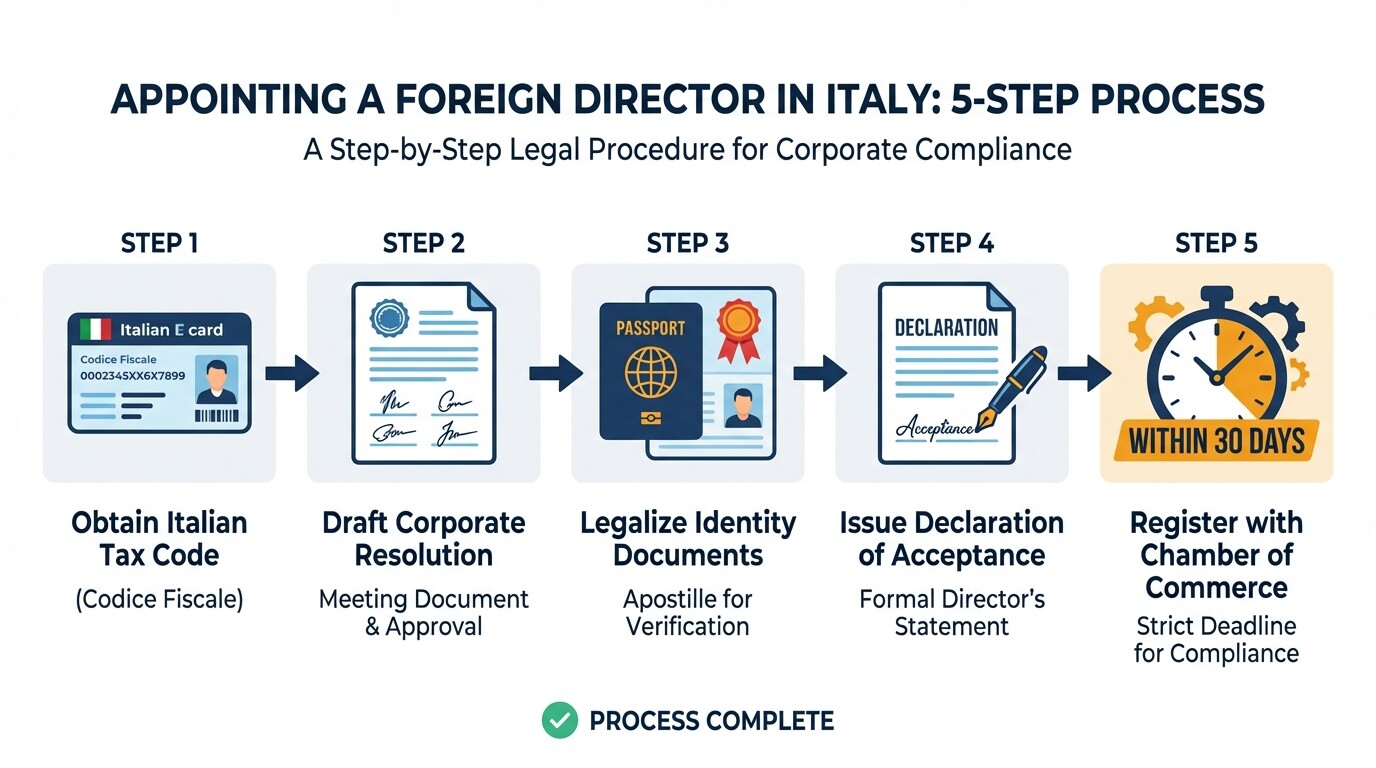
Foreign nationals can serve as directors of Italian companies without residing in Italy, but their appointment requires precise administrative steps. Missing any of these steps will result in the rejection of the appointment by the Italian authorities.
- Obtain an Italian Tax Code: Apply for a Codice Fiscale for the prospective foreign director through the Italian Revenue Agency (Agenzia delle Entrate) or an Italian consulate abroad.
- Draft the Corporate Resolution: Prepare the shareholder meeting minutes formally resolving the appointment of the new director and defining their compensation.
- Legalize Identity Documents: Obtain notarized and apostilled (or legalized) copies of the director's passport. If the documents are not in Italian, secure sworn translations.
- Issue the Declaration of Acceptance: Have the new director sign a formal declaration accepting the role and confirming there are no legal impediments to their appointment under Italian law.
- Register with the Chamber of Commerce: File the appointment package with the official Italian Business Register (Registro delle Imprese) within 30 days of the shareholder resolution. This filing must be completed digitally by an authorized professional using a certified email address (PEC) and digital signature.
Ongoing Corporate Governance Checklist
- Update the PEC: Ensure the company's Certified Electronic Mail (Posta Elettronica Certificata) is active and monitored daily, as all official legal and tax notices are served here.
- Review Bylaws (Statuto): Verify that the Articles of Association explicitly permit video-conferencing for board and shareholder meetings to accommodate foreign directors.
- Define Powers of Attorney: Draft clear, financially capped powers of representation (procura) for local managing directors to prevent unauthorized commitments.
Essential Documentation for Board and Shareholder Meetings
Italian law requires corporations to maintain formal corporate books and document all major operational decisions through proper resolutions. Failure to maintain these records can render corporate actions void and expose the board of directors to personal liability.
Foreign subsidiaries must keep properly stamped and numbered corporate books, including the Shareholders' Minute Book (Libro delle decisioni dei soci) and the Board of Directors' Minute Book (Libro delle decisioni degli amministratori). Whenever a meeting occurs, the minutes must record the date, the attendees, the agenda items discussed, and the precise voting outcomes. For remote meetings, the minutes must explicitly state that the chairman was able to identify all participants and that participants could follow the discussion and intervene in real-time.
Mandatory Annual Financial Reporting and Audit Compliance
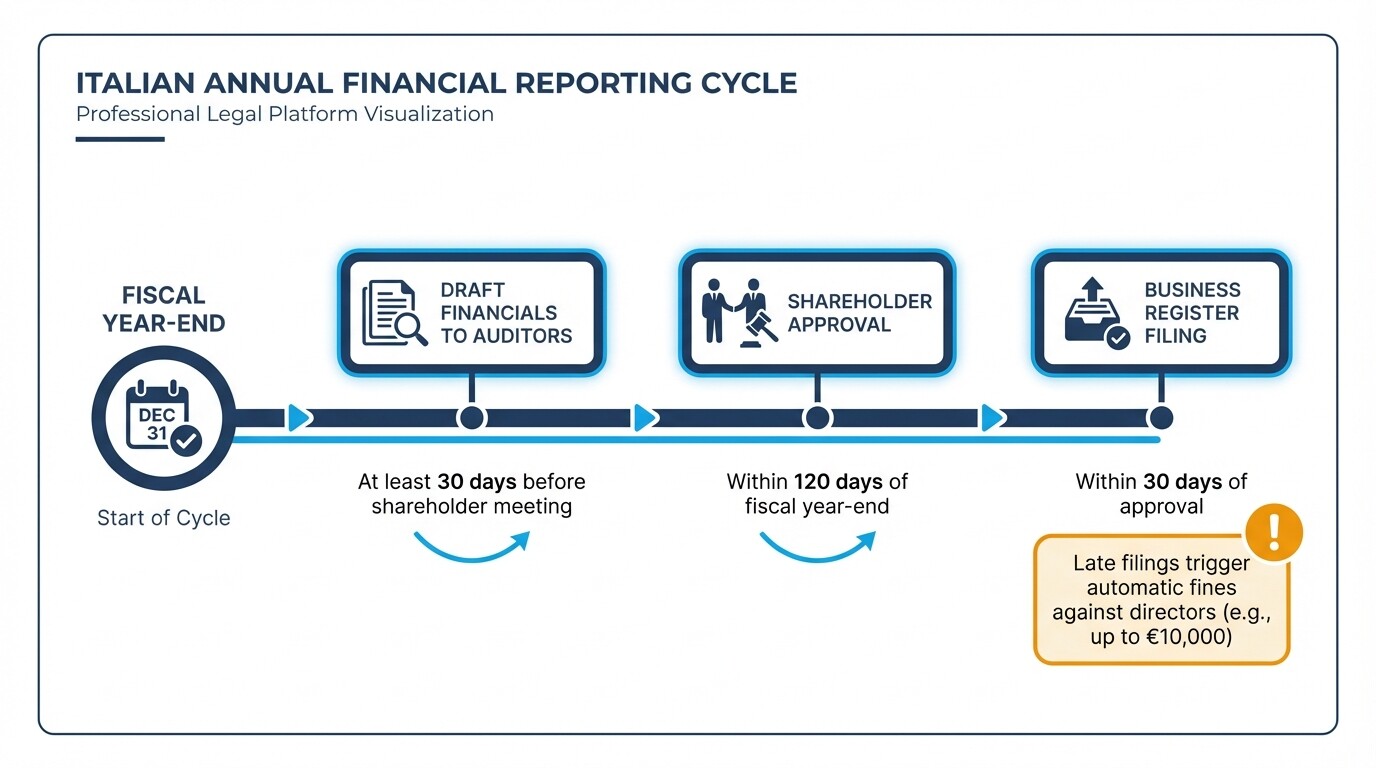
Italian subsidiaries must approve their annual financial statements within 120 days of the fiscal year-end and file them with the Business Register within 30 days of approval. Certain larger subsidiaries are also legally required to appoint a statutory audit board (Collegio Sindacale) or an external auditor.
The mandatory annual reporting package includes the balance sheet, income statement, explanatory notes, and a management report. To successfully navigate this annual cycle, the board of directors must draft the financial statements and share them with the statutory auditors at least 30 days before the scheduled shareholder meeting. Once the shareholders approve the financials, the company must pay the necessary secretarial fees (typically between €130 and €150) and execute the digital filing. Late filings trigger automatic administrative fines levied against every active director.
Preventing Local Management Disputes and Pre-Litigation Protection
Multinational parent companies protect themselves from local management disputes in Italy by strictly defining executive powers of attorney and implementing a local organizational model. These legal mechanisms prevent rogue actions by local directors and shield the parent company from civil and criminal liability.
Under Italian corporate law, a managing director (Amministratore Delegato) has broad operational powers unless explicitly restricted. Parent companies must formally limit these powers by registering specific financial thresholds and joint-signature requirements with the Chamber of Commerce. Furthermore, adopting an Organizational and Management Model under Legislative Decree 231/2001 is highly recommended. This compliance framework exempts the corporate entity from administrative liability for specific crimes (such as fraud, bribery, or environmental offenses) committed by its directors or employees, provided the company proves it actively implemented the model to prevent such actions.
Common Misconceptions About Italian Corporate Governance
Foreign investors frequently misinterpret Italian corporate law by assuming it mirrors common law systems or parent-country regulations. Correcting these assumptions early prevents costly administrative bottlenecks and compliance failures.
- Foreign directors must reside in Italy: This is false. A foreign national can serve as a director and live entirely outside of Italy, provided they obtain an Italian tax code and the country of origin has reciprocal rights with Italy.
- Limited Liability Companies (Srl) do not require formal meeting minutes: Many parent companies treat an Srl informally. Under Italian law, an Srl is heavily regulated, and all corporate decisions must be formally documented in the mandatory corporate books.
- The parent company is completely shielded from subsidiary debts: While corporate veils exist, the Italian Civil Code contains strict rules regarding "direction and coordination" (direzione e coordinamento). If a parent company directly interferes in the subsidiary's management to the detriment of local creditors or minority shareholders, the parent company can be held liable.
Frequently Asked Questions
Do foreign directors of an Italian subsidiary need an Italian work visa?
No, a work visa is not required if the director resides abroad and performs their board duties remotely or during brief business trips. However, if they plan to physically relocate and work in Italy, standard immigration and visa requirements apply.
What is the penalty for late filing of financial statements in Italy?
Late filings result in automatic administrative fines ranging from €137 to €1,032 per director, depending on how many days the filing is delayed past the statutory deadline.
Can board meetings of an Italian subsidiary be held entirely via video conference?
Yes, fully remote board and shareholder meetings are entirely legal in Italy, provided that the company's Articles of Association (Statuto) explicitly allow for telecommunications usage and all participants can be properly identified.
What is a Collegio Sindacale?
A Collegio Sindacale is a mandatory statutory board of auditors required for all SpA entities and larger Srl entities. Their role is to oversee the company's compliance with the law, adherence to its bylaws, and the principles of correct administration.
When to Hire a Corporate Governance Lawyer in Italy
Foreign parent companies should engage Italian corporate counsel when structuring the subsidiary's initial governance, issuing executive powers of attorney, or navigating the annual statutory reporting cycle. Local legal expertise ensures the parent company's operational directives translate legally and safely into the Italian jurisdiction. Attempting to draft corporate resolutions or bylaws using translated parent-company templates frequently violates mandatory provisions of the Italian Civil Code. Finding experienced corporate governance lawyers in Italy allows multinationals to confidently delegate compliance tasks while maintaining absolute control over the subsidiary.
Next Steps for Foreign Parent Companies
Aligning an Italian subsidiary with 2026 corporate governance standards requires an immediate review of existing corporate bylaws and compliance frameworks. Parent companies should begin by auditing the subsidiary's current board composition to ensure all directors have active digital signature capabilities and valid tax codes. Next, management should review all registered powers of attorney to confirm financial thresholds are properly calibrated and securely filed. Finally, corporate officers should consult with Italian legal counsel to assess whether the subsidiary meets the new thresholds requiring ESG reporting under the CSRD, updating their annual filing timelines accordingly.