- Italian technology manufacturers must comply with EU Regulation 2021/821, which governs the export, brokering, and transit of dual-use items that can be used for both civil and military purposes.
- The primary regulatory body in Italy is UAMA (Unità per le autorizzazioni dei materiali di armamento), located within the Ministry of Foreign Affairs and International Cooperation.
- Implementing an Internal Compliance Program (ICP) is no longer optional for companies seeking certain types of "General Export Authorizations" and is highly recommended for all tech exporters to mitigate legal risks.
- Failure to comply with Italian export controls can result in criminal prosecution, including imprisonment for up to six years and administrative fines exceeding €250,000.
- Rigorous end-user verification through an End-User Certificate (EUC) is mandatory to ensure technology does not reach sanctioned entities or contribute to WMD proliferation.
How are dual-use items classified under EU Regulation 2021/821?
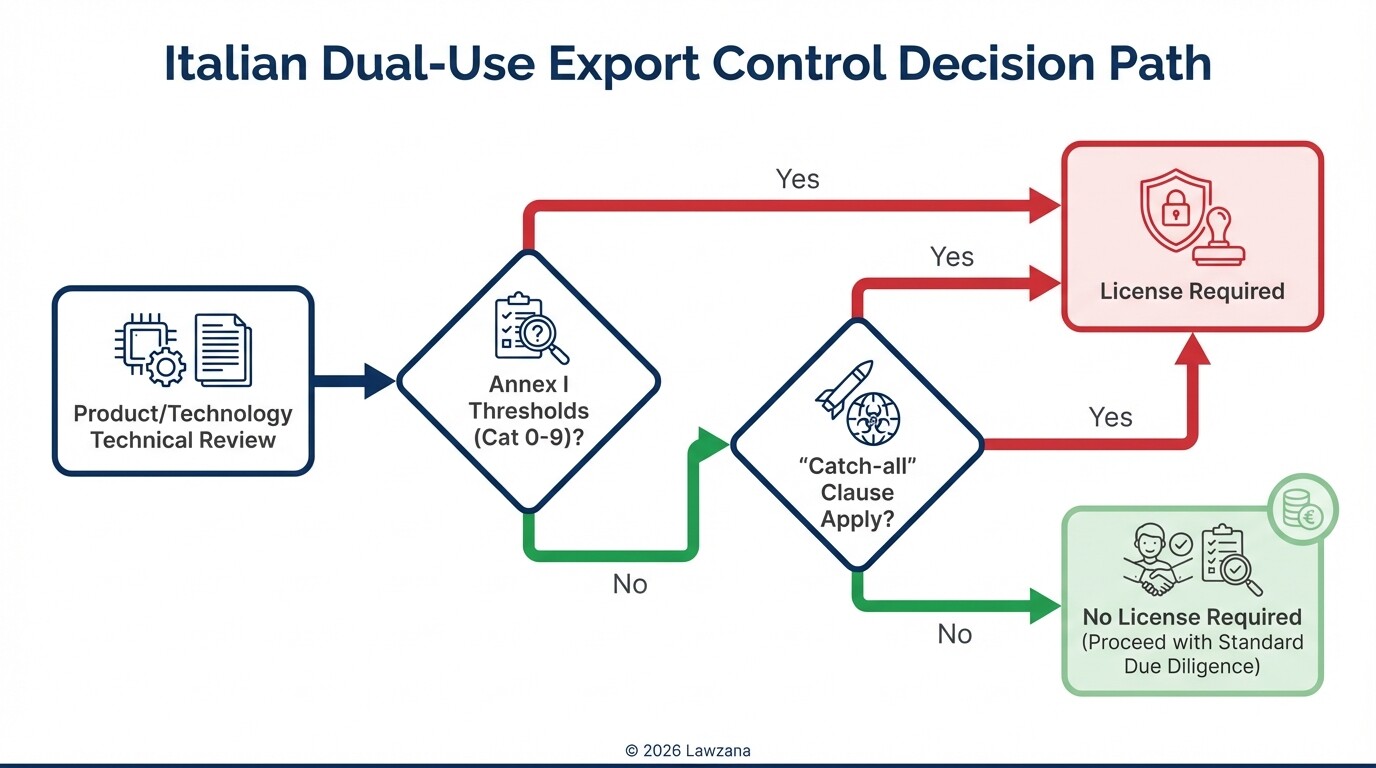
Dual-use items are goods, software, and technology that can be used for both civilian and military applications, including items that can contribute to the proliferation of weapons of mass destruction. Under EU Regulation 2021/821, classification is determined by comparing the technical specifications of your product against the control lists found in Annex I of the regulation.
The classification process requires a granular technical assessment. If your product meets or exceeds the technical thresholds listed in the following categories, you must obtain an export license before shipping outside the European Union:
- Category 0: Nuclear materials, facilities, and equipment.
- Category 1: Special materials and related equipment (e.g., high-strength alloys, chemicals).
- Category 2: Materials processing (e.g., high-precision CNC machine tools).
- Category 3: Electronics (e.g., high-performance semiconductors).
- Category 4: Computers.
- Category 5: Telecommunications and information security (e.g., encryption software).
- Category 6: Sensors and lasers.
- Category 7: Navigation and avionics.
- Category 8: Marine.
- Category 9: Aerospace and propulsion.
Even if an item is not explicitly listed in Annex I, the "catch-all" clause may apply. This means that if the exporter is aware (or informed by Italian authorities) that the items are intended for use in connection with chemical, biological, or nuclear weapons, a license is still required.
How do you apply for export authorizations from UAMA in Italy?
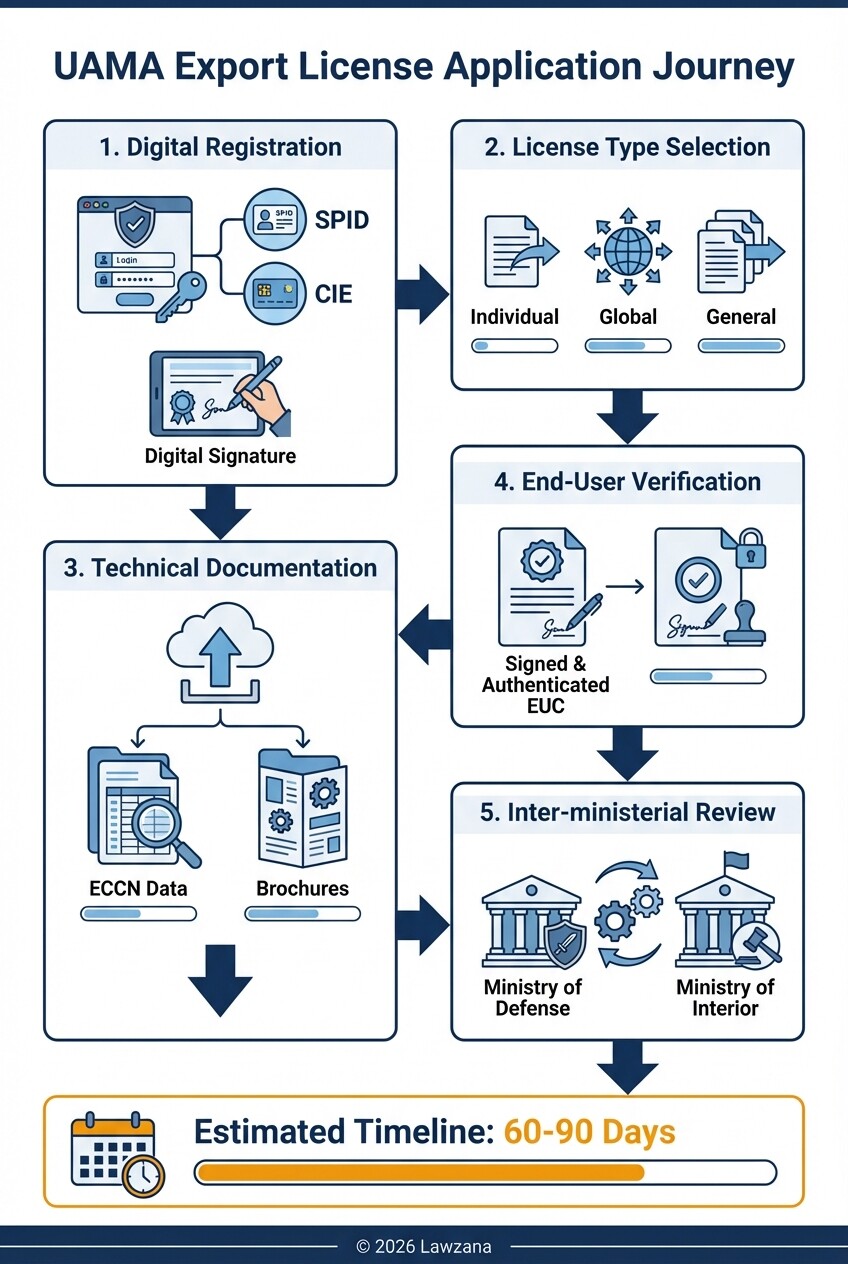
To obtain an export license in Italy, manufacturers must submit a formal application to the UAMA (Unità per le autorizzazioni dei materiali di armamento) via the "Export Control" online portal. The process involves registering the company, classifying the goods, and providing detailed information about the end-user and the final destination.
The application process typically follows these steps:
- Digital Registration: The company legal representative must register on the UAMA portal using a digital signature (Firma Digitale) and SPID/CIE credentials.
- License Selection: You must choose the appropriate license type: Individual (for one end-user), Global (for multiple end-users in specific countries), or General (EUGEAs for low-risk destinations).
- Technical Documentation: Submit technical data sheets, brochures, and the Export Control Classification Number (ECCN) derived from Annex I.
- End-User Certificate (EUC): Upload a signed and stamped EUC from the buyer, confirming they will not divert the technology to prohibited uses.
- Review Period: UAMA consults with other ministries (Defense, Interior). The standard processing time is 60 to 90 days, though complex cases involving sensitive destinations can take longer.
What are the requirements for an Internal Compliance Program (ICP)?
An Internal Compliance Program (ICP) is a set of formal policies and procedures that an Italian company implements to ensure it adheres to export control laws. While historically voluntary, the EU 2021/821 regulation and Italian national guidelines now make an ICP a prerequisite for obtaining "Global" export licenses.
An effective ICP for a technology firm must include several core elements:
- Management Commitment: A written statement from top management pledging to prioritize compliance over commercial interests.
- Organization and Resources: Appointment of an Export Compliance Officer (ECO) with the authority to stop shipments.
- Risk Assessment: Regular evaluation of the company's specific risks based on product type, geographic reach, and customer profile.
- Screening Procedures: Automated or manual checks against "Denied Parties Lists" (EU, UN, and US lists) to ensure no transactions involve sanctioned individuals.
- Training: Mandatory annual training for sales, logistics, and R&D staff regarding dual-use restrictions.
- Recordkeeping: Maintaining all export-related documents, licenses, and correspondence for at least five years as required by Italian law.
What are the legal penalties for violating international sanctions?
Violating international trade sanctions or exporting dual-use goods without a license is a serious criminal offense in Italy, governed by Legislative Decree No. 221/2017. Italian authorities, including the Guardia di Finanza, strictly enforce these regulations to prevent the unauthorized transfer of sensitive technology to embargoed nations.
The legal consequences for non-compliance are severe:
- Criminal Prison Sentences: Exporters may face 2 to 6 years of imprisonment for exporting controlled items without a license or using falsified documents.
- Administrative Fines: Financial penalties range from €25,000 to over €250,000, depending on the gravity of the violation and the value of the goods.
- Confiscation: The Italian state can seize the goods involved in the illegal transaction and any profits derived from the sale.
- Debarment: Companies convicted of violations may be prohibited from participating in public tenders or receiving future export licenses for a specified period.
- Reputational Damage: Being listed as a sanctioned entity can lead to the termination of banking relationships and the loss of international contracts.
How does the end-user certificate verification process work?
The End-User Certificate (EUC) is the most critical document in the Italian export control process, serving as a legal guarantee that the technology will remain with the intended recipient. Exporters are legally responsible for performing "due diligence" to verify that the information provided in the EUC is accurate and that the customer is legitimate.
To verify an end-user effectively, Italian tech firms should follow this checklist:
- Authenticity Check: Ensure the EUC is on the official letterhead of the customer, signed by an authorized representative, and, if required, authenticated by the local Chamber of Commerce or Italian Consulate in the destination country.
- Business Consistency: Evaluate whether the technology requested is consistent with the buyer's known line of business. For example, a bakery purchasing high-end cryptographic sensors is a major red flag.
- Red Flag Screening: Watch for "circumvention" signals, such as customers who are reluctant to provide information, pay in cash for expensive items, or request unusual shipping routes.
- Final Destination Clause: The EUC must explicitly state that the goods will not be re-exported or transferred to a third party without prior authorization from the Italian government.
Common Misconceptions about Italian Export Controls
"My product is for civilian use, so I don't need a license."
This is a dangerous misunderstanding. Dual-use regulations focus on the capability of the item, not just its intended use. Even if you sell high-performance sensors to a hospital, if those sensors exceed the technical thresholds in Annex I, they are controlled.
"Export controls only apply to hardware."
In the tech sector, software and "technology" (information required for the development, production, or use of a product) are equally regulated. Emailing technical blueprints or providing remote cloud access to controlled software to a person in a non-EU country constitutes an "export" that may require a license.
"I am a small company, so UAMA won't notice me."
UAMA and the Guardia di Finanza utilize sophisticated data monitoring systems that flag shipments of sensitive HTS (Harmonized Tariff Schedule) codes. Small and Medium Enterprises (SMEs) are frequently audited because they often lack the robust compliance departments of larger corporations.
FAQ
How much does an export license from UAMA cost?
There is no direct government fee for the issuance of a dual-use export license in Italy. However, companies incur internal costs related to technical classification, ICP development, and potential legal consultation.
How long is an individual export license valid?
In Italy, an individual license for dual-use goods is typically valid for 6 months to 2 years, depending on the nature of the contract. Global licenses are usually valid for up to 3 years and are renewable.
Does a license for one EU country allow export to non-EU countries?
No. While dual-use goods can generally move freely within the EU Single Market (with some exceptions for highly sensitive items in Annex IV), a license granted by UAMA is specifically required for exports leaving the EU customs territory.
What is the "Catch-all" clause?
The catch-all clause allows Italian authorities to require a license for any item-even those not listed in the regulations-if there is reason to believe the item will be used in connection with weapons of mass destruction or for military end-use in a country subject to an arms embargo.
When to Hire a Lawyer
You should consult an international trade lawyer in Italy if:
- You are unsure of the technical classification (ECCN) of your technology.
- You are planning to export to "high-risk" jurisdictions or countries under partial sanctions.
- You have received a "request for information" or notification of an audit from UAMA or the Guardia di Finanza.
- You need to draft a robust Internal Compliance Program (ICP) to qualify for Global Export Authorizations.
- You have discovered a potential past violation and need to navigate the "voluntary self-disclosure" process to minimize penalties.
Next Steps
- Audit Your Inventory: Review your technical specifications against Annex I of EU Regulation 2021/821 to identify controlled items.
- Designate a Compliance Lead: Appoint a senior employee to oversee export controls and provide them with specialized training.
- Register with UAMA: Ensure your company has the necessary digital credentials to access the Italian export control portal.
- Implement an ICP: Create a written manual outlining your screening and verification procedures.
- Verify Your Customers: Before signing any new international contracts, obtain a preliminary End-User Certificate to screen for potential red flags.