


- The UKCA (UK Conformity Assessed) marking is the mandatory product marking for most goods placed on the market in Great Britain, though the UK government has indefinitely extended CE mark recognition for many product categories to ease the transition.
- To benefit from zero tariffs under the UK-EU Trade and Cooperation Agreement (TCA), businesses must strictly prove the economic nationality of their goods through Rules of Origin documentation.
- All commercial imports into the UK require a UK Economic Operator Registration and Identification (EORI) number, regardless of whether the business is based in the UK or the EU.
- The 2026 Border Operating Model introduces full implementation of the "Single Trade Window," requiring more sophisticated digital data sharing to prevent logistical delays.
- Standard "Force Majeure" clauses in pre-Brexit contracts may not cover trade disruptions caused by regulatory divergence, requiring specific amendments for cross-border agreements.
UK-EU Trade Compliance Checklist
Use this checklist to audit your supply chain and ensure your business meets current UK import requirements.
- Verify EORI Status: Ensure you have a UK EORI number (starting with GB) for UK imports and an EU EORI number for EU exports.
- Classify Goods (HS Codes): Audit your Harmonized System (HS) codes to ensure accurate tariff application and VAT calculation.
- Review Product Marking: Confirm if your specific product category requires the UKCA mark or if it still falls under the CE marking extension.
- Proof of Origin: Collect and store "Statements on Origin" from suppliers to qualify for zero-tariff trade under the TCA.
- VAT Registration: If selling B2C to UK customers, ensure you are registered for UK VAT for consignments valued at £135 or less.
- Customs Intermediary: Appoint a customs broker or freight forwarder unless you have the internal capacity to manage the Customs Declaration Service (CDS).
- Contract Review: Update "Incoterms" (e.g., DDP vs. DAP) in all sales contracts to clearly define who pays duties and taxes.
The Transition from CE Marking to UKCA Certification
The UKCA marking is the product marking used for goods being placed on the market in Great Britain (England, Scotland, and Wales). It covers most goods that previously required the CE marking, ensuring they meet UK-specific technical requirements and safety standards.
While the UK government announced an indefinite extension for the use of CE marking for many products to prevent supply chain disruption, this does not apply to all sectors. Regulations for medical devices, construction products, and cableways have different timelines and specific requirements. Businesses must evaluate their specific product category under the Product Safety and Metrology guidelines. Failure to apply the correct marking can result in goods being blocked at the border or removed from the market by Trading Standards.
Changes in Rules of Origin and VAT for EU Sellers
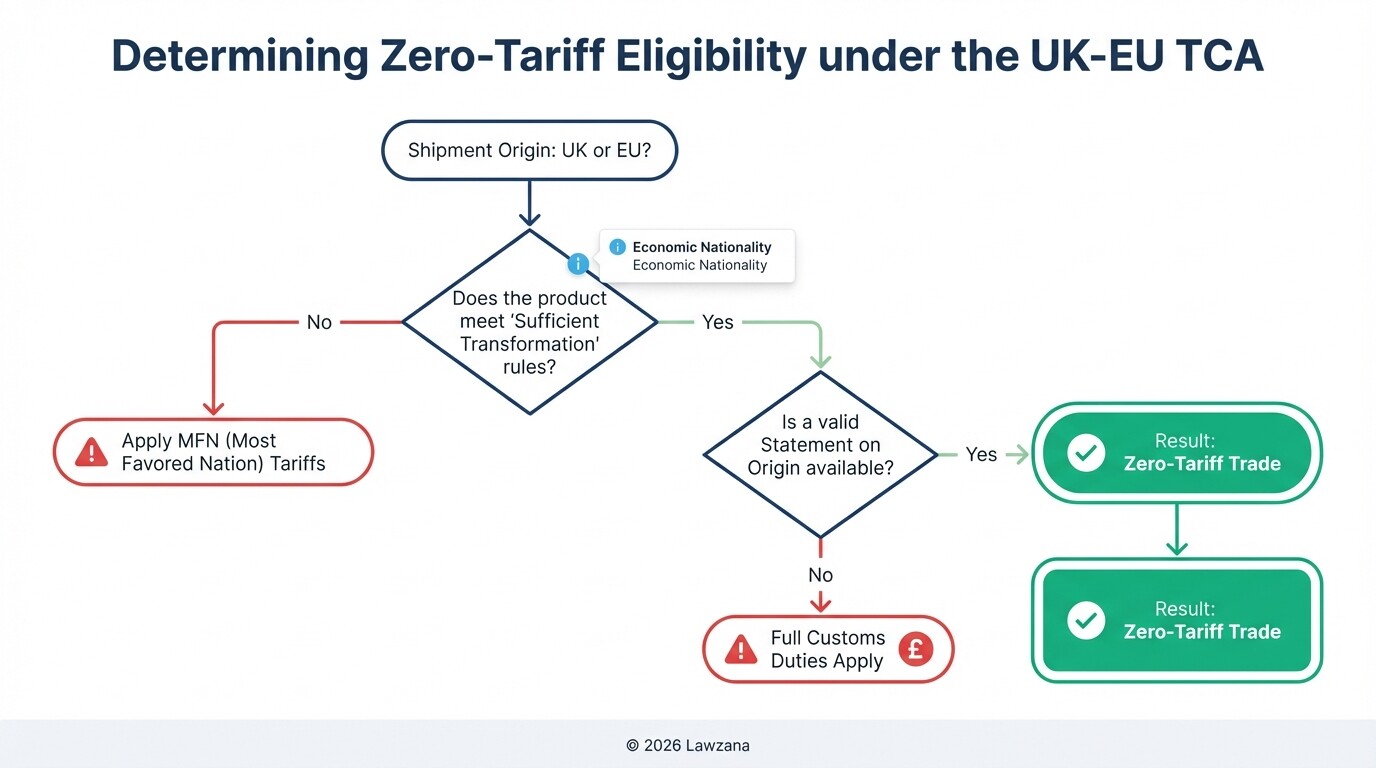
Rules of Origin determine the "economic nationality" of a product and are the primary mechanism for deciding if a shipment qualifies for zero tariffs under the UK-EU Trade and Cooperation Agreement. Simply shipping a product from an EU warehouse does not make it an EU-originating good; it must undergo "sufficient transformation" within the EU to qualify.
EU sellers must also navigate complex VAT changes. For B2C shipments valued at £135 or less, the seller or the online marketplace is responsible for collecting UK VAT at the point of sale, rather than at the border. For shipments over £135, import VAT is generally due at the border, though businesses can use Postponed VAT Accounting (PVA) to account for the VAT on their periodic VAT return rather than paying it upfront. This requires a valid UK VAT registration and a GB EORI number.
Common Customs Declaration Mistakes Leading to Seizures
The most frequent cause of cargo seizures and fines in the UK is the use of incorrect Commodity Codes (HS Codes). These codes determine the rate of duty, VAT, and any necessary licenses; an incorrect code is viewed by HM Revenue & Customs (HMRC) as a potential attempt at tax evasion or a breach of safety protocols.
Other common errors include:
- Incorrect Valuation: Failing to include the cost of insurance, packaging, or royalties in the "customs value" of the goods.
- Missing Licenses: Importing restricted items (such as certain chemicals, plants, or animal products) without the necessary Department for Environment, Food & Rural Affairs (DEFRA) certificates.
- Inaccurate Incoterms: Misrepresenting the "Delivery Duty Paid" (DDP) status, which leads to confusion over who is legally liable for customs debt.
Legal Strategies for Resolving Cross-Border Contract Disputes
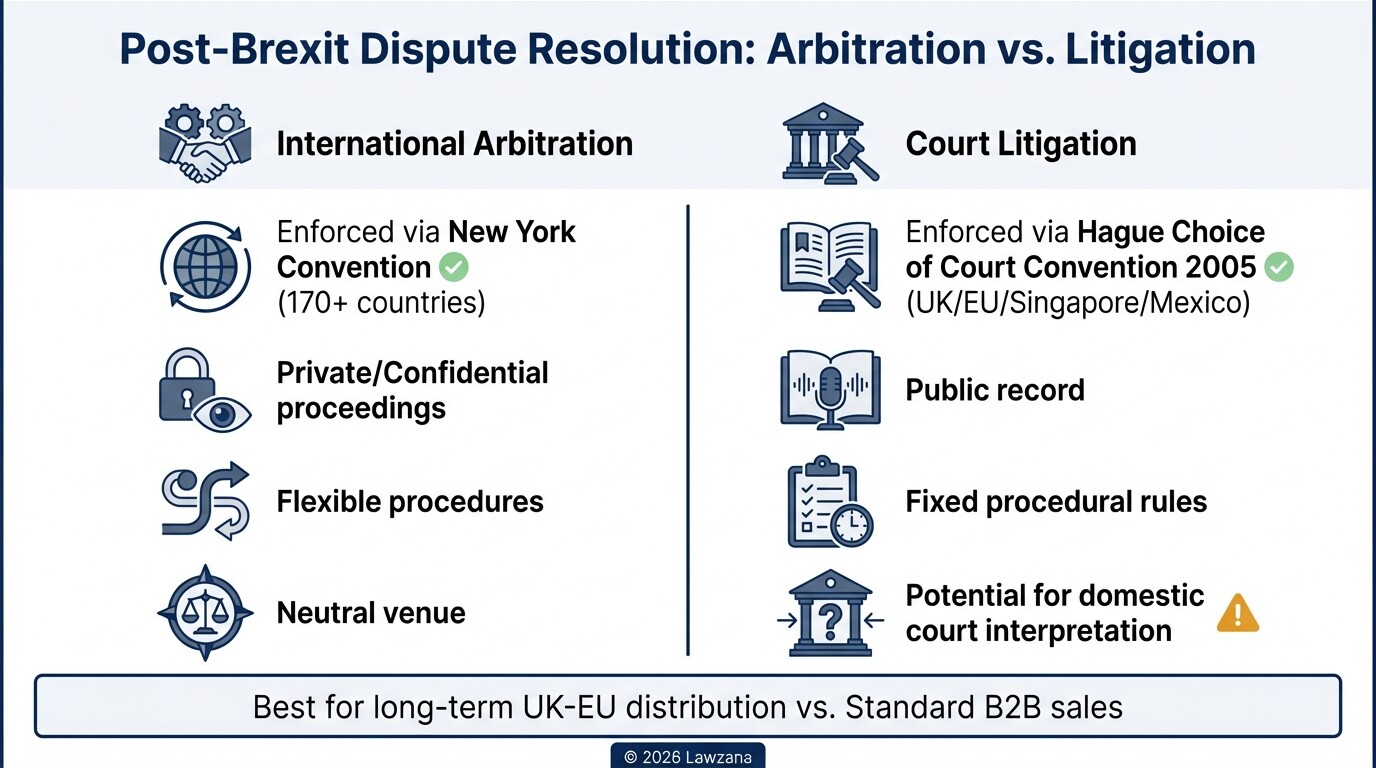
Resolving disputes in a post-Brexit environment requires precise "Choice of Law" and "Jurisdiction" clauses to avoid the complexities of navigating two different legal systems. Since the UK is no longer part of the Lugano Convention, the enforcement of UK court judgments in the EU (and vice versa) relies on the Hague Choice of Court Convention 2005.
To minimize risk, businesses should adopt the following strategies:
- Arbitration Clauses: Include a mandatory arbitration clause (e.g., LCIA or ICC) as arbitration awards are generally easier to enforce globally than court judgments under the New York Convention.
- Hardship Clauses: Beyond standard Force Majeure, include "Hardship" or "Change of Law" provisions that allow for contract renegotiation if new regulatory divergence makes the contract commercially unviable.
- Define "The Territory": Ensure contracts clearly define whether "The European Union" includes or excludes the United Kingdom to avoid ambiguity in distribution rights or non-compete clauses.
Sample Choice of Law and Jurisdiction Clause
"This Agreement and any dispute or claim arising out of or in connection with it shall be governed by and construed in accordance with the laws of England and Wales. Each party irrevocably agrees that the courts of England and Wales shall have exclusive jurisdiction to settle any dispute or claim arising out of or in connection with this Agreement or its subject matter or formation."
Impact of the 2026 Border Operating Model on Logistics
The 2026 Border Target Operating Model (BTOM) represents the final stage of the UK's move toward a fully digital, "frictionless" border. This model shifts the focus from manual document checks to a data-driven approach, utilizing the UK Single Trade Window to allow businesses to submit all import/export data through a single portal.
By 2026, logistics providers must adapt to "trusted trader" schemes which allow high-compliance businesses to perform their own inspections or bypass certain physical checks. However, for those not in these schemes, the requirements for pre-lodgment of declarations and Sanitary and Phytosanitary (SPS) checks for agri-food products will become even more stringent. Businesses should invest in integrated customs software now to ensure their data can interface directly with HMRC systems to avoid bottleneck delays at ports like Dover or Holyhead.
Common Misconceptions
- "The CE mark is gone for good in the UK." This is a myth. While the UKCA mark was intended to replace it, the UK government has extended the recognition of the CE mark for many goods indefinitely to support businesses. However, you must check your specific product regulations as some exceptions apply.
- "Free trade means no customs paperwork." Many businesses believe the UK-EU Trade and Cooperation Agreement eliminates paperwork. In reality, while it can eliminate tariffs, the administrative burden of customs declarations, safety and security filings, and proving Rules of Origin remains mandatory.
- "I don't need a UK representative if I'm an EU company." If you are exporting to the UK and acting as the Importer of Record, you generally need a UK-based entity or a specialized customs agent to handle the legal liabilities of the import.
FAQ
Do I need a different EORI number for Northern Ireland?
Yes, if you are moving goods between Northern Ireland and Great Britain or other non-EU countries, you may need an EORI number that starts with "XI." This is part of the specific arrangements under the Windsor Framework.
How much does a UK customs declaration cost?
While HMRC does not charge a fee to submit a declaration, most businesses use a customs broker. These agents typically charge between £45 and £150 per declaration, depending on the complexity and volume of the shipment.
What happens if I use the wrong HS code?
Using an incorrect HS code can lead to the underpayment of duty. HMRC may issue a "Post-Clearance Demand Note" for the unpaid tax, apply civil penalties (fines), and in cases of persistent errors, seize future shipments.
When to Hire a Lawyer
International trade law is increasingly volatile. You should consult a legal professional if:
- You are drafting long-term distribution agreements that span both the UK and EU markets.
- You are facing a "Notice of Seizure" or a formal investigation from HMRC regarding customs non-compliance.
- Your goods fall into "high-risk" categories like chemicals, medical devices, or defense equipment where UK-EU regulatory divergence is greatest.
- You need to restructure your corporate presence in the UK to manage Importer of Record liabilities.
Next Steps
- Conduct a Trade Audit: Identify every product you ship and confirm its current HS code and origin status.
- Consult the UK Integrated Online Tariff: Check the specific duty rates and commodity requirements for your goods entering the UK.
- Update Your Terms: Ensure your commercial contracts reflect the modern reality of UK-EU trade, specifically regarding Incoterms and dispute resolution.
- Speak with an Expert: Contact a trade lawyer or customs consultant to review your compliance framework before the 2026 border updates take full effect.