- Golden Power Oversight: The Italian government can veto or impose conditions on foreign investments in strategic sectors such as energy, transport, and communication.
- Mandatory Labor Transfers: Under Article 2112 of the Italian Civil Code, employees transfer automatically to the buyer with all existing rights preserved in a "transfer of business."
- Urbanistic Compliance: Real estate due diligence must confirm that buildings align with land registry records; failure to do so can render a sale null and void.
- Decree 231 Liability: Corporations in Italy can be held liable for crimes committed by their directors or employees unless they have adopted a specific compliance "Model 231."
- Notarial Involvement: Most Italian M&A transactions require a Public Notary to formalize the transfer of shares and file documents with the Register of Companies.
Legal Due Diligence Checklist for Italian M&A
Legal due diligence in Italy requires a focus on civil law specificities that differ significantly from common law jurisdictions. Investors must verify the "good standing" of the target company through the Certificato Camerale and ensure all hidden liabilities-particularly social security and tax-are identified before the signing.
| Category | Essential Action Items |
|---|---|
| Corporate Status | Verify the Visura Camerale (Company Report) and ensure all share transfers are recorded in the Register of Companies. |
| Golden Power | Determine if the target operates in "strategic" sectors (Defense, 5G, Energy) requiring Prime Minister notification. |
| Employment | Audit the Documento Unico di Regolarità Contributiva (DURC) to ensure all social security payments are current. |
| Real Estate | Confirm Conformità Urbanistica (planning permission) and Conformità Catastale (mapping consistency). |
| Regulatory | Check for "Model 231" compliance to mitigate administrative liability for corporate crimes. |
| Tax | Obtain the Certificato dei Carichi Pendenti from the Italian Revenue Agency (Agenzia delle Entrate). |
Navigating Italy's Golden Power Regulations
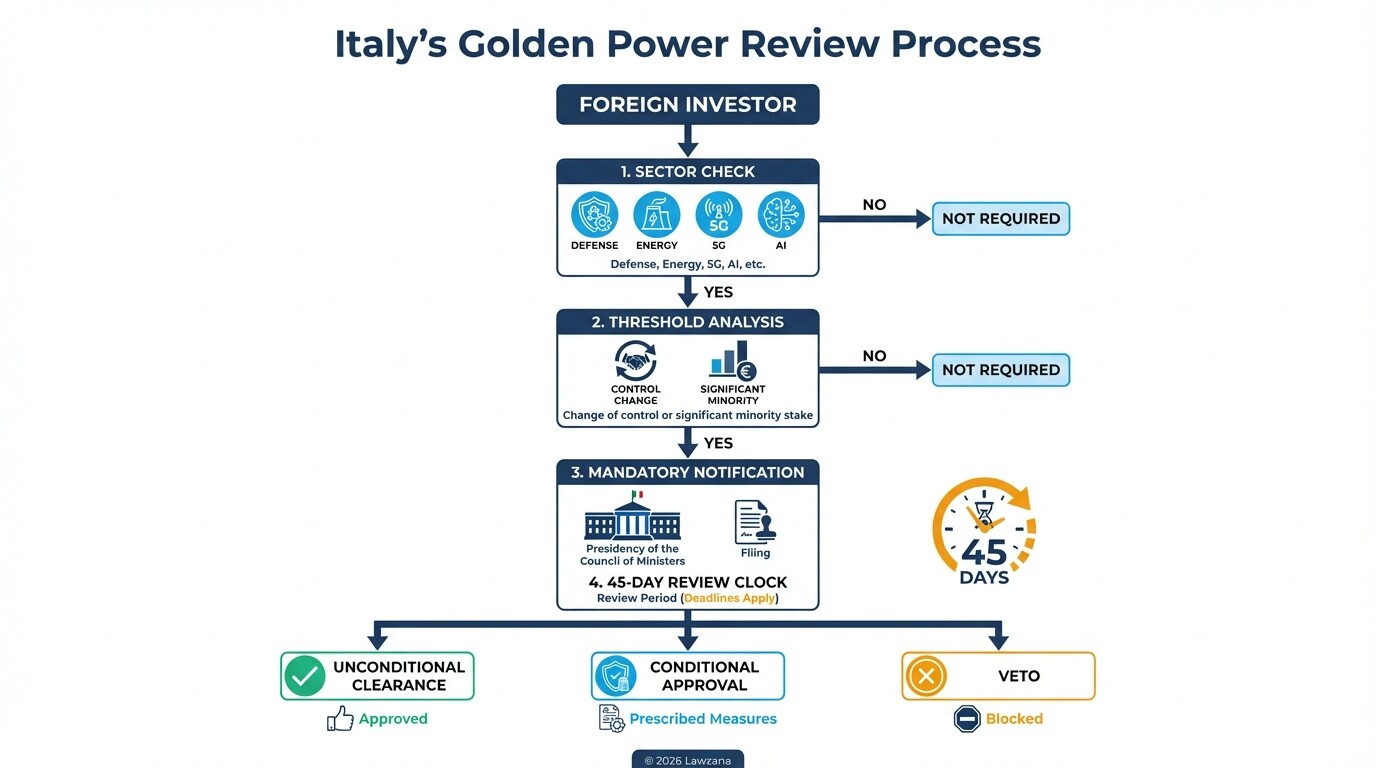
The Italian government exercises "Golden Power" to protect national interests by reviewing foreign direct investment (FDI) in strategic sectors. This regulatory framework allows the Presidency of the Council of Ministers to prohibit an acquisition or impose specific conditions on the buyer to safeguard national security and public order.
Under Legislative Decree 21/2012 and subsequent expansions, the scope of Golden Power is broad. It includes defense, national security, energy, transport, and communications, but has recently expanded to include "critical technologies" like semiconductors, AI, and even the agri-food and insurance sectors.
Foreign investors must notify the government of a transaction if it meets certain thresholds, typically involving a change of control or the acquisition of a significant minority stake by a non-EU entity. The government generally has 45 days to review the notification. Failure to notify can result in administrative fines of up to double the value of the transaction (minimum 1% of turnover) and may render the transaction's legal effects null.
Employment Law Risks and Mandatory Employee Transfers
In Italy, the transfer of a business or a "going concern" (trasferimento d'azienda) is governed by Article 2112 of the Civil Code, which provides high levels of protection for workers. The buyer cannot pick and choose which employees to take; all staff associated with the business unit being sold are automatically transferred to the purchaser by law.
Key considerations for employment due diligence include:
- Automatic Continuity: Employees retain their seniority, salary levels, and all acquired rights from their previous employment.
- Joint Liability: The buyer and seller are jointly and severally liable for all credits (unpaid wages or social security) the employee had at the time of the transfer.
- Union Consultation: For companies with more than 15 employees, both the buyer and seller must undergo a mandatory consultation process with trade unions (sindacati) at least 25 days before the transfer.
- No-Dismissal Rule: A transfer of business is not a valid legal ground for dismissal. Terminations occurring shortly before or after a deal are highly scrutinized by Italian labor courts.
Environmental and Real Estate Due Diligence
Real estate in Italy is subject to strict "urbanistic" and "catastale" compliance rules that can jeopardize the validity of an entire M&A deal. If a target company owns property with unauthorized structural changes (abuses), the deed of sale may be considered legally void under Italian law.
Environmental liability follows the "polluter pays" principle. However, if the polluter cannot be identified or fails to act, the owner of the land may be required to implement cleanup measures up to the value of the property. Investors should conduct Phase I and Phase II Environmental Site Assessments (ESA) particularly when acquiring industrial targets.
Additionally, investors must verify the Certificato di Agibilità (Certificate of Habitability/Usability), which confirms the building meets safety, hygiene, and energy efficiency standards.
Drafting Enforceable Representations and Warranties (R&W)
In cross-border transactions, R&W clauses are used to bridge the gap between Italian statutory protections and international commercial expectations. Because the Italian Civil Code provides limited "default" warranties (mostly covering title and latent defects), specific contractual language is vital to protect the buyer.
Under Italian law, the parties can limit or extend the seller's liability, but "willful misconduct" (dolo) or "gross negligence" (colpa grave) cannot be contractually waived. It is standard practice to include an "Indemnity" section that bypasses some of the stricter procedural requirements of the Civil Code regarding the notification of defects.
Sample Clause: Tax Indemnification
"The Seller hereby agrees to indemnify, defend, and hold harmless the Buyer against any and all losses, liabilities, and damages arising out of or relating to any Tax liability of the Target Company pertaining to any taxable period ending on or before the Closing Date, including any interest or penalties related thereto, regardless of whether such liabilities were disclosed in the Due Diligence process."
Compliance with Italian Anti-Corruption and AML Laws
Anti-money laundering (AML) and anti-corruption compliance in Italy is centered on Legislative Decree 231/2001. This statute introduces a form of corporate administrative liability for crimes committed by individuals in the interest or to the advantage of the company.
To avoid liability, an Italian company must prove it has adopted and effectively implemented an "Organizational, Management, and Control Model" (Model 231) designed to prevent such crimes. During due diligence, a buyer must evaluate:
- Existence of Model 231: Does the target have a current model and an independent supervisory body (Organismo di Vigilanza)?
- Beneficial Ownership: Does the target comply with the Italian Register of Beneficial Owners?
- KYC Protocols: Are there robust "Know Your Customer" procedures in place for third-party vendors and clients?
Common Misconceptions in Italian M&A
- "I can fire the management team immediately after closing." While top-level executives (Dirigenti) have fewer protections than standard workers, Italian law still requires "justifiable reason" or a specific notice period/indemnity for termination.
- "The Notary is just a rubber stamp." In Italy, the Notary is a public official who performs a legality check on the transaction. They are responsible for ensuring the deal does not violate public policy and for the correct filing with the Italian Business Register.
- "Foreign law can govern all aspects of the deal." While the Sale and Purchase Agreement (SPA) can be governed by New York or English law, mandatory Italian rules (like labor laws, real estate transfers, and Golden Power) will always prevail regardless of the chosen jurisdiction.
FAQ
What is the typical timeline for an M&A deal in Italy?
A standard cross-border deal takes 4 to 9 months. This includes 1-2 months for preliminary negotiations and NDAs, 2-3 months for due diligence, and 45-60 days for any mandatory regulatory clearances like Golden Power.
Do I need to translate all documents into Italian?
For the due diligence phase, English is common. However, the final deed of transfer filed with the Public Notary must be in Italian. If the parties do not speak Italian, a certified translation and an interpreter are required during the signing.
How much are the transaction taxes for an Italian acquisition?
Share transfers of an S.r.l. (limited liability company) are subject to a fixed registration tax of €200. For an S.p.A. (joint-stock company), a "Tobin Tax" of 0.2% on the value of the transaction usually applies.
When to Hire a Lawyer
Engaging an Italian corporate attorney is essential when the target company operates in a regulated sector or holds significant real estate assets. You should seek legal counsel as soon as a Letter of Intent (LOI) is drafted to ensure that "binding" versus "non-binding" clauses are clearly defined according to the Italian Civil Code's "good faith" negotiation requirements (responsabilità precontrattuale).
Next Steps
- Request a Visura Camerale: Obtain the official company report from the Italian Chamber of Commerce to verify the target's corporate structure.
- Assess Golden Power Status: Consult with counsel to determine if a formal notification to the Italian Presidency of the Council of Ministers is required.
- Initiate "Model 231" Review: Audit the target's compliance framework to identify potential legacy liabilities for corporate crimes.
- Confirm Urbanistic Compliance: Hire a local surveyor (geometra) to cross-reference the physical state of the target's properties with official municipal records.