- California law generally provides a four-year statute of limitations for written contract breaches and a two-year limit for oral agreements.
- Proving a breach requires demonstrating a valid contract, your performance, the other party's failure to perform, and resulting financial harm.
- Many California courts and contracts mandate mediation or alternative dispute resolution (ADR) before a case can proceed to a jury trial.
- International businesses can recover compensatory damages, though punitive damages are rarely awarded in standard commercial contract disputes.
- Formal "Notice of Breach" letters are often a mandatory first step required by the contract terms or California civil procedure.
What documentation is essential for proving a breach of contract in California?
To win a breach of contract case in California, you must provide a clear paper trail that establishes the existence of the agreement and the specific nature of the violation. The most critical documents include the fully executed contract, any written amendments, and a comprehensive log of communications such as emails, formal letters, and Slack messages. Without these records, proving the "meeting of the minds" required under California law becomes significantly more difficult.
Beyond the contract itself, international entities should gather:
- Proof of Performance: Documentation showing that your business fulfilled its obligations before the breach occurred (e.g., shipping receipts, service logs, or payment confirmations).
- Evidence of the Breach: Direct evidence that the other party failed to perform, such as a notice of cancellation or internal reports showing the delivery of non-conforming goods.
- Financial Records: Detailed invoices, bank statements, and accounting ledgers that quantify the exact financial loss suffered due to the breach.
- Expert Reports: In complex commercial cases, reports from industry experts or forensic accountants may be necessary to explain technical failures or lost profit projections.
What are the statute of limitations and filing deadlines for 2026?
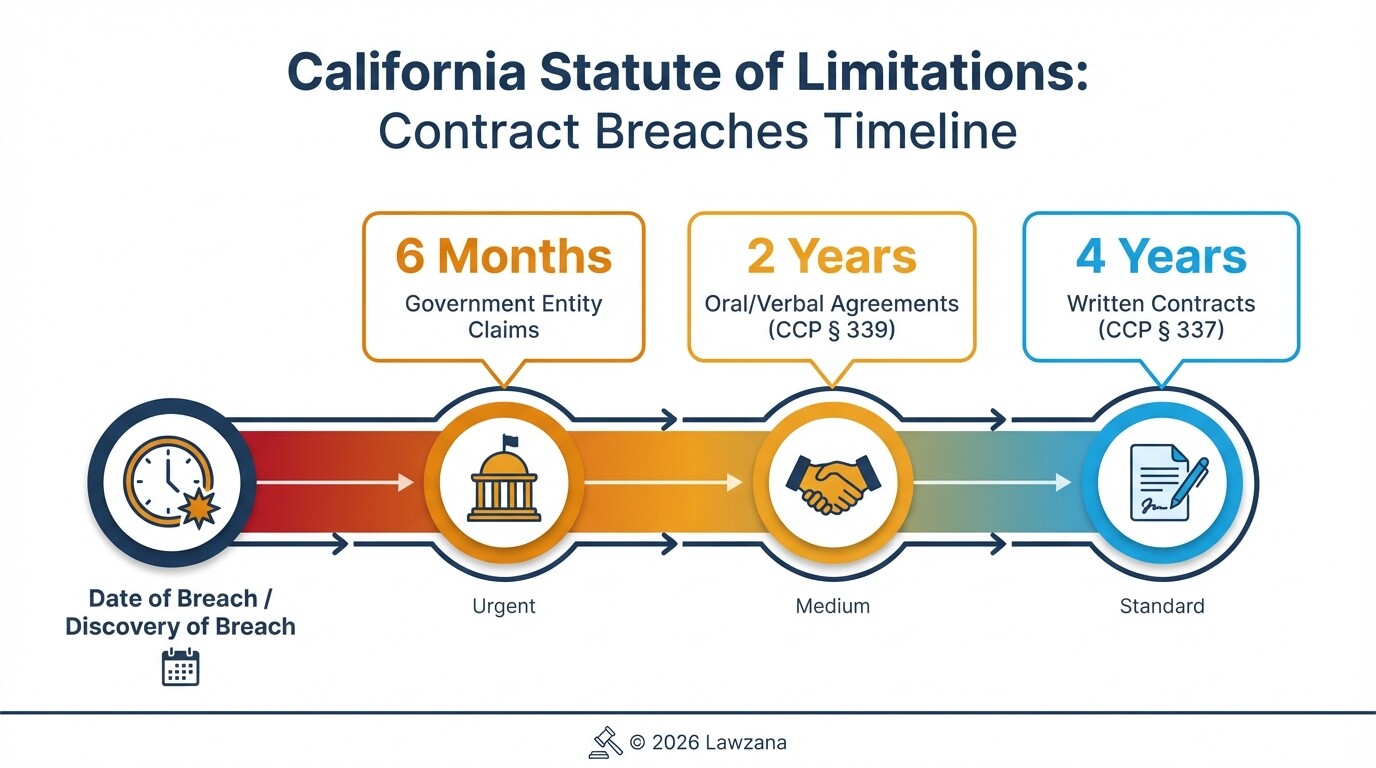
In 2026, California continues to enforce strict deadlines for filing breach of contract lawsuits, governed primarily by the California Code of Civil Procedure. For a written contract, the statute of limitations is four years from the date the breach occurred. For oral or verbal agreements, the deadline is much shorter at only two years.
Failure to file within these windows usually results in the permanent loss of the right to sue. Key deadlines to monitor include:
- Written Contracts: Four years (CCP § 337). The clock typically starts when the claimant discovers, or should have discovered, the breach.
- Oral Contracts: Two years (CCP § 339). These are harder to prove and have the highest risk of expiring early.
- Government Entities: If the defendant is a California government agency, you must file a formal administrative claim within six months before you can even initiate a lawsuit.
- Tolling: In rare cases, such as when a defendant leaves the state or is a minor, the clock may be "tolled" or paused, but international businesses should never rely on this as a primary strategy.
How do mediation and courtroom litigation compare in California?
California courts heavily favor mediation as a way to reduce the backlog in the state's superior court system. Mediation is a confidential, voluntary process where a neutral third party helps businesses reach a settlement, whereas litigation is a public, adversarial process where a judge or jury makes a final, binding decision. For international stakeholders, mediation often offers a more predictable and cost-effective resolution.
| Feature | Mediation | Courtroom Litigation |
|---|---|---|
| Cost | Generally lower; split mediator fees. | High; includes filing fees, discovery, and trial costs. |
| Privacy | Private and confidential. | Public record; available to competitors and media. |
| Speed | Can be resolved in weeks or months. | Often takes 18 to 36 months to reach trial. |
| Control | Parties decide the outcome together. | A judge or jury dictates the final judgment. |
| Enforceability | Requires a signed settlement agreement. | Results in a court order or judgment. |
What damages and recovery options are available for foreign entities?
Foreign entities litigating in California are entitled to "compensatory damages," which aim to put the business in the position it would have been in had the contract been performed. California law focuses on the "expectation interest," meaning the court looks at the lost value of the bargain. While foreign companies can sue for significant sums, California courts rarely award punitive damages in contract cases unless a separate fraud or tort occurred.
Recovery options typically include:
- General Damages: The direct financial loss resulting from the breach, such as the unpaid balance on an invoice.
- Consequential Damages: Indirect losses that were foreseeable at the time the contract was signed, such as lost profits from a downstream contract that was canceled because of the defendant's breach.
- Liquidated Damages: A specific amount of money agreed upon in the contract itself to be paid in the event of a breach, provided the amount is reasonable and not a penalty.
- Specific Performance: A court order forcing the defendant to fulfill their end of the bargain, usually reserved for unique goods or real estate where money cannot fix the harm.
- Attorney's Fees: Under the California Civil Code Section 1717, attorney's fees are only recoverable if the contract specifically includes a "prevailing party" fee clause.
What are the mandatory pre-litigation notice requirements in California?
Before a lawsuit can be filed in California, the plaintiff often must provide the breaching party with a formal notice and an opportunity to fix the problem, known as a "right to cure." Many commercial contracts explicitly state that a party cannot be sued until they have received a 10, 15, or 30-day written notice of the alleged breach. Ignoring these requirements can lead to a court dismissing your case early in the process.
To ensure compliance, businesses should follow these steps:
- Review the Notice Clause: Check the "General Provisions" or "Boilerplate" section of your contract for specific delivery methods (e.g., certified mail or overnight courier).
- Draft a Formal Demand Letter: Clearly state which section of the contract was breached, the facts supporting the claim, and the specific action required to remedy the situation.
- Establish a Deadline: Provide a clear timeframe for the response as dictated by the contract or California industry standards.
- Preserve Proof of Service: Keep the return receipt or delivery confirmation, as you will need this to prove to the court that you fulfilled your pre-litigation obligations.
Common Misconceptions in California Commercial Litigation
Myth 1: I can sue for "pain and suffering" or emotional distress in a business breach. In California, commercial litigation is strictly about financial loss. Courts do not award emotional distress damages for business contract breaches, regardless of how stressful the situation was for the business owners.
Myth 2: If I win, the other side automatically pays my legal fees. This is incorrect. California follows the "American Rule," where each party pays its own legal fees unless the contract specifically contains an attorney's fee provision or a specific statute applies.
Myth 3: An email isn't a "real" contract. Digital signatures and email chains are fully enforceable under the California Uniform Electronic Transactions Act (UETA). If an exchange of emails shows a clear offer, acceptance, and consideration, it is a binding contract.
Frequently Asked Questions
Can a foreign company sue a California company in California courts?
Yes, foreign companies have the legal standing to sue in California Superior Courts or Federal District Courts, provided the contract was signed in California, performed in California, or contains a California "forum selection" clause.
What is the "Four Corners" rule in California?
The "Four Corners" rule generally prevents parties from using outside evidence (extrinsic evidence) to contradict the plain language of a written contract. If the contract is clear on its face, the court will only look at the document itself.
How long does a commercial litigation case take in Los Angeles or San Francisco?
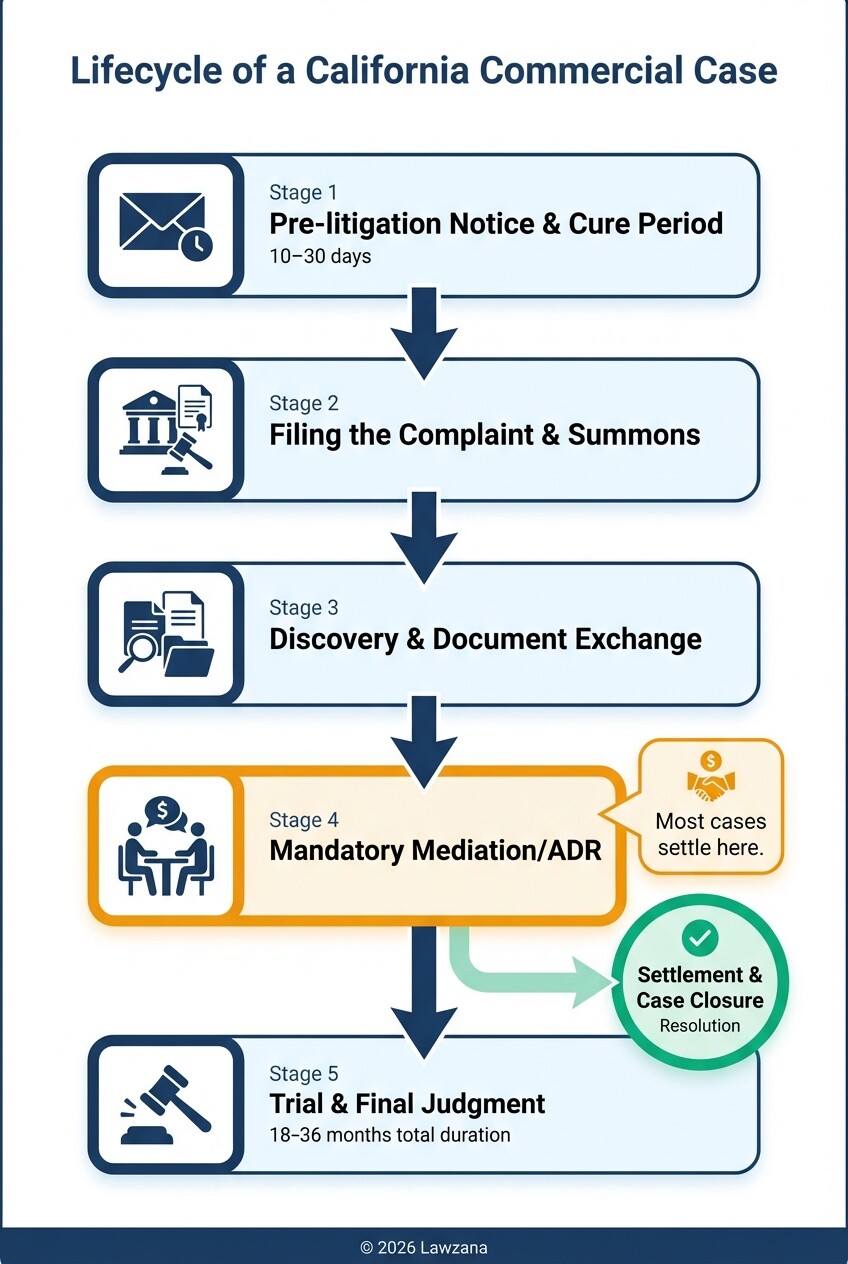
Due to court congestion, a standard commercial case typically takes between 18 months and three years to reach a trial verdict. However, most cases settle during the discovery or mediation phase within 12 months.
What happens if the contract doesn't specify which law applies?
If there is no "choice of law" clause, California courts use a "governmental interest" analysis to determine which state's laws have the most significant relationship to the dispute and the parties involved.
When to Hire a Lawyer
You should consult a California commercial litigator the moment you suspect a breach is imminent or immediately after receiving a "Notice of Breach" from another party. Early legal intervention is critical when the dispute involves more than $25,000 (the threshold for Limited Civil cases), when the contract involves international trade, or when you need to seek an immediate injunction to prevent irreparable harm to your business reputation or assets.
Next Steps
- Secure Your Records: Immediately freeze all document deletion protocols and gather every version of the contract and related correspondence.
- Review the Dispute Resolution Clause: Determine if your contract requires mandatory arbitration or mediation before you can file a lawsuit.
- Send a Formal Demand: If safe to do so, issue a formal "Notice of Breach" to the other party to start the clock on their cure period.
- Consult Counsel: Schedule a strategy session with a lawyer admitted to the California Bar to evaluate the strength of your evidence and estimate potential recovery.