


New Zealand Foreign Direct Investment: 2026 Regulatory FAQ
- Foreign investors acquiring 25 percent or more of a New Zealand business worth over $100 million NZD must obtain consent from the Overseas Investment Office (OIO).
- Any acquisition involving "sensitive land" requires OIO approval regardless of the transaction's monetary value.
- Applicants must pass the strict "Benefit to New Zealand" test by proving the investment creates tangible economic, social, or environmental advantages.
- Government application fees range from $40,000 to over $100,000 NZD, not including necessary legal and advisory costs.
- The approval timeline typically takes 60 to 130 working days but can extend beyond six months for highly complex or politically sensitive transactions.
When Does Your Business Need OIO Consent?
Foreign companies must obtain OIO consent before completing a transaction if they acquire a 25 percent or greater ownership stake in significant New Zealand assets. Regulatory approval is primarily triggered by the value of the business or the type of land being acquired.
New Zealand's Land Information New Zealand (LINZ) manages the OIO and strictly enforces these thresholds under the Overseas Investment Act 2005. The two main triggers for consent are:
- Significant Business Assets (SBA): Acquiring an ownership interest of 25 percent or more in a New Zealand business or assets valued at over $100 million NZD. Higher thresholds apply to investors from countries with specific free trade agreements, such as Australia.
- Sensitive Land: Purchasing or leasing specific categories of land for more than three years. This applies regardless of the purchase price and is the most common trigger for foreign investors.
- Fishing Quota: Acquiring an interest in fishing quotas recognized under New Zealand law.
Proving the Benefit to New Zealand Test
The 'Benefit to New Zealand' test requires foreign investors to prove their transaction will create tangible economic, environmental, or social value that would not happen under local ownership. Meeting this threshold requires extensive documentation and a highly detailed forward-looking business plan.
To satisfy the OIO, your legal and financial teams must prepare comprehensive evidence across several categories. The OIO measures the proposed benefits against a counterfactual scenario of what would happen if the investment did not proceed.
Required documentation typically includes:
- Economic modeling: Detailed financial projections showing direct job creation, increased export volumes, or the introduction of new capital for business expansion.
- Technology and innovation plans: Blueprints or operational plans proving the introduction of proprietary technology, new business skills, or enhanced productivity to the local market.
- Environmental compliance data: Evidence of ecological protection efforts, enhanced public access to natural resources, or sustainable land management practices.
- Historical track record: Corporate records demonstrating the applicant's prior success in executing similar business plans globally.
Navigating Sensitive Land and Environmental Compliance
Sensitive land includes non-urban land over five hectares, properties adjoining marine areas or conservation reserves, and all residential real estate. Investors targeting these properties must submit detailed environmental compliance plans and undergo rigorous government scrutiny.
If your corporate acquisition includes sensitive land, the regulatory burden increases significantly. You must separate the business valuation from the land valuation and prove specific benefits related to the property itself.
Key compliance requirements for sensitive land include:
- Farm land advertising: Before a foreign entity can purchase agricultural land, the property must be advertised on the open market to New Zealanders for at least 30 working days.
- Environmental enhancement: Applications must outline how the investor will protect indigenous flora and fauna, improve waterways, or reduce greenhouse gas emissions.
- Public access provisions: The OIO frequently requires foreign investors to grant or maintain public walking access across parts of the land, particularly near beaches, lakes, and forests.
Cost Breakdown: Application Fees and Legal Expenses
Securing OIO consent requires a significant financial commitment, with standard government application fees ranging from $40,000 to over $100,000 NZD depending on transaction complexity. Legal, financial, and environmental advisory fees typically add a further $50,000 to $150,000 NZD to the total regulatory budget.
The OIO charges a single flat fee upon application submission. These fees are non-refundable even if the application is withdrawn or declined. Below is an estimated breakdown of costs for a standard corporate transaction in 2026.
OIO Timeline Expectations and Ministerial Approval
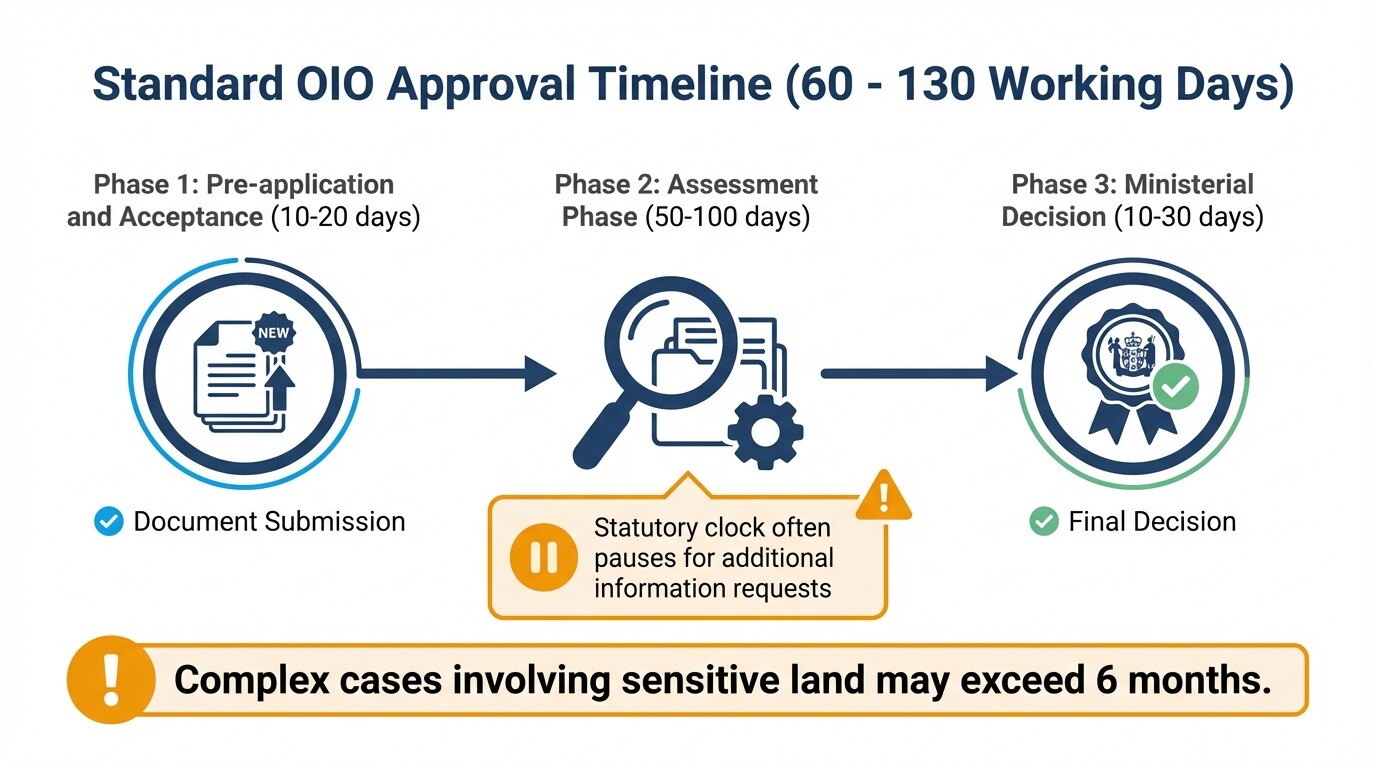
The OIO consent process typically takes between 60 to 130 working days from the moment a formal, complete application is accepted. Complex cases involving sensitive land or requiring joint ministerial approval can extend well beyond six months.
Foreign investors must build this regulatory waiting period into their sale and purchase agreements. A standard timeline unfolds in three distinct phases:
- Pre-application and Acceptance (10 to 20 days): The OIO reviews the submitted application to ensure all required documentation is present. The statutory clock does not start until the OIO formally accepts the file.
- Assessment Phase (50 to 100 days): Regulators analyze the business plan, verify the 'Benefit to New Zealand' claims, and consult with other government departments. The OIO frequently pauses the statutory clock to request additional information from the applicant.
- Ministerial Decision (10 to 30 days): For highly sensitive transactions, the OIO drafts a recommendation and forwards it to the Minister of Finance and the Minister for Land Information. The Ministers hold the ultimate authority to approve or decline the investment.
Common Misconceptions About NZ Foreign Investment
Foreign corporations frequently underestimate the complexity of New Zealand's regulatory environment. Falling for common myths can lead to rejected applications and collapsed deals.
- The $100 million threshold applies to everything: Many investors believe they do not need approval if the deal is under $100 million NZD. However, if the business owns or leases sensitive land, OIO consent is required regardless of the transaction's financial value.
- Indirect acquisitions do not trigger OIO rules: Global mergers between two foreign entities still require New Zealand OIO consent if one of the companies owns significant business assets or sensitive land in New Zealand.
- OIO approval is a standard rubber stamp: Regulators actively reject applications that fail to prove a genuine, measurable benefit to the country. It is a rigorous, evidence-based assessment, not a simple registration process.
Frequently Asked Questions
What defines an 'overseas person' under New Zealand law?
An overseas person is an individual who is neither a New Zealand citizen nor ordinarily resident in the country. For corporations, any company incorporated outside New Zealand, or a New Zealand company with 25 percent or more foreign ownership or control, is classified as an overseas person.
Are there OIO exemptions for Australian corporate investors?
Yes. Due to the Closer Economic Relations agreement, non-government Australian investors benefit from a significantly higher monetary threshold. As of recent updates, Australian entities only trigger the Significant Business Asset rules if the transaction exceeds $618 million NZD, though sensitive land rules still apply normally.
Can foreign businesses buy commercial property in New Zealand?
Yes, foreign businesses can purchase commercial property. However, if the commercial property sits on sensitive land, adjoins a marine area, or includes residential components, it will trigger the OIO consent requirement and the benefit test.
What happens if a company breaches the Overseas Investment Act?
Penalties for bypassing OIO consent are severe. The High Court can force the foreign investor to dispose of the assets, impose financial penalties up to three times the quantifiable gain of the transaction, and levy corporate fines up to $300,000 NZD per offense.
When to Hire a Corporate Lawyer
Engage local corporate counsel immediately once a New Zealand target asset is identified and long before drafting a sale and purchase agreement. Early legal strategy prevents costly OIO application rejections, helps structure the transaction to minimize regulatory friction, and ensures all contractual timelines align with government processing speeds.
Navigating the Overseas Investment Office requires specialized domestic knowledge. Partnering with experienced corporate and commercial lawyers in New Zealand ensures your economic models, environmental plans, and legal structures meet the exact statutory requirements demanded by government ministers.
Next Steps for Foreign Investors
Before committing capital or signing term sheets for a New Zealand acquisition, execute a structured preliminary assessment.
- Assess the target business for any owned or leased real estate to determine if sensitive land rules apply.
- Calculate the total transaction value in New Zealand Dollars to check against the Significant Business Assets threshold.
- Assemble a local advisory team consisting of legal counsel, environmental consultants, and independent valuers.
- Begin drafting the 'Benefit to New Zealand' business plan, focusing on job creation, capital investment, and technological advancement.
- Structure your Sale and Purchase Agreement to make the transaction strictly conditional upon obtaining OIO consent.