- Foreign companies can sue in Nigerian courts without registering a local subsidiary or branch.
- Mareva injunctions allow you to freeze a defendant's Nigerian assets before they can hide or transfer them.
- International arbitration awards are easier to enforce than foreign court judgments because Nigeria is a signatory to the New York Convention.
- Fast Track courts in Lagos State significantly shorten litigation timelines for high-value commercial disputes.
How to File a Commercial Lawsuit as a Foreign Entity
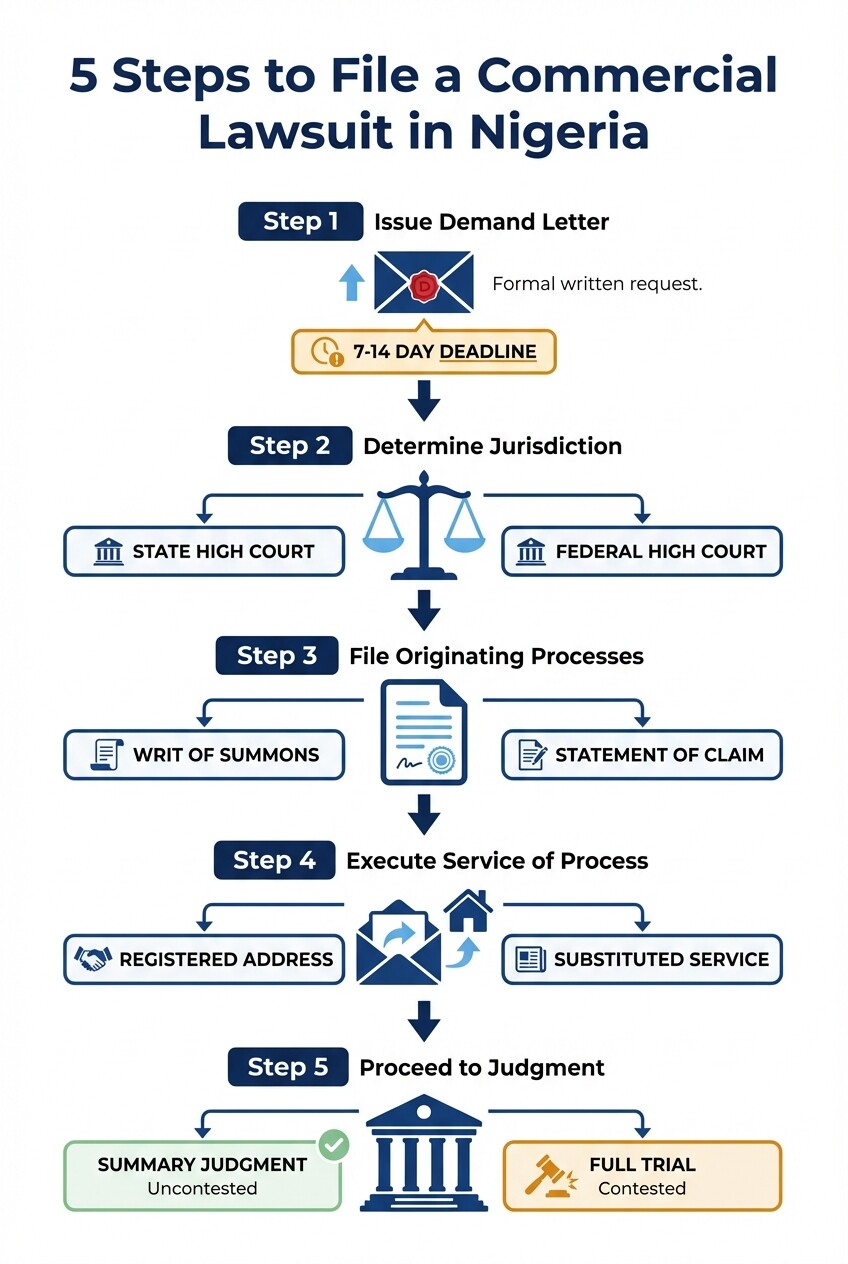
Foreign entities can initiate commercial litigation in Nigeria to recover debts or enforce contracts without maintaining a local physical presence. The process requires identifying the correct jurisdiction, filing originating processes, and formally serving the Nigerian counterparty.
- Issue a Demand Letter: Send a formal demand letter to the defaulting party. State the exact debt owed, outline the contract breach, and provide a final deadline (usually 7 to 14 days) for compliance.
- Determine Jurisdiction: General contract breaches go to the State High Court. Matters involving corporate governance, admiralty, or intellectual property go to the Federal High Court of Nigeria.
- File Originating Processes: Your lawyer files a Writ of Summons, a Statement of Claim, a witness list, and evidence documents. For uncontested debts, your lawyer can use the "Summary Judgment" or "Undefended List" procedure to skip a full trial.
- Execute Service of Process: The court must officially serve the lawsuit documents on the defendant at their registered address. If the defendant evades service, the court may order substituted service, such as publishing the notice in a national newspaper.
- Proceed to Judgment: If the defendant lacks a valid defense, the judge issues a summary judgment in your favor. If they raise factual disputes, the case proceeds to a full trial.
Costs and Timelines for Debt Recovery in Nigeria (2026)
Commercial litigation costs in Nigeria include court filing fees, lawyer retainers, and contingency fees. Timelines depend on case complexity, court congestion, and whether the dispute qualifies for summary judgment.
| Expense or Phase | Estimated Cost (NGN) or Timeline | Description |
|---|---|---|
| Court Filing Fees | 1% to 5% of claim value | Assessed by the court registry based on the total claim value. Some states cap this fee. |
| Legal Retainer | ₦2,000,000 - ₦15,000,000+ | Upfront fee to commence work. Varies based on firm tier and case complexity. |
| Contingency Fee | 5% to 20% of recovered sum | Paid upon successful debt recovery. Often paired with a lower upfront retainer. |
| Summary Judgment | 3 to 6 months | Applies to uncontested debt recovery cases with clear documentary evidence. |
| Full Trial | 1.5 to 3 years | Applies to contested contract breaches requiring witness cross-examination. |
| Appellate Process | 2 to 5 additional years | Applies if the losing party appeals to the Court of Appeal and the Supreme Court. |
Freezing Local Assets During Cross-Border Disputes
A Mareva injunction is a temporary court order that stops a Nigerian defendant from moving or hiding assets while your lawsuit is pending. Securing this injunction requires proving your claim is strong and the risk of asset flight is immediate.
- Establish a Strong Case: Demonstrate a high probability of winning the underlying lawsuit based on contract terms and communication records.
- Identify Specific Assets: The court requires specific targets. You must identify exact Nigerian bank accounts, real estate, or physical goods.
- Prove Dissipation Risk: Provide evidence the defendant is actively liquidating assets or moving funds offshore to avoid paying.
- Provide an Undertaking: Agree to compensate the Nigerian defendant for financial losses caused by the freeze if the court later decides the injunction was improper.
Commercial Courts and Alternative Dispute Resolution
Nigeria has a dual court system. Commercial disputes are divided between State High Courts and the Federal High Court. To avoid backlogs, many foreign businesses use fast-track procedures and court-connected Alternative Dispute Resolution (ADR) centers.
High-value commercial hubs like Lagos State have specialized Commercial Divisions and Fast Track Courts designed to resolve disputes within nine months. To qualify for the Lagos Fast Track, the claim must be for a liquidated monetary sum exceeding a specific threshold (often ₦100,000,000) or involve a non-Nigerian resident.
The Lagos Multi-Door Courthouse and similar centers provide structured mediation and arbitration. Settlements reached through these centers are enforceable as official High Court judgments.
Enforcing Foreign Judgments and Arbitration Awards
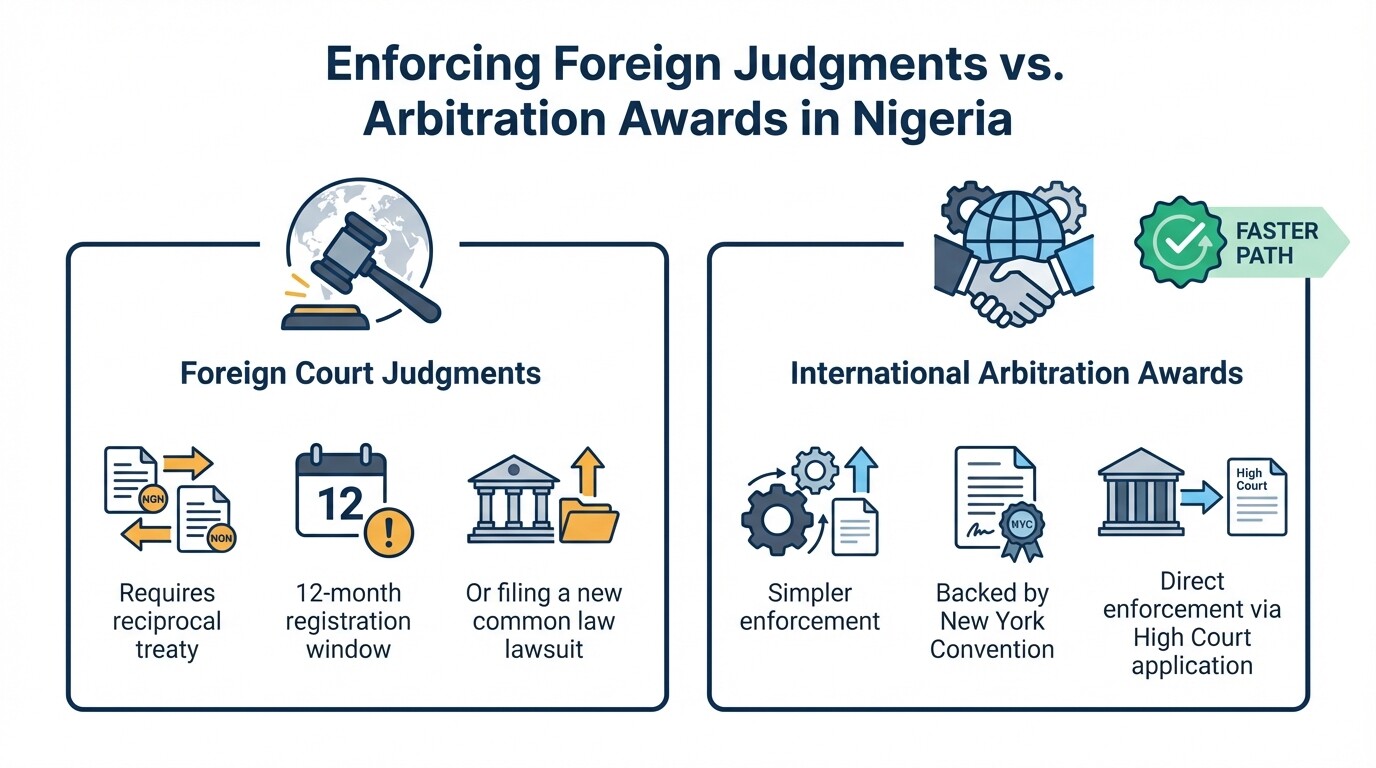
Foreign court judgments and international arbitration awards are not automatically enforceable in Nigeria. They must go through a formal recognition process. Once registered, these decisions carry the exact same legal weight as a local judgment and are enforceable through asset seizure or garnishment.
Enforcing a foreign court judgment requires reciprocity. Judgments from specific jurisdictions (like the UK) can be registered within 12 months of the ruling. For judgments from countries without a reciprocal treaty, the foreign entity must file a new lawsuit in Nigeria under common law. This uses the foreign judgment as primary evidence of the debt.
International arbitration awards have a simpler enforcement path. Nigeria is a signatory to the New York Convention, making awards from recognized foreign tribunals directly enforceable. Under the Nigerian Arbitration and Mediation Act, you apply to the High Court with the original arbitration agreement and the authenticated award to execute against the defaulting party's local assets.
Contract Rules and Legal Limitations
Choice of Law Clauses
Nigerian courts respect freedom of contract and uphold clauses designating foreign law, such as English or New York law. You must provide expert testimony during the Nigerian trial to prove the specific rules of that foreign jurisdiction.
Statute of Limitations
You have six years from the date of the breach to file a lawsuit in Nigeria for a simple commercial contract. If the parties executed the contract as a deed under seal, the limitation period is twelve years.
Recovering Legal Fees
Recovering legal fees is difficult in Nigeria. Courts view professional legal fees as a standard business expense rather than direct contract damages. You can only recover these costs if your original contract explicitly states the defaulting party must pay for enforcement and legal fees.
Common Misconceptions About Nigerian Litigation
Foreign businesses often hold misconceptions about the Nigerian legal system. Understanding local litigation realities prevents strategic mistakes.
- Local incorporation: Foreign entities do not need to register with the Corporate Affairs Commission to sue a Nigerian company. You have the right to pursue legal action in Nigeria as a foreign claimant if the contract breach occurred in Nigeria or the defendant resides there.
- Litigation timelines: The appellate system is slow, but straightforward debt recovery cases do not require years of litigation. Using the Summary Judgment procedure or Fast Track courts in jurisdictions like Lagos reduces clear commercial debts to a judgment in months.
Enforcement Next Steps
Engaging a Nigerian commercial litigation attorney early preserves assets and ensures strict procedural compliance. Attempting cross-border debt recovery without local representation often leads to dismissed claims and unrecovered capital.
Hire legal counsel the moment a Nigerian counterparty misses a payment milestone or breaches a core contract provision. A local attorney will assess whether to file for a Mareva injunction to freeze assets before sending a demand letter. To evaluate your enforcement options, search for specialized commercial litigation lawyers in Nigeria with direct experience in cross-border debt recovery and international arbitration enforcement.