Guide to Foreign BPO Corporate Registration - Philippines
- Foreign BPO companies can be 100% foreign-owned in the Philippines because they qualify as export enterprises, bypassing standard domestic capital minimums.
- The Board of Investments (BOI) provides better flexibility for work-from-home models compared to the Philippine Economic Zone Authority (PEZA) while maintaining similar tax incentives.
- Domestic subsidiaries must appoint a resident Filipino citizen as Corporate Secretary and a resident Treasurer, though directors can be non-residents.
- Philippine labor law strictly mandates specific statutory benefits like 13th-month pay, night shift differentials, and holiday premiums for all employees.
- Including a standard arbitration clause in local vendor agreements helps foreign entities bypass the heavily congested Philippine court system.
BPO Registration Step-by-Step Checklist
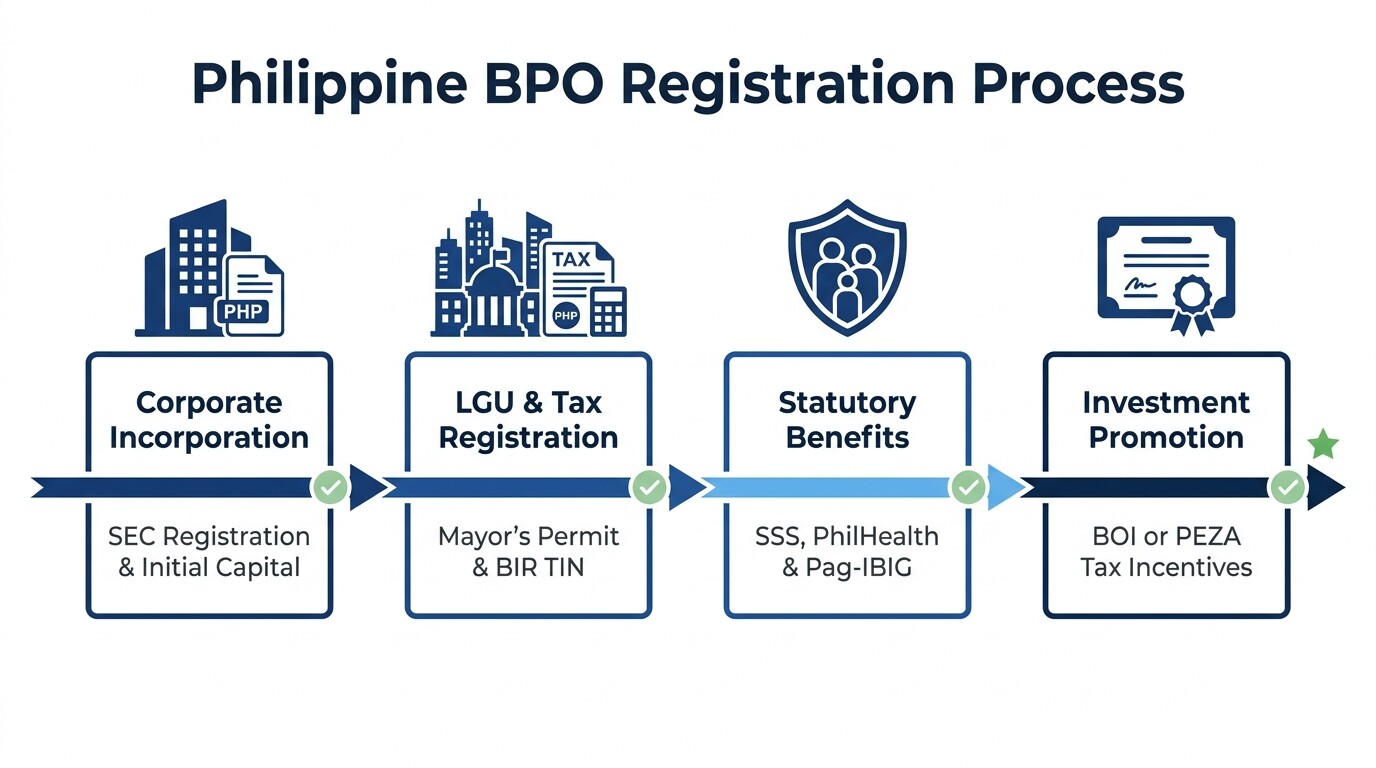
Establishing a Business Process Outsourcing (BPO) company requires registering with multiple national and local government agencies. Following the exact sequence prevents application rejections and launch delays.
Phase 1: Corporate Incorporation
- Reserve and register the corporate name with the Securities and Exchange Commission (SEC).
- Draft and notarize the Articles of Incorporation and By-laws.
- Open a corporate bank account and secure a Certificate of Inward Remittance for initial capital.
- File all documents with the SEC to receive the Certificate of Incorporation.
Phase 2: Local Government and Tax Registration
- Obtain a Barangay Clearance in the municipality where the principal office is located.
- Apply for the Mayor's Permit from the Local Government Unit.
- Register with the Bureau of Internal Revenue (BIR) to secure a Tax Identification Number (TIN), print receipts, and register books of accounts.
Phase 3: Statutory Benefits Enrollment
- Register as an employer with the Social Security System (SSS).
- Enroll with the Philippine Health Insurance Corporation (PhilHealth).
- Register with the Home Development Mutual Fund (Pag-IBIG).
Phase 4: Investment Promotion Agency Registration
- Submit financial projections and business plans to either the BOI or PEZA for tax incentive approval.
- Secure the Certificate of Registration from the chosen agency.
PEZA vs. BOI Registration and Tax Incentives
The Philippine Economic Zone Authority (PEZA) and the Board of Investments (BOI) are the primary agencies granting tax holidays and incentives to BPO operators under the Corporate Recovery and Tax Incentives for Enterprises (CREATE) Act.
Many BPOs have moved their registration from PEZA to BOI to accommodate remote work. BOI allows 100% work-from-home (WFH) arrangements without forfeiting tax incentives. PEZA requires companies to operate inside designated IT parks or economic zones, making it better suited for traditional facility-based operations.
| Feature | PEZA Registration | BOI Registration |
|---|---|---|
| Location | Must be within a PEZA-accredited IT Park or Ecozone | Can locate anywhere in the Philippines |
| Remote Work | Restricted and subject to percentage caps | Up to 100% WFH allowed without losing incentives |
| Income Tax Holiday | 4 to 7 years, then 5% tax on Gross Income | 4 to 7 years, followed by enhanced deductions |
| Customs Duties | Tax and duty-free importation of equipment | Duty exemption on capital equipment under specific conditions |
Minimum Capital Documentation
Foreign-owned BPO operators are legally classified as export enterprises because they export at least 60% of their services to foreign clients. This classification exempts them from the standard USD 200,000 minimum paid-in capital requirement for domestic market enterprises.
Foreign entities must submit SEC Form F-100 (Application to Do Business in the Philippines) and a notarized Treasurer's Affidavit during registration to prove this exemption. The company must also provide a Certificate of Inward Remittance from a local commercial bank confirming the initial capital deposit. This deposit can be as low as the bank's minimum opening balance, typically between PHP 5,000 and PHP 50,000.
Subsidiary Board and Officer Requirements
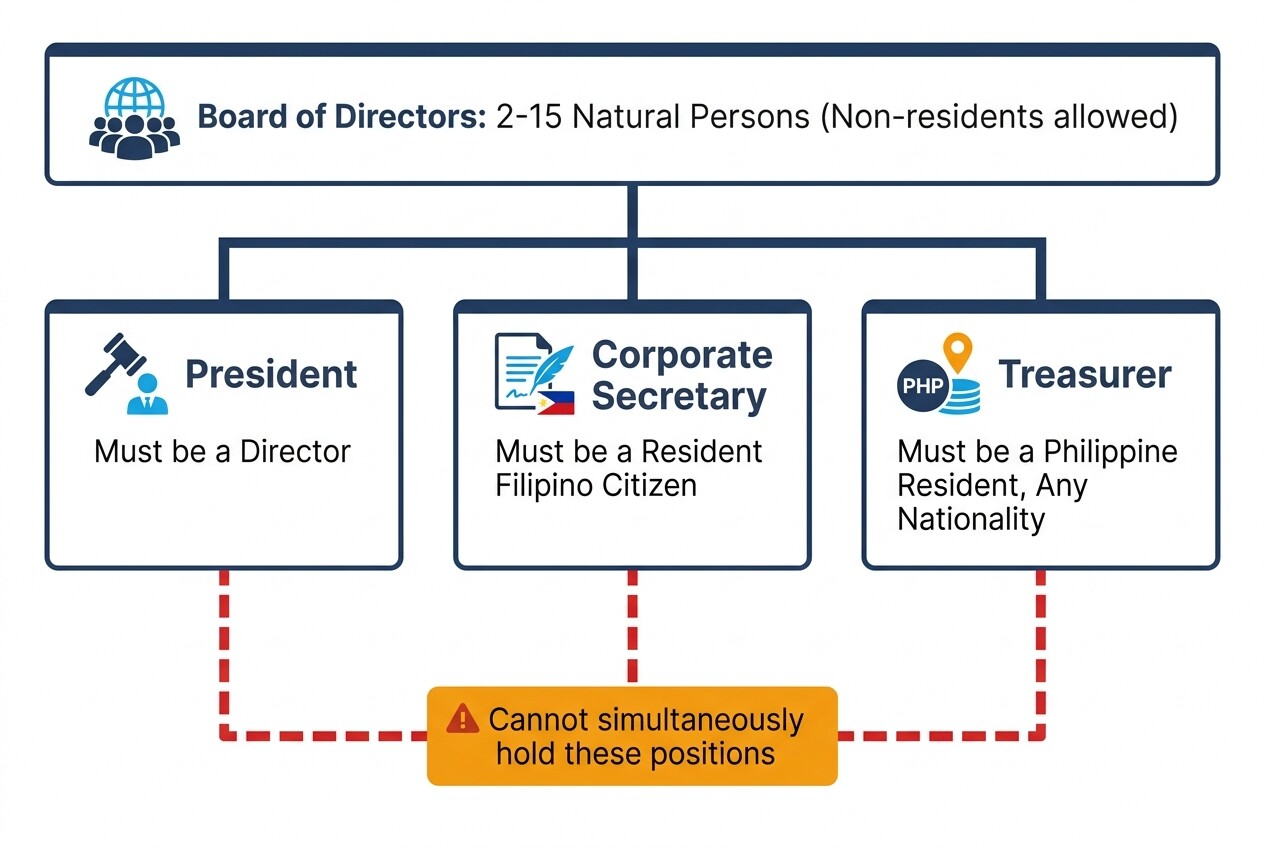
The Revised Corporation Code of the Philippines requires a domestic subsidiary to have between two and fifteen directors, and all directors must be natural persons. While the law no longer requires directors to be residents of the Philippines, the executive officers appointed by the board must meet specific residency and citizenship rules.
Foreign BPOs must appoint a Corporate Secretary who is a natural-born or naturalized Filipino citizen residing in the Philippines. The company must also appoint a Treasurer who is a resident of the Philippines, though they do not need to be a citizen. The President must be a director and cannot simultaneously hold the position of Corporate Secretary or Treasurer.
Employment Contracts and Remote Work
Philippine labor laws apply universally to all employees working within the country. Remote and hybrid workers retain the exact same labor rights and protections as office-based employees under the Department of Labor and Employment (DOLE) guidelines.
Compliant BPO employment contracts must explicitly define the working arrangement and compensation rules. Required provisions include:
- Night shift differential: A mandatory 10% additional compensation for work between 10:00 PM and 6:00 AM.
- 13th-month pay: An annual bonus equivalent to one-twelfth of the employee's basic salary earned during the year, paid by December 24.
- Holiday pay: Regular holidays pay 200% if worked, while special non-working days pay 130%.
- Data privacy rules: Clauses binding remote workers to the Data Privacy Act of 2012 and detailing home network security requirements.
ADR Clauses in Local Vendor Agreements
Including an Alternative Dispute Resolution (ADR) clause in local vendor agreements helps foreign BPOs avoid the congested Philippine court system. Arbitration in the Philippines is governed by the Alternative Dispute Resolution Act of 2004. Standard clauses should specify the Philippine Dispute Resolution Center, Inc. (PDRCI) to ensure private conflict resolution.
Sample Arbitration Clause for Vendor Agreements
Any dispute, controversy, or claim arising out of or relating to this Agreement, or the breach, termination, or invalidity thereof, shall be settled by arbitration in the Philippines in accordance with the Arbitration Rules of the Philippine Dispute Resolution Center, Inc. (PDRCI) in force at the time of the commencement of the arbitration. The number of arbitrators shall be one (1). The place of arbitration shall be Makati City, Philippines. The language to be used in the arbitral proceedings shall be English.
Common Misconceptions
- BPOs require 60% Filipino ownership: Because BPOs export their services, the Foreign Investments Act allows them to be 100% foreign-owned. The 60/40 rule applies only to specific nationalized industries like public utilities and land ownership.
- Remote workers are independent contractors: Foreign companies often try to classify remote agents as contractors to bypass labor laws. Under Philippine law, the "Four-Fold Test" (which measures the employer's degree of control) classifies most BPO agents as regular employees entitled to statutory benefits.
- Tax holidays are automatic: Incorporating a BPO does not automatically grant tax incentives. Companies must formally apply and secure approval from PEZA or BOI to receive an Income Tax Holiday.
Structural and Timeline Considerations
Registration Timeline
The process from SEC name reservation to securing local permits and BIR registration takes 8 to 12 weeks. Registering with BOI or PEZA adds another 4 to 8 weeks to the launch schedule.
One Person Corporations (OPC)
Under the Revised Corporation Code, a foreign natural person, trust, or estate can establish a One Person Corporation (OPC). Foreign corporations cannot set up an OPC and must register as a domestic subsidiary or branch office.
Branch Office vs. Domestic Subsidiary
A branch office is a direct extension of the foreign parent company, leaving the parent company legally liable for Philippine operations. A domestic subsidiary is a separate legal entity that shields the foreign parent company from direct legal and financial liability in the Philippines.
Legal Counsel
Foreign entities should retain local corporate counsel before signing commercial leases or transferring capital into the country. A lawyer is necessary to draft incorporation documents and execute the Treasurer's Affidavit. They also manage the approval tracks for BOI or PEZA tax incentives. Labor counsel should review employment templates to ensure DOLE compliance and prevent labor disputes over night shift and holiday pay.
Next Steps
- Determine whether your operational model requires a physical office in an IT Park (favoring PEZA) or a distributed remote workforce (favoring BOI).
- Gather passport copies and initial financial projections. You will also need board resolutions from the parent company authorizing the Philippine expansion.
- Consult with business registration lawyers in the Philippines to draft your Articles of Incorporation and begin the SEC name reservation process.