Managing Labor Inspections for BPO Companies in the Philippines
- The Department of Labor and Employment (DOLE) conducts unannounced inspections to verify compliance with General Labor Standards and Occupational Safety and Health standards.
- BPO companies must maintain meticulous payroll records covering the past three years to prove payment of night shift differentials and overtime premiums.
- Mandatory health facilities, including designated clinics and certified safety officers, are non-negotiable requirements for call centers operating round the clock.
- Misclassifying regular workers as independent contractors or probationary employees can result in severe penalties under Philippine regularization laws.
- Routine internal audits and organized documentation are the most effective defenses against adverse findings during a DOLE visitorial audit.
What are Common Issues in DOLE Visitorial and Enforcement Power Audits?
The Department of Labor and Employment exercises visitorial and enforcement powers under Article 128 of the Labor Code to ensure employers adhere strictly to labor laws. Common audit issues for BPO companies include the miscalculation of holiday pay, failure to remit statutory benefits, and improper classification of probationary employees.
DOLE conducts two primary types of assessments: routine inspections to check general compliance and complaint-driven inspections triggered by employee grievances. During these audits, inspectors focus heavily on whether the company accurately tracks employee hours and correctly pays mandatory wage premiums. BPO companies frequently face citations for failing to properly document the exact hours worked by agents during night shifts or special holidays. Another recurring issue is the lack of proper anti-sexual harassment policies and mental health workplace programs, which are strictly required in high-stress call center environments.
DOLE Labor Inspection Preparation Checklist
Preparing for a DOLE inspection requires organizing employment records, payroll documents, and safety protocols well in advance. Use this checklist to conduct a self-audit and ensure your BPO facility meets all minimum statutory requirements before an inspector arrives.
General Labor Standards (GLS) Requirements:
- Business Permit and Securities and Exchange Commission (SEC) Registration
- Payroll records and daily time records (DTR) for the past three years
- Proof of payment for the 13th-month pay
- Proof of remittance for SSS, PhilHealth, and Pag-IBIG contributions
- Copies of employment contracts showing clear terms of engagement
- Approved policy on anti-sexual harassment and the corresponding committee
Occupational Safety and Health (OSH) Requirements:
- Certificate of DOLE-approved OSH training for designated Safety Officers
- Proof of a functional workplace clinic with required medical staff
- Documentation of a drug-free workplace policy and tuberculosis prevention program
- Fire safety inspection certificate and emergency evacuation plans
- Reports of health and safety committee meetings
How Must BPOs Comply with Night Shift Differential and Overtime Pay?
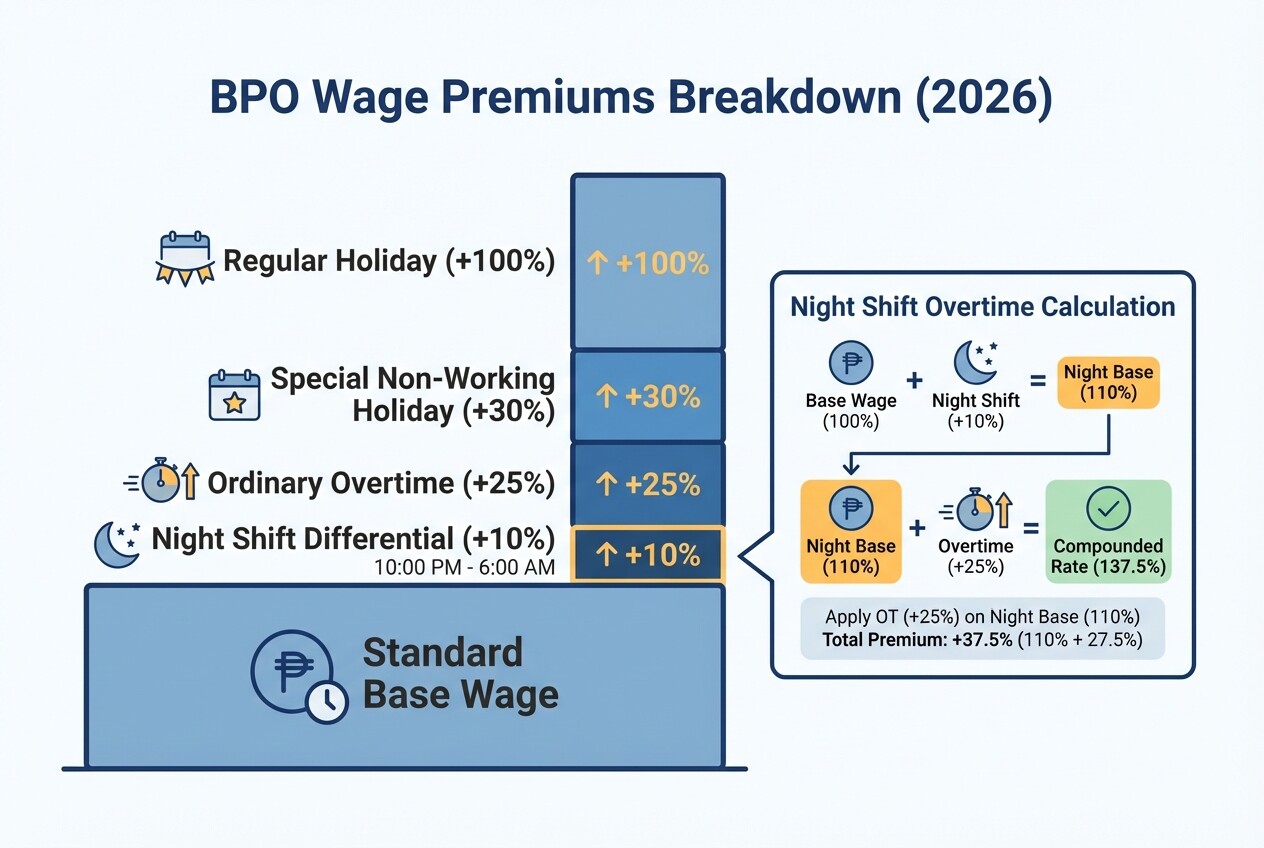
BPO companies must pay a night shift differential of not less than 10% of the employee's regular wage for each hour worked between 10:00 PM and 6:00 AM. Overtime pay requires an additional 25% premium on ordinary days and higher percentage rates during rest days or statutory holidays.
Because call centers typically operate on 24-hour global schedules, accurate timekeeping systems are essential to calculate these compounded rates legally. If an employee works overtime during a night shift on a regular day, the 10% night shift differential must be applied first, followed by the 25% overtime premium. Work performed on a special non-working holiday demands a 30% premium, while work on a regular holiday requires a 100% premium. DOLE inspectors will manually review daily time records against payroll slips to ensure these exact mathematical formulas are applied without deduction or delay.
What are the Occupational Safety and Health Standards for Call Centers?
Republic Act No. 11058 mandates strict Occupational Safety and Health standards to protect workers from physical and mental health risks. Call centers must provide designated medical clinics, certified safety officers, and specific ergonomic programs to prevent occupational hazards.
Under the Occupational Safety and Health Standards Act, the requirements scale based on the total number of employees in a single physical location. A BPO facility with more than 50 employees must have a registered nurse, while facilities exceeding 200 employees must retain a workplace physician and a dentist. Furthermore, DOLE heavily scrutinizes BPOs for specialized policies addressing the unique strains of the industry. This includes mandatory programs for mental health awareness, HIV/AIDS education, and ergonomic workplace assessments to prevent musculoskeletal disorders associated with prolonged computer use.
How Do Security of Tenure and Contractualization Rules Apply?
Philippine law guarantees security of tenure, meaning regular employees cannot be dismissed without just or authorized cause and procedural due process. BPOs must strictly avoid labor-only contracting and ensure project-based or probationary employment does not illegally bypass regular employment rights.
The maximum probationary period allowed by law is six months. If an agent is allowed to work beyond this period, they automatically attain regular employee status by operation of law. BPO operators must also be cautious when utilizing third-party agencies for janitorial, security, or IT services. The third-party agency must have substantial capital or investment, and the BPO must not exercise direct control over the means and methods of the agency's workers. Failing this "four-fold test" of employment results in a finding of illegal labor-only contracting, making the BPO directly liable as the principal employer.
What Documentation is Needed for a Labor Law Compliance Certificate?
Securing a Labor Law Compliance Certificate requires presenting comprehensive corporate, payroll, and safety records to the DOLE labor inspector. Missing or incomplete documentation is the most frequent reason BPO companies fail their initial audits.
When a DOLE inspector issues a Notice of Inspection, the HR and payroll departments must immediately consolidate specific files. Inspectors require hard copies or accessible digital records of employment contracts, company policies, and proof of statutory benefit remittances. If a company uses a third-party payroll provider, the BPO remains legally responsible for presenting these documents during the audit. Failing to produce these records on the day of the inspection generally results in a Notice of Results detailing compliance deficiencies, requiring the company to submit the missing proof within a strict correction period.
Common Misconceptions About DOLE Inspections
Many BPO operators misunderstand the scope and triggers of DOLE inspections, leading to poor preparation and compliance failures. Clearing up these regulatory myths helps companies avoid unexpected penalties and operational disruptions.
- "DOLE only inspects if an employee files a complaint." This is entirely false. DOLE actively conducts routine, unannounced inspections across high-density industries like the BPO sector to ensure proactive compliance.
- "Paying above minimum wage exempts you from inspections." While BPOs generally pay well above the statutory minimum wage, DOLE still audits for correct overtime calculations, night differentials, and strict adherence to health and safety standards.
- "Inspectors must provide advance notice." The visitorial power granted by the Labor Code allows DOLE inspectors to enter work premises during regular operating hours without prior warning to review employment records and interview staff.
Frequently Asked Questions
Can DOLE inspectors shut down a BPO operation?
Yes, DOLE holds the authority to issue a Work Stoppage Order if an inspector discovers an imminent danger to the health and safety of the workers. This usually involves severe structural hazards, fire code violations, or complete absence of mandatory medical protocols.
How far back can DOLE audit payroll records?
Labor inspectors typically audit payroll records, daily time records, and proof of remittances for the past three years. Employers are legally required to preserve all employment records for at least three years from the date of the last entry.
What happens if a BPO fails a DOLE inspection?
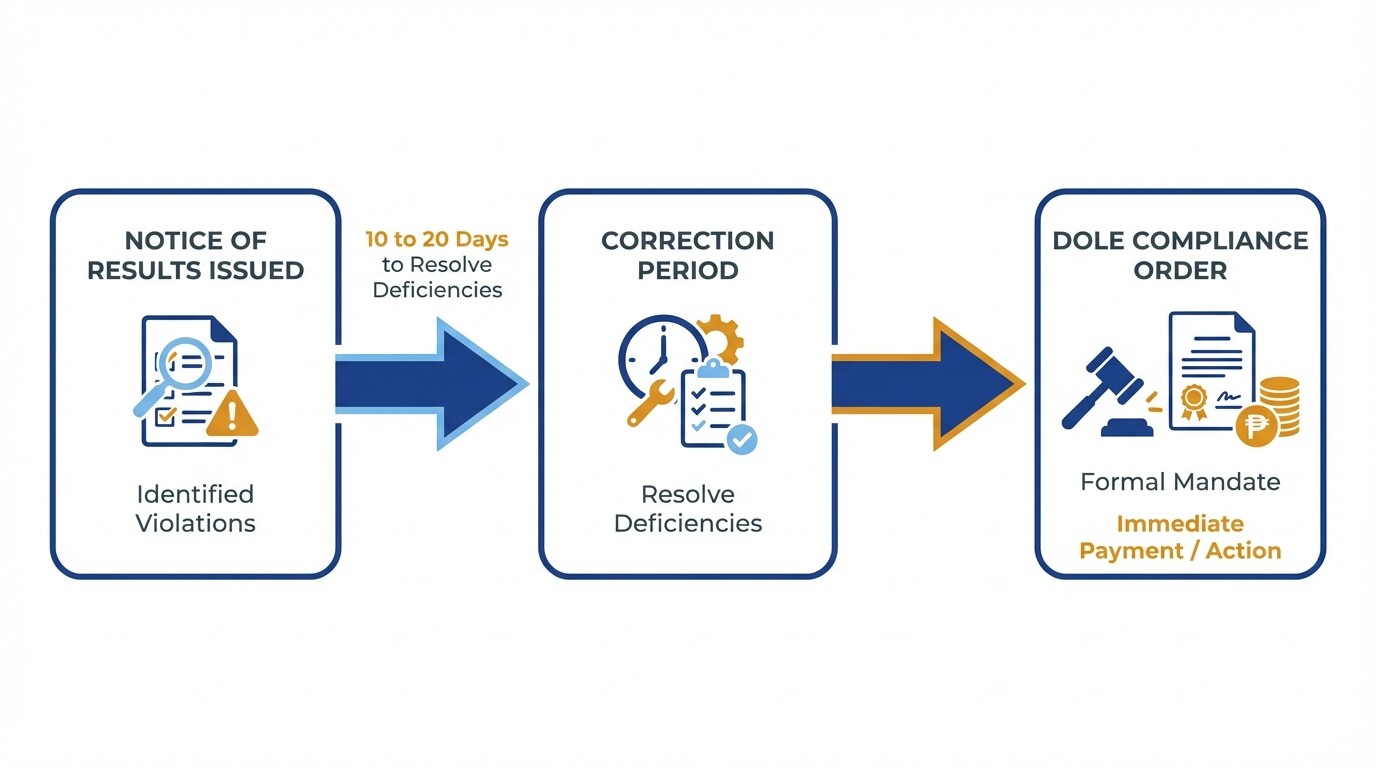
The inspector will issue a Notice of Results listing all identified violations. The company is given a specific period, usually 10 to 20 days, to correct the deficiencies, after which DOLE may issue a formal Compliance Order requiring immediate payment of liabilities or implementation of safety measures.
When to Hire a Lawyer
Engaging legal counsel is crucial when you receive a Notice of Results detailing severe compliance violations or when facing complex illegal dismissal claims. A labor lawyer can negotiate compliance schedules, appeal adverse compliance orders, and restructure your contracting agreements to align with current jurisprudence. If your company is struggling to interpret complex DOLE department orders or needs to defend against claims of illegal contractualization, consulting with experienced business lawyers in the Philippines ensures your corporate interests remain protected.
Next Steps for BPO Companies
Proactive compliance is the most cost-effective way to manage Philippine labor regulations. BPO management should regularly audit their own practices rather than waiting for a DOLE inspector to arrive. Start by forming an internal compliance committee composed of HR, payroll, and legal personnel to review current employment contracts and timekeeping systems. Next, verify that your safety officers possess updated DOLE certifications and that your workplace clinic meets the required medical staffing ratios. Finally, schedule quarterly mock audits to ensure all mandatory documentation is organized and instantly accessible for future state inspections.