Setting Up a Foreign-Owned Domestic Corporation in the Philippines
Key Takeaways
Foreign investors can successfully incorporate and operate within the Philippine market by following highly structured national and local regulations. Successfully establishing your business requires understanding foreign ownership limits, meeting specific capital requirements, and navigating multiple government agencies.
- The Foreign Investment Negative List determines the maximum allowable foreign ownership percentage for your specific industry.
- Domestic market enterprises generally require a minimum paid-in capital of USD 200,000, though exceptions exist for export-oriented businesses.
- Company registration is a sequential process starting with the Securities and Exchange Commission, followed by local government units, and concluding with national tax authorities.
- The Revised Corporation Code allows foreign investors to form a corporation with as few as two incorporators, or even register a One Person Corporation.
Step-by-Step Incorporation Checklist for Foreign Investors
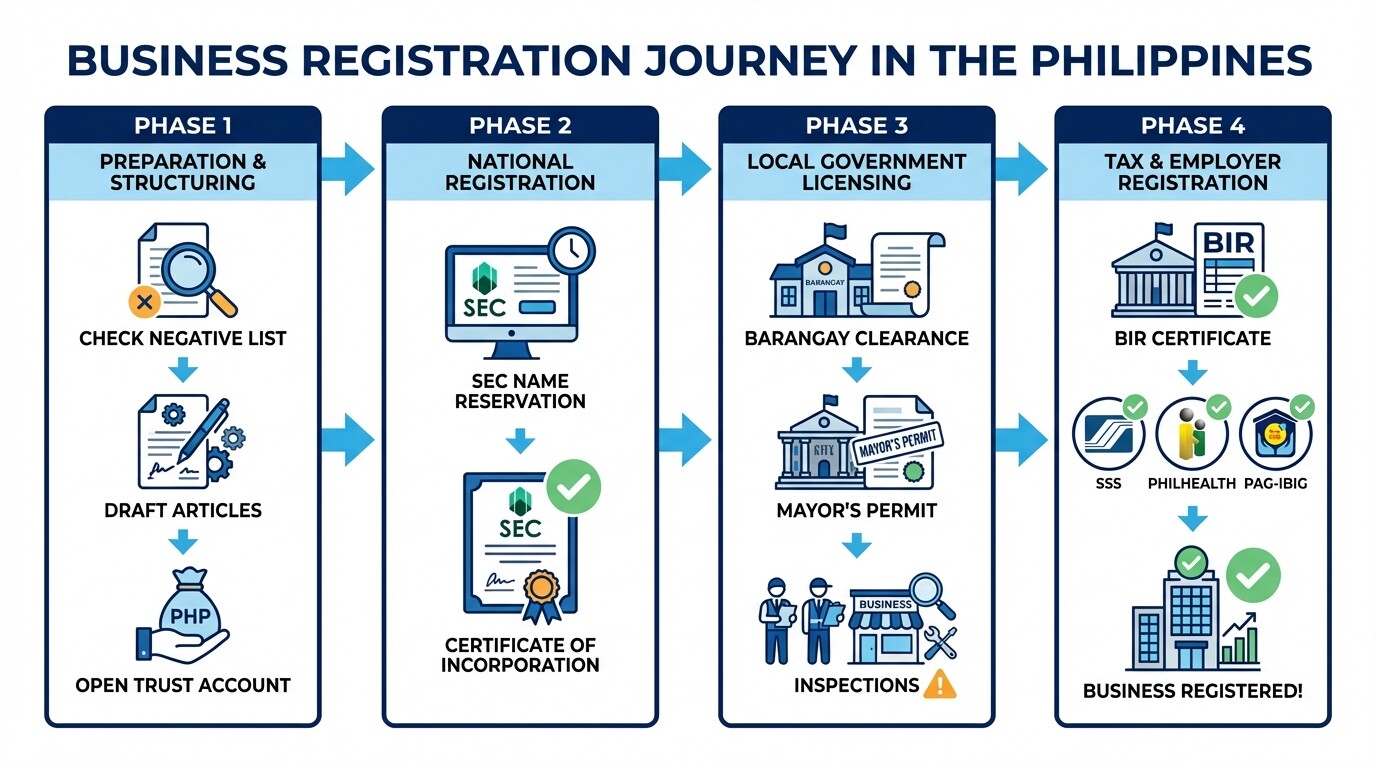
Setting up a domestic corporation in the Philippines takes roughly four to eight weeks, depending on document readiness and capital remittance. Following this structured checklist ensures compliance with national and local government requirements without unnecessary delays.
Phase 1: Preparation and Structuring
- Verify your proposed business activity against the Foreign Investment Negative List.
- Determine your required minimum paid-in capital based on your target market (domestic vs. export).
- Draft your Articles of Incorporation and Corporate By-laws.
- Open a Treasurer-in-Trust account with a local Philippine bank to hold your initial capital deposit.
Phase 2: National Registration
- Reserve your corporate name through the Securities and Exchange Commission portal.
- Submit notarized incorporation documents and proof of inward remittance.
- Secure your Certificate of Incorporation from the SEC.
Phase 3: Local Government Licensing
- Obtain a Barangay Clearance from the local district of your registered office.
- Apply for a Mayor's Permit (Business Permit) at the local City or Municipal Hall.
- Pass local zoning, sanitary, and fire safety inspections.
Phase 4: Tax and Employer Registration
- Register with the Bureau of Internal Revenue to obtain a Certificate of Registration (BIR Form 2303).
- Register your official books of accounts and apply for the Authority to Print official receipts.
- Enroll your corporation as an employer with the Social Security System, PhilHealth, and Pag-IBIG Fund.
Navigating the Foreign Investment Negative List
The Foreign Investment Negative List is a government mandate dictating which economic sectors restrict foreign equity and participation. Foreign investors must consult this list before incorporating to determine if they can own 100% of their business or if they are capped at a minority stake.
The list is regularly updated and divided into two main categories. List A covers areas reserved for Filipinos by mandate of the Constitution and specific laws, such as mass media, retail trade below certain capital thresholds, and land ownership. List B restricts foreign ownership in businesses related to defense, law enforcement, and activities that pose risks to public health and morals. If your business activity does not fall under either list, it is generally open to 100% foreign ownership, provided you meet the capital requirements.
What Are the Minimum Paid-In Capital Requirements for Foreigners?
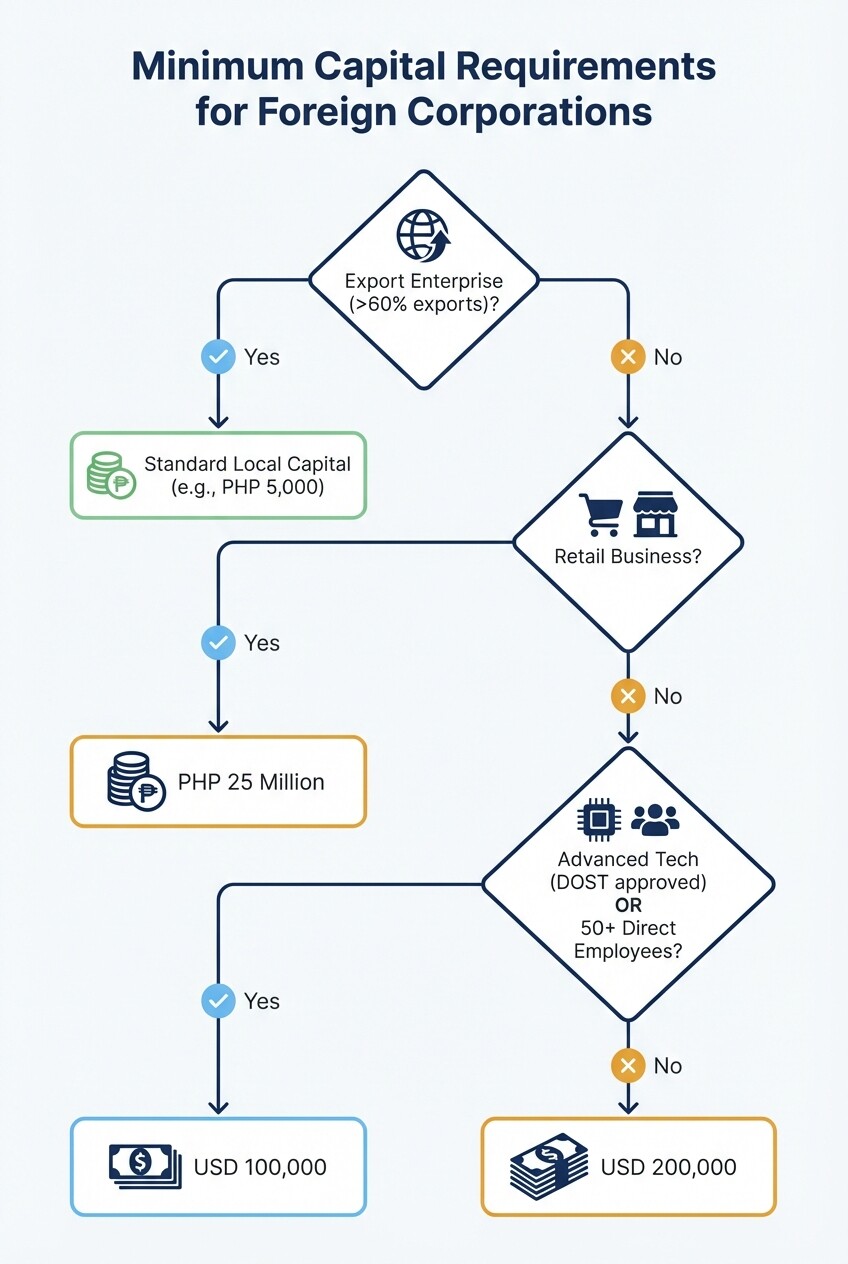
Foreign-owned domestic corporations targeting the local market must generally inject a minimum paid-in capital of USD 200,000. However, this requirement drops to USD 100,000 if the business involves advanced technology recognized by the Department of Science and Technology, or if it directly employs at least 50 direct employees.
Capital requirements shift dramatically based on your business model. If your corporation is classified as an Export Enterprise, meaning it exports at least 60% of its goods or services, the business is exempt from the USD 200,000 requirement. In these export-oriented cases, the minimum paid-in capital defaults to the standard local requirement, which can be as low as PHP 5,000. Retail businesses face different thresholds governed by the Retail Trade Liberalization Act, currently requiring a minimum paid-up capital of PHP 25 million for foreign operators.
SEC Registration and Articles of Incorporation
The Securities and Exchange Commission is the primary registry and regulatory agency for all corporations in the Philippines. Investors must submit their Articles of Incorporation, By-laws, and proof of capital remittance to secure a Certificate of Incorporation.
Your Articles of Incorporation serve as the charter of your company, detailing the primary purpose, principal office address, capital structure, and the names of the incorporators and directors. Under the Revised Corporation Code, you no longer need five incorporators; you can incorporate with two to fifteen individuals, or establish a One Person Corporation. Once the SEC reviews and approves your documentary submissions and name reservation, they issue the Certificate of Incorporation, which officially grants your business its juridical personality.
Obtaining the Mayor's Permit and Barangay Clearance
Local government units require businesses to secure local operating licenses before commencing commercial activities. You must first obtain a Barangay Clearance from the local district, followed by a Mayor's Permit from the city or municipality where your main office is physically located.
The Barangay Clearance is a prerequisite certificate confirming that your business complies with the immediate community's standards. After securing this, you submit it alongside your SEC Certificate and commercial lease contract to the municipal Business Permit and Licensing Office. The local government will dispatch inspectors to ensure your office space complies with local zoning ordinances, fire safety codes, and sanitary standards before issuing the final Mayor's Permit.
Tax Registration (BIR) and Social Security Compliance
Corporate taxpayers must register with the Bureau of Internal Revenue to obtain a Certificate of Registration and legal authority to print official receipts. Additionally, corporations must immediately register as employers with three mandatory Philippine social agencies to remit employee benefits.
Tax registration requires submitting BIR Form 1903 alongside your SEC Certificate and Mayor's Permit. During this stage, you will pay the necessary Documentary Stamp Tax on your initial capital and register your official books of accounts. Simultaneously, you must register the corporation with the Social Security System for pensions, PhilHealth for medical insurance, and the Pag-IBIG Fund for housing benefits. Failing to register with these statutory agencies before hiring employees violates Philippine labor laws and carries heavy financial penalties.
Common Misconceptions About Foreign Business Ownership
Many international investors make costly assumptions about Philippine corporate law due to outdated information or misinterpretation of regional standards. Correcting these misconceptions early prevents regulatory delays, structural rework, and legal penalties.
- Foreigners cannot own 100% of a Philippine business. This is entirely false. Foreigners can fully own domestic corporations provided the business activity is not restricted by the Foreign Investment Negative List and the company meets the required minimum capitalizations.
- A corporation must have a Filipino President. The President of a foreign-owned corporation can be a foreign national, provided the industry allows foreign ownership. However, the Corporate Secretary must be a Filipino citizen and a resident of the Philippines.
- Incorporating a company grants land ownership rights. Foreign-owned corporations cannot own land in the Philippines, even if they are legally registered to do business. Companies must be at least 60% Filipino-owned to acquire land, so foreign investors typically rely on long-term commercial leases.
Frequently Asked Questions
Can a foreign national be the Corporate Secretary or Treasurer?
A foreign national cannot act as the Corporate Secretary, as Philippine law mandates this role be held by a resident Filipino citizen. A foreigner may serve as the Corporate Treasurer, provided the corporation's industry is open to foreign ownership and the individual possesses a valid working visa.
What is the difference between a Branch Office and a Domestic Corporation?
A Domestic Corporation is a distinct legal entity incorporated under Philippine laws, shielding the foreign parent company from local liabilities. A Branch Office is merely an extension of the foreign parent company, meaning the parent company's global assets are legally exposed to liabilities incurred by the Philippine branch.
Can I operate my business using a virtual office address?
The SEC and the BIR require corporations to have a legitimate physical address for localized tax mapping and serving official legal notices. While virtual offices can sometimes be used for initial SEC registration, local government units generally require a physical commercial lease contract to issue a Mayor's Permit.
Do I need to physically travel to the Philippines to register the company?
You do not need to be physically present in the Philippines to incorporate the business. You can appoint a local legal representative via a notarized and authenticated Special Power of Attorney to process the registrations and open the initial bank accounts on your behalf.
When to Hire a Business Registration Lawyer
Engaging local legal counsel is highly recommended when navigating complex foreign ownership rules and strict local bureaucracies. A lawyer ensures your corporate structure complies with the latest Foreign Investment Act amendments, preventing expensive capitalization errors.
Legal professionals handle the drafting of specialized Articles of Incorporation, manage interactions with government examiners, and ensure your initial corporate compliance is flawless. If you are ready to structure your investment, consult experienced business registration lawyers in the Philippines to safeguard your capital and streamline your market entry.
Next Steps
- Outline your specific business activities and confirm your maximum allowable foreign equity under the Foreign Investment Negative List.
- Determine your target market to finalize your paid-in capital requirements and prepare your funds for inward remittance.
- Secure a physical commercial office space in the Philippines, ensuring the landlord can provide the necessary documents for local permits.
- Hire a local corporate lawyer to draft your incorporation documents and act as your legal representative before the SEC and local authorities.