- Victims of medical negligence in the Philippines generally have four years from the date of the incident or discovery to file a civil lawsuit for damages.
- You must prove four specific legal elements-duty, breach, injury, and proximate causation-to win a medical malpractice case.
- Expert medical testimony is almost always mandatory in Philippine courts to establish the standard of care and prove that a doctor deviated from it.
- Mediation through the Philippine Mediation Center (PMC) is a required step before a case can proceed to a full trial.
- Compensation can include actual damages (medical bills), moral damages (emotional suffering), and exemplary damages (to set a public example).
Medical Malpractice Filing Checklist
To file a successful medical malpractice claim in the Philippines, you must systematically gather evidence and follow specific procedural steps. Use this checklist to ensure your case is prepared for the scrutiny of the Regional Trial Court.
- Request Complete Medical Records: Secure certified true copies of all charts, lab results, surgical notes, and discharge summaries from the hospital. Under Philippine law, patients have a right to their medical records.
- Secure a Second Opinion: Consult a different specialist in the same field to review your records and provide a written assessment of whether the previous treatment met the standard of care.
- Document the Timeline: Create a detailed log of events, including dates of consultations, names of attending nurses or staff, and when specific symptoms or complications began.
- Preserve Physical Evidence: Keep any faulty medical devices, prescriptions, or external photographs of injuries or surgical sites.
- Compile Financial Records: Gather all receipts for hospital bills, additional medications, lost wages, and transportation costs related to the injury.
- Identify Potential Expert Witnesses: Note which doctors are willing to testify in court, as a case cannot move forward without a medical expert to validate your claims.
- File a Formal Complaint: Work with an attorney to draft and file a "Complaint for Damages based on Quasi-Delict" or "Criminal Negligence" with the appropriate court.
What are the elements of medical malpractice in the Philippines?
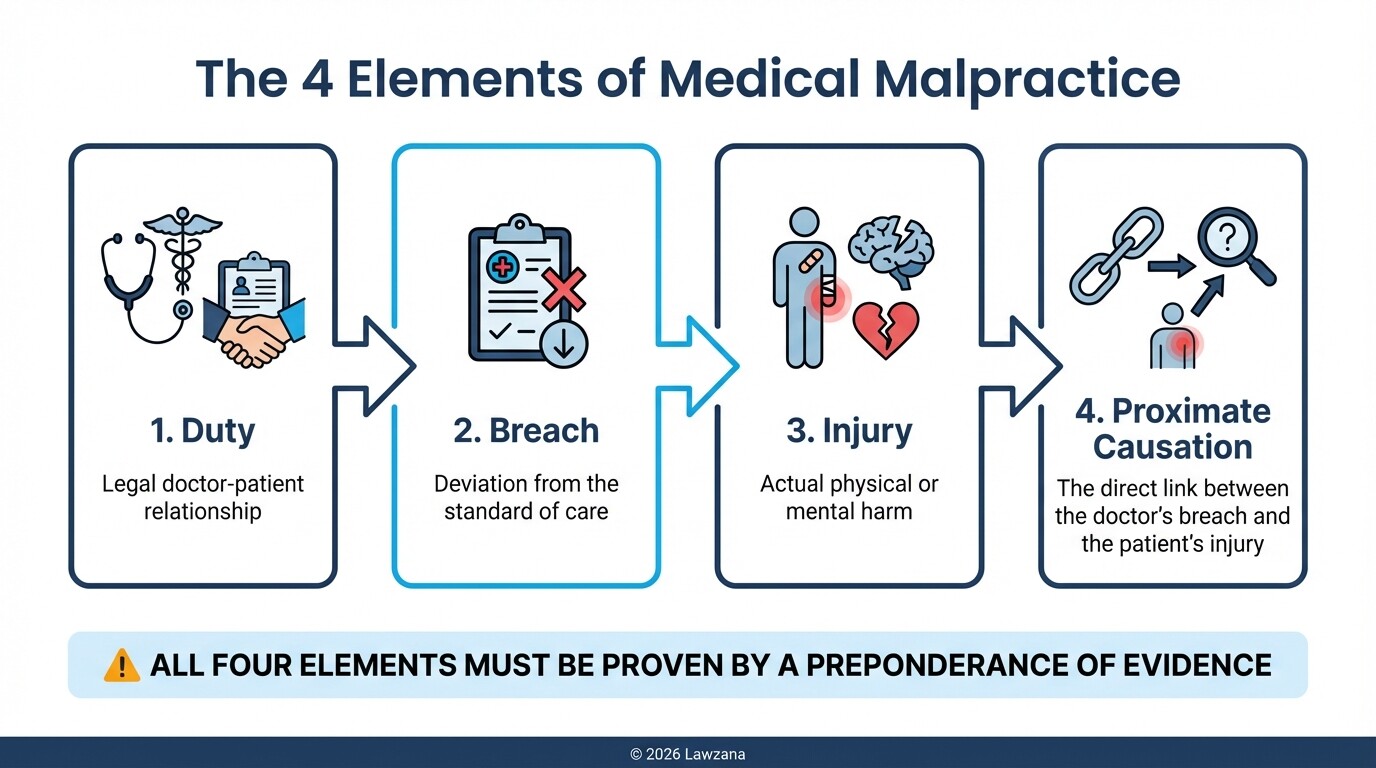
To prevail in a medical malpractice lawsuit, the plaintiff must prove four distinct elements by a preponderance of evidence. These elements demonstrate that a professional relationship existed and that the healthcare provider's failure directly caused the patient's harm.
- Duty: You must show that a physician-patient relationship existed. Once a doctor agrees to treat you, they owe you a legal duty to provide care that meets the established professional standards of their specialty.
- Breach: You must prove the doctor failed to act as a reasonably prudent physician would have under similar circumstances. This "breach of duty" happens when the doctor deviates from the accepted "standard of care."
- Injury: There must be a compensable injury. If a doctor makes a mistake but the patient suffers no actual physical or psychological harm, there is no basis for a lawsuit.
- Proximate Causation: You must prove that the doctor's breach of duty was the direct and primary cause of your injury. If your condition worsened due to an underlying illness rather than the doctor's actions, the element of causation is not met.
Why is expert medical testimony essential?
Philippine courts generally follow the "Doctrine of Informed Expert Testimony," which means judges lack the technical expertise to determine if a medical procedure was performed correctly. An expert witness is a licensed physician who explains the standard of care to the court and clarifies how the defendant failed to meet it.
Without an expert witness, a medical malpractice case will likely be dismissed via a "demurrer to evidence." The only exception is the doctrine of Res Ipsa Loquitur ("the thing speaks for itself"), which applies when the negligence is so obvious that a layperson can understand it-such as a surgeon leaving a pair of scissors inside a patient's abdomen. In almost all other cases involving complex diagnoses or surgical techniques, you must hire an independent specialist to testify on your behalf.
How long do you have to file a medical malpractice claim?
In the Philippines, the statute of limitations for filing a civil medical malpractice suit based on "quasi-delict" is four years. This timeline generally begins from the day the negligent act occurred or from the moment the patient could have reasonably discovered the injury.
If you are filing a criminal case for "Reckless Imprudence Resulting in Physical Injuries" under the Revised Penal Code, the prescriptive period varies based on the severity of the injury. For serious physical injuries, the limit is typically 10 years, while less serious injuries may prescribe in a much shorter timeframe. Failing to file within these legal deadlines results in the permanent loss of your right to seek justice in court.
Comparing Mediation and Trial Litigation
The Philippine judicial system mandates alternative dispute resolution (ADR) to reduce court congestion. Most medical malpractice cases undergo a period of mediation before they are allowed to reach the trial stage.
| Feature | Mediation (Settlement) | Trial Litigation |
|---|---|---|
| Duration | 30 to 60 days | 3 to 7 years (or more) |
| Control | Parties decide the outcome together | A Judge makes the final decision |
| Confidentiality | Private and confidential | Public record |
| Cost | Relatively low (mediation fees) | High (legal fees, expert fees, court costs) |
| Outcome | Compromise agreement/Settlement | Judgment (Win or Lose) |
If mediation fails at the Philippine Mediation Center, the case returns to the court for a "Judicial Dispute Resolution" (JDR) conducted by a different judge. If that also fails, the case proceeds to a full-blown trial where evidence is presented and witnesses are cross-examined.
How are damages calculated in Philippine courts?
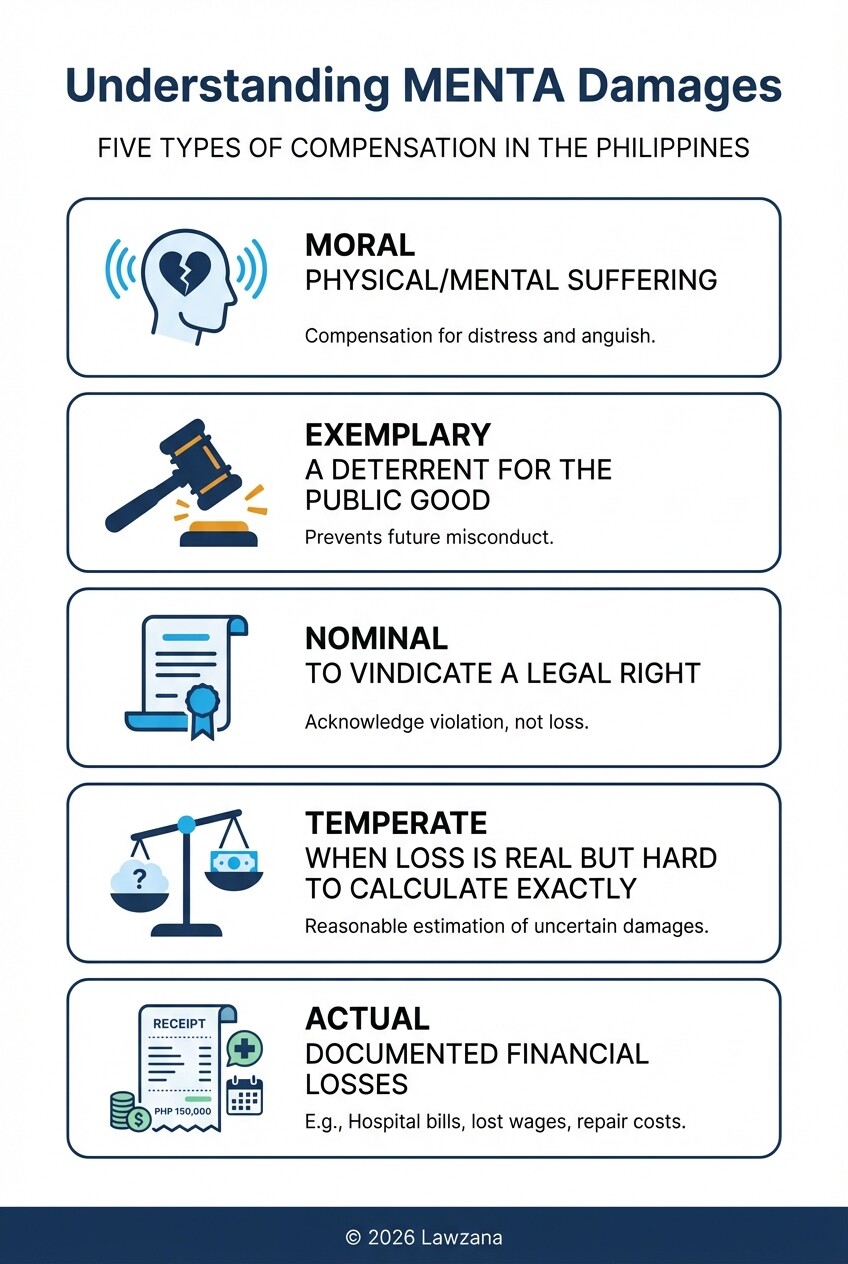
Damages in the Philippines are not meant to make a victim rich, but rather to "make the victim whole" and penalize gross negligence. The court categorizes damages into several types, often referred to by the acronym MENTA (Moral, Exemplary, Nominal, Temperate, and Actual).
- Actual or Compensatory Damages: These cover documented financial losses. This includes hospital bills, the cost of future rehabilitation, and "lucrum cessans" (unearned income) if the injury prevents you from working.
- Moral Damages: These are awarded for physical suffering, mental anguish, and fright. In the Philippines, you must prove that the doctor acted with "bad faith" or gross negligence to receive a high award for moral damages.
- Exemplary or Corrective Damages: These are intended to serve as a deterrent to the public good. They are usually only awarded if the doctor acted in a "wanton, fraudulent, or oppressive manner."
- Attorney's Fees: If you win, the court may order the defendant to pay a portion of your legal expenses, though this is at the judge's discretion.
Common Misconceptions about Medical Malpractice
"A bad medical outcome is always malpractice." In the Philippines, medicine is not an exact science. A doctor does not guarantee a cure; they only guarantee that they will exercise the standard of care expected of their profession. If a patient dies or remains ill despite the doctor following all correct protocols, it is not malpractice.
"I can sue the hospital for everything the doctor did." Philippine courts often apply the "Independent Contractor" rule. Many doctors are not employees of the hospital but are "consultants" with admitting privileges. Unless the hospital had direct control over the doctor's actions or the doctor is a regular employee (like a resident or nurse), the hospital might not be legally liable for the doctor's specific mistakes.
"The doctor will lose their license immediately if I sue." A civil lawsuit for damages is separate from an administrative case. To have a doctor's license revoked, you must file a separate complaint with the Professional Regulation Commission (PRC). A court judgment for money does not automatically result in the loss of a medical license.
Frequently Asked Questions
Can I sue a government hospital for malpractice?
Yes, you can sue government-owned hospitals and their physicians, but the process may involve the Office of the Solicitor General and specific rules regarding the "suability" of the state. These cases are often filed as claims for damages against the specific negligent officials.
How much does it cost to file a medical malpractice suit in the Philippines?
Filing fees are based on the total amount of damages you are claiming. If you are claiming several million pesos, the filing fees can reach tens of thousands of pesos. Additionally, you must factor in the "appearance fees" for your lawyer and the professional fees for your expert witnesses.
Can I file a criminal case and a civil case at the same time?
Yes. Under Philippine law, a single act of medical negligence can give rise to a civil case (for money) and a criminal case (for imprisonment). However, the burden of proof in a criminal case is "beyond reasonable doubt," which is much harder to meet than the "preponderance of evidence" required in civil cases.
When to Hire a Lawyer
You should consult a litigation lawyer immediately if you suspect that a medical error has caused permanent disability, significant financial loss, or the death of a loved one. Because medical malpractice cases involve complex technical data and strict filing deadlines, attempting to negotiate with a hospital's legal team or an insurance company on your own often leads to undervalued settlements or the expiration of your right to sue. A lawyer is essential to help you secure medical records that hospitals may be reluctant to release and to find specialized doctors willing to testify as experts.
Next Steps
- Request your records: Contact the hospital's Medical Records Office today to request a certified copy of your "Complete Clinical Abstract."
- Consult a specialist: Find an independent doctor who is not affiliated with the hospital where the incident occurred to evaluate your condition.
- Audit your expenses: Start a spreadsheet of every centavo spent on additional medical care since the suspected negligence occurred.
- Schedule a legal consultation: Meet with a lawyer specializing in personal injury or medical malpractice to review your evidence and determine if your case meets the four elements of negligence.