- Dual-Tier Thresholds: As of 2026, the minimum investment is €800,000 in high-demand areas (Athens, Thessaloniki, Mykonos, Santorini) and €400,000 in the rest of Greece.
- Surface Area Requirements: To qualify for the Golden Visa via real estate, the property must have a minimum interior living space of 120 square meters.
- Short-Term Rental Bans: Properties purchased under the 2024-2026 rules cannot be rented out via platforms like Airbnb or Vrbo; they must be used for long-term residential purposes or personal use.
- Estate Planning Mandatory: Greek "forced heirship" laws apply to property located in Greece, meaning international owners need a specific Greek will to ensure assets pass to their chosen beneficiaries.
- Immediate Family Coverage: The permit extends to the spouse, children under 21, and the parents of both the main applicant and the spouse.
Updated 2026 Investment Minimums for Athens and the Islands
The Greek Golden Visa program underwent significant restructuring to address local housing shortages, resulting in a tiered investment system. Investors must now commit higher capital amounts depending on the geographic location and the strategic importance of the region.
The 2026 investment landscape is divided into two primary zones. In the "Tier 1" zone, which includes the entire Administrative Region of Attica (Athens), the Regional Units of Thessaloniki, Mykonos, Santorini, and all islands with a population over 3,100 residents, the minimum investment is €800,000. In all other regions of Greece, the minimum investment is €400,000. For both tiers, the investment must be made in a single property of at least 120 square meters.
| Region Type | Key Locations | Minimum Investment | Property Requirements |
|---|---|---|---|
| Tier 1 (High Demand) | Athens, Thessaloniki, Mykonos, Santorini, Large Islands | €800,000 | Single property, min. 120 sqm |
| Tier 2 (Standard) | Peloponnese, Crete (select areas), Chalkidiki, Epirus | €400,000 | Single property, min. 120 sqm |
| Conversion (Special) | Commercial-to-Residential Conversions | €250,000 | No minimum sqm; must be completed before filing |
| Restoration (Special) | Listed/Historic Buildings | €250,000 | Restoration must be completed for renewal |
Checklist for the Permanent Residence Permit Application
The application for a Greek Golden Visa involves a multi-stage process requiring coordination between legal counsel, Greek tax authorities, and the Ministry of Migration. Following this checklist ensures that the "Permanent Resident - Investor" permit is issued without administrative delays.
Phase 1: Pre-Investment and Legal Setup
- Obtain a Greek Tax Identification Number (AFM): Issued by the local tax office (DOY) via a power of attorney.
- Open a Greek Bank Account: Necessary for paying utilities and receiving potential long-term rental income.
- Appoint a Legal Representative: A specialized Greek lawyer to perform due diligence and handle the property transfer.
Phase 2: Property Acquisition
- Title Search: Confirm the property is free of liens, mortgages, or legal encumbrances.
- Technical Due Diligence: A civil engineer must verify the 120 sqm living space and compliance with building permits.
- Execution of the Notarial Deed: The purchase price must be paid in full via bank transfer or credit institution check.
- Land Registry Recordation: Register the deed at the competent Land Registry or Cadastral Office.
Phase 3: Residency Application
- Health Insurance: Secure a private insurance policy from a Greek provider covering inpatient and outpatient care.
- Certified Copies of Passports: For the main applicant and all qualifying family members.
- Apostilled Certificates: Birth certificates (for children) and marriage certificates, translated into Greek by certified translators.
- Payment of State Fees: €2,000 for the main applicant; €150 for family members (plus card printing fees).
- Biometric Appointment: Physical presence in Greece is required to provide fingerprints.
Timeline for Property Acquisition and Permit Issuance
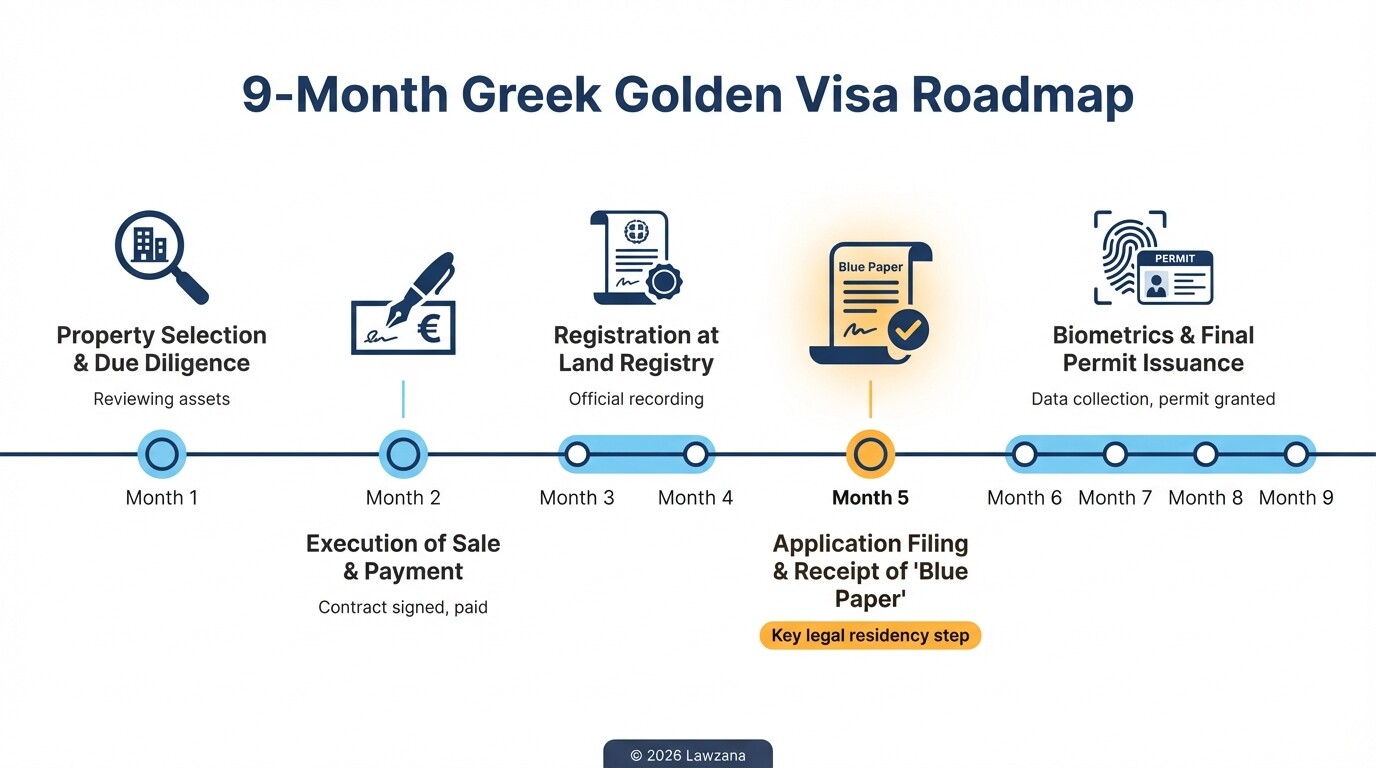
Securing residency through investment in Greece typically takes between six to nine months from the initial property search to the receipt of the physical residence card. The process is governed by strict administrative windows and property registration laws.
- Month 1: Property Selection and Due Diligence. This phase involves touring properties and having your legal team verify the legal and technical standing of the asset.
- Month 2: Execution of Sale and Purchase Agreement. Once the deposit is paid and the contract is signed before a notary, the full payment is transferred.
- Month 3-4: Registration and Issuance of Certificates. The Land Registry typically takes several weeks to issue the "Certificate of Registration," which is a mandatory document for the visa application.
- Month 5: Filing the Application. Your lawyer submits the application to the Ministry of Migration and Asylum. You will receive a "Blue Paper" (Vevaiosi) immediately, which allows you to reside in Greece legally while waiting for the card.
- Month 6-9: Biometrics and Approval. After attending the biometrics appointment, the Ministry reviews the file. Once approved, the residence card is mailed to your legal representative.
Managing Greek Inheritance Law for International Property Owners
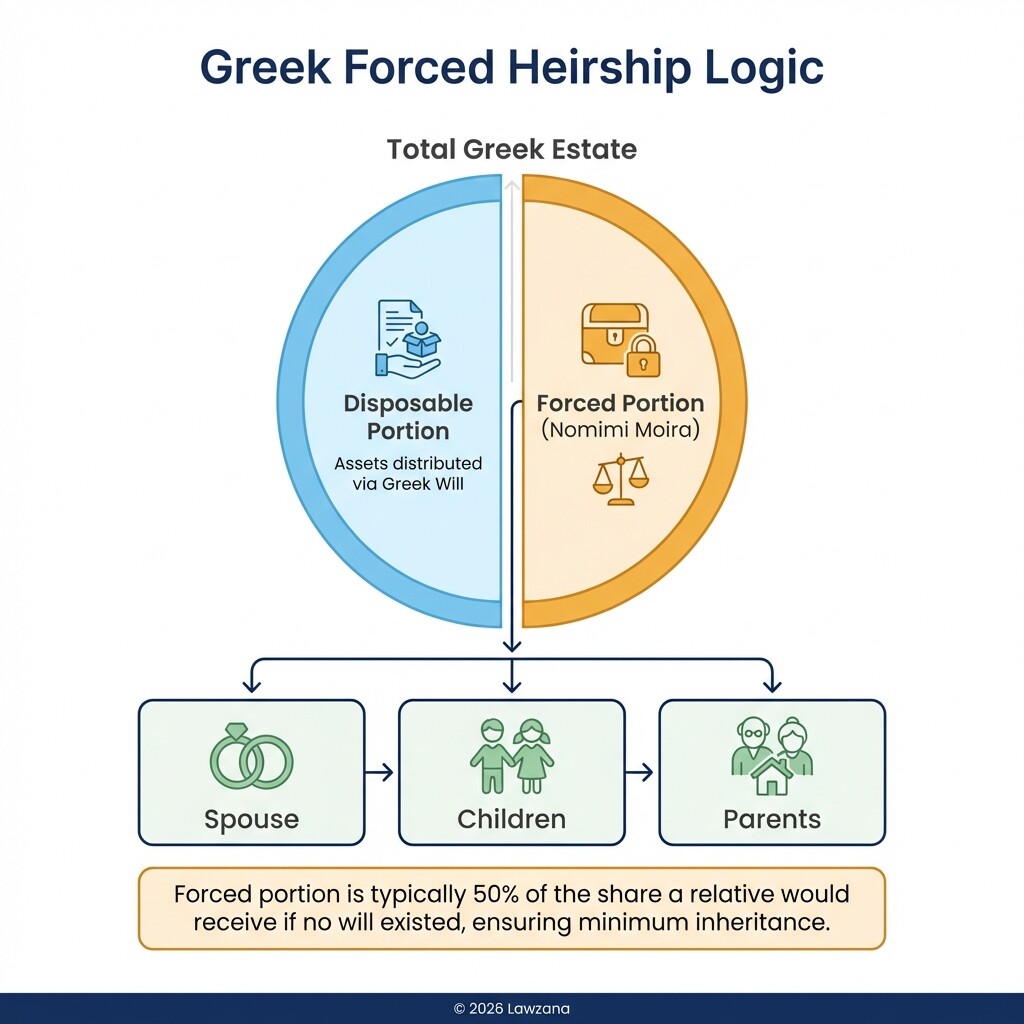
Greek inheritance law (Civil Code, Articles 1710-2035) applies to all real estate located on Greek soil, regardless of the owner's nationality or residence. For Golden Visa holders, understanding "forced heirship" is critical for protecting the family's future interest in the investment property.
In Greece, you cannot completely disinherit your closest relatives. The law reserves a "forced portion" (nomimi moira) for children, spouses, and sometimes parents. This portion is generally half of what the heir would have received if there were no will. If a foreign investor dies without a Greek-specific estate plan, the property may be distributed according to Greek default rules, which often conflicts with the laws of the investor's home country.
To manage this, investors should:
- Draft a Greek Will: A "Public Will" signed before a Greek notary ensures the document is recognized immediately by Greek courts and the Land Registry.
- Utilize EU Regulation 650/2012: If you are an EU resident or have links to an EU state, you may be able to choose the law of your nationality to govern your entire estate. However, this must be explicitly stated in a legal document.
- Consider Joint Ownership: Purchasing the property in joint names (e.g., husband and wife) can simplify the transition of ownership, though it does not bypass forced heirship rules entirely.
Mistakes in Maintaining the Investment to Ensure Permit Renewal
The Greek Golden Visa is valid for five years and is renewable indefinitely as long as the investment is maintained. However, the 2026 regulations have introduced stricter compliance checks that can lead to the revocation of the permit.
- Violating Rental Restrictions: The most significant change in 2026 is the ban on short-term rentals for Golden Visa properties. If an investor is caught listing their property on Airbnb or similar platforms, the residence permit will be revoked, and a fine of €50,000 will be imposed.
- Failing to Maintain Ownership: If you sell the property or transfer the title to another individual (even a family member) without simultaneously investing in a new qualifying asset, your permit becomes void.
- Lapse in Insurance: You must maintain active Greek health insurance for all family members. A gap in coverage can lead to complications during the five-year renewal window.
- Neglecting the "120 sqm" Integrity: If the property is modified or subdivided such that the living area falls below the 120 sqm threshold required at the time of purchase, the renewal may be denied.
Common Misconceptions
- "I can get citizenship immediately." The Golden Visa provides residency, not citizenship. To apply for Greek citizenship, you must reside in Greece physically for at least seven years and pass a language and culture exam.
- "I can buy two small apartments to reach the €800,000 limit." As of the 2024-2026 rules, the investment must be in a single property of at least 120 square meters. You can no longer combine multiple smaller units to meet the threshold.
- "I need to live in Greece to keep my visa." There is no minimum stay requirement. You can visit Greece for one day every five years and still maintain your permanent residency status.
FAQ
Can I sell my Golden Visa property before the 5-year period ends?
Yes, but you will lose your residence permit immediately upon the transfer of the title unless you have already obtained Greek citizenship or have purchased another qualifying property.
Does the 120 sqm requirement include balconies or storage?
No. The 120 square meters must be "net interior living space." Balconies, terraces, parking spaces, and external storage units do not count toward this minimum requirement.
Are there any restrictions on the nationality of the investor?
Greece currently suspends the issuance of Golden Visas to citizens of the Russian Federation and Belarus. Citizens of all other countries are generally eligible to apply.
Can I work in Greece with a Golden Visa?
The Golden Visa (Permanent Resident - Investor) does not grant the right to be employed in Greece. However, it does allow you to be a shareholder or a Director in a Greek company.
When to Hire a Lawyer
You should engage a Greek immigration lawyer before signing any reservation agreement or transferring any funds. The Golden Visa process involves complex "due diligence" that goes beyond simple price negotiation. A lawyer is required to verify that the property has no secret debts, that the construction is fully legal under Greek urban planning laws, and to handle the sophisticated application filing through the Ministry of Migration and Asylum digital portal. Legal expertise is particularly vital if you are navigating the commercial-to-residential conversion path or purchasing a listed building.
Next Steps
- Define Your Budget and Zone: Determine if you are targeting the €800,000 tier (prime urban/islands) or the €400,000 tier (regional/emerging markets).
- Secure Legal Counsel: Choose a firm experienced in both Greek property law and immigration administrative procedures.
- Conduct a Site Visit: While some aspects can be handled remotely via Power of Attorney, visiting Greece to inspect the 120 sqm requirement and property condition is highly recommended.
- Gather Documentation: Begin the process of apostilling birth and marriage certificates in your home country, as this can often take several weeks.