Legal Guide to Last Wills and Testaments in the Philippines
A last will and testament is a legal document that dictates how your assets will be distributed after your death, governed strictly by the Civil Code of the Philippines. Creating a legally valid will ensures your loved ones are protected, family disputes are minimized, and your final wishes are honored within the bounds of Philippine succession law.
- The Philippines strictly recognizes two types of wills: Notarial Wills and Holographic Wills.
- You cannot freely distribute your entire estate; Philippine law reserves a mandatory portion, known as the legitime, for compulsory heirs like your children and spouse.
- All wills must go through a mandatory court proceeding called probate before any property can be distributed to heirs.
- Joint wills (a single document signed by two people, like a husband and wife) are strictly prohibited under Philippine law.
- Minor technical errors, such as missing page signatures or improper witness attestation, can completely invalidate a notarial will.
Types of Wills: Notarial vs. Holographic
The Philippines recognizes two types of wills: notarial and holographic. A notarial will is a formally typed document signed before a notary public and witnesses, while a holographic will is completely handwritten, dated, and signed by the testator themselves.
Understanding the difference helps you choose the right approach for your estate size and privacy preferences.
| Feature | Notarial Will | Holographic Will |
|---|---|---|
| Preparation | Typed or printed | Entirely handwritten by the testator |
| Witnesses Required | At least three credible witnesses | No witnesses required during drafting |
| Notarization | Mandatory | Not required |
| Language | Must be in a language known to the testator | Must be in a language known to the testator |
| Best For | Complex estates, minimizing post-death disputes | Simple, private wishes or emergency situations |
| Probate Difficulty | Generally smoother if formalities are met | Can be challenged if handwriting authenticity is questioned |
Formal Requirements for a Valid Will Checklist
To be legally valid, a will must comply with strict formal requirements outlined in the Civil Code. Failure to meet these exact standards will result in the will being invalidated during probate, causing your estate to be distributed according to default intestacy laws.
Checklist for a Valid Notarial Will:
- Language requirement: The will must be written in a language or dialect known to the testator.
- End signature: The testator must sign at the logical end of the will.
- Marginal signatures: The testator and all three witnesses must sign the left margin of every page, except the last.
- Page numbering: Pages must be correlated by writing the page numbers in letters (e.g., "Page One") on the upper part of each page.
- Attestation clause: A specific clause stating the number of pages, that the testator signed in the presence of the witnesses, and that the witnesses signed in the presence of the testator and each other.
- Notarial acknowledgment: The will must be acknowledged before a notary public by the testator and the witnesses.
Checklist for a Valid Holographic Will:
- Completely handwritten: Every single word must be in the testator's own handwriting.
- Date: Must include the exact day, month, and year it was written.
- Signature: Must be signed by the testator at the end of the document.
- Alterations: Any crossed-out words, insertions, or corrections must be authenticated by the testator's full signature.
For the exact statutory language regarding will formalities, you can reference the Civil Code of the Philippines via the Official Gazette.
Understanding Compulsory Heirs and the Legitime
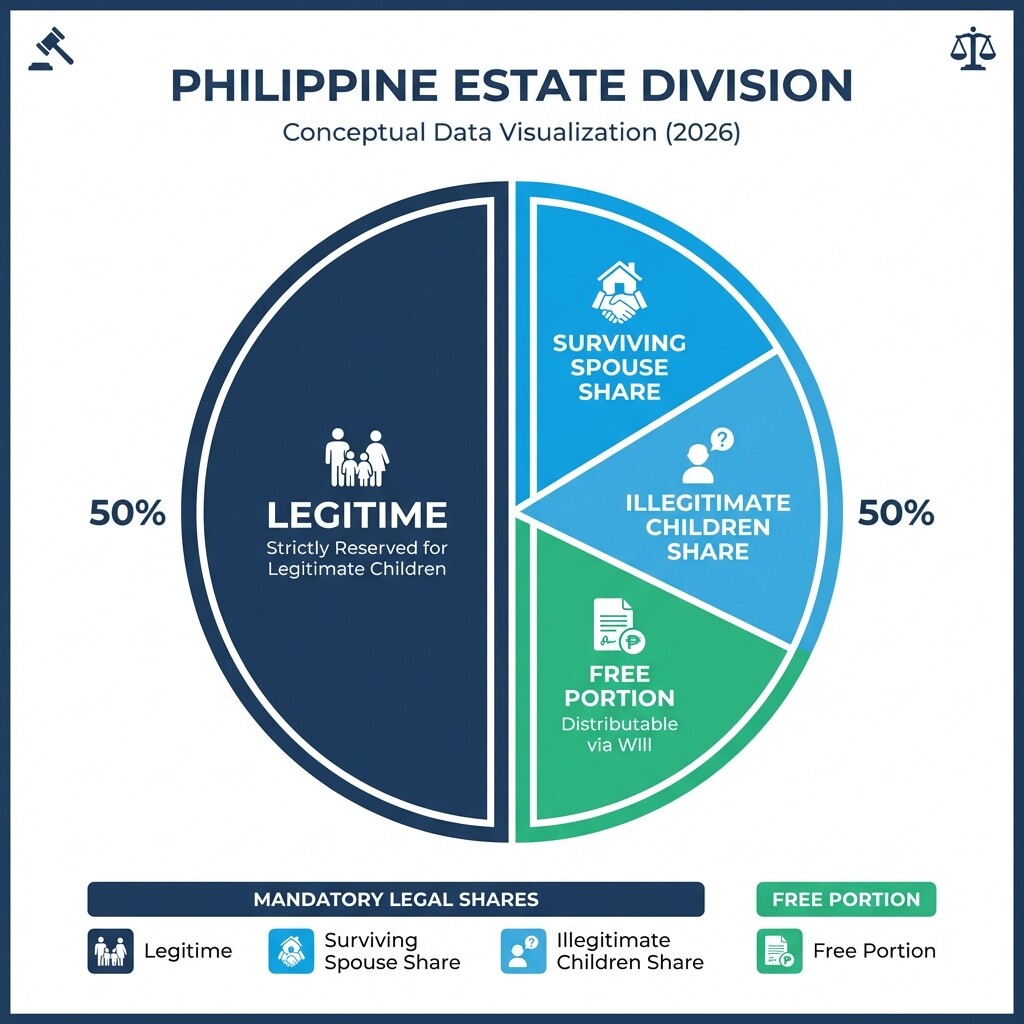
Philippine law restricts you from giving away your entire estate to whomever you choose if you have compulsory heirs. A specific portion of your estate, known as the legitime, is strictly reserved by law for specific family members, primarily your legitimate children and surviving spouse.
The estate is divided into two parts: the legitime (reserved portion) and the free portion. You can only use your will to assign the free portion to non-compulsory heirs, friends, or charities.
- Legitimate Children: Entitled to one-half (1/2) of the entire estate.
- Surviving Spouse: Entitled to a share equal to that of one legitimate child.
- Illegitimate Children: Entitled to a share equal to one-half (1/2) of the share of a legitimate child.
If your will infringes upon the legitime of a compulsory heir, the court will reduce the distribution of the free portion to satisfy the legal requirements.
The Judicial Probate Process in the Philippines
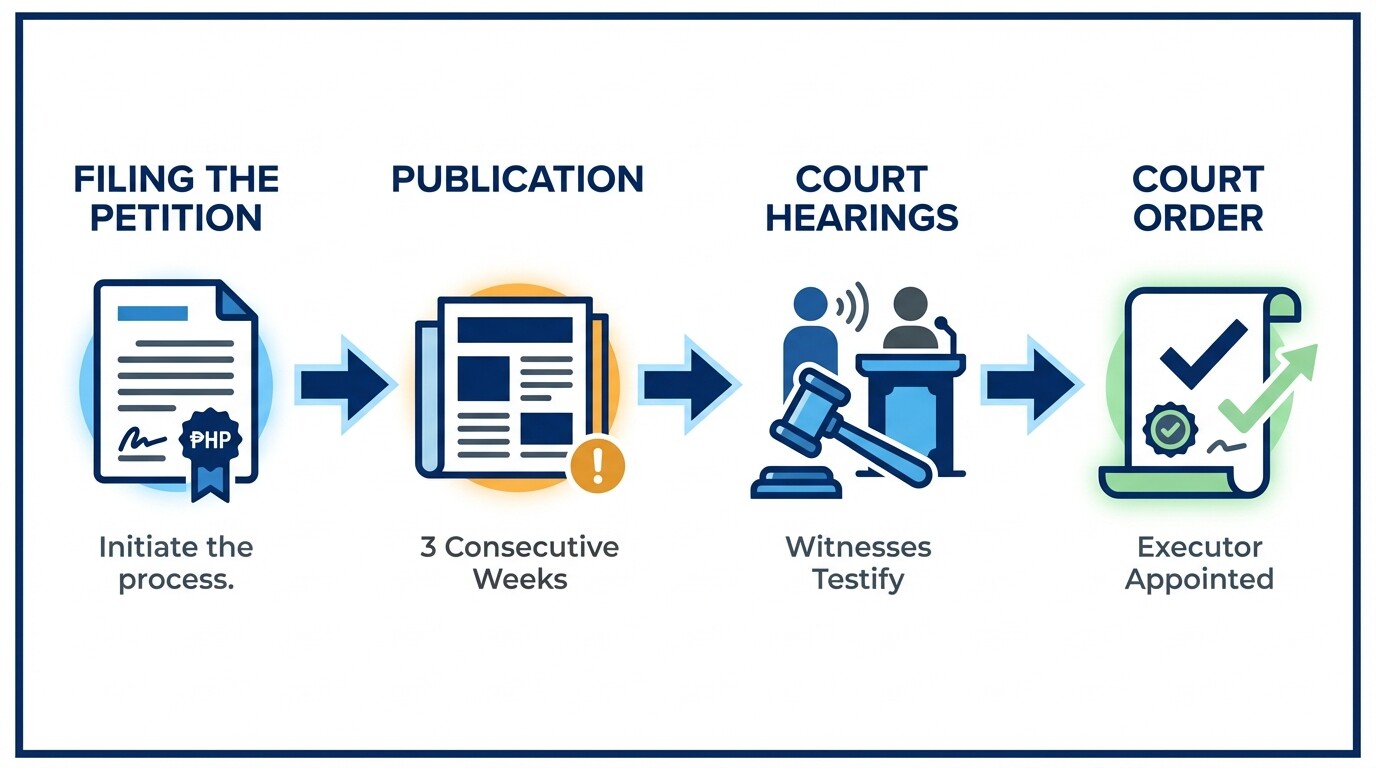
Before any property can be transferred to your heirs, the will must undergo a judicial probate process in a Philippine court. Probate is a mandatory legal procedure to establish the will's authenticity, confirm the testator's mental capacity at the time of signing, and ensure it was executed according to law.
The process involves several critical steps:
- Filing the Petition: A petition for probate is filed in the Regional Trial Court (RTC) or Metropolitan Trial Court (MTC) of the city or province where the deceased last resided. The court venue depends on the gross value of the estate.
- Publication: The court will issue an order setting a hearing date, which must be published in a newspaper of general circulation for three consecutive weeks to notify any interested parties.
- Court Hearings: During the hearing, the subscribing witnesses (for a notarial will) or individuals familiar with the testator's handwriting (for a holographic will) must testify to the document's authenticity.
- Court Order: If the court finds no legal defects, it issues an order allowing the will and appointing an executor or administrator to manage debt settlement and asset distribution.
Grounds for Contesting a Will
Interested parties can contest a will during probate proceedings if they believe it is legally flawed. Understanding the common grounds for annulment helps you take preventive steps during the drafting phase to secure your estate.
Common grounds for disallowance include:
- Lack of Formalities: Missing signatures, improper attestation clauses, or failure to notarize a notarial will.
- Lack of Testamentary Capacity: The testator was not of sound mind or was under 18 years old when the will was executed.
- Undue Influence: The testator was coerced, pressured, or threatened into signing the document.
- Fraud or Forgery: The signature is faked, or the testator was tricked into signing a document they did not know was a will.
How to Prevent Contests: Have a physician examine the testator and issue a medical certificate of sound mind on the day of signing. Additionally, video recording the signing ceremony and utilizing highly experienced legal counsel can preemptively defeat claims of fraud or undue influence.
Common Misconceptions About Philippine Estate Planning
- "If I have a will, my family avoids going to court." This is false. In the Philippines, probate is absolute and mandatory. No bank account can be released, and no land title can be transferred under a will without a final court order approving the will.
- "I can completely disinherit my estranged child." Disinheritance is incredibly difficult under Philippine law. It must be explicitly stated in the will for legally recognized causes (e.g., attempt on the testator's life or groundless criminal accusations). Otherwise, their legitime remains protected.
- "My spouse and I can write a joint will." Joint wills are strictly void in the Philippines, even if executed by Filipinos in a foreign country where joint wills are allowed. Each person must execute their own separate document.
Frequently Asked Questions
Can a foreigner make a will for properties in the Philippines?
Yes. A foreigner can execute a will in accordance with the formalities prescribed by the laws of their own country, the laws of their residence, or Philippine law. However, Philippine courts will generally apply the foreigner's national law regarding the substantive validity (who gets what) of the estate.
How much does it cost to draft and notarize a will?
Legal fees for drafting a notarial will generally range from PHP 15,000 to PHP 50,000 or more, depending on the complexity of the estate and the lawyer's expertise. Probate court filing fees will also apply later, scaling with the estate's total assessed value.
Can I change or revoke my will after signing it?
Yes. You can revoke or amend your will at any time before your death, provided you are still of sound mind. You can do this by physically destroying the old will with the intent to revoke it, or by executing a new will that explicitly revokes the previous one.
When to Hire a Lawyer and Next Steps
You should hire a lawyer immediately if your estate includes real estate, active businesses, or multiple bank accounts, or if you anticipate family disputes over your assets. Because Philippine succession laws are highly technical regarding legitimes and formal requirements, a DIY approach to a notarial will almost always results in legal invalidity.
Next Steps:
- Make a comprehensive list of your assets (properties, bank accounts, shares) and liabilities.
- Identify your compulsory heirs and decide how you want to distribute the "free portion" of your estate.
- Consult a qualified lawyer in the Philippines to draft your notarial will.
- If you expect a high likelihood of contested proceedings upon your death, seek out experienced litigation lawyers in the Philippines to oversee the execution and secure necessary evidence of your mental capacity. Store the original document in a safe deposit box or a secure location known to your intended executor.