Navigating Cross-Border Inheritance Laws for Expats in Egypt
- Applicable Law: Egyptian Civil Code generally applies the deceased's national law to the distribution of their estate, but Islamic Sharia law applies if the deceased was Muslim.
- Strict Documentation: All foreign documents, including death certificates and wills, must be legalized by the Egyptian embassy in the issuing country and officially translated into Arabic.
- Property Restrictions: Transferring Egyptian real estate to foreign heirs requires formal registration with the Shahr El Akari (Real Estate Registration Office) and adherence to foreign ownership laws.
- Timely Action: Heirs should initiate the formal declaration of inheritance within a few months of death to avoid frozen bank accounts, property disputes, and bureaucratic penalties.
- Preventative Planning: Formalizing an estate plan with a localized will prevents lengthy, multi-jurisdictional family litigation.
Which Law Applies to Expat Estates in Egypt?
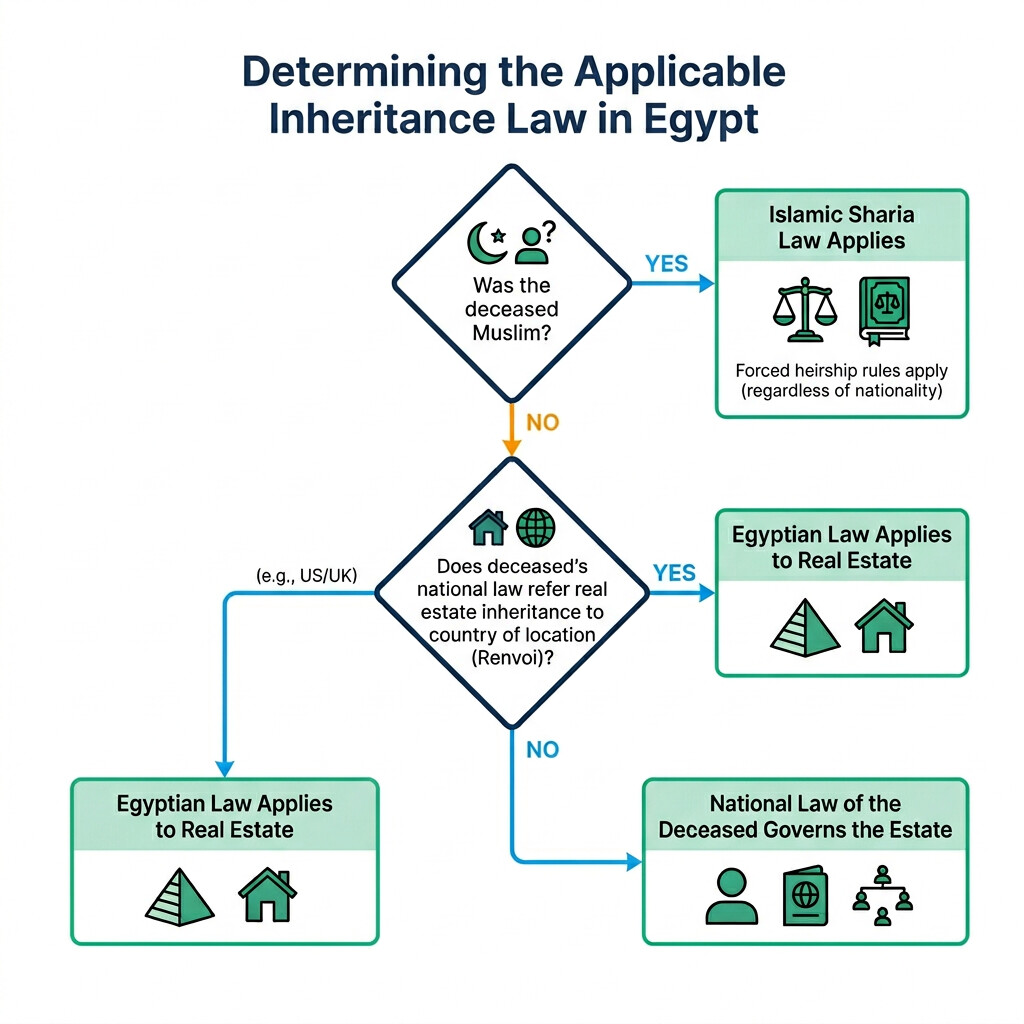
The applicable law for an expat's estate in Egypt generally depends on their nationality at the time of death, though their religion can radically alter this framework. Article 17 of the Egyptian Civil Code establishes that the distribution of an estate is governed by the national law of the deceased.
However, resolving cross-border jurisdiction is rarely that simple. Egyptian courts apply the doctrine of renvoi. If the deceased's national law states that real estate inheritance is governed by the laws of the country where the property is located (as is common in the US and UK), the Egyptian court will apply Egyptian law to the real estate. Furthermore, if the deceased expat was Muslim, Egyptian courts will apply Islamic Sharia law to the estate regardless of the individual's nationality. Sharia law dictates strict forced heirship rules, meaning specific relatives are legally entitled to fixed percentages of the estate, and individuals can only freely will away up to one-third of their assets.
Required Documents Checklist for Cross-Border Estates
Heirs must gather, authenticate, and translate a specific set of primary documents to initiate the inheritance process in Egyptian courts. Presenting incomplete or unauthenticated paperwork will result in immediate rejection by the Egyptian Family Court.
To successfully open an inheritance file, you must prepare the following dossier:
- Legalized Death Certificate: The original foreign death certificate, authenticated by the Egyptian embassy or consulate in the issuing country.
- Original Will: If one exists, the original testament along with proof of its validity under the deceased's national law.
- Passports and Identification: Clear, valid copies of the deceased's passport (showing their Egyptian residency visa) and the passports of all potential heirs.
- Marriage and Birth Certificates: Legalized certificates to prove the familial relationship between the heirs and the deceased.
- Proof of Assets: Egyptian bank account statements, real estate deeds, and vehicle registration documents.
- Certified Arabic Translations: Every foreign document must be translated into Arabic by an official translation office recognized by the Egyptian Ministry of Justice.
Filing the Formal Declaration of Inheritance
Heirs must file a formal declaration of inheritance, known as El-Elam El-Sharii, with the Egyptian Family Court to legally establish the identities of the heirs and their respective shares. This process should ideally begin within a few months of the death to prevent administrative delays, asset freezing, and potential late penalties.
The procedure begins by submitting a petition to the Family Court located in the jurisdiction where the deceased maintained their primary Egyptian residence. The court will schedule a hearing where at least two male witnesses (or one male and two female witnesses) must testify to the identity of the deceased and confirm the surviving heirs. Once the court is satisfied with the documentation and testimonies, it issues the official inheritance decree. This decree is the master document required to unlock bank accounts, transfer business shares, and register property in Egypt.
Transferring Egyptian Real Estate to Foreign Heirs
Transferring Egyptian real estate to foreign heirs requires registering the court-issued inheritance decree with the local Real Estate Registration Office. Foreigners face specific ownership restrictions in Egypt, and successfully transferring the title requires strict adherence to these regulations.
Under Law No. 230 of 1996, which regulates foreign ownership of real estate, foreigners are generally limited to owning a maximum of two properties in Egypt, and neither can exceed 4,000 square meters. When inheriting property, heirs must submit the El-Elam El-Sharii to the Ministry of Justice's real estate department (Shahr El Akari). While direct inheritance taxes were abolished in Egypt, the process incurs administrative and surveying fees. Registration fees for property transfers at Shahr El Akari are legally capped at a maximum of 2,000 EGP per property, though mandatory legal, surveying, and engineering syndicate fees will increase the total cost of the transfer.
Preventing Family Litigation Through Estate Planning
Formalizing a cross-border estate plan prevents lengthy and expensive family disputes over jurisdiction, asset division, and legal interpretation. Expats residing or holding assets in Egypt should draft a valid will localized for the Egyptian legal system to ensure their wishes are honored.
Relying solely on a foreign will leaves the estate vulnerable to legal challenges from family members who might benefit more under Egyptian law. By working with specialized litigation lawyers in Egypt, expats can draft a localized will that aligns with their national law while satisfying Egyptian procedural requirements. For Muslim expats, localized planning is even more critical to navigate forced heirship rules and properly structure gifts or lifetime transfers to protect specific family members.
Common Misconceptions About Inheritance in Egypt
Navigating two distinct legal systems often leads to confusion regarding how Egyptian authorities handle foreign assets and wills. Understanding the truth behind these myths is crucial for protecting your family's wealth and ensuring a smooth transition of assets.
- "The Egyptian government will seize my assets." Many expats believe the state automatically assumes ownership of their property upon death. In reality, the Egyptian Civil Code respects the inheritance rights of foreigners and their heirs, provided the proper legal procedures are followed to claim the estate.
- "My foreign will is automatically valid in Egypt." A will drafted in your home country is not immediately enforceable in Egypt. It must go through a lengthy process of legalization, translation, and formal recognition by an Egyptian court before local authorities or banks will honor it.
- "My spouse will inherit everything." Even if your national law leaves everything to a surviving spouse, Egyptian banks and property registries will freeze assets until the Family Court issues an official decree dividing the shares. If the deceased was Muslim, Sharia law restricts the spouse's share significantly in favor of children and parents.
Frequently Asked Questions
How long does it take to settle an expat estate in Egypt?
Settling an expat estate in Egypt typically takes between 6 to 12 months. The timeline heavily depends on how quickly foreign documents can be legalized, translated, and processed through the Egyptian Family Court.
Are there inheritance taxes in Egypt?
Egypt does not levy a direct inheritance tax or estate tax. However, heirs must pay nominal administrative fees, surveying costs, and registration fees (capped at 2,000 EGP per property) when transferring real estate titles into their names.
Can a non-Muslim inherit from a Muslim in Egypt?
Under the principles of Islamic Sharia law applied by Egyptian courts, a non-Muslim cannot legally inherit from a Muslim through standard intestate succession. Cross-faith transfers generally require specific legal mechanisms, such as a localized will utilizing the one-third bequest allowance.
Can I access the deceased's Egyptian bank account to pay for funeral expenses?
Generally, no. Egyptian banks immediately freeze individual accounts upon notification of death. Funds cannot be accessed for funeral expenses, debts, or distribution until the heirs present the official court-issued inheritance decree.
When to Hire a Lawyer
Managing a cross-border estate involves complex bureaucratic hurdles, strict Arabic language requirements, and intricate jurisdictional overlaps that are incredibly difficult to navigate independently. Engaging specialized legal counsel is essential the moment a foreign national with assets in Egypt passes away.
A local lawyer is necessary to translate and legalize foreign documents, represent the family in front of the Egyptian Family Court to obtain the inheritance decree, and navigate the notoriously bureaucratic Shahr El Akari for real estate transfers. Partnering with experienced lawyers in Egypt ensures the estate is settled quickly, protecting the assets from devaluation, squatters, or prolonged legal disputes.
Next Steps
Taking prompt, organized action immediately following a death protects the estate's assets and prevents administrative roadblocks from the Egyptian authorities. Follow these immediate steps to secure your family's inheritance:
- Obtain Multiple Death Certificates: Secure at least five original copies of the death certificate. If the death occurred outside Egypt, begin the legalization process at the Egyptian embassy immediately.
- Locate Estate Planning Documents: Search for original wills, property deeds, bank account details, and marriage certificates.
- Do Not Move Assets: Avoid attempting to withdraw funds from Egyptian bank accounts or moving physical assets until you have legal authorization, as this can trigger fraud investigations.
- Consult Local Counsel: Contact an Egyptian inheritance lawyer to begin drafting the petition for the Family Court and scheduling official translations for your foreign documents.