


Suffering an injury while visiting or living temporarily in the United States presents a deeply stressful situation, combining physical trauma with the shock of notoriously high US medical costs. Foreign nationals, tourists, and expatriates have the same fundamental rights to seek compensation for injuries caused by negligence as US citizens, but asserting those rights from abroad requires strategic action.
Key Takeaways
Successfully navigating a US personal injury claim as a foreign national requires acting quickly while you are still inside the country. Keep these crucial points in mind:
- Your legal status does not block your rights: Whether you are on a tourist visa, student visa, or undocumented, you are entitled to pursue compensation for injuries caused by someone else's negligence in the US.
- US medical care is a legal right in emergencies: Federal law requires hospitals to provide emergency medical treatment regardless of your citizenship or immediate ability to pay.
- You pay no upfront legal fees: US personal injury lawyers work on a contingency fee basis, meaning they take a percentage of your final settlement and nothing out of pocket.
- Never settle verbally: Do not accept early payout offers from US insurance adjusters or sign release forms before consulting legal counsel, as this typically waives your right to full compensation.
Post-Accident Checklist for Preserving Evidence
Taking immediate, documented action following an injury in the United States is critical to protecting your right to compensation. Because you will eventually return to your home country, securing physical evidence and official reports before leaving the US is your highest priority.
Complete these steps as soon as you are safely able to do so:
- Call 911 for Police and Medical Assistance: Always ensure a police officer or emergency responder arrives at the scene. An official police report is often the most critical piece of evidence for insurance claims.
- Seek Immediate Medical Evaluation: Do not decline a hospital visit out of fear of US healthcare costs. Refusing immediate care allows the insurance company to argue that your injuries are not serious or were caused by a separate event later.
- Capture Scene Evidence: Use your phone to take wide and close-up photos of the accident scene, property damage, hazards that caused a slip and fall, and your visible injuries.
- Collect Witness Contact Information: Request the names, phone numbers, and email addresses of anyone who saw the incident. US-based witnesses are highly valuable, as they can be easily contacted by your local legal team later.
- Report to Your Embassy or Consulate: In cases of severe injury, notify your home country's local embassy or consulate. They cannot provide legal representation, but they can assist with emergency travel arrangements and contacting family.
Managing Cross-Border Medical Billing and Out-of-Network Costs
Navigating the US healthcare system is overwhelming, especially when facing massive out-of-network charges or attempting to coordinate with international travel insurance. You must act quickly to ensure medical providers bill the appropriate liability or travel insurance rather than sending your accounts directly to international debt collections.
Under the Emergency Medical Treatment and Labor Act (EMTALA), Medicare-participating hospitals in the US must provide medical screening and stabilize emergency conditions for anyone, regardless of their nationality or ability to pay. However, you will still be billed for this care. To manage these expenses, your attorney may issue a "Letter of Protection" (LOP) to medical providers. This legally binding document guarantees that the hospital or doctor will be paid directly out of your future legal settlement, allowing you to receive ongoing care without paying thousands of dollars out of pocket. Additionally, if you have travel insurance, your attorney will manage the "subrogation" process-coordinating between the travel insurer who paid your initial bills and the at-fault party's insurance to ensure all medical debts are satisfied without cutting into your personal compensation.
Common Mistakes When Dealing With US Insurance Adjusters
Foreign nationals often assume that US insurance companies will offer a fair settlement once provided with medical bills, which is a dangerous misconception. Adjusters frequently use your unfamiliarity with US law to minimize your injuries or deny your claim entirely.
Avoid these common pitfalls when interacting with insurance representatives:
- Giving a recorded statement: Adjusters are trained to ask leading questions that may trick you into admitting partial fault. You are not legally obligated to give a recorded statement to the at-fault party's insurance company without a lawyer present.
- Accepting the first settlement offer: Insurance companies often offer a fast, low-value settlement to tourists, hoping they will take the cash before flying home. Accepting this money requires signing a release waiver, permanently barring you from seeking further funds if your injuries require long-term care.
- Discussing your return flight: Telling an adjuster you are leaving the US on a specific date gives them leverage. They will intentionally delay the process, knowing you will become desperate to settle before your flight departs.
Using Alternative Dispute Resolution to Avoid US Trials
Resolving a personal injury claim does not necessarily mean you have to return to the United States for a lengthy court trial. Alternative dispute resolution (ADR) methods, such as pre-litigation mediation, allow you to settle your case efficiently from your home country.
The vast majority of US personal injury cases-often exceeding 95%-are settled out of court. If direct negotiations with the insurance company stall, your attorney can demand mediation. During mediation, a neutral third party (often a retired judge) facilitates a settlement conference between your legal team and the insurance company. Following the rise of remote legal proceedings, courts and private mediators routinely allow foreign plaintiffs to attend these sessions via secure video conferencing. This saves you the immense cost and time of traveling back to the US, while still applying the pressure needed to secure a maximum financial recovery.
Timelines and Contingency Fee Structures in the US
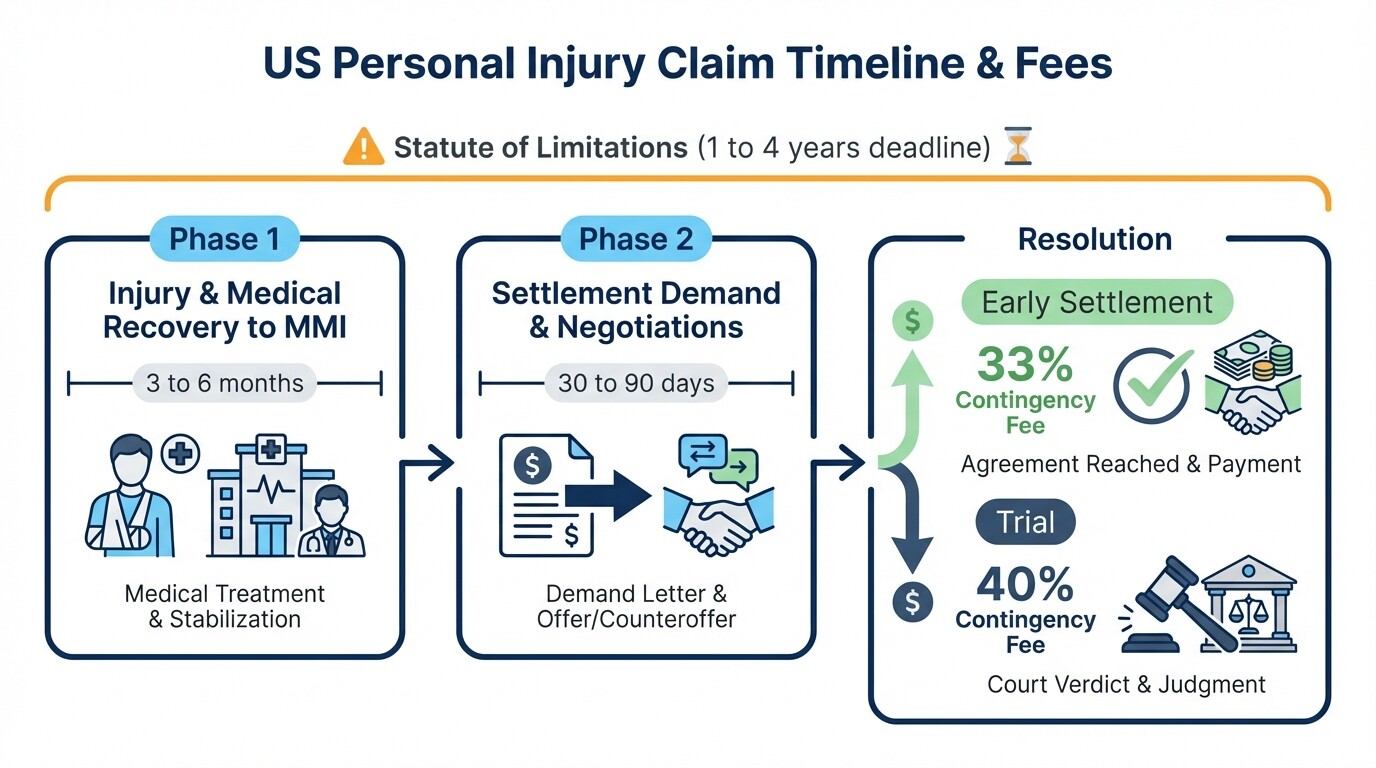
Personal injury claims in the US are almost universally handled on a contingency fee basis, meaning you pay nothing upfront and your lawyer only gets paid if you win your case. The timeline for resolving a claim can range from a few months to over a year, depending heavily on the severity of your injuries and the insurance company's willingness to negotiate in good faith.
When you secure compensation, the standard contingency fee in the US ranges from 33% (one-third) if the case settles early, to 40% if the case goes to trial. This fee structure is highly beneficial for international visitors, as it eliminates the financial risk of hiring premium US legal counsel.
The timeline of your claim is governed by two factors: your medical recovery and the state's statute of limitations. Attorneys generally wait until you have reached "Maximum Medical Improvement" (MMI)-the point where your condition is stable and future medical costs can be accurately predicted-before demanding a settlement. This medical phase can take 3 to 6 months. Once the demand is sent, negotiations typically take another 30 to 90 days. Keep in mind that every US state enforces a strict "Statute of Limitations" (a legal deadline to file a lawsuit), which generally ranges from one to four years from the date of the accident. Missing this deadline permanently destroys your claim.
Frequently Asked Questions
Do I have to pay taxes on my personal injury settlement in the US?
No. Under US federal tax law, compensation received for physical bodily injuries or physical sickness is generally not taxable. However, if a portion of your settlement is specifically designated as compensation for lost wages, that specific portion may be subject to income tax.
Can I file a claim if the driver who hit me was uninsured?
Yes. If you were injured in a vehicle (like a rental car or rideshare), that vehicle's insurance policy likely includes Uninsured Motorist (UM) coverage. This coverage acts as a safety net, paying for your medical bills and suffering if the at-fault driver has no insurance or fled the scene.
Will filing a lawsuit affect my future ability to get a US visa?
No. Pursuing a lawful civil claim for personal injury has no impact on your immigration status, your current visa, or your ability to visit the United States in the future. The US civil justice system is entirely separate from the immigration and visa enforcement systems.
When to Hire a US Personal Injury Lawyer
You should consult a personal injury attorney immediately after receiving emergency medical treatment, ideally before leaving the United States. Early representation stops aggressive insurance adjusters from contacting you directly and ensures vital evidence, such as security camera footage, is secured before it is legally destroyed.
Because state laws vary dramatically regarding fault, insurance minimums, and deadlines, it is vital to hire a lawyer licensed in the specific state where your injury occurred. If you were injured in Florida, you need a Florida lawyer, even if you flew into New York. You can use platforms like Lawzana to find US personal injury lawyers who are qualified to represent international clients and manage cross-border complexities.
Next Steps
Your immediate focus should be on your physical recovery while establishing a strong legal foundation for your claim. To ensure your rights are protected as you transition back to your home country, prioritize organizing your documentation.
Gather all discharge papers, medical bills, the police report number, and contact information for any witnesses. Place all physical receipts related to the injury-including pharmacy purchases, crutches, and altered travel arrangements-in a dedicated folder. Finally, decline any calls from the at-fault party's insurance company and schedule a free virtual consultation with a US-based attorney to assess the value of your claim.