Key Takeaways
Foreign tourists injured in Greece have the legal right to seek compensation through the Greek civil court system for medical expenses, lost wages, and moral damages. Succeeding in a cross-border personal injury claim requires strict adherence to local documentation procedures immediately following the incident.
- Obtain official medical reports from a Greek public hospital or certified private clinic before leaving the country.
- File a mandatory incident report with the Hellenic Police to establish an objective, court-admissible record of the event.
- Determine the correct legal jurisdiction early, as liability may fall on a local Greek business, a global tour operator, or a third-party insurance company.
- Act within the Greek statute of limitations for torts, which generally allows you five years from the date of the injury to file a civil lawsuit.
- Expect to pay an upfront court filing fee based on the claimed amount, while legal representation can often be arranged on a contingency fee basis capped by Greek law.
Step-by-Step Tourist Injury Checklist
Taking the correct steps immediately after an accident in Greece dictates the strength of your future civil lawsuit. This checklist outlines the exact sequence of actions an injured international visitor must take to preserve their right to compensation. Greek courts rely heavily on contemporaneous paper documentation rather than delayed witness testimonies.
- Call the Emergency Services: Dial 112 for the general European emergency number or 166 for the Greek ambulance service (EKAV).
- Involve the Hellenic Police: Do not leave the scene of a traffic or severe recreational accident without a police unit arriving to log the incident.
- Gather Scene Evidence: Take photographs of the hazard, the vehicles involved, your visible injuries, and the surrounding environment.
- Collect Witness Data: Write down the names, phone numbers, and home countries of any bystanders, as tourists often leave Greece shortly after witnessing an event.
- Get Treated Locally: Visit a Greek hospital to create a local medical record. Do not wait until you fly back to your home country to seek initial treatment.
- Secure Official Stamps: Ensure all hospital discharge papers and police reports carry the official round blue ink stamp of the issuing Greek authority.
- Notify Your Insurers: Contact your travel insurance and health insurance providers to report the incident and coordinate emergency coverage.
Immediate Medical Attention and Documentation
Securing official medical documentation from a Greek healthcare facility is the foundational requirement for proving the severity and origin of your injuries in a Greek court. You must seek treatment locally immediately after the accident, as Greek judges heavily scrutinize claims where the victim only sought medical attention after returning to their home country.
Greece operates a dual healthcare system comprising public hospitals and private clinics. Public hospitals provide emergency care to everyone regardless of nationality and generate highly respected medical reports for litigation purposes. Private clinics offer faster service and English-speaking staff, but their reports must be comprehensive and signed by the attending specialist to hold equal weight in court. Request all medical records, X-rays, and discharge summaries in writing before you fly home. If these documents are in Greek, your legal team will have them officially translated and certified by the Greek Ministry of Foreign Affairs or a registered Greek lawyer later in the process.
Securing the Hellenic Police Report
To pursue a personal injury claim in Greece, you must obtain an official incident report from the Hellenic Police. This document establishes an objective, state-verified record of the accident location, involved parties, and immediate circumstances. Without this official report, Greek civil courts will generally dismiss your compensation claim for lack of foundational evidence.
For motor vehicle, moped, or ATV accidents, the Traffic Police division (Trochaia) must attend the scene to measure skid marks, administer breathalyzer tests, and document vehicle positions. For hotel injuries, boating accidents, or assaults, the local precinct of the Hellenic Police will handle the report. You have the right to request a copy of this report. Keep the incident reference number and the name of the responding precinct safe, as your legal representative will need these details to extract the full case file for civil litigation.
Determining Liability and Jurisdiction
Identifying exactly who to sue after an injury in Greece depends on the nature of the accident and how you booked your travel. You must pinpoint the correct corporate entity or individual liable under Greek or international law to ensure your lawsuit is filed in the appropriate jurisdiction. Suing the wrong party wastes valuable time and court fees.
If you booked a comprehensive package holiday through an international tour operator, you might be able to file a lawsuit in your home country under consumer protection laws like the European Package Travel Directive. However, if you independently rented a moped, booked a local boat tour, or slipped in a locally owned taverna, jurisdiction falls strictly to the Greek civil courts. In cases involving motor vehicle accidents, Greek law allows direct action against the at-fault driver's insurance company. Your attorney will analyze corporate registries to uncover the parent companies, franchise agreements, and insurance policies shielding the local vendor that caused your injury.
Civil Lawsuit Timelines and Statute of Limitations
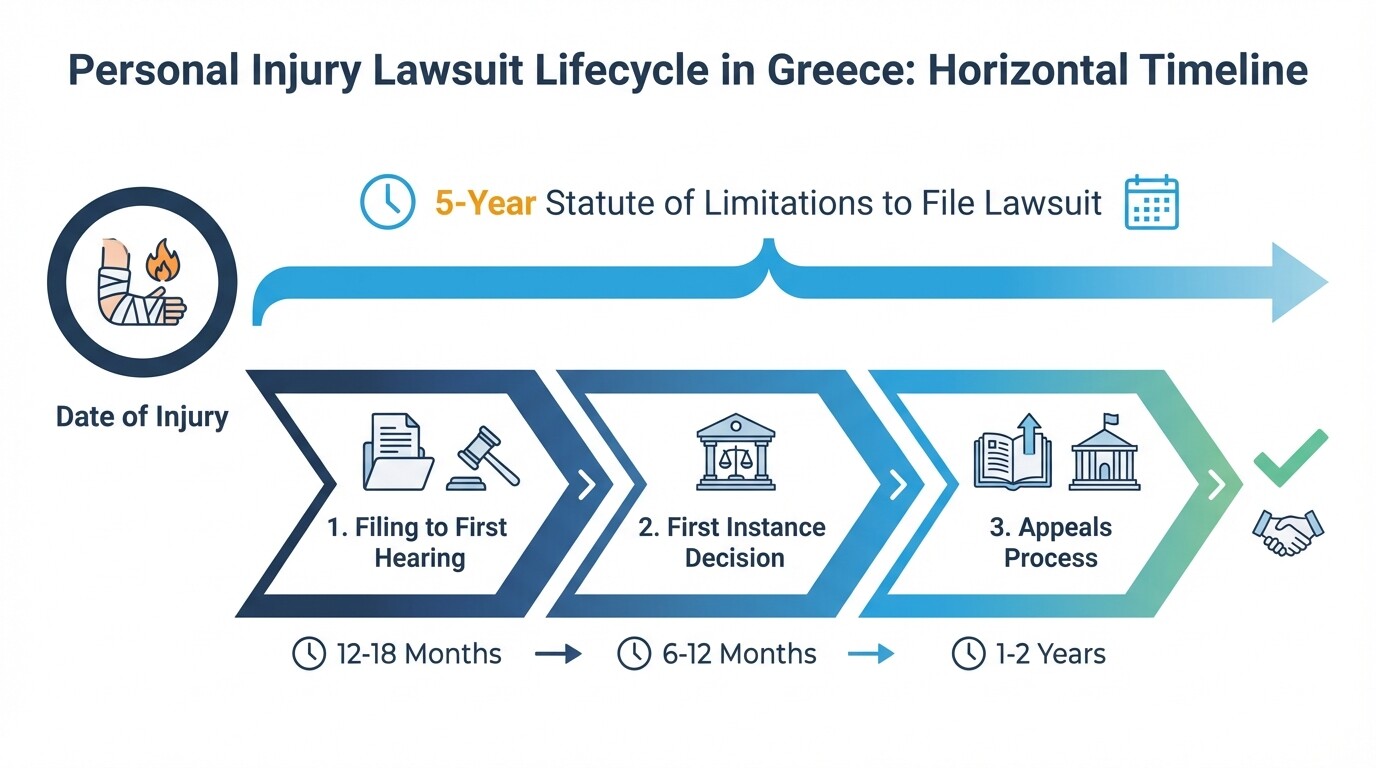
The statute of limitations for personal injury claims in Greece is generally five years from the moment the victim becomes aware of the injury and the identity of the liable party. Failing to file a formal lawsuit within this five-year window will permanently bar you from recovering any compensation through the Greek legal system.
While five years provides ample time to build a case, the Greek civil litigation process itself requires patience. Once your attorney files the lawsuit (Agogi), the court will serve notice to the defendants and schedule a hearing.
- Filing to First Hearing: Typically takes 12 to 18 months depending on the case backlog at the specific regional court.
- First Instance Decision: The court generally issues a written judgment 6 to 12 months after the hearing concludes.
- Appeals Process: Either party can appeal the decision, which can add another 1 to 2 years to the timeline before compensation is finalized.
Estimated Legal Costs and Compensation Breakdown
Litigating a personal injury case in Greece involves specific mandatory court fees and unique categories of compensation governed by the Greek Civil Code. You must budget for upfront procedural costs, though successful plaintiffs can recover a portion of their legal expenses from the losing defendant.
In Greece, compensation focuses heavily on actual financial loss and moral damages (Ithiki Vlavi), which covers pain, suffering, and emotional distress.
| Cost / Compensation Type | Description | Estimated Amount |
|---|---|---|
| Court Filing Fee | Mandatory state fee (Dikastiko Ensimo) required to process the lawsuit. | Approximately 1% of the total compensation amount claimed. |
| Lawyer Fees | Legal representation costs. Greek lawyers often accept personal injury cases on contingency. | 10% to 20% of the awarded compensation, strictly capped by Greek law. |
| Special Damages | Reimbursement for out-of-pocket expenses. | Exact cost of medical bills, rehabilitation, travel costs, and lost wages. |
| Moral Damages | Compensation for physical pain, emotional trauma, and reduced quality of life. | Variable. Ranges from EUR 5,000 for minor injuries to EUR 100,000+ for severe disability. |
Common Misconceptions About Suing in Greece
Foreign nationals frequently misunderstand how Greek civil courts operate, leading to critical errors in how they handle their immediate recovery and legal strategy. Addressing these misconceptions early prevents injured tourists from jeopardizing their claims.
- Greece awards massive punitive damages: Greek civil law focuses strictly on restoring the victim to their pre-accident state. Courts award compensatory and moral damages but do not award millions of euros in "punitive" damages to punish negligent companies.
- Your home embassy can file the lawsuit for you: Embassies and consulates can provide a list of local English-speaking lawyers and assist with emergency travel documents. They cannot provide legal advice, investigate the accident, or represent you in a Greek court.
- Verbal agreements with local vendors are safe: If a local rental agency or hotel manager offers you cash to cover your medical bills without calling the police, accepting it can legally waive your right to future compensation. Injuries often worsen weeks later, and without a police report, you have no further recourse.
Frequently Asked Questions
Can I leave Greece before my lawsuit is filed?
Yes, you can return to your home country to recover. You will need to sign a Power of Attorney (Plirexousio) in front of a Greek notary or at a Greek consulate in your home country, which grants your local lawyer the authority to file documents, attend hearings, and negotiate settlements on your behalf.
Do Greek courts accept medical reports from my home country?
Greek courts accept international medical records to prove ongoing treatment and long-term disability. However, these documents must be officially translated into Greek and apostilled. They serve as supplementary evidence to the initial Greek medical reports generated at the time of the accident.
Are lawyer contingency fees legal in Greece?
Contingency fee agreements are entirely legal and common for personal injury cases in Greece. The maximum contingency fee is capped by law at 20% of the recovered amount. If your case involves multiple plaintiffs, the cap remains regulated to protect victims from excessive legal fees.
When to Hire a Lawyer and Next Steps
You should retain a qualified Greek civil litigation attorney immediately if your injury required hospitalization, resulted in a canceled flight, or involved a complex liability dispute with a business. Engaging legal counsel early ensures critical evidence is preserved before local vendors delete security footage or repair faulty equipment. A local attorney will navigate the language barrier, extract police reports, and manage communications with uncooperative Greek insurance companies while you focus on medical recovery in your home country.
To begin the process, organize all your photographs, receipts, and preliminary medical documents. You can then search for general litigation lawyers in Greece who specialize in cross-border personal injury claims. Schedule initial consultations to evaluate your case strength, discuss contingency fee arrangements, and outline the exact strategy required to secure your compensation in the Greek civil courts.