Joint Venture Agreements in Saudi Arabia: Legal Structures for Partners
- Foreign investors must secure a Ministry of Investment (MISA) license to participate in any Saudi joint venture, regardless of the chosen structure.
- The new Saudi Companies Law explicitly recognizes and enforces binding Shareholders' Agreements, offering unprecedented structural flexibility.
- Contractual joint ventures allow for faster project execution but expose foreign partners to joint and several liability.
- Compliance with the Nitaqat (Saudization) workforce nationalization program is mandatory and determines the venture's ability to operate and secure visas.
- Arbitration seated in Saudi Arabia under the Saudi Center for Commercial Arbitration (SCCA) is the preferred dispute resolution mechanism for international partners.
Choosing Between a Limited Liability Company and a Contractual JV
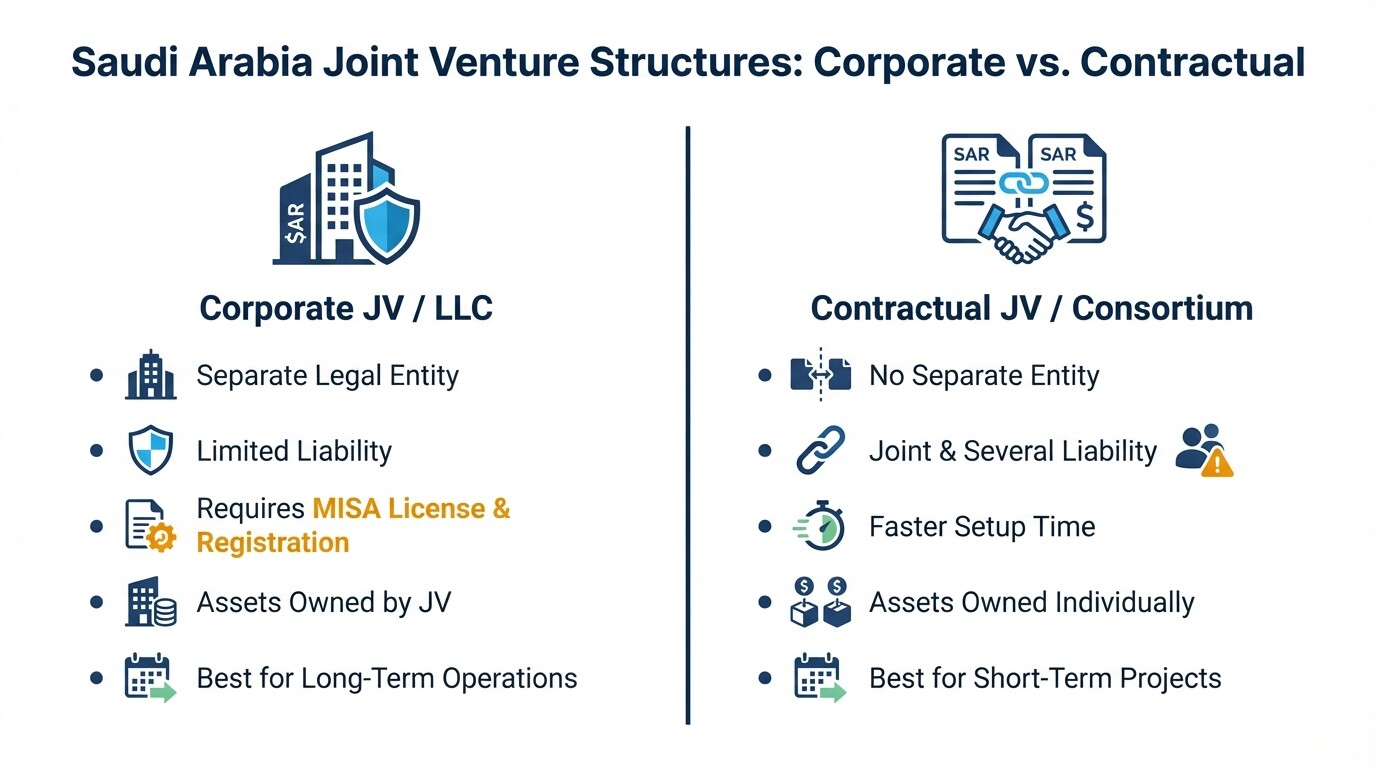
Foreign investors partnering with local entities in Saudi Arabia typically choose between a Corporate Joint Venture and a Contractual Joint Venture. A Corporate JV creates a distinct, registered legal entity that limits partner liability, while a Contractual JV relies entirely on a partnership agreement without forming a new company.
Selecting the right structure depends on the project duration, risk tolerance, and the need for a localized commercial presence. A Corporate JV, usually formed as a Limited Liability Company (LLC) or a Simple Joint Stock Company (SJSC), requires capital injection and formal registration but protects the parent companies' assets. A Contractual JV, often referred to as an unincorporated consortium, is generally used for executing specific, time-bound government contracts.
Structural Comparison: Corporate vs. Contractual JV
| Feature | Corporate JV (LLC) | Contractual JV (Consortium) |
|---|---|---|
| Legal Status | Separate legal entity | No separate legal entity |
| Liability | Limited to the partners' share capital | Joint and several liability for partners |
| Setup Time | Slower (requires MISA license, commercial registration) | Faster (governed by the underlying contract) |
| Asset Ownership | Assets are owned by the JV entity | Assets are owned by the individual partners |
| Best Used For | Long-term partnerships, ongoing commercial operations | Short-term, project-specific execution |
Drafting Management and Control Clauses Under the New Companies Law
The new Saudi Companies Law allows joint venture partners to customize management structures, voting rights, and veto powers directly within their Articles of Association or a separate Shareholders' Agreement. Partners can now allocate management control disproportionately to equity ownership, providing minority foreign investors with enhanced protections.
To maintain control over critical business decisions, foreign investors typically negotiate a list of "Reserved Matters" that require unanimous consent or a supermajority vote. This ensures that the majority local partner cannot unilaterally alter the core nature of the business, take on excessive debt, or liquidate the company.
Sample Reserved Matters Clause The following actions shall constitute Reserved Matters and shall require the affirmative vote of at least eighty percent (80%) of the total voting shares of the Company: 1. Any amendment, alteration, or repeal of any provision of the Articles of Association. 2. The issuance, sale, or transfer of new shares, or the creation of any encumbrance over existing shares. 3. Entering into any borrowing, guarantee, or financial commitment exceeding SAR 5,000,000. 4. The appointment or removal of the General Manager or Chief Financial Officer. 5. The initiation or settlement of any material litigation or arbitration.
Deadlock Resolution Mechanisms and Exit Strategy Provisions
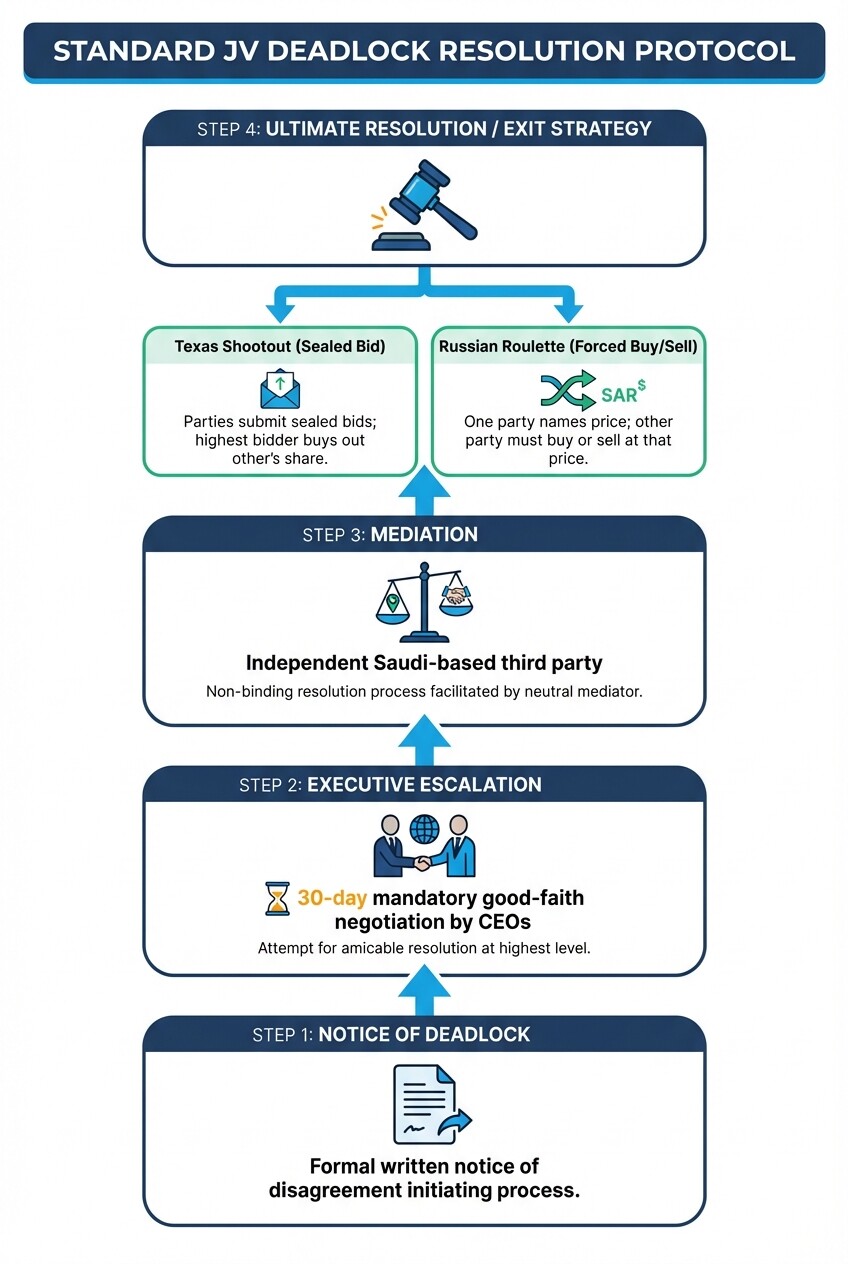
A deadlock occurs when joint venture partners cannot reach a majority decision on a critical business matter, paralyzing operations. To prevent forced liquidation under Saudi law, JV agreements must include clear escalation protocols and structured exit strategies that allow one partner to buy out the other.
Effective agreements utilize a multi-tiered approach to resolve disputes before they trigger an exit mechanism. If negotiation fails, forced transfer provisions ensure the business can continue operating under single ownership rather than facing dissolution by the commercial courts.
Standard Escalation and Resolution Steps:
- Notice of Deadlock: A formal written notice declaring a deadlock on a specific board or shareholder resolution.
- Executive Escalation: A mandatory 30-day period where the Chief Executive Officers of the parent companies attempt to negotiate a resolution in good faith.
- Mediation: Engaging an independent third-party mediator based in Saudi Arabia to facilitate a non-binding settlement.
- Texas Shootout (Sealed Bid): If mediation fails, both partners submit sealed bids specifying the price they are willing to pay for the other's shares. The highest bidder buys the other partner's shares.
- Russian Roulette: One partner offers to buy the other's shares at a specified price. The receiving partner must either accept the offer and sell, or buy the offering partner's shares at that exact same price.
Navigating Saudization (Nitaqat) Requirements in JV Structures
Joint ventures operating in Saudi Arabia must comply with the Nitaqat program, a nationalization initiative requiring businesses to hire a specific percentage of Saudi nationals. Failure to meet these demographic quotas restricts the JV's ability to obtain or renew essential work permits for foreign employees.
The Nitaqat system categorizes companies into color-coded tiers (Platinum, Green, Yellow, and Red) based on their ratio of Saudi to expatriate employees. For a Corporate JV, the entity receives its own Nitaqat rating. For a Contractual JV, the Nitaqat compliance burden falls on the individual local sponsor or the registered branch of the foreign entity. Navigating these workforce requirements requires careful planning during the JV formation stage, as the required Saudization percentage varies heavily by industry sector and total employee headcount. You can review the official classification guidelines through the Ministry of Human Resources and Social Development.
Dispute Resolution: Selecting Between Saudi Courts and Arbitration
JV partners must explicitly choose how to resolve legal conflicts, weighing the public nature and rigid procedures of Saudi Commercial Courts against the privacy and flexibility of arbitration. Most international investors prefer arbitration seated in Saudi Arabia under recognized institutional rules.
Historically, foreign investors hesitated to seat arbitrations in Saudi Arabia. However, the modern Saudi Arbitration Law aligns with the UNCITRAL Model Law, making local arbitration highly reliable. Choosing the Saudi Center for Commercial Arbitration (SCCA) ensures that proceedings can be conducted in English, arbitrators can be foreign nationals, and awards are readily enforceable within the Kingdom without facing extensive reviews of the merits by local judges.
Common Misconceptions About JVs in Saudi Arabia
- Misconception: Foreigners cannot own a majority stake in a Saudi LLC. While certain restricted sectors require a minimum percentage of Saudi ownership, foreign investors can own 100% of an LLC in most commercial, industrial, and service sectors, provided they meet MISA capital requirements.
- Misconception: Contractual JVs do not require government approval. Even if you do not form a new LLC, a foreign entity cannot legally execute commercial contracts in Saudi Arabia without a valid foreign investment license from MISA and proper commercial registration.
- Misconception: Shareholders' Agreements are not enforceable in Saudi courts. Before the new Companies Law, side agreements were difficult to enforce if they contradicted the Articles of Association. The new law explicitly recognizes Shareholders' Agreements as binding and enforceable frameworks for corporate governance.
Frequently Asked Questions
What is the minimum capital required to form a Corporate JV?
Under the new Companies Law, there is no statutory minimum capital requirement for a standard Limited Liability Company. However, MISA imposes varying minimum capital requirements for foreign investors depending on the specific industry, ranging from SAR 500,000 for standard services to SAR 30,000,000 for real estate financing.
Can a foreign partner manage the day-to-day operations of the JV?
Yes. The JV partners can appoint a foreign national as the General Manager or Chief Executive Officer. The manager must obtain a valid Saudi residency permit (Iqama) sponsored by the Corporate JV entity.
What happens if the JV agreement does not specify a governing law?
If a Corporate JV is registered in Saudi Arabia, Saudi Arabian law automatically governs the corporate mechanics, internal governance, and shareholder duties, regardless of any foreign law chosen in a side contract.
What is a Simple Joint Stock Company (SJSC)?
The SJSC is a newly introduced corporate entity under the Saudi Companies Law designed specifically to attract venture capital and joint ventures. It offers the structural flexibility of an LLC combined with the ability to issue different classes of shares, making it ideal for complex JV partnerships.
When to Hire a Corporate Lawyer
Structuring a joint venture in Saudi Arabia requires navigating foreign investment regulations, local corporate laws, and strict labor nationalization policies. You should engage legal counsel before signing any Memorandum of Understanding or Term Sheet with a prospective local partner. A lawyer is essential for drafting the Shareholders' Agreement, structuring deadlock and exit mechanisms, and managing the MISA licensing process. Consulting with experienced corporate and commercial lawyers in Saudi Arabia ensures that your management control rights are legally enforceable and compliant with the latest statutory updates.
Next Steps
- Verify Sector Restrictions: Check the MISA negative list to ensure your proposed business activity allows for foreign investment and confirm the maximum permitted foreign ownership percentage.
- Draft a Term Sheet: Outline the commercial intentions, capital contributions, profit-sharing ratios, and management control requirements before drafting formal legal documents.
- Apply for a MISA License: Submit your investment application, business plan, and the parent companies' authenticated corporate documents to the Ministry of Investment.
- Draft and Notarize Governance Documents: Finalize the Articles of Association and Shareholders' Agreement, then authenticate them before a Saudi notary public to formalize the joint venture.