- The Civil Transactions Law (CTL), effective December 2023, is Saudi Arabia's first comprehensive codification of contract law, moving away from uncodified Sharia principles.
- Good faith is a mandatory statutory requirement that applies to both the negotiation and the execution of all commercial contracts.
- Liquidated damages clauses are enforceable, but Saudi courts now have the explicit authority to reduce compensation if it is significantly higher than the actual damage suffered.
- The CTL applies retroactively to existing contracts signed before its enactment, with limited exceptions for actions already completed.
- Termination of a contract generally requires formal notice, even if a breach has occurred, unless the contract explicitly waives this requirement.
How has the Civil Transactions Law changed contract formation and interpretation?
The Civil Transactions Law (CTL) provides a structured framework where a contract is formed the moment an offer meets an acceptance, provided the subject matter is permissible and the parties have legal capacity. For interpretation, the law shifts the focus from strictly literal wording to the "common intention" of the parties, considering the nature of the transaction and local custom.
Under the new regime, the following principles govern how business deals are made and understood:
- Offer and Acceptance: An offer remains binding for the period specified by the offeror. If no period is specified, it must be accepted within a reasonable timeframe based on the circumstances of the communication.
- Electronic Formation: Contracts concluded via email or digital platforms are fully recognized under the CTL, provided they comply with the Saudi Electronic Transactions Law.
- Interpretation Priority: If a contract's language is clear, a court cannot deviate from it under the guise of interpretation. However, if the text is ambiguous, judges must look at the "hidden" intent of the parties, previous dealings, and the principle of honesty in business.
- Standard Form Contracts: The law provides protections for the "adhering party" in contracts where terms are non-negotiable (such as utilities or insurance), allowing courts to modify or exempt unfair terms.
How are liability and liquidated damages codified in commercial deals?
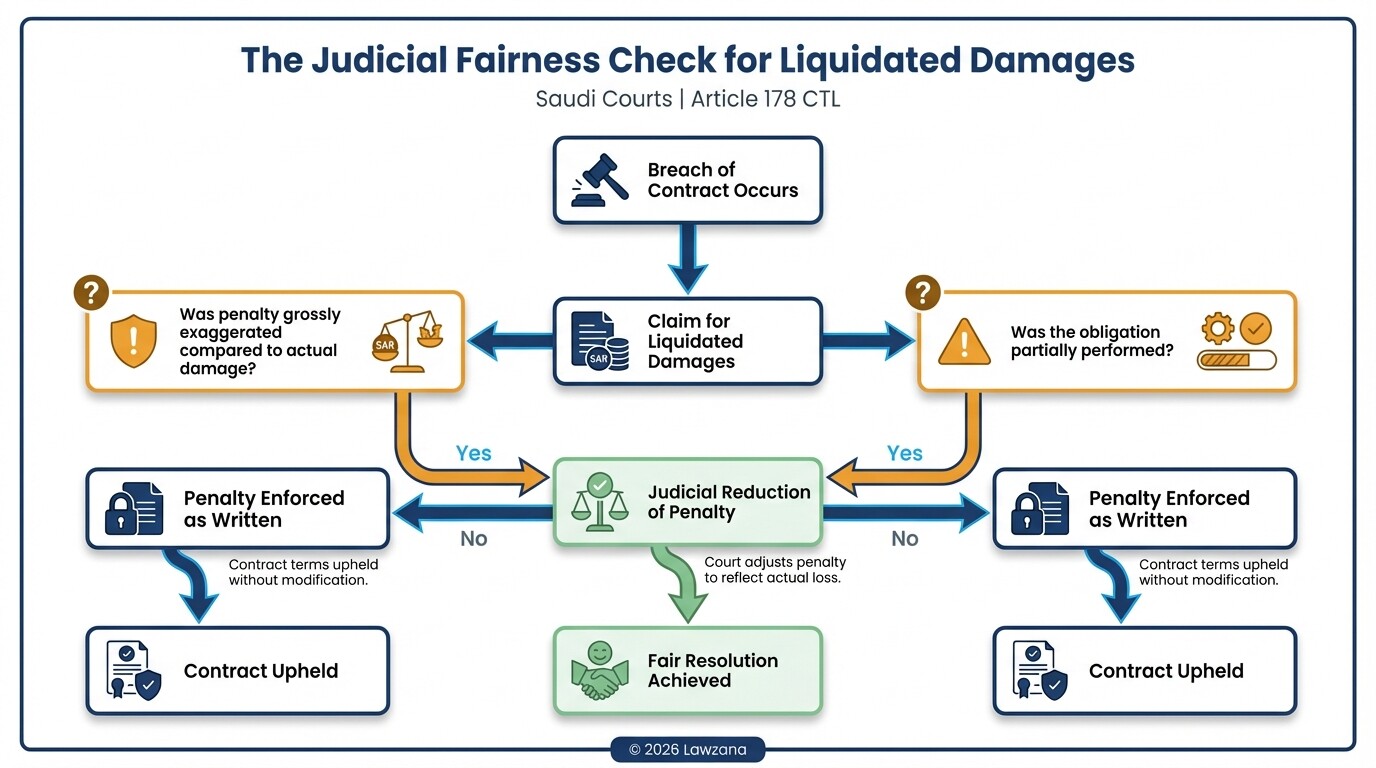
Contractual liability in Saudi Arabia arises when one party fails to fulfill an obligation, leading to a loss for the other party. The CTL codifies the right to "liquidated damages," which are pre-agreed compensation amounts set in the contract, but it introduces a significant "fairness" check that allows judicial intervention.
Key aspects of liability and damages include:
- Compensatory Focus: Damages are generally intended to cover the actual loss suffered (damnum emergens) and lost profits (lucrum cessans), provided they are a natural result of the breach.
- Adjustment of Penalties: While parties can agree on a penalty amount for a breach, Article 178 of the CTL allows a court to reduce this amount if the debtor proves it was grossly exaggerated or if the original obligation has been partially performed.
- Exclusion of Liability: Parties may agree to limit or waive liability for negligence, but any agreement to waive liability for "fraud" or "gross fault" is legally void and unenforceable.
- Causality: A party is not liable if they can prove the damage resulted from an "external cause" beyond their control, such as a force majeure event or the fault of the claimant.
What is the impact of the CTL on existing agreements signed before its enactment?
The Civil Transactions Law generally applies to all legal relationships existing at the time it came into force in December 2023. This means that even if your contract was signed years ago, any new disputes or ongoing performance issues will be governed by the new codified rules rather than previous uncodified judicial practices.
There are, however, specific limitations to this retroactivity:
- Completed Actions: Any contractual action or performance that was fully completed before the law's effective date remains governed by the rules that were in place at that time.
- Statutory Limitation Periods: If a period for filing a claim (prescription period) had already started under old rules, the old rules continue to apply to that specific timeline.
- Conflict with Specific Laws: The CTL is a general law; if a specialized regulation (like the Government Tenders and Procurement Law) has a specific provision, the specialized law takes precedence.
| Aspect | Before CTL (Uncodified) | Under CTL (Codified) |
|---|---|---|
| Legal Source | General Sharia principles | Royal Decree M/191 (Civil Transactions Law) |
| Predictability | Dependent on individual judge's interpretation | High; based on specific statutory articles |
| Lost Profits | Often difficult to recover | Explicitly recoverable if foreseeable |
| Court Intervention | Broad discretion | Structured discretion governed by the Code |
What are the termination rights and statutory notice periods for businesses?
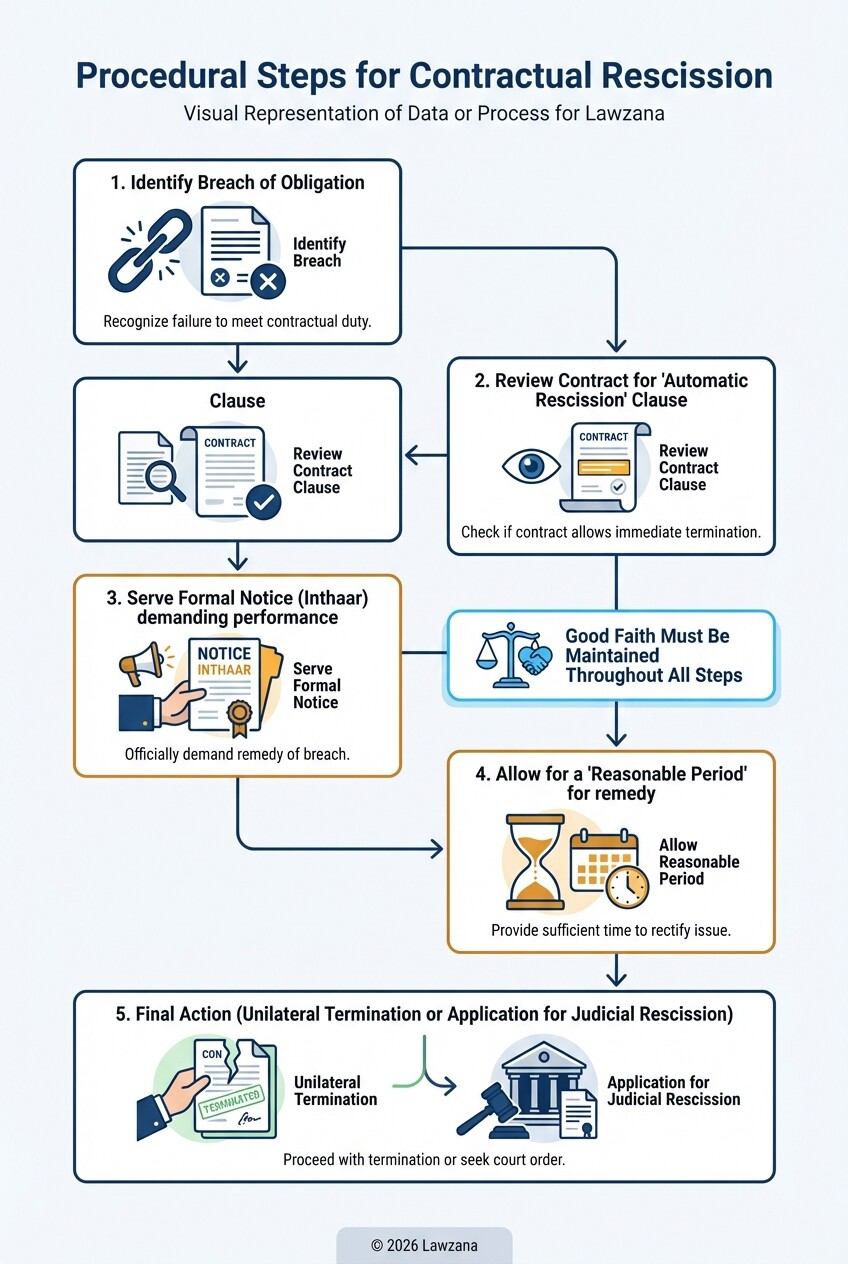
A contract in Saudi Arabia can be terminated through mutual agreement, a court order (judicial rescission), or the exercise of a unilateral termination clause. The CTL emphasizes that termination must be handled with procedural fairness, requiring a formal notice to the breaching party unless the contract specifically states otherwise.
When navigating a contract exit, businesses must follow these steps:
- Check for "Automatic Rescission": Parties can agree that a contract is automatically terminated if obligations are not met. This must be explicitly stated to bypass the need for a court order.
- The Requirement of Notice: Before terminating for a breach, you must usually serve a formal notice (Inthaar) demanding performance within a reasonable period.
- Judicial Rescission: If the contract doesn't have an automatic termination clause, you may need to apply to the Commercial Court to have the contract legally dissolved.
- Exceptional Circumstances: If an unforeseen event of a public nature (hardship) makes performing the contract "oppressive" (but not impossible), a court can now intervene to reduce the obligation or increase the compensation to a reasonable level, rather than terminating the deal entirely.
How do good faith obligations affect B2B transactions?
The principle of good faith is no longer just a moral guideline in Saudi Arabia; it is a legal mandate under Article 95 of the CTL. This requires every party to a contract to act with honesty and integrity throughout the life of the agreement, from the initial "handshake" to the final delivery.
Good faith obligations manifest in several practical ways:
- Pre-contractual Liability: If a company enters into negotiations with no real intention of reaching an agreement, or breaks off negotiations abruptly and unfairly, they may be liable for the other party's wasted costs.
- Duty of Disclosure: Parties must disclose essential facts that would influence the other party's decision to enter the contract, particularly if one party has specialized knowledge the other lacks.
- Abuse of Rights: Even if you have a "right" under a contract (like the right to audit or terminate), you cannot exercise that right solely to cause harm to the other party without a legitimate benefit to yourself.
- Performance: You must perform your obligations in a way that aligns with "honesty and the requirements of the transaction."
Common Misconceptions about Saudi Contract Law
- "Sharia means contracts are whatever the judge says they are." This is no longer the case. While the CTL is Sharia-compliant, it is a codified law with 721 articles. Judges are now bound by these specific statutes, providing significantly more certainty for international investors.
- "I can include a 50% penalty for late delivery and it's final." Many businesses believe that a "liquidated damages" clause is bulletproof. In Saudi Arabia, the court retains the right to look at the actual damage. If you set a $1 million penalty for a breach that only caused $10,000 in loss, the court will likely slash the penalty.
- "Foreign law choices are always ignored." While Saudi courts are increasingly respectful of "Choice of Law" clauses in international contracts, the CTL remains the mandatory "lex loci" (law of the place) for many aspects of business conducted within the Kingdom, especially regarding real estate and labor.
FAQ
Does a contract in Saudi Arabia need to be in Arabic?
While the CTL does not strictly mandate Arabic for private B2B contracts, any contract used in government dealings or presented as evidence in a Saudi court must be translated into Arabic by a certified translator. It is standard practice to use bilingual (English/Arabic) formats.
What is the standard limitation period for contract claims?
Under the CTL, the general limitation period for filing a lawsuit for a breach of contract is 10 years. However, specific types of claims, such as those related to labor or certain commercial disputes, may have shorter statutory windows.
Are oral contracts enforceable in Saudi Arabia?
Yes, oral contracts are generally enforceable under the CTL, provided their existence and terms can be proven. However, for commercial certainty and to meet the requirements of various regulatory bodies, written agreements are highly recommended.
Can I recover "indirect" or "consequential" damages?
The CTL allows for the recovery of lost profits, but they must be a direct and foreseeable result of the breach. Purely speculative or "remote" damages that could not have been anticipated at the time of signing are typically not recoverable.
When to Hire a Lawyer
Navigating the Saudi Civil Transactions Law requires more than just a template agreement. You should consult a qualified legal professional if:
- You are transitioning long-term "legacy" contracts to ensure they comply with the new CTL provisions.
- You are involved in high-value infrastructure or Vision 2030 projects where "exceptional circumstances" or "hardship" clauses are critical.
- You need to draft complex liquidated damages or limitation of liability clauses that must withstand judicial scrutiny.
- You are entering a joint venture or partnership where "good faith" and "pre-contractual liability" risks are high.
Next Steps
- Audit Existing Agreements: Review your current Saudi-based contracts to identify any "penalty clauses" that may be considered excessive under the new law.
- Standardize Notice Procedures: Ensure your operational teams understand the formal notice requirements for declaring a breach or terminating a vendor.
- Update "Choice of Law" Provisions: Evaluate whether your contracts should explicitly reference the Civil Transactions Law to ensure alignment with local judicial standards.
- Document Negotiations: Keep clear records of pre-contractual discussions to protect your position against claims of "bad faith" during the negotiation phase.