- Multinational companies must establish a Regional Headquarters (RHQ) in Saudi Arabia to remain eligible for government contracts exceeding SAR 1 million.
- The RHQ license provides a 30-year 0% corporate income tax rate and a 10-year exemption from "Saudization" labor quotas.
- Companies must employ at least 15 full-time employees at the RHQ within one year of licensing, including at least three executive-level managers.
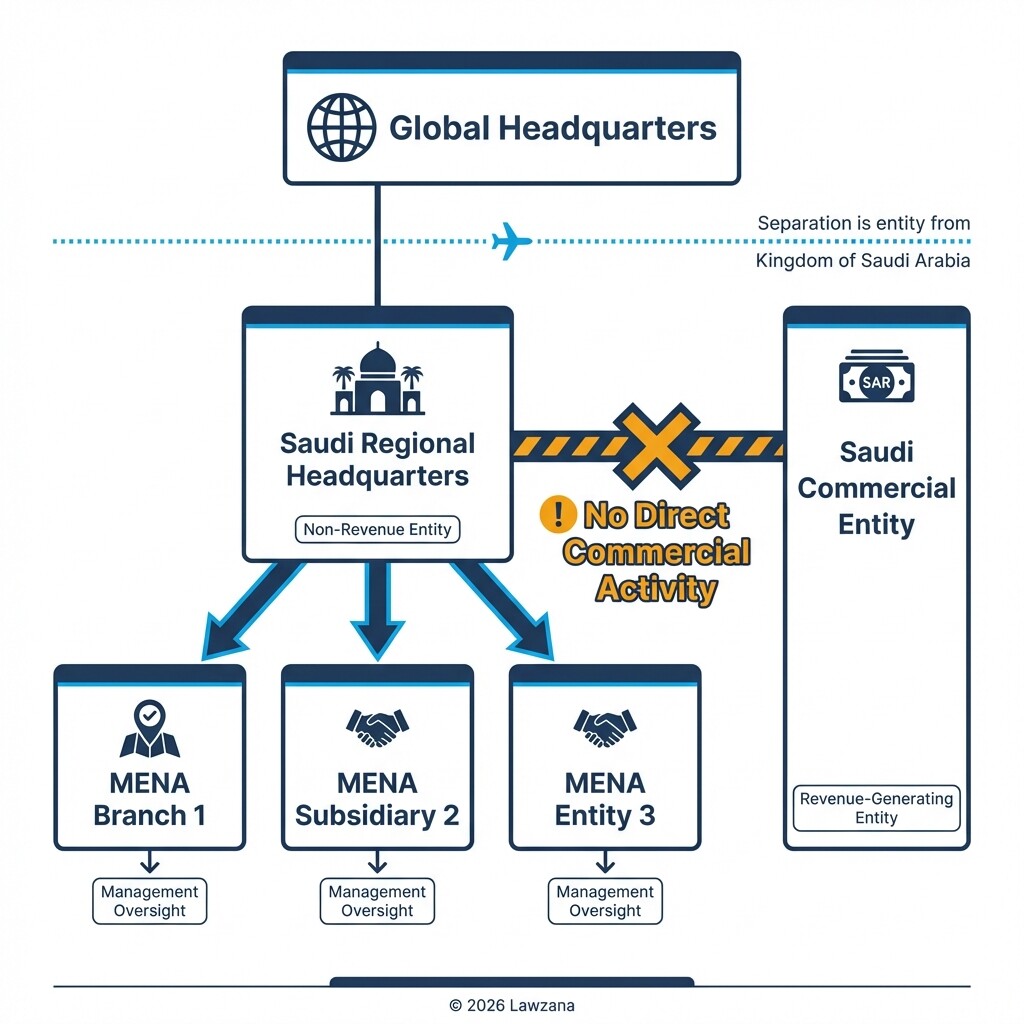
- An RHQ is a non-revenue-generating entity that provides strategic direction and administrative support to branches and subsidiaries in the MENA region.
- Eligibility requires the parent company to have a presence in at least two different countries, excluding Saudi Arabia and the country of the global headquarters.
RHQ Compliance and Registration Checklist
To successfully register a Regional Headquarters in Saudi Arabia, multinational groups must satisfy specific documentary and operational requirements. This checklist outlines the essential steps and documents needed to secure approval from the Ministry of Investment (MISA).
| Requirement Category | Essential Actions & Documents |
|---|---|
| Proof of Global Presence | Certified copies of commercial registrations for entities in at least two countries (excluding KSA and HQ country). |
| Corporate Authorization | Board resolution or Power of Attorney (PoA) authorizing the RHQ establishment, legalized by the Saudi Embassy. |
| Financial Transparency | Audited financial statements for the last fiscal year of the parent company. |
| Executive Staffing | Appointment letters for at least three "C-level" or executive managers who will relocate to Riyadh. |
| Operational Commitment | A signed undertaking to hire 15 full-time employees for RHQ functions within 12 months. |
| Physical Infrastructure | A valid commercial lease agreement for an office space in Saudi Arabia (Ejar registration). |
| Licensing Fees | Payment of the MISA application fee (typically SAR 2,000 for the first year, then SAR 62,000 annually). |
What are the eligibility criteria for the Regional Headquarters (RHQ) license?
The Saudi RHQ license is reserved for multinational groups that maintain a significant global footprint and wish to centralize their Middle East and North Africa (MENA) operations. To qualify, the applicant must demonstrate that the group operates in at least two countries other than Saudi Arabia and the country where the global headquarters is located.
MISA evaluates the applicant based on the following criteria:
- Corporate Structure: The applicant must be a branch of a foreign company or a subsidiary of a multinational group.
- Geographic Reach: Documentation must prove the group's active operations in multiple jurisdictions.
- Activity Limitation: The RHQ itself cannot engage in commercial, profit-generating activities; its sole purpose is to provide management and strategic support to other group entities.
- Contractual Necessity: While any eligible MNC can apply, the license is particularly critical for firms bidding on projects with Saudi government agencies, institutions, or funds.
What tax and regulatory benefits does the RHQ program offer?
The Saudi government offers a highly competitive incentive package to encourage global firms to relocate their regional decision-making to the Kingdom. The primary benefit is a 30-year tax holiday, which includes a 0% rate on corporate income tax and 0% withholding tax on related-party transactions.
Key benefits include:
- Tax Incentives: A guaranteed 0% corporate tax rate for 30 years from the date the RHQ license is issued.
- Saudization Exemptions: A 10-year exemption from the mandatory hiring quotas for Saudi nationals, allowing firms to staff the RHQ with international talent more easily during the startup phase.
- Visa Facilitation: RHQ employees and their families receive expedited processing for residency permits (Iqamas), and there are no limits on the number of professional visas an RHQ can request.
- Spousal Benefits: Spouses of RHQ employees are granted the right to work in the Kingdom, and the age limit for dependent children is extended to 25.
What are the timelines for shifting executive functions to Riyadh?
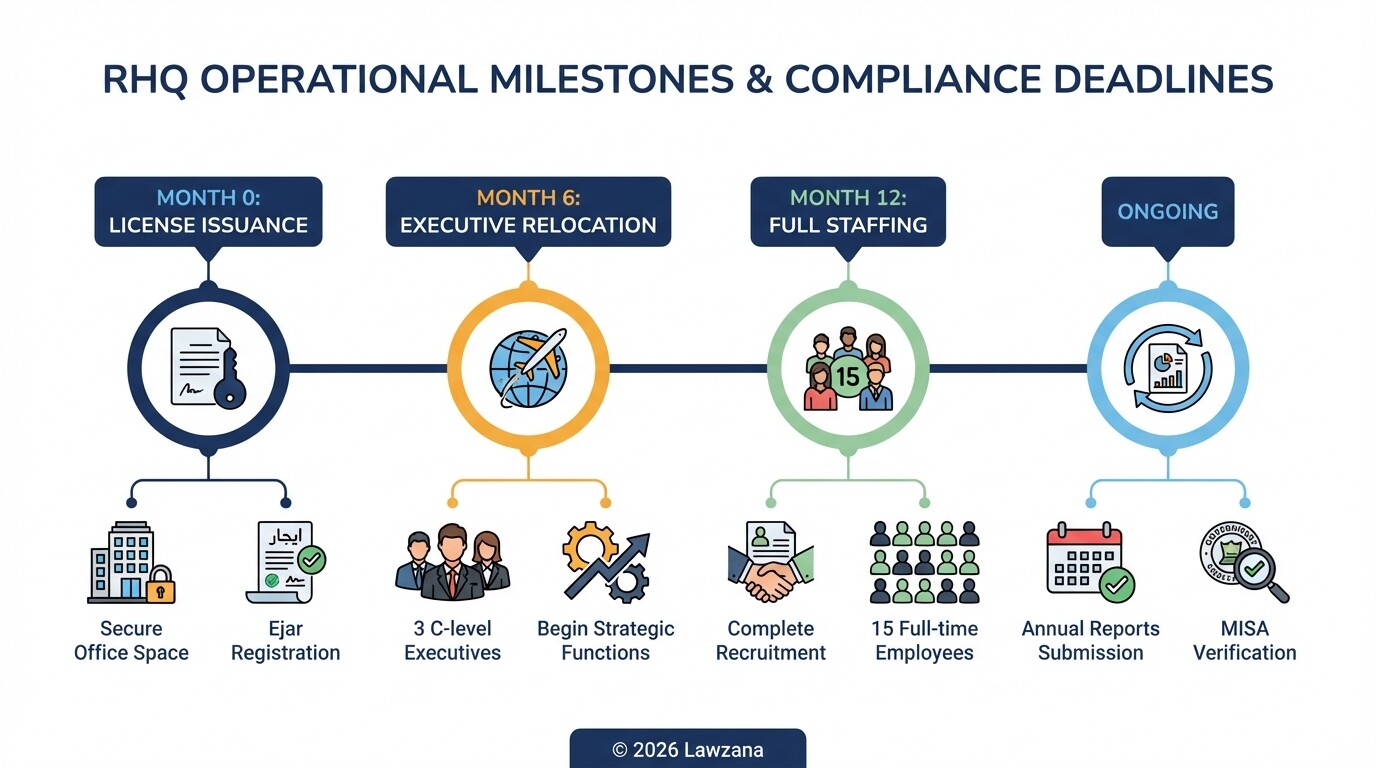
Multinational companies must transition their regional management functions to Saudi Arabia within a strict timeframe to maintain compliance with MISA regulations. The RHQ must be operational and performing its mandatory "Level 1" functions within six months of the license issuance.
The transition timeline generally follows these stages:
- Immediate (Post-License): Formalize the legal entity and secure physical office space.
- Within 6 Months: Relocate the three required executive-level managers (e.g., CEO, CFO, COO) to Riyadh and begin providing strategic direction to regional subsidiaries.
- Within 12 Months: Complete the hiring of at least 15 full-time employees dedicated exclusively to RHQ activities.
- Annual Reporting: Submit yearly reports to MISA demonstrating that the RHQ continues to fulfill its management and support roles for the region.
What are the minimum employee requirements and hiring mandates?
The RHQ is designed to be a center of expertise and leadership, requiring a minimum staff of 15 full-time employees within the first year. These employees must be dedicated to the RHQ's internal operations and cannot be shared with the company's local commercial branches.
Minimum staffing requirements include:
- Executive Leadership: At least three employees must be at the executive or "C-suite" level (e.g., Regional CEO, Regional VP).
- Mandatory Functions: Staff must perform strategic functions such as regional business planning, coordination of marketing, financial supervision, and legal oversight.
- Exclusivity: RHQ employees must work specifically on regional oversight and are not permitted to work on the day-to-day operations of the Saudi-based commercial subsidiary.
- Gradual Localization: While the 10-year Saudization exemption exists, firms are still encouraged to integrate local talent as the entity scales.
How do RHQ regulations interact with MISA and government procurement?
The RHQ program is a central pillar of Saudi Arabia's "Vision 2030" and is strictly enforced through the Ministry of Investment (MISA). The most significant regulatory interaction is the link between RHQ status and the right to participate in public sector projects.
Key regulatory intersections include:
- Procurement Ban: As of January 1, 2024, Saudi government entities are prohibited from contracting with foreign companies that do not have their regional headquarters in the Kingdom, provided the contract value exceeds SAR 1 million.
- Operating License vs. RHQ License: The RHQ license is distinct from a standard MISA "Service" or "Trading" license. A company typically maintains an RHQ license for regional management and a separate commercial license for its local business activities.
- Reporting and Audits: MISA conducts regular reviews to ensure the RHQ is not being used as a shell entity. The company must prove that regional decisions for the MENA area are actually being made within the Saudi office.
Common Misconceptions About Saudi RHQs
"The RHQ can be our main commercial entity in Saudi Arabia."
This is incorrect. An RHQ is legally restricted from generating revenue. You must still maintain a separate subsidiary or branch with its own MISA license to conduct sales, delivery, or services within the Saudi market.
"We only need to move a few junior staff to Riyadh to comply."
MISA requires high-level decision-makers to be based in the Kingdom. At least three of your 15 employees must be senior executives. The goal is to move the "center of gravity" for your regional business to Saudi Arabia, not just a support desk.
"The Saudization exemption lasts forever."
The exemption from labor quotas is generous but temporary, currently set at 10 years. Companies should use this time to build a pipeline of local talent so they are prepared when standard Nitaqat (localization) requirements eventually apply.
FAQ
Can an RHQ provide services to third parties?
No. An RHQ can only provide management and support services to entities within the same multinational group. It cannot act as a consultant or service provider for external clients.
What happens if we don't meet the 15-employee requirement?
Failure to meet the minimum staffing requirement within 12 months can lead to the suspension or cancellation of the RHQ license, which would subsequently disqualify the firm from government contracts.
Is Riyadh the only city where we can set up an RHQ?
While Riyadh is the primary business hub and the preferred location for most MNCs, you can legally establish an RHQ in other Saudi cities, such as Jeddah or Dammam, as long as it serves as the regional management center.
Does the RHQ need to be a separate legal entity?
Yes, the RHQ is typically established as a distinct branch of the foreign company or a separate subsidiary, registered specifically with an RHQ license from MISA.
When to Hire a Lawyer
Navigating the RHQ mandate involves complex cross-border legal considerations, particularly regarding corporate restructuring and tax planning. You should consult a legal expert if:
- You are currently bidding on or planning to bid on Saudi government contracts.
- You need to restructure your global corporate hierarchy to meet the "presence in two countries" requirement.
- You require assistance with the legalization and translation of foreign corporate documents for use in Saudi Arabia.
- You need to draft employment contracts for expatriate executives that comply with both Saudi Labor Law and RHQ-specific regulations.
Next Steps
- Conduct an Audit: Determine if your current regional structure meets the MISA definition of a multinational group.
- Consult Tax Advisors: Analyze how the 30-year tax holiday interacts with your home country's tax laws and double taxation treaties.
- Engage with MISA: Reach out to the Ministry of Investment to begin the pre-approval process and clarify any specific requirements for your industry.
- Secure Office Space: Begin the search for a physical headquarters in Riyadh or another major Saudi city to satisfy the Ejar registration requirement.
- Begin Executive Recruitment: Identify the three senior leaders who will lead the transition and relocate to the Kingdom.