Resolving Asian Cross-Border Disputes in Singapore: Arbitration Costs and Alternatives
- Singapore is the premier dispute resolution hub in Asia, offering specialized regulatory frameworks and neutral grounds for multinational business disputes.
- Structuring a multi-tier dispute resolution clause in your commercial contracts can save millions by mandating mediation before arbitration.
- The Singapore International Arbitration Centre (SIAC) scales administrative costs based on the dispute amount, with complex commercial cases typically resolving in 12 to 18 months.
- Arbitral awards issued in Singapore are enforceable in over 170 jurisdictions worldwide under the New York Convention.
- The Singapore Convention on Mediation provides a cost-effective alternative by allowing international commercial settlement agreements to be enforced directly across borders.
Regulatory Advantages of the Singapore International Arbitration Centre (SIAC)
Singapore provides a neutral, pro-arbitration legal framework supported by an independent judiciary and the highly regarded Singapore International Arbitration Centre (SIAC). Multinational corporations favor Singapore because local courts strictly limit their intervention in the arbitration process, ensuring proceedings remain confidential and entirely driven by the parties' agreements.
The jurisdiction operates under an English common law system, providing high predictability for corporate entities. Furthermore, Singapore's International Arbitration Act 1994 is heavily based on the UNCITRAL Model Law, creating a globally recognized standard of procedural fairness. SIAC rules offer critical regulatory advantages for joint ventures and mergers, including provisions for emergency arbitrators, early dismissal of claims, and the consolidation of multiple related contracts into a single arbitration proceeding.
Sample Multi-Tier Dispute Resolution Clause
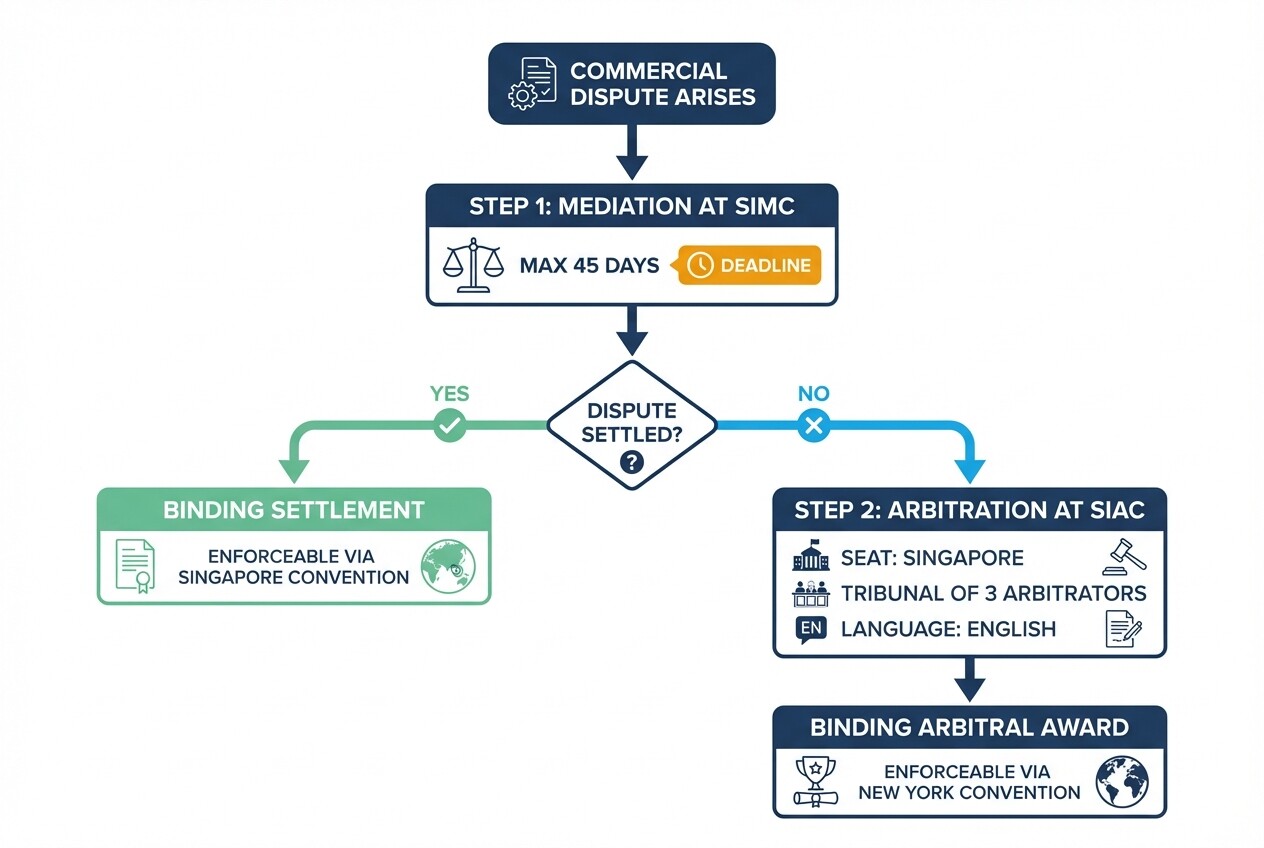
A multi-tier dispute resolution clause requires parties to attempt mediation before escalating to binding arbitration, preserving business relationships and reducing legal fees. When drafting pan-Asian joint venture agreements, precision is critical to ensure the clause is legally enforceable rather than just an "agreement to agree."
Below is a standard multi-tier "Arb-Med-Arb" clause framework suitable for cross-border commercial contracts:
Dispute Resolution Provision:
- Mediation First: "In the event of any dispute arising out of or in connection with this contract, including any question regarding its existence, validity, or termination, the parties shall first seek settlement of that dispute by mediation at the Singapore International Mediation Centre (SIMC) in accordance with the SIMC Mediation Rules in force at the time."
- Escalation to Arbitration: "If the dispute is not settled by mediation within 45 days of the commencement of the mediation, or such further period as the parties shall agree in writing, the dispute shall be referred to and finally resolved by arbitration administered by the Singapore International Arbitration Centre (SIAC) in accordance with the Arbitration Rules of the SIAC for the time being in force, which rules are deemed to be incorporated by reference in this clause."
- Seat and Language: "The seat of the arbitration shall be Singapore. The Tribunal shall consist of three arbitrator(s). The language of the arbitration shall be English."
Arbitration Costs and Timelines at SIAC
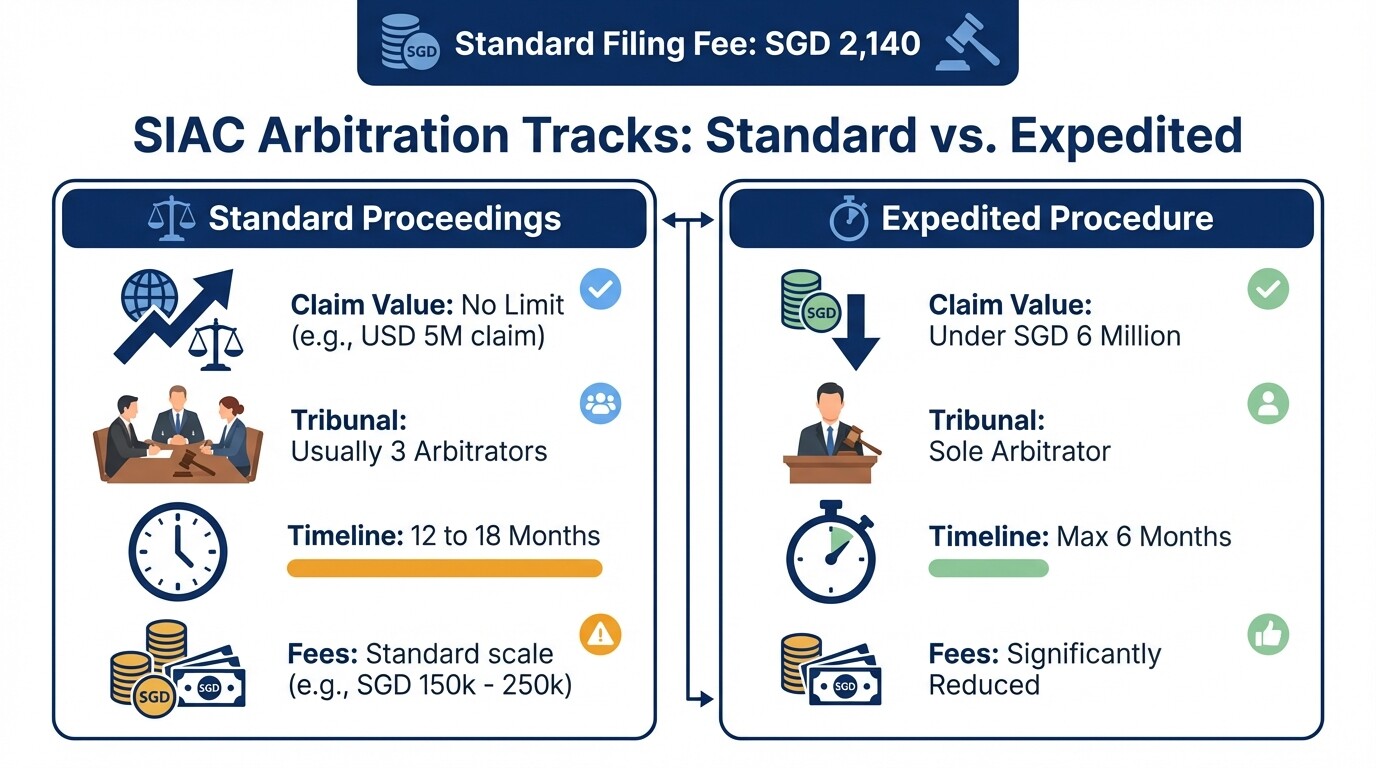
Administrative costs and arbitrator fees at SIAC are tiered based on the sum in dispute, with an average cross-border arbitration taking 12 to 18 months from filing to the final award. Understanding these costs upfront allows general counsel to accurately budget for dispute resolution in complex joint venture agreements.
To commence arbitration, the claimant must pay a non-refundable Notice of Arbitration filing fee of SGD 2,140. Beyond the filing fee, both SIAC administrative fees and the arbitrators' fees are calculated using a sliding scale based on the total claim value.
Key cost and timeline factors include:
- Standard Proceedings: For a USD 5 million (approx. SGD 6.7 million) dispute handled by a three-person tribunal, the combined institutional and arbitrator fees typically range from SGD 150,000 to SGD 250,000. These figures do not include legal counsel or expert witness fees. Standard proceedings usually take a year and a half.
- Expedited Procedure: If the amount in dispute is less than SGD 6 million, or if the parties agree, SIAC offers an Expedited Procedure. This process utilizes a sole arbitrator and mandates that the final award be issued within six months of the tribunal's constitution, significantly reducing both time and administrative costs.
The Singapore Convention on Mediation Explained
The Singapore Convention on Mediation transforms international commercial mediation by allowing parties to directly enforce cross-border settlement agreements in the courts of participating countries. Traditionally, if a party defaulted on a mediated settlement, the aggrieved party had to file a new breach of contract lawsuit. This convention eliminates that redundant step.
For businesses operating across Asia, mediation presents a highly cost-effective alternative to arbitration. Mediation typically resolves within days or weeks rather than months, costing a fraction of arbitration fees. More importantly, mediation focuses on collaborative problem-solving, which is essential for preserving long-term pan-Asian joint ventures and supply chain relationships where cultural norms highly value saving face and maintaining harmony.
Enforcing Singapore Arbitral Awards Globally
Arbitral awards issued in Singapore are highly portable and enforceable in 172 jurisdictions globally due to the New York Convention. When a tribunal in Singapore issues an award, the winning party can take that award to the local courts of the losing party's home country to seize assets and enforce compliance.
Because Singapore is a signatory to the New York Convention, foreign courts are required to recognize and enforce Singaporean awards as if they were domestic court judgments. The grounds on which a foreign court can refuse enforcement are extremely narrow, generally limited to severe procedural failures, lack of due process, or situations where enforcing the award would violate the public policy of that specific country. This robust enforceability is the primary reason multinational companies prefer arbitration over traditional litigation for cross-border deals.
Common Misconceptions About Asian ADR
- Arbitration is always cheaper than litigation. While arbitration avoids the drawn-out appeals process of traditional courts, it requires parties to pay for the "judges" (arbitrators) and the venue. For smaller disputes, institutional arbitration can actually require a higher upfront capital investment than domestic litigation.
- Mediation is just a non-binding discussion with no legal teeth. Since the introduction of the Singapore Convention on Mediation, mediated settlements carry profound legal weight. Once an agreement is signed by both corporate entities, it can be executed as a binding international instrument in signatory jurisdictions.
- Foreign lawyers cannot represent clients in Singapore. Unlike local court litigation, which requires locally admitted advocates, international arbitration in Singapore allows parties to use foreign legal counsel. Your preferred corporate counsel from New York or London can fly to Singapore to represent you in a SIAC hearing.
Frequently Asked Questions
How do I initiate an arbitration at SIAC?
You must file a Notice of Arbitration with the Registrar of SIAC. This document should outline the nature of the dispute, the specific contract clause invoked, and the relief sought, accompanied by the mandatory non-refundable filing fee of SGD 2,140.
Can we choose a governing law different from the seat of arbitration?
Yes. It is highly common in cross-border joint ventures to choose a neutral seat (e.g., Singapore) while governing the substantive contract under a different law (e.g., English Law or New York Law). The tribunal will apply the chosen substantive law to the dispute.
What happens if the other party refuses to participate in the arbitration?
SIAC rules allow the arbitration to proceed even if the respondent fails to submit a response or refuses to attend hearings. The tribunal can issue a binding default award based on the evidence provided by the claimant, which remains globally enforceable.
When to Hire an International Arbitration Lawyer
You should engage an international arbitration lawyer during the contract drafting phase to structure an ironclad dispute resolution clause, or immediately when a high-stakes cross-border dispute threatens your operations. Navigating the strategic choices between expedited procedures, emergency arbitrator applications, and jurisdictional challenges requires specialized expertise. You can find leading alternative dispute resolution lawyers in Singapore to evaluate your joint venture agreements or represent your corporate interests in an active dispute.
Next Steps for Your Business
- Audit Existing Contracts: Review your current international agreements to ensure the dispute resolution clauses accurately specify SIAC or another reputable institution, including the seat and language of arbitration.
- Implement Tiered Clauses: Update future contract templates to include multi-tier Arb-Med-Arb clauses, ensuring you have the opportunity to resolve issues through the Singapore Convention on Mediation before incurring arbitration costs.
- Consult Legal Counsel: If a cross-border dispute is emerging, compile all related communications and contract drafts, and consult an arbitration specialist to assess the strategic viability and potential cost of filing a Notice of Arbitration.