- The Singapore International Arbitration Centre (SIAC) provides a private, neutral venue for resolving complex cross-border joint venture disputes.
- You must draft a precise multi-party arbitration clause to avoid jurisdictional battles when a joint venture involves three or more parties.
- SIAC's Expedited Procedure resolves disputes valued under SGD 6 million in six months.
- Emergency arbitrators can be appointed within 24 hours to secure cross-border asset freezing and prevent intellectual property theft.
- SIAC arbitral awards are enforceable in over 170 countries under the New York Convention.
Why Choose SIAC for Joint Venture Disputes?
Multinationals operating in the Asia-Pacific region frequently use the Singapore International Arbitration Centre (SIAC) to resolve joint venture conflicts. SIAC offers a private forum for complex commercial disputes.
Singapore has a strong rule of law and a pro-arbitration judiciary. Governed locally by the International Arbitration Act 1994, Singapore courts support the arbitral process and minimize judicial interference. Choosing Singapore as the legal "seat" of arbitration means the process is protected by these local laws, even if the physical hearings happen elsewhere. Corporate secrets remain confidential, and specialized commercial arbitrators handle the dispute instead of domestic judges.
Multi-Party Joint Venture Arbitration Clauses
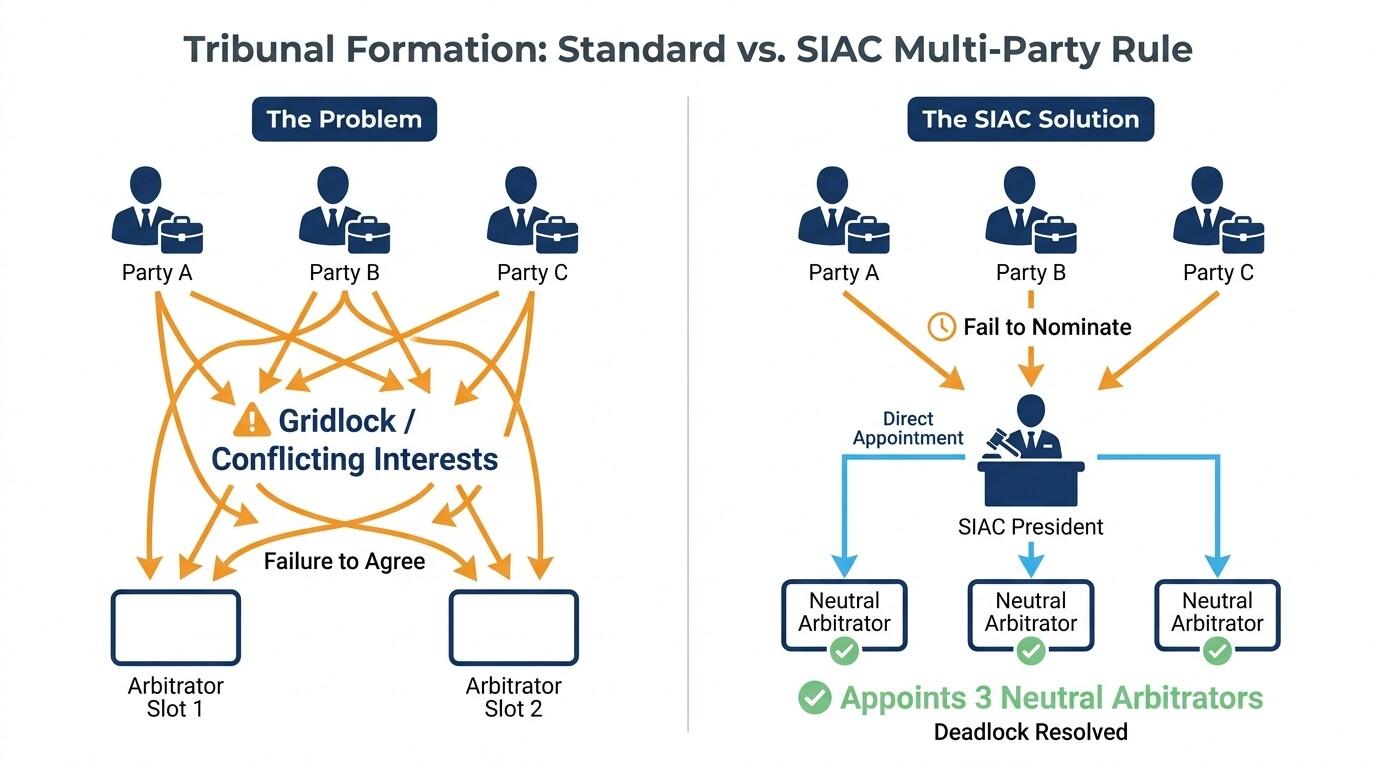
Joint ventures often involve three or more parties. Drafting an arbitration agreement for these structures requires specific language regarding arbitrator appointment and dispute consolidation. Without this, parties face jurisdictional battles before the arbitration begins.
A standard two-party arbitration clause allows each side to appoint an arbitrator. This fails when three parties have conflicting interests.
Common drafting mistakes include:
- Asymmetric appointment rights: Failing to specify how a three-member tribunal is formed if respondents cannot agree on a joint nominee.
- Ignoring consolidation: SIAC Rules allow parties to consolidate multiple arbitrations if the claims fall under compatible agreements. The arbitration clause should explicitly permit related disputes under subsidiary contracts to merge.
- Vague scope: Using narrow phrasing like "disputes arising under this contract" instead of broad language like "disputes arising out of or in connection with this contract." Narrow phrasing may exclude tort or statutory claims.
- Non-signatory ambiguity: Failing to specify whether affiliates or parent companies are bound by the clause. While legal doctrines can sometimes compel non-signatories to arbitrate, explicit language prevents confusion.
Sample SIAC Multi-Party Arbitration Clause
To avoid multi-party disputes over tribunal formation, your joint venture agreement should adopt language that delegates the appointment power to the SIAC President if the parties cannot align.
"Any dispute arising out of or in connection with this contract, including any question regarding its existence, validity, or termination, shall be referred to and finally resolved by arbitration administered by the Singapore International Arbitration Centre (SIAC) in accordance with the Arbitration Rules of the Singapore International Arbitration Centre (SIAC Rules) for the time being in force, which rules are deemed to be incorporated by reference in this clause.
The seat of the arbitration shall be Singapore. The Tribunal shall consist of three arbitrator(s).
In the event that there are more than two parties to the dispute, and the parties acting as Claimant(s) or the parties acting as Respondent(s) fail to jointly nominate an arbitrator within the time limit stipulated by the SIAC Rules, the President of the Court of Arbitration of SIAC shall appoint all three arbitrators, and shall designate one of them to act as the presiding arbitrator.
The language of the arbitration shall be English."
Expedited Arbitration Under SIAC Rules
SIAC's Expedited Procedure resolves disputes in under six months. This track is useful for joint venture disputes affecting time-sensitive operations.
A party can apply for the Expedited Procedure if the aggregate amount in dispute does not exceed SGD 6 million, if the parties agree, or in cases of exceptional urgency.
Key features of expedited SIAC arbitration:
- Sole arbitrator: A single arbitrator hears the dispute, reducing scheduling conflicts and fees.
- Streamlined process: The arbitrator has broad discretion to limit document production, restrict witness testimony, and decide the case on documentary evidence alone.
- Strict timeline: The tribunal must issue the final award within six months from the date it is constituted.
Emergency Arbitrators for Asset Freezing
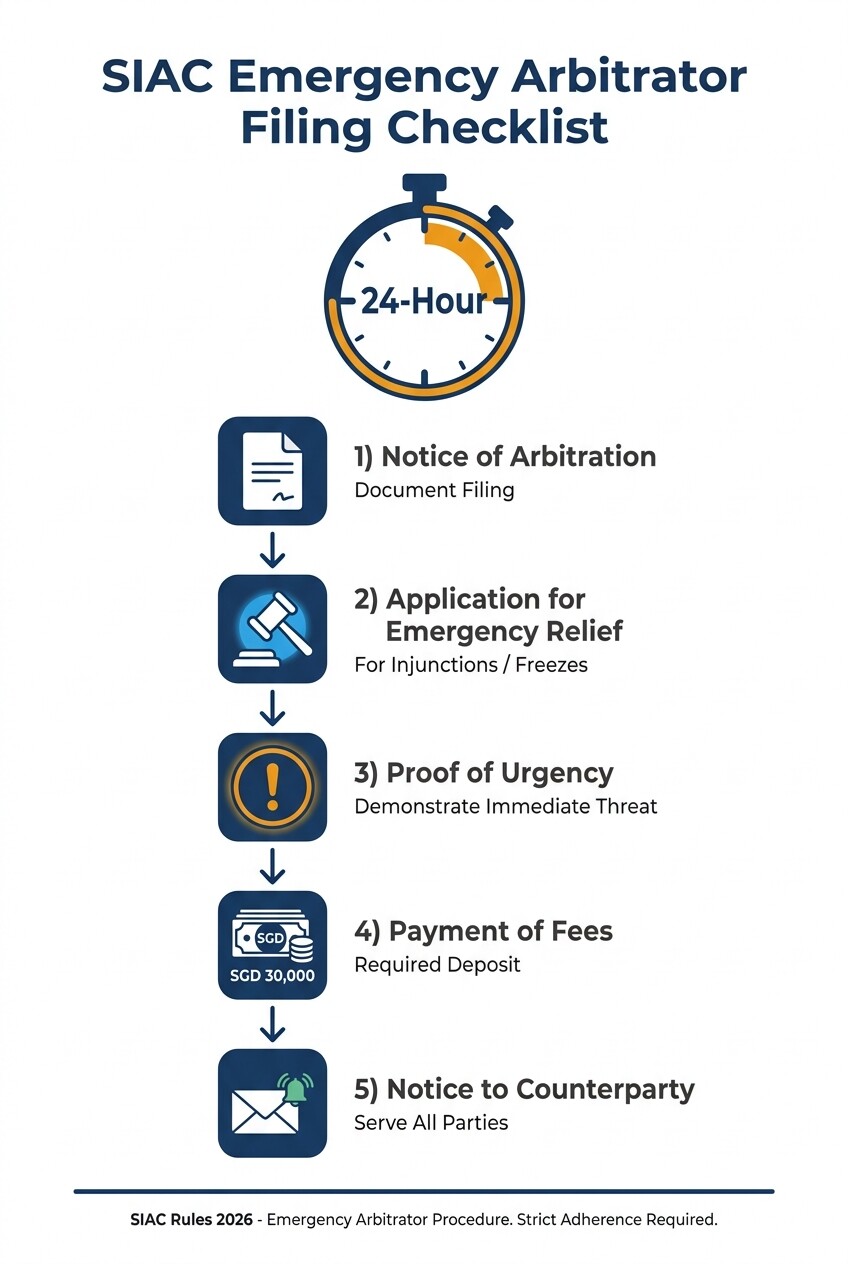
If a joint venture partner threatens to dissipate assets or steal intellectual property, SIAC rules allow you to appoint an emergency arbitrator within 24 hours. This provides binding interim relief before the main arbitral tribunal forms.
A rogue partner might attempt to empty joint bank accounts or transfer proprietary software. Singapore law explicitly recognizes the powers of an emergency arbitrator. Their orders for injunctions and asset freezes carry the same legal weight as a court order.
Emergency arbitrator filing checklist:
- Notice of Arbitration: File the primary Notice of Arbitration alongside the emergency application.
- Application for Emergency Relief: Detail the interim orders sought (e.g., asset freeze, anti-suit injunction).
- Proof of Urgency: Provide evidence showing why relief cannot wait for the main tribunal.
- Payment of Fees: Submit the non-refundable administration fee and emergency arbitrator deposit (around SGD 30,000).
- Notice to Counterparty: Notify the opposing party simultaneously unless an ex parte application is legally justified.
Cost and Timeline of a Singapore-Seated Arbitration
A standard SIAC commercial arbitration takes 12 to 18 months from the notice of arbitration to the final award. Costs depend on the sum in dispute. SIAC calculates administrative and arbitrator fees on a transparent sliding scale.
Arbitration costs in Singapore include institutional fees, arbitrator fees, and legal fees. Legal fees typically account for 70% to 80% of the total cost.
| Arbitration Type | Average Timeline | Estimated Fees (SGD) | Best Used For |
|---|---|---|---|
| Expedited Procedure | 6 months | ~SGD 35,000 - 60,000 | Disputes under $6M. Straightforward breaches, debt recovery. |
| Standard (Sole Arbitrator) | 9 - 12 months | ~SGD 80,000 - 150,000 | Disputes $10M+. Mid-sized JV disputes requiring some discovery. |
| Standard (Three Arbitrators) | 12 - 18+ months | ~SGD 250,000+ | Disputes $50M+. Complex, high-stakes multi-party JV conflicts. |
Note: Institutional fees require an initial filing fee of SGD 2,140. External legal counsel and expert witness fees are additional.
Strategies for Enforcing SIAC Arbitral Awards
Enforcing a SIAC award abroad relies on the New York Convention, which requires over 170 member countries to recognize and enforce the ruling. Prevailing parties must secure a certified copy of the award and follow the local procedural rules of the target country.
Joint ventures often involve holding companies and assets scattered across multiple jurisdictions. You must identify these assets to enforce the award successfully.
- Identify assets early: Map out the opposing party's bank accounts, real estate, and operational subsidiaries before initiating arbitration.
- Ensure flawless due process: The most common defense against enforcement is a breach of due process. The losing party must receive proper notice and a fair opportunity to present their case.
- Local counsel coordination: Engage local enforcement counsel in the jurisdiction where the assets are located to file recognition petitions in domestic courts.
Common Misconceptions About SIAC Arbitration
Many businesses misunderstand the scope and finality of international arbitration in Singapore.
- Cost vs. litigation: Complex international arbitrations with three-member tribunals and extensive document production can rival or exceed the cost of commercial litigation. The primary benefits are confidentiality, specialized expertise, and global enforceability.
- Appeal limitations: Arbitral awards are final and binding. Under Singapore law, you can only set aside an award on narrow procedural grounds, such as fraud, lack of jurisdiction, or a breach of natural justice. You cannot appeal simply because the arbitrator made an error of fact or law.
- Foreign legal counsel: Parties are free to use foreign legal counsel for international commercial arbitration seated in Singapore. You only need a Singapore-qualified lawyer if the dispute involves Singapore domestic law or requires local court litigation.
When to Hire a Lawyer
Engage legal counsel when a joint venture shows signs of fracturing or when drafting the initial commercial agreements. An arbitration lawyer helps secure your position, manage cross-border asset risks, and navigate SIAC's procedural rules.
Seek legal advice if a joint venture partner threatens a material breach, acts unilaterally, or attempts to siphon company assets. Early action allows your counsel to draft emergency arbitrator applications and structure a dispute resolution strategy before the tribunal forms. You can connect with verified ADR, mediation, and arbitration lawyers in Singapore through Lawzana.
Next Steps
- Review agreements: Locate the dispute resolution clause in your joint venture contract to verify the chosen institution, seat, and governing law.
- Secure company data: Restrict access to sensitive intellectual property and preserve all communications, financial records, and board meeting minutes.
- Assess counterparty assets: Conduct asset tracing to identify where the opposing party's liquid assets and operational centers are located.
- Draft arbitration notice: Work with your legal counsel to prepare a notice outlining your claims, the relief sought, and your proposal for tribunal formation.