Setting Up a VCC in Singapore: A Guide for Foreign Fund Managers
Key Takeaways
The Variable Capital Company (VCC) is Singapore's flagship corporate structure tailored specifically for investment funds. It offers unparalleled operational flexibility and tax efficiencies for foreign fund managers seeking a regulated, reputable Asian base.
- Ring-fenced liabilities: The VCC allows you to group multiple sub-funds under one umbrella, ensuring the debts of one sub-fund cannot compromise the assets of another.
- Privacy of financials: Unlike standard corporate entities in Singapore, a VCC's shareholder register and financial statements are not available to the public.
- Mandatory local management: Foreign fund managers must partner with or establish a Singapore-based, MAS-regulated fund manager to operate a VCC.
- Flexible capital movements: VCCs can easily issue and redeem shares or pay dividends out of capital, bypassing the strict capital maintenance rules of traditional companies.
Benefits of the VCC Structure for Sub-Fund Segregation
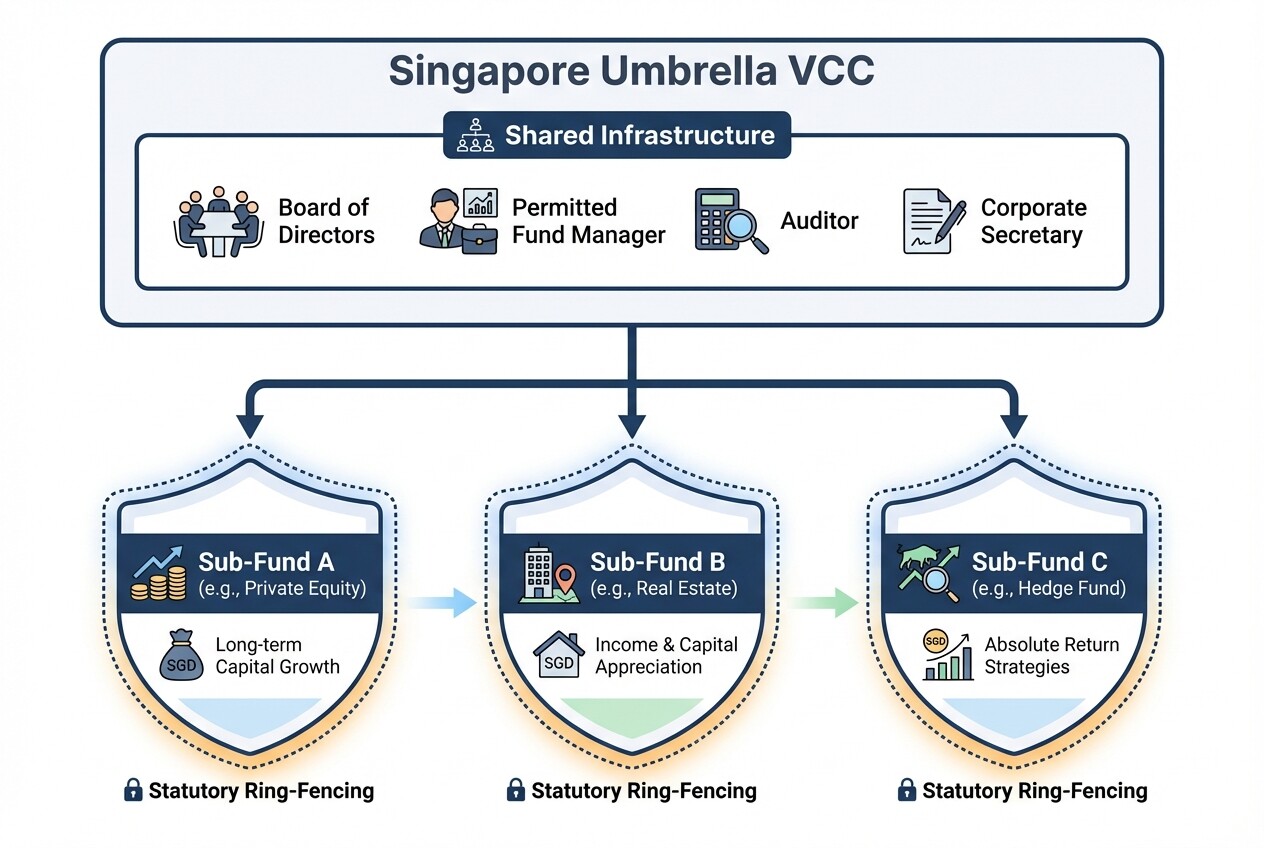
The VCC structure allows fund managers to group multiple investment strategies under a single corporate umbrella while legally ring-fencing their assets and liabilities. This statutory segregation prevents the insolvency of one sub-fund from affecting the others, protecting investors who commit capital to different risk profiles.
Operating a single umbrella entity with multiple sub-funds creates significant economies of scale. Instead of incorporating a new corporate entity for every new investment strategy, fund managers simply register a new sub-fund under the existing VCC. All sub-funds can share the same board of directors, fund manager, corporate secretary, and auditor. This shared infrastructure drastically reduces administrative overhead and accelerates the time-to-market for new fund launches. Furthermore, the VCC framework accommodates both open-ended and closed-ended funds, allowing you to house private equity, real estate, and hedge fund strategies within the same umbrella.
Traditional Private Limited Company vs. VCC
While a traditional Private Limited company requires you to establish separate legal entities for different investment strategies to protect assets, a VCC houses multiple strategies within distinct sub-funds under one entity. The VCC was explicitly engineered to overcome the rigid capital maintenance and dividend restrictions that make traditional companies cumbersome for investment funds.
| Feature | Traditional Private Limited (Pte. Ltd.) | Variable Capital Company (VCC) |
|---|---|---|
| Asset Segregation | Requires incorporating multiple separate companies. | Built-in via statutory ring-fencing of sub-funds. |
| Capital Reduction | Complex process requiring shareholder or court approval. | Seamless issuance and redemption of shares at net asset value. |
| Dividend Payments | Can only be paid out of company profits. | Can be paid out of capital. |
| Public Disclosure | Financials and shareholder registers are publicly accessible. | Financials and shareholder registers remain private. |
| Tax Treatment | Each company files individual tax returns. | Single tax return filed for the entire umbrella VCC. |
Regulatory Requirements for Foreign Fund Managers in 2026
Foreign fund managers cannot directly manage a VCC from overseas; you must operate through a Singapore-based Permitted Fund Manager regulated by the Monetary Authority of Singapore (MAS). As regulatory frameworks evolve toward 2026, MAS is implementing stricter anti-money laundering controls and phasing in mandatory environmental, social, and governance reporting for financial institutions.
To establish a VCC, your appointed Singapore fund manager must hold a Capital Markets Services (CMS) license for fund management, or fall under a specific exemption such as the single family office exemption. The VCC must appoint at least one local resident director. Furthermore, at least one director must be a qualified representative of the appointed fund manager. Looking toward 2026, foreign managers setting up local entities must ensure their compliance frameworks account for enhanced MAS scrutiny on digital asset exposures, robust sanctions screening, and transparent climate-risk disclosures in their annual reporting.
Step-by-Step Registration with ACRA and MAS
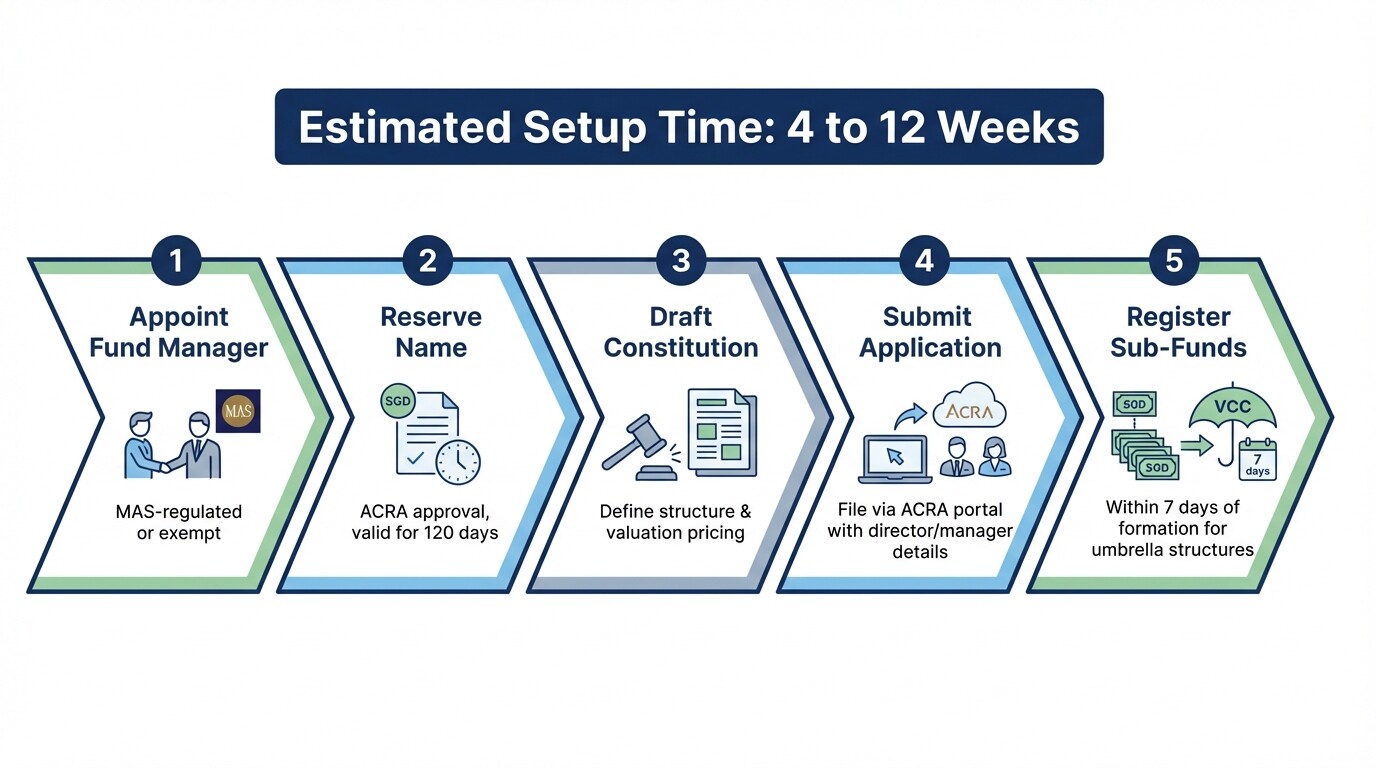
Incorporating a VCC involves a dual-agency process starting with name approval via the Accounting and Corporate Regulatory Authority (ACRA) and concluding with regulatory compliance alignment under MAS. The entire setup typically takes four to twelve weeks, depending on the complexity of your sub-funds and the readiness of your local management team.
Step 1: Appoint a Singapore Fund Manager You must secure a commitment from an MAS-regulated Permitted Fund Manager. This entity will be legally responsible for the management of the VCC's property.
Step 2: Reserve the VCC Name Submit your proposed VCC name to ACRA for approval. Once approved, the name is reserved for 120 days. If you are setting up an umbrella VCC, sub-funds do not need separate name reservations at this stage.
Step 3: Draft the Constitution Prepare the VCC constitution. This document must explicitly state that the entity is a VCC, define whether it operates as an umbrella or standalone fund, and outline the valuation and pricing methodologies for shares.
Step 4: Submit Incorporation Documents to ACRA File the incorporation application through ACRA's digital portal. You must provide details of the VCC directors, the corporate secretary, the registered Singapore office address, and the formal appointment of the Permitted Fund Manager.
Step 5: Register Sub-Funds If operating an umbrella structure, you must register each sub-fund with ACRA within seven days of its formation. Each sub-fund receives a unique registration number for distinct tracking.
Estimated Annual Compliance and Audit Costs
Maintaining a VCC in Singapore costs between SGD 30,000 and SGD 80,000 annually, depending on the number of sub-funds, trading volume, and asset complexity. This operating budget covers statutory compliance, corporate secretarial duties, local director fees, and independent financial audits.
A standalone VCC with standard asset classes will generally sit at the lower end of this spectrum. However, an umbrella VCC with multiple sub-funds holding complex alternative investments will incur higher costs due to extensive valuation and audit requirements.
Typical annual cost breakdown for a basic umbrella VCC:
- Corporate Secretarial Fees: SGD 3,000 to SGD 6,000
- Local Resident Director Fees: SGD 5,000 to SGD 10,000
- Fund Administration Services: SGD 15,000 to SGD 40,000
- Annual Audit Fees: SGD 8,000 to SGD 25,000
- Tax Agent and Filing Fees: SGD 3,000 to SGD 8,000
Common Misconceptions About VCCs
Many foreign investors mistakenly assume that a VCC operates exactly like an offshore Cayman Segregated Portfolio Company or that it bypasses standard local tax requirements. Understanding the nuances of Singapore's specific regulatory framework prevents costly compliance errors and structural missteps.
A frequent myth is that foreign entities can self-manage a Singapore VCC. In reality, the legal requirement for an MAS-regulated Permitted Fund Manager is absolute. You cannot merely register a VCC and manage it from London or New York without a licensed Singapore intermediary or your own licensed Singapore subsidiary. Another common misconception is that VCC sub-funds possess separate legal personalities. While their assets and liabilities are strictly ring-fenced by law, the sub-funds do not have independent legal personalities; the umbrella VCC is the single legal entity that enters into all contracts on behalf of its sub-funds.
Frequently Asked Questions
Can an existing offshore fund re-domicile as a Singapore VCC?
Yes, foreign corporate entities configured as investment funds can re-domicile to Singapore as a VCC. You must submit a transfer of registration application to ACRA, which allows the fund to retain its corporate history and track record without triggering capital gains taxes associated with liquidating and transferring assets.
Is a VCC required to pay Singapore corporate tax?
A VCC is treated as a single entity for corporate tax purposes and is subject to Singapore's prevailing corporate tax rate. However, most VCCs apply for tax exemption schemes under sections 13O or 13U of the Income Tax Act, which exempts specified income from designated investments from tax.
Can a VCC be used for a single family office?
Yes, single family offices can utilize the VCC structure. While family offices are generally exempt from holding a CMS license, they can still act as the Permitted Fund Manager for a VCC if they secure a specific MAS exemption tailored to their operational scope.
When to Hire a Corporate Lawyer
Engaging legal counsel is critical during the initial structuring phase to draft the VCC constitution and ensure alignment with specific MAS regulations regarding asset ring-fencing. A corporate lawyer navigates the complex intersection of fund management licensing, cross-border tax planning, and local corporate governance.
You will need legal expertise to draft private placement memorandums, negotiate agreements with local fund administrators, and structure the legal relationship between your foreign entity and the local Permitted Fund Manager. To ensure compliance and structural efficiency, connect with experienced corporate and commercial lawyers in Singapore who specialize in fund formation and financial services regulation.
Next Steps for Foreign Fund Managers
Transitioning to or establishing a VCC requires careful sequencing of regulatory approvals, corporate filings, and operational setups. Begin by assessing your firm's licensing eligibility and deciding whether you will build a local subsidiary or partner with an existing Singapore fund manager.
- Evaluate the costs and timelines of securing your own MAS Capital Markets Services license versus outsourcing to a third-party Permitted Fund Manager.
- Finalize the investment strategies and determine whether a standalone VCC or an umbrella structure with multiple sub-funds best serves your capital raising goals.
- Engage a Singapore corporate service provider and legal counsel to begin drafting the VCC constitution and preparing the ACRA incorporation filings.