Structuring Tech Joint Ventures in Nigeria: Investor FAQ
- Speed to market: Registering an equity joint venture with the Corporate Affairs Commission (CAC) takes one to two weeks, but securing necessary foreign investor permits adds time.
- Capital security: You must obtain an electronic Certificate of Capital Importation (e-CCI) within 24 hours of importing funds to legally repatriate future profits.
- IP protection: Registering technology transfer agreements with the National Office for Technology Acquisition and Promotion (NOTAP) is mandatory if you plan to remit royalties abroad.
- Dispute management: Seat alternative dispute resolution (ADR) in a recognized commercial hub like Lagos to bypass backlogged local courts.
What is the timeline for registering a joint venture with the CAC in Nigeria?
Registering a joint venture company with the Corporate Affairs Commission (CAC) takes one to two weeks when all documentation is complete. Foreign investors should factor in an additional three to six weeks to secure the post-incorporation regulatory permits required for lawful operation.
The Companies and Allied Matters Act (CAMA) 2020 governs the foundation of equity joint ventures in Nigeria. Foreign investors usually establish a Private Limited Liability Company (LLC) alongside their local partners.
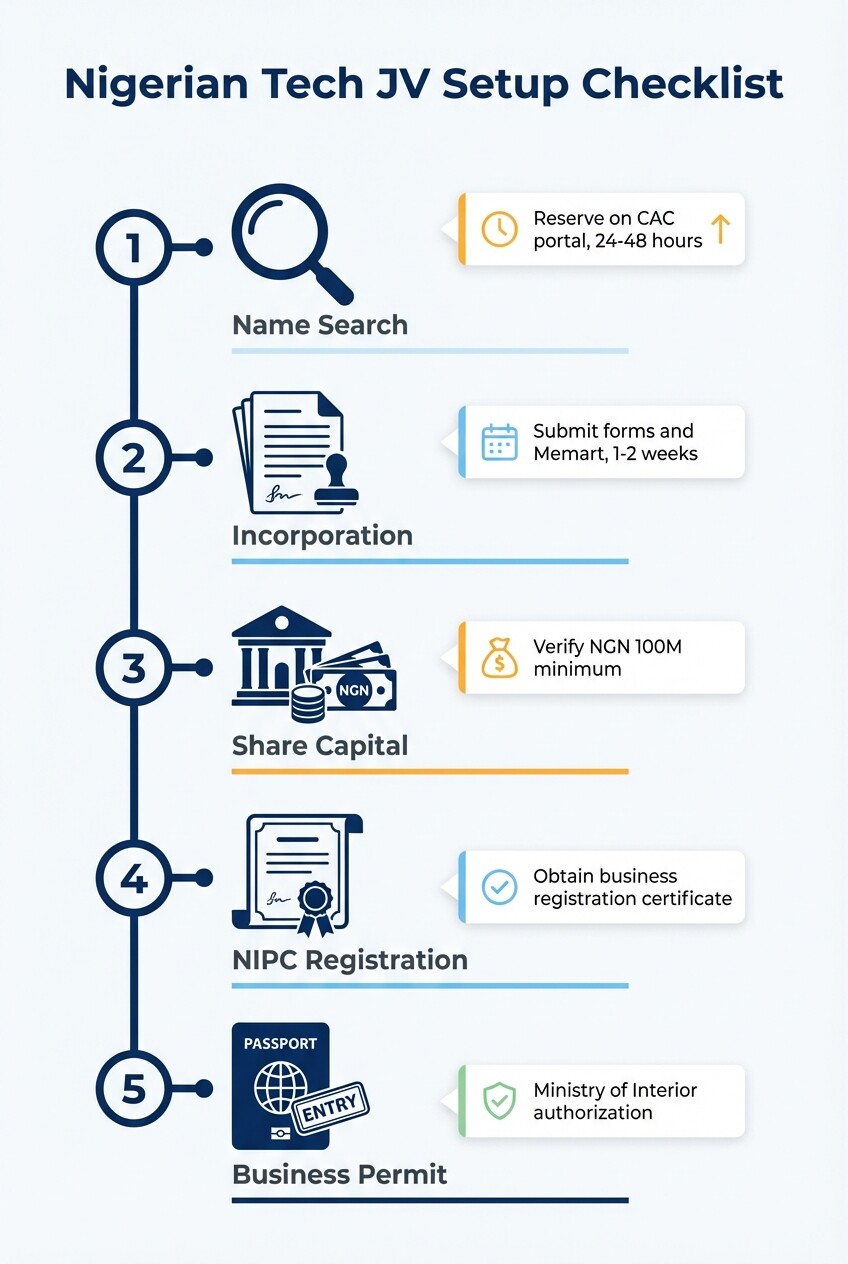
Setup checklist:
- Name search: Reserve the proposed JV name on the CAC portal (takes 24 to 48 hours).
- Incorporation: Submit incorporation forms, shareholder details, and the Memorandum and Articles of Association (takes 1 to 2 weeks).
- Share capital: Ensure the company meets the NGN 100 million minimum share capital requirement for foreign-owned entities.
- NIPC registration: Register the newly formed entity with the Nigerian Investment Promotion Commission (NIPC) to obtain a business registration certificate.
- Business permit: Apply to the Ministry of Interior for a business permit, which authorizes the foreign-backed entity to commence operations locally.
Alternatives to Equity JVs
Foreign investors can bypass shared equity ownership by using contractual joint ventures or technology licensing agreements. These alternatives allow tech companies to test the Nigerian market while limiting local liability and protecting proprietary technology.
An equity joint venture creates a shared legal entity with joint tax liabilities and specific exit mechanisms. Alternative structures offer different business-to-business advantages:
- Contractual joint ventures: The foreign tech company and a Nigerian firm sign an agreement to collaborate on a specific project without forming a new company. The contract allocates profits, risks, and operational duties. This structure is ideal for short-term software integrations or public sector tech bids.
- Licensing agreements: The foreign investor grants a local Nigerian company the right to use its software, brand, or technology infrastructure for a fee. The local partner handles sales, marketing, and local compliance. The foreign entity collects licensing royalties.
Securing International IP Rights
Protecting international intellectual property in Nigeria requires explicit assignment and licensing clauses compliant with local laws and National Office for Technology Acquisition and Promotion (NOTAP) regulations. Without a registered NOTAP agreement, Nigerian banks cannot legally process foreign currency transfers for IP royalties or management fees.
When drafting a joint venture or licensing agreement, clearly define who owns pre-existing IP and who owns IP developed during the venture. Home country IP laws do not automatically shield assets in Nigeria.
Sample IP Licensing Clause
Use this foundational language when structuring tech transfer contracts (ensure local counsel reviews before execution):
"The Foreign Party (Licensor) retains absolute and exclusive ownership of all proprietary software, source code, patents, and trademarks ('Background IP') introduced into this Joint Venture. The Licensor grants the Joint Venture Company a non-exclusive, non-transferable license to utilize the Background IP solely for operations within the Federal Republic of Nigeria. Any modifications or localized derivative works created during the term of this Agreement shall vest automatically and exclusively in the Licensor. The Local Party shall immediately execute any documents required to register these rights with the Nigerian Trademarks, Patents and Designs Registry and the National Office for Technology Acquisition and Promotion (NOTAP)."
Managing Foreign Capital
Foreign investors can freely repatriate capital and profits from Nigeria if they initially bring their investment funds through an authorized dealer (a Nigerian commercial bank) and obtain a Certificate of Capital Importation (CCI). Failing to secure a CCI traps funds in Naira and exposes returns to currency volatility.
The Central Bank of Nigeria (CBN) strictly regulates foreign exchange. Follow these steps for smooth capital repatriation:
- Select a dealer: Open a corporate bank account for the JV with a commercial bank authorized to deal in foreign exchange.
- Transfer funds: Send the foreign capital via SWIFT transfer directly into the authorized dealer account.
- Obtain the e-CCI: The Nigerian bank must issue an electronic Certificate of Capital Importation (e-CCI) within 24 hours of the funds clearing. Keep this digital certificate secure. It is an absolute prerequisite for buying foreign exchange at official rates to remit dividends or capital upon exiting the JV.
Resolving Partner Disputes
Alternative Dispute Resolution (ADR), particularly arbitration, is the most efficient way to resolve joint venture disputes without the burden of Nigeria's lengthy public litigation process. Commercial court cases in Nigeria can take years to resolve. Arbitration keeps tech trade secrets private and yields a binding, enforceable award.
When drafting dispute resolution mechanisms, investors should specify the governing law, the arbitration seat, and the appointing authority. Lagos is a primary commercial hub in West Africa and hosts arbitration centers like the Lagos Court of Arbitration (LCA).
Sample Arbitration Clause
"Any dispute, controversy, or claim arising out of or relating to this Agreement, or the breach, termination, or invalidity thereof, shall be settled by binding arbitration in accordance with the Arbitration Rules of the Lagos Court of Arbitration (LCA). The arbitral tribunal shall consist of three (3) arbitrators. The seat of the arbitration shall be Lagos, Nigeria. The language to be used in the arbitral proceedings shall be English. The resulting award shall be final and binding on the Parties."
Common Misconceptions About Nigerian Tech JVs
- Foreigners must have a Nigerian partner to do business: Nigerian law allows 100% foreign ownership of businesses in nearly all sectors, including technology. A local partner is often chosen for strategic market access rather than legal necessity.
- Standard US or UK corporate contracts work perfectly: Nigerian corporate law is rooted in English common law, but statutes like CAMA 2020 introduce local requirements for corporate governance, board composition, and shareholder rights.
- NOTAP registration is optional: NOTAP registration is a strict financial prerequisite. If a tech transfer agreement is not registered and approved by NOTAP, the Central Bank of Nigeria will not permit the repatriation of royalty fees.
Frequently Asked Questions
What is the minimum share capital for a foreign-owned company in Nigeria?
Foreign-owned companies, including joint ventures with foreign participation, must have a minimum issued share capital of NGN 100 million. This requirement applies during the CAC incorporation phase.
Can a foreign entity serve as a corporate director in a Nigerian JV?
No, directors of a Nigerian company must be individuals. A foreign corporate entity can be a shareholder, but it must appoint natural persons to represent its interests on the joint venture's board of directors.
Are there tax incentives for tech joint ventures in Nigeria?
Yes. Tech companies operating in designated sectors like software development or renewable energy may qualify for Pioneer Status Incentive (PSI). This grants a corporate tax holiday for an initial three years, extendable for up to two additional years.
Do I need an expatriate quota to send foreign managers to Nigeria?
Yes. If the joint venture plans to employ non-Nigerians on a long-term basis, the company must apply for an Expatriate Quota from the Ministry of Interior, which authorizes the hiring of foreign nationals for specific roles.
Next Steps
Structuring a cross-border tech joint venture involves navigating regulatory bodies like the CAC, NIPC, NOTAP, and the CBN. Consult a lawyer before signing a Memorandum of Understanding (MoU) or term sheet with a prospective Nigerian partner. Early legal intervention prevents accidental IP leakage and ensures your capital is imported correctly to guarantee future repatriation.
Begin by conducting due diligence on your proposed local partner and consulting a corporate attorney to decide between an equity JV, a contractual JV, or a licensing model. Browse verified corporate and commercial lawyers in Nigeria to safely structure your investment.