Timelines for SIAC Arbitration vs Litigation in Singapore
Key Takeaways
Managing cross-border disputes requires choosing between the global enforceability of arbitration and the statutory authority of litigation.
- Enforceability: SIAC arbitration awards are enforceable in over 170 countries under the New York Convention. Standard court judgments have a much narrower reach.
- Speed: The SIAC Expedited Procedure issues a final award within six months of the tribunal's constitution for disputes under SGD 6 million.
- Confidentiality: Arbitration is private. Singapore High Court litigation enters the public record.
- Asset protection: Both Singapore courts and SIAC emergency arbitrators can freeze foreign assets within days.
Practical Comparison: SIAC Arbitration vs Singapore Litigation
Choosing between the Singapore International Arbitration Centre (SIAC) and the Singapore High Court alters cost structures, discovery obligations, and privacy protections. The decision often comes down to whether a party prefers a final, binding decision or the ability to appeal.
Litigation is a state-backed process with public precedents. Arbitration lets parties tailor the procedure and select specific adjudicators. Selecting Singapore as the legal "seat" means the arbitration is governed by the International Arbitration Act, granting the Singapore High Court supervisory jurisdiction.
| Feature | SIAC Arbitration | Singapore High Court |
|---|---|---|
| Confidentiality | Proceedings, documents, and awards remain private. | Hearings are open, and judgments are published. |
| Document discovery | Limited to specific requests, avoiding broad searches. | Parties must disclose all relevant documents, including harmful ones. |
| Legal costs | Parties pay administrative fees and hourly arbitrator rates upfront. | Court filing fees are lower, but discovery and appeals drive up lawyer fees. |
| Appeals process | Final and binding. Awards can be set aside only on narrow procedural grounds. | Judgments can be appealed to the Court of Appeal, adding 12 to 18 months. |
| Flexibility | Parties choose the language, governing law, and arbitrator expertise. | Governed strictly by the Rules of Court 2021. |
Global Enforceability of SIAC Awards vs High Court Judgments
A favorable decision matters only if it can be enforced against the opposing party's assets in their home jurisdiction.
Under the New York Convention, SIAC awards are recognized in over 170 member states. Local courts uphold the award with minimal grounds for refusal. Enforcing a Singapore High Court judgment relies on reciprocal frameworks like the Hague Convention on Choice of Court Agreements or specific bilateral treaties. These cover fewer jurisdictions. If a debtor's assets are in a non-reciprocal country, enforcing a court judgment means filing a new lawsuit in that foreign jurisdiction.
Expected Timelines for Expedited SIAC Arbitration
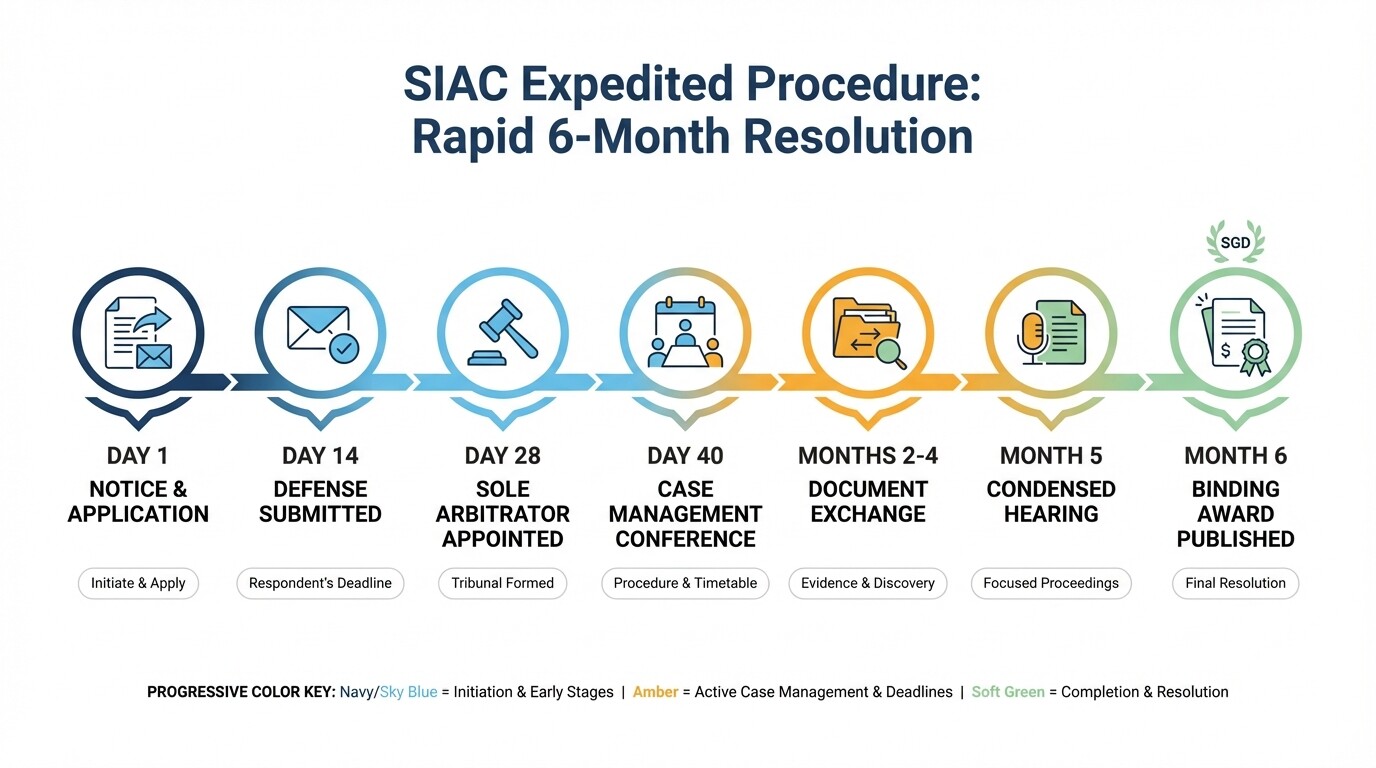
The SIAC Expedited Procedure bypasses the multi-year timelines of complex international arbitration. For qualifying commercial disputes, parties receive a final award within six months from the tribunal's constitution.
This procedure applies automatically if the disputed amount is under SGD 6 million, if parties agree to it, or in cases of exceptional urgency. If the respondent ignores the arbitration notice, the tribunal proceeds and can issue a binding default award against the absent party.
- Day 1: Claimant files the Notice of Arbitration and applies for the Expedited Procedure.
- Day 14: Respondent submits their initial reply and defense.
- Day 28: SIAC appoints a sole arbitrator.
- Day 40: The arbitrator holds a Case Management Conference to establish a tight procedural timetable.
- Months 2 to 4: Parties exchange limited documents and witness statements.
- Month 5: A condensed hearing occurs, often virtually or on a documents-only basis.
- Month 6: The sole arbitrator publishes the binding award.
Pre-Litigation Strategies and SIMC Protocols
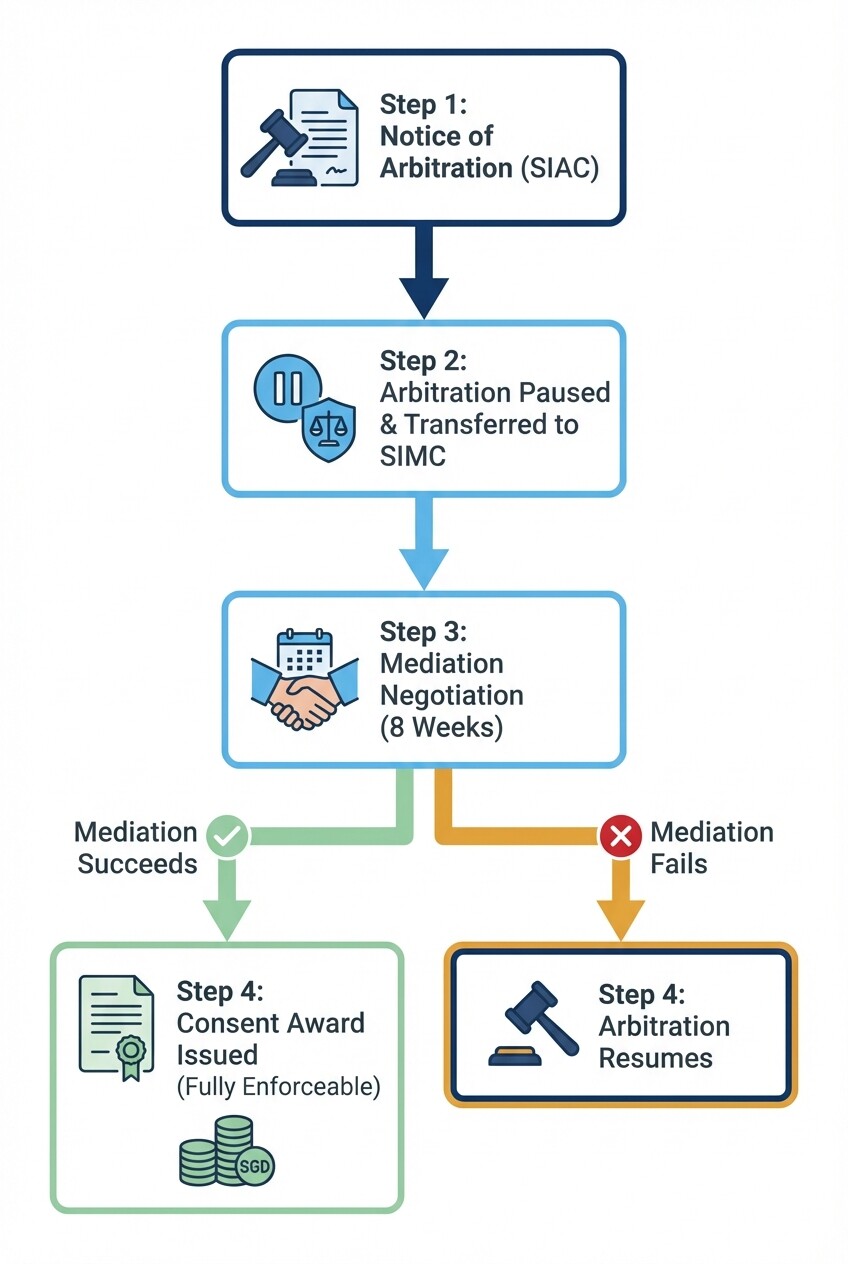
Pre-litigation mediation can preserve commercial relationships and avoid formal hearings. Singapore integrates mediation into the arbitration process through the Arb-Med-Arb (AMA) Protocol, administered by SIAC and the Singapore International Mediation Centre (SIMC).
- Step 1: The claimant files a Notice of Arbitration with SIAC.
- Step 2: The arbitration is paused. The case transfers to the SIMC for mediation.
- Step 3: An independent mediator helps parties negotiate a settlement within eight weeks.
- Step 4: If mediation succeeds, the settlement is recorded as a "Consent Award" with the same enforceability as a standard arbitration judgment. If it fails, arbitration resumes.
Step-by-Step Timeline for Interim Injunctions
When opposing parties threaten to move assets or destroy evidence, immediate legal intervention is necessary. Both Singapore courts and SIAC have mechanisms to secure interim injunctions.
In Singapore litigation, parties apply for a Mareva injunction to freeze assets. In arbitration, parties use a SIAC Emergency Arbitrator before the main tribunal is formed. Both require proving a strong prima facie case and a real risk of asset dissipation. Under the International Arbitration Act 1994, Singapore courts grant interim injunctions to preserve assets while the tribunal is constituted.
- Days 1 to 3: Counsel drafts an urgent application and an affidavit detailing the risk of asset dissipation. Full disclosure is mandatory.
- Day 4: The application is filed ex parte (without notifying the respondent). A judge or Emergency Arbitrator hears the case within 24 to 48 hours.
- Day 5: If granted, the freezing order takes immediate effect. Banks and third parties are served with notices to freeze accounts.
- Days 14 to 21: An inter partes hearing is scheduled. The respondent can present a defense and argue to discharge the injunction.
Common Misconceptions About Cross-Border Dispute Resolution
Outdated assumptions cause procedural mistakes. The realities of Singapore's legal system differ from standard expectations.
- Arbitration is always cheaper: Arbitration involves paying the arbitrator's hourly fees and institution administrative costs. A SGD 2 million dispute with a sole arbitrator incurs SIAC administrative and arbitrator fees ranging from SGD 40,000 to SGD 80,000, excluding legal counsel and expert costs. Upfront expenses are often higher than court filing fees. It becomes cost-effective only by limiting document discovery and avoiding multi-year appeals.
- Mediation shows weakness: Proposing mediation is standard practice. Singapore courts actively penalize parties in costs if they unreasonably refuse to mediate before trial.
- Arbitration clauses cover everything: Vague arbitration clauses often fail to specify the institution, the seat, or the number of arbitrators. This leads to preliminary jurisdictional battles before the core dispute is addressed.
- Arbitration awards can be appealed: A SIAC award cannot be appealed on the merits or errors of law. Parties can only apply to the Singapore High Court to set aside the award on narrow procedural grounds, such as a breach of natural justice or fraud.
Next Steps for Corporate Counsel
When preparing a cross-border claim in Singapore, immediate procedural organization is necessary. Engage a dispute resolution lawyer once a contract is breached or legal action is threatened. Early intervention allows counsel to assess whether to initiate mediation, apply for a freezing injunction, or draft a Notice of Arbitration. Waiting until formal legal proceedings begin limits options for early settlement.
- Secure related communications, contract copies, and financial records to ensure no evidence is lost.
- Review the contract's dispute resolution clause to confirm if you are bound by SIAC arbitration, Singapore High Court litigation, or a mandatory pre-condition to mediate.
- Consult with dispute resolution lawyers in Singapore to outline a cost-benefit analysis of expedited arbitration versus standard court proceedings.