
Corporate Governance for South African Multinational Subsidiaries
Key Takeaways
Foreign companies operating subsidiaries in South Africa must navigate a unique blend of mandatory statutory laws and voluntary, yet highly expected, governance codes. Achieving compliance requires balancing your parent company's global standards with local regulatory demands.
- South African corporate governance relies heavily on the Companies Act 71 of 2008 and the King IV Report on Corporate Governance.
- The King IV Code operates on an "apply and explain" basis, offering flexibility that differs from rigid international frameworks like Sarbanes-Oxley.
- Foreign directors face strict fiduciary duties and liability risks under South African law, making localized indemnification agreements critical.
- Multinational subsidiaries must actively manage Broad-Based Black Economic Empowerment (B-BBEE) compliance alongside their global corporate policies.
- Maintaining accurate statutory registers with the Companies and Intellectual Property Commission (CIPC) prevents costly shareholder disputes and administrative penalties.
International Governance Standards vs. South Africa's King IV Code
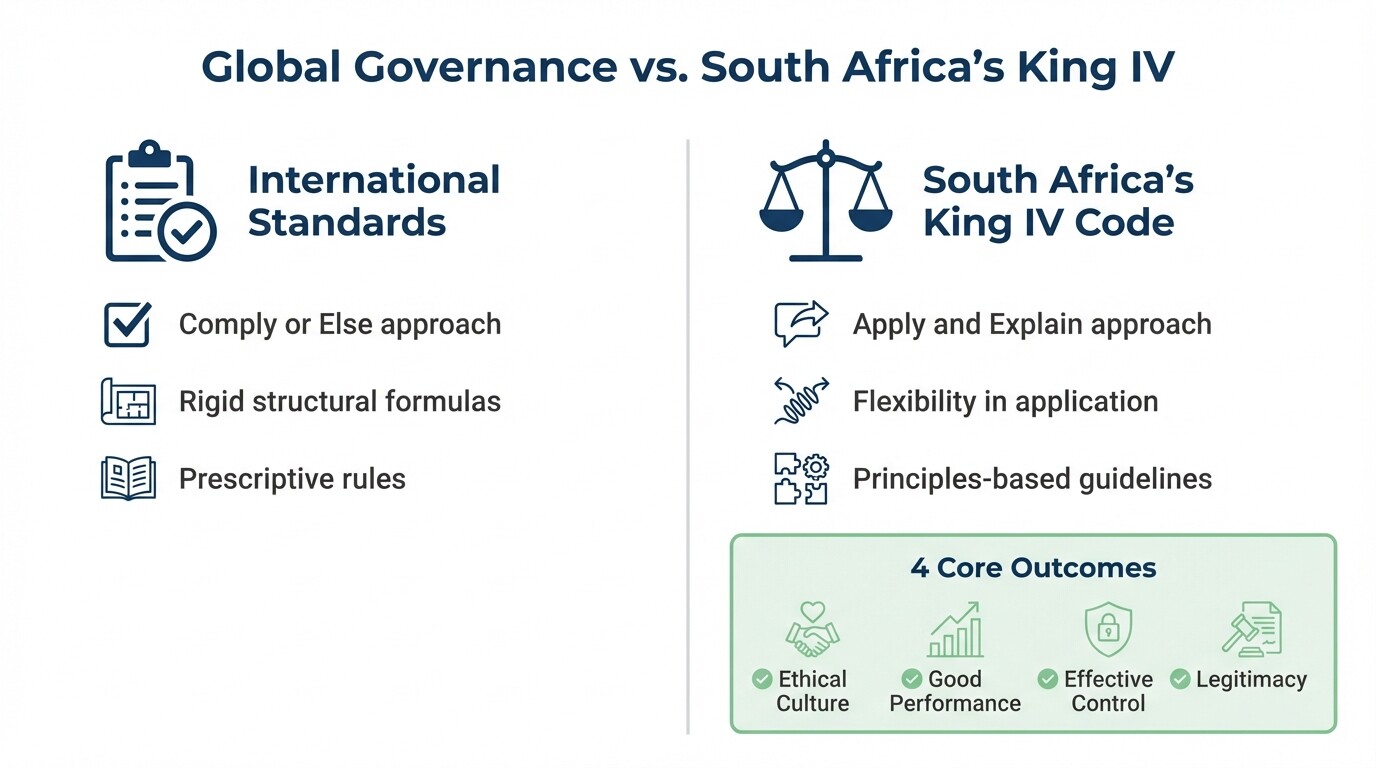
South Africa governs corporate behavior through a hybrid system of strict statutory requirements under the Companies Act and principles-based guidelines under the King IV Code. While global standards often dictate a "comply or else" approach, South Africa favors an "apply and explain" methodology.
The King IV Report focuses on achieving four core governance outcomes: ethical culture, good performance, effective control, and legitimacy. Unlike international regulations that prescribe exact structural formulas, King IV requires a board to apply broad principles and publicly explain how their specific practices achieve those core outcomes. For multinational subsidiaries, this means you do not necessarily have to abandon your parent company's global board structure. Instead, you must document and demonstrate how your global policies satisfy King IV's local ethical and operational expectations.
Subsidiary Corporate Governance Checklist
Managing a local subsidiary requires tracking specific administrative and strategic obligations that go beyond standard global reporting. Use this baseline checklist to audit your South African subsidiary's governance health.
- Statutory Registrations: Confirm active registration with the CIPC and the South African Revenue Service (SARS).
- Director Appointments: Verify that all foreign and local directors are correctly listed on the CIPC Cor39 form.
- Governance Framework: Map parent company governance policies against the 16 principles of the King IV Code.
- B-BBEE Strategy: Establish a localized strategy for Broad-Based Black Economic Empowerment compliance and reporting.
- Indemnification Agreements: Execute localized Director & Officer (D&O) indemnification contracts aligned with Section 78 of the Companies Act.
- Statutory Records: Ensure the share register, minute books, and director disclosures are physically or electronically accessible at the designated South African registered office.
Registering Foreign Directors with the CIPC
Foreign nationals can serve as directors of a South African subsidiary, but their appointments must be formally registered with the Companies and Intellectual Property Commission (CIPC). Failing to update director details within the mandated statutory period can result in administrative fines and operational delays.
To register or update a foreign director, the subsidiary must submit a Cor39 form to the CIPC. The application requires certified copies of the foreign director's passport, which must be certified by a notary public or South African embassy in their home country. Additionally, the CIPC requires a signed resolution from the board or shareholders approving the appointment, along with the director's written consent to serve. Because the CIPC frequently updates its verification protocols, multinational parent companies should maintain a standardized onboarding package for all international executives joining the South African board.
Director Liability and Indemnification Alternatives
Under South African law, directors face extensive personal liability for breaches of fiduciary duty, reckless trading, or failure to comply with statutory obligations. Multinational parent companies must structure localized indemnification agreements, as global D&O insurance policies often fail to cover specific South African statutory penalties.
Section 77 of the Companies Act 71 of 2008 codifies the standard of directors' conduct, holding them liable for losses sustained by the company due to negligence or breach of trust. However, Section 78 permits a company to advance legal expenses and indemnify directors, provided the director did not engage in willful misconduct or reckless trading. Subsidiaries should adopt specific clauses within their Memorandum of Incorporation (MOI) and separate indemnification deeds to protect foreign-appointed board members.
Sample Director Indemnification Clause
The Company shall, to the maximum extent permitted by Section 78 of the Companies Act 71 of 2008, indemnify the Director against any liability, expense, or cost incurred in their capacity as a director of the Company. This indemnification shall not apply to liabilities arising from willful misconduct, willful breach of trust, or reckless trading as defined by the Act. The Company further agrees to advance reasonable legal expenses incurred by the Director in defending any related proceedings, subject to a written undertaking by the Director to repay such amounts if they are ultimately found not entitled to indemnification under South African law.
Balancing Global Policies with Local B-BBEE Requirements
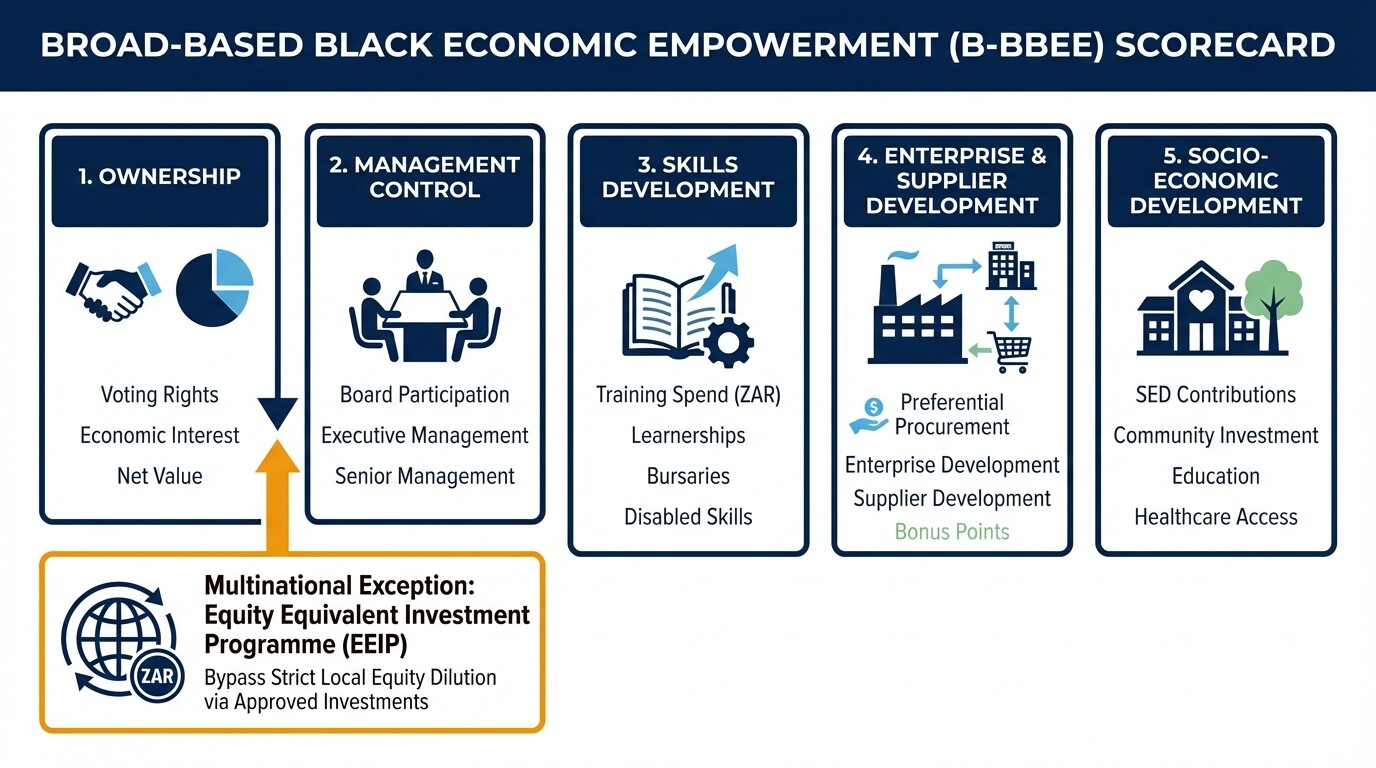
Multinational subsidiaries frequently struggle to align their parent company's rigid global equity structures with South Africa's Broad-Based Black Economic Empowerment (B-BBEE) requirements. While a foreign parent may prohibit diluting ownership, alternative compliance structures exist to achieve a favorable local empowerment rating.
B-BBEE is a central government policy aimed at economic inclusion. It measures companies across five elements: Ownership, Management Control, Skills Development, Enterprise and Supplier Development, and Socio-Economic Development. A poor B-BBEE rating heavily restricts a subsidiary's ability to secure government contracts or do business with other highly-rated local corporations. If the parent company cannot transfer equity to local partners due to global policy, the subsidiary can utilize the "Equity Equivalent Investment Programme" (EEIP). This allows multinationals to earn ownership points by investing heavily in approved local skills development or enterprise programs instead of transferring actual shares.
Maintaining Statutory Registers and Minute Books
Accurate maintenance of statutory registers and minute books is a strict legal requirement in South Africa and the primary defense against shareholder disputes. Incomplete records can invalidate board decisions and complicate annual audits.
The Companies Act requires every company to keep a register of its shares, directors, and an up-to-date minute book of all board and shareholder resolutions. These documents must be kept at the subsidiary's registered South African office or another local location reported to the CIPC. For multinationals relying on centralized, cloud-based governance software at their overseas headquarters, you must ensure that exact, verifiable copies are instantly accessible to local regulators, auditors, and shareholders in South Africa upon request.
Common Misconceptions About Subsidiary Governance
- Global D&O insurance covers everything: Many foreign executives assume their parent company's global Directors & Officers policy covers all liabilities. In reality, South African statutory penalties (like SARS tax liabilities or specific CIPC fines) often fall outside standard global coverage, requiring localized riders or agreements.
- Foreign subsidiaries are exempt from B-BBEE: Multinational status does not grant a waiver from B-BBEE. While you are not legally forced to achieve a specific level, failing to participate will severely limit your commercial viability in the South African market.
- King IV is a mandatory law: King IV is a voluntary code of corporate governance, not a statute. However, South African courts frequently use King IV as the benchmark to determine if a director acted with the expected standard of care, making it a de facto legal baseline.
FAQs
What is a Memorandum of Incorporation (MOI) in South Africa?
The MOI is the founding constitutional document of a South African company, replacing the older Articles of Association. It dictates the rights, duties, and responsibilities of shareholders, directors, and the company itself, and overrides any conflicting shareholder agreements.
Can a South African subsidiary have a board comprised entirely of foreigners?
Yes, there is no statutory requirement under the Companies Act for a South African company to have local resident directors. However, practical hurdles, such as opening a local bank account or managing SARS tax registrations, heavily favor having at least one local resident director.
How often must a South African subsidiary hold board meetings?
The Companies Act does not mandate a specific frequency for board meetings unless stipulated in the company's MOI. However, King IV best practices recommend holding meetings at least quarterly to properly discharge fiduciary oversight.
What happens if a subsidiary fails to file its annual returns with CIPC?
Failing to file annual returns and pay the prescribed fees will result in penalties and eventually lead to the CIPC placing the company in deregistration. Deregistration strips the company of its legal status, freezing its assets and exposing directors to personal liability.
When to Hire a Corporate Governance Lawyer
Engaging legal counsel early in your subsidiary's lifecycle prevents structural mistakes that are costly to unwind later. You should consult a corporate governance attorney when drafting your localized MOI, structuring B-BBEE compliance strategies, or onboarding foreign executives to the local board. Legal expertise is also crucial when aligning your parent company's global delegation of authority with South Africa's statutory director duties. To ensure your compliance frameworks are legally sound, consult experienced corporate governance lawyers in South Africa who understand cross-border corporate structures.
Next Steps
- Audit Your MOI: Review your subsidiary's Memorandum of Incorporation to ensure it aligns with your parent company's global delegation of authority and South African law.
- Verify CIPC Filings: Conduct an internal check to confirm all current directors, both local and foreign, are accurately registered with the CIPC.
- Assess B-BBEE Strategy: Evaluate your current B-BBEE scorecard and consult with a local specialist to explore Equity Equivalent Investment Programmes if global policy restricts share transfers.
- Update Indemnifications: Draft and execute South African-specific indemnification deeds for all foreign directors serving on the subsidiary's board.