- South Africa lacks a codified class action statute, relying instead on common law precedent and the Constitution to certify environmental class actions.
- Foreign corporations frequently jeopardize their defense by misapplying US or EU discovery preservation protocols to South Africa's broad Uniform Rule 35 discovery standards.
- Successful resolution of South African environmental claims increasingly requires localized Alternative Dispute Resolution (ADR) that actively engages traditional community leadership.
- South African courts are rapidly expanding the interpretation of corporate duty of care, meaning parent companies face higher risks of liability for local subsidiary actions.
- Landmark climate rulings are setting new precedents that will mandate stricter environmental impact assessments and ESG accountability by 2026.
Comparing South African Class Action Certification Standards with US and EU
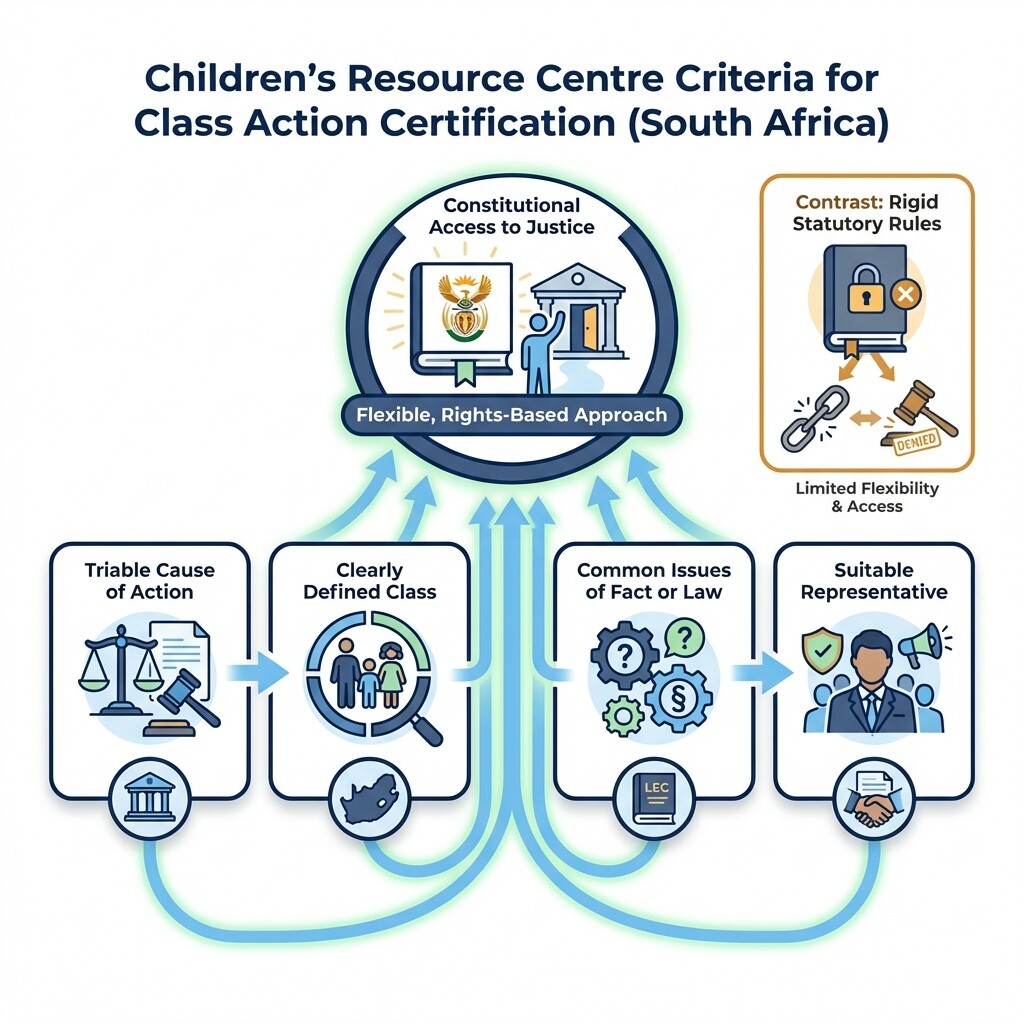
South African courts evaluate class action certification through common law criteria established by the Supreme Court of Appeal, rather than through codified legislation. This makes the South African process highly distinct from the rigid, statutory frameworks governing class actions in the United States and the European Union.
In South Africa, a class action must first be certified by a High Court before summons can be issued. The court uses the Children's Resource Centre criteria, which require a triable cause of action, a clearly defined class, common issues of fact or law, and a suitable representative. Unlike the US, where Rule 23 governs strict numerosity and typicality, South African courts prioritize whether the class action is the most appropriate means of access to justice, heavily influenced by the Bill of Rights in the South African Constitution.
| Feature | South Africa (Common Law & Constitution) | United States (FRCP Rule 23) | European Union (Representative Actions Directive) |
|---|---|---|---|
| Legal Framework | Supreme Court of Appeal precedent and Constitution. | Codified Federal Rules of Civil Procedure. | EU Directive implemented into national laws. |
| Opt-in vs. Opt-out | Courts discretionarily decide between opt-in or opt-out per case. | Predominantly opt-out for damages claims. | Varies by member state; mostly opt-in for damages. |
| Certification Stage | Mandatory prior certification before issuing summons. | Certification happens after initial pleadings and early discovery. | Varies by state; many require qualified entities to sue. |
| Funding | Third-party funding is legal and actively encouraged for access to justice. | Third-party funding is common but subject to state-level restrictions. | Heavily restricted to prevent abusive litigation. |
Common Pre-Litigation Discovery Mistakes by Foreign Corporations
International mining and manufacturing firms frequently mishandle South African discovery by applying their home-country privilege rules or failing to implement immediate, localized litigation holds. This often results in critical environmental compliance documents being destroyed or improperly shielded, leading to adverse inferences in court.
Under Uniform Rule 35 of the South African High Court, the scope of discoverable documents is exceptionally broad, covering any document relating to any matter in question. Multinationals often mistakenly treat local subsidiaries as entirely separate data silos, failing to realize that South African courts can compel the production of parent-company communications if they influence local environmental policy. Furthermore, foreign executives often incorrectly assume that internal environmental audits and ESG risk assessments are protected by attorney-client privilege. In South Africa, unless a document was created specifically for the dominant purpose of pending litigation, it is generally discoverable.
Alternative Dispute Resolution for Environmental Damage Claims
Settling environmental claims out of South African courts requires a blend of formalized mediation and community-based stakeholder engagement. Because environmental class actions often involve indigenous lands and vulnerable populations, standard corporate settlement structures are rarely sufficient.
Effective Alternative Dispute Resolution (ADR) in South Africa involves recognizing the authority of traditional leadership alongside statutory environmental bodies. Multinationals must structure ADR processes that provide tangible community remediation rather than simply dispersing financial payouts.
- Facilitated Stakeholder Mediation: Engaging independent, culturally competent mediators who can bridge the gap between corporate boards and local community trusts.
- Expert Determination: Using independent environmental scientists agreed upon by both parties to quantify soil or water contamination levels, bypassing drawn-out courtroom battles over expert testimonies.
- Community Trust Settlements: Structuring financial compensation into independently managed community trusts (often requiring initial capitalizations of tens of millions of ZAR) to fund long-term health monitoring and land rehabilitation.
Managing Global Corporate Governance and Reputational Risk
An environmental class action in South Africa immediately triggers global ESG scrutiny, requiring multinationals to align their local defense strategies with international corporate governance standards. A localized crisis can rapidly threaten a parent company's global shareholder value and regulatory standing.
Multinationals must coordinate their legal messaging across jurisdictions to ensure that statements made in South African courts do not contradict global sustainability reports. The King IV Report on Corporate Governance, which serves as the benchmark for corporate governance in South Africa, mandates that governing bodies take stakeholder-inclusive approaches to environmental impacts. Foreign parent companies must ensure their local boards are deeply involved in the litigation strategy, demonstrating proactive governance rather than distant, defensive maneuvering. Failure to integrate the defense strategy with global ESG reporting can lead to secondary shareholder lawsuits in the corporation's home country.
South Africa's Evolving Climate Litigation Precedents and 2026 Implications
South African courts are rapidly expanding corporate liability for environmental harm, with landmark rulings setting the stage for stricter climate litigation precedents leading into 2026. Recent judicial decisions have consistently prioritized environmental preservation over economic development, signaling a harsher regulatory environment for extractive industries.
Litigation leveraging the National Environmental Management Act 107 of 1998 (NEMA) has shifted from simple pollution claims to complex climate change impacts. Courts are increasingly interdicting (halting) major mining and seismic exploration projects on the grounds of inadequate public consultation and failure to assess long-term climate impacts. By 2026, legal experts project that South African courts will formally recognize direct corporate liability for historical greenhouse gas emissions. Multinationals must prepare for class actions that utilize advanced climate attribution science to link localized severe weather events to specific corporate operations.
Corporate Defense Strategy Checklist
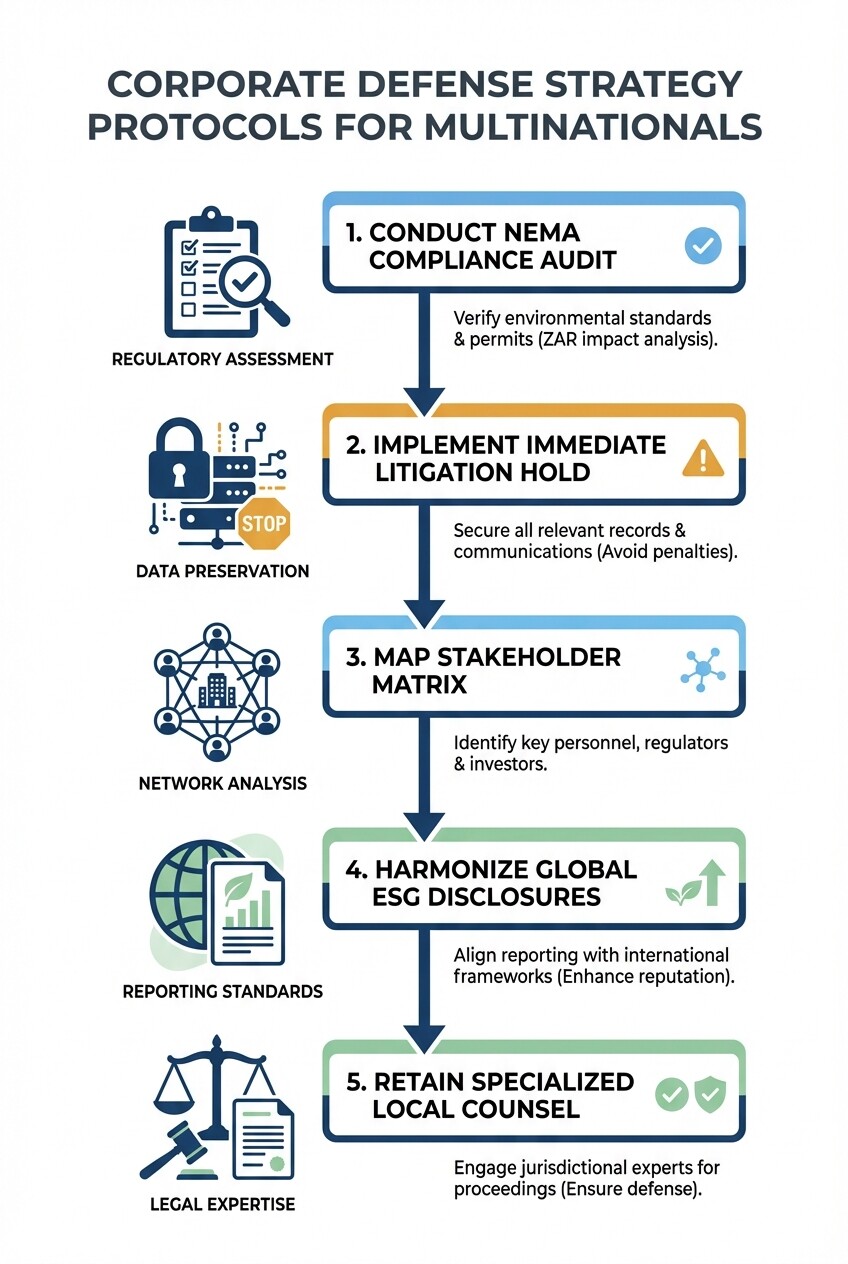
To effectively prepare for and defend against an environmental class action in South Africa, multinational corporations should implement the following internal protocols before a crisis occurs:
- Conduct a NEMA Compliance Audit: Review all current local operations against the strict liability provisions of the National Environmental Management Act.
- Implement an Immediate Litigation Hold: Draft and distribute data preservation notices to both the South African subsidiary and the global parent company regarding all relevant environmental impact data.
- Map the Stakeholder Matrix: Identify local community leaders, environmental NGOs, and relevant government departments operating near your facilities.
- Harmonize Global ESG Disclosures: Ensure that internal environmental audits conducted in South Africa align with the sustainability claims published in international shareholder reports.
- Retain Specialized Local Counsel: Engage South African legal teams with specific expertise in complex constitutional and environmental litigation, rather than relying solely on general corporate counsel.
Common Misconceptions About South African Environmental Litigation
Foreign executives often misjudge the South African legal landscape, assuming local courts lack the sophisticated mechanisms to hold parent companies accountable for localized environmental damage.
Parent companies are protected by the corporate veil. Many multinationals believe that isolating operations within a South African subsidiary shields the parent company from liability. In reality, South African courts are increasingly willing to look past corporate structures to hold foreign parent companies directly liable if they exercised control over the subsidiary's environmental policies.
Class actions require statutory framework. Foreign legal teams often assume that because South Africa lacks a specific "Class Action Act," massive aggregate litigation is impossible. South African common law actively facilitates class actions to promote constitutional access to justice, particularly for marginalized communities affected by pollution.
Discovery is limited to local subsidiary files. Corporations often believe they can limit discovery strictly to the South African entity. South African courts routinely grant orders compelling the discovery of international communications, board minutes, and internal audits if they are relevant to the local environmental breach.
Frequently Asked Questions
What triggers an environmental class action in South Africa?
Environmental class actions are typically triggered by widespread pollution, such as toxic spills, groundwater contamination, or unlawful emissions that impact the health or livelihoods of a defined community or ecosystem.
Can foreign parent companies be sued in South African courts?
Yes. If the parent company maintained significant operational control or dictated the environmental, health, and safety policies of the local subsidiary, South African courts can establish jurisdiction over the foreign entity.
How long does the class action certification process take?
The certification stage alone can take between 12 to 24 months, as it often involves complex preliminary arguments regarding the definition of the class and the viability of the cause of action.
Is third-party litigation funding legal in South Africa?
Yes. South African courts have explicitly recognized and permitted third-party litigation funding, provided the funding agreement is fair and does not compromise the independence of the legal representation.
When to Hire Corporate Defense Counsel
Multinational corporations should engage specialized defense counsel the moment they detect a significant environmental incident or receive inquiries from environmental NGOs regarding local operations. Waiting for a formal letter of demand or a certification application is a critical error. Early engagement allows legal teams to properly manage internal investigations under the protection of legal privilege and to structure immediate community engagement strategies. Finding experienced class action lawyers in South Africa is essential for navigating the unique intersection of constitutional law and environmental regulation.
Next Steps for Multinationals
If your corporation operates in high-impact sectors within South Africa, begin by commissioning an independent legal review of your current environmental compliance and community engagement frameworks. Ensure your data retention policies comply with South African discovery rules and immediately align your local operational practices with your global ESG commitments. Establishing a proactive defense posture today will significantly mitigate the financial and reputational damage of future litigation.