Navigating Divorce Proceedings in South Africa
Key Takeaways
Ending a marriage in South Africa involves navigating specific legal channels, from deciding on child care to dividing assets based on your matrimonial property regime. Understanding the procedural differences between regional courts and the High Court can save you significant time, money, and emotional stress.
- Antenuptial Contracts rule asset division: Your marriage regime (in or out of community of property) dictates exactly how wealth is split.
- Mediation is strongly encouraged: High Court Rule 41A requires parties to formally consider mediation before proceeding with litigation.
- The Family Advocate is crucial for parents: Any divorce involving minor children must be endorsed by the Office of the Family Advocate to ensure the children's best interests are met.
- Uncontested divorces save thousands: Agreeing on terms outside of court can finalize a divorce in weeks rather than years, saving tens of thousands of Rands.
Differences Between Contested and Uncontested Divorces
An uncontested divorce happens when both spouses agree on all terms, whereas a contested divorce involves disputes that a judge must ultimately resolve. Choosing the uncontested route drastically reduces both the emotional toll and legal fees.
An uncontested divorce is the most straightforward and cost-effective method. You and your spouse work together, often with a single attorney or through a DIY process, to draft a settlement agreement covering asset division, maintenance, and child care. Once the agreement is signed, only the plaintiff needs to appear in court, and the process is finalized quickly.
In a contested divorce, spouses cannot reach an agreement on key issues. This requires formal legal pleadings, discovery of financial documents, and a formal trial where both sides present evidence. Contested divorces are inherently adversarial, demanding extensive legal representation that can drain family resources and prolong the emotional strain for everyone involved.
Divorce Process Checklist: From Summons to Decree
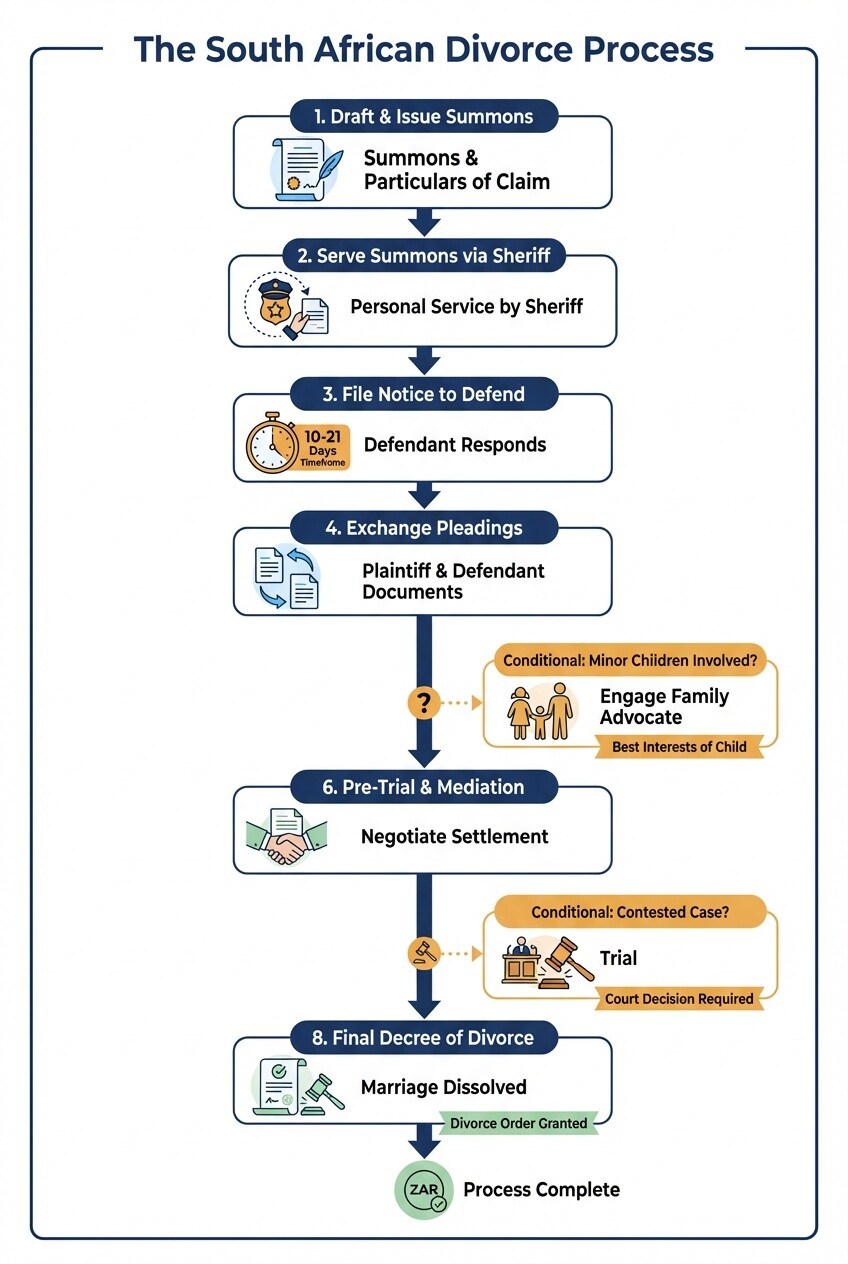
The South African divorce process follows a strict legal sequence starting with the issuance of a summons and ending with a final court order. Following this checklist ensures you meet all procedural requirements under the law.
- Draft and Issue the Summons: The plaintiff initiates the process by having an attorney draft a divorce summons, which is then stamped and issued by the relevant court.
- Serve the Summons: The summons must be personally delivered to the defendant by the Sheriff of the Court.
- File Notice of Intention to Defend: The defendant has 10 days (if living in the same jurisdiction) or 21 days (if in a different province) to file a notice to defend if they disagree with the terms.
- Exchange Pleadings: If defended, both parties exchange formal legal documents outlining their claims and counterclaims regarding assets, maintenance, and children.
- Engage the Family Advocate (If Applicable): If minor children are involved, a parenting plan must be drafted and approved by the Department of Justice and Constitutional Development's Office of the Family Advocate.
- Attend Pre-Trial and Mediation: Parties must attempt to settle the matter through mandatory mediation considerations or pre-trial conferences to narrow down the disputed issues.
- Proceed to Trial: If no settlement is reached, the matter goes to trial where a judge will hear evidence and make a final ruling.
- Receive the Decree of Divorce: The court issues a formal decree, legally terminating the marriage and cementing the settlement or court order.
How Your Marriage Contract (ANC) Impacts Asset Division
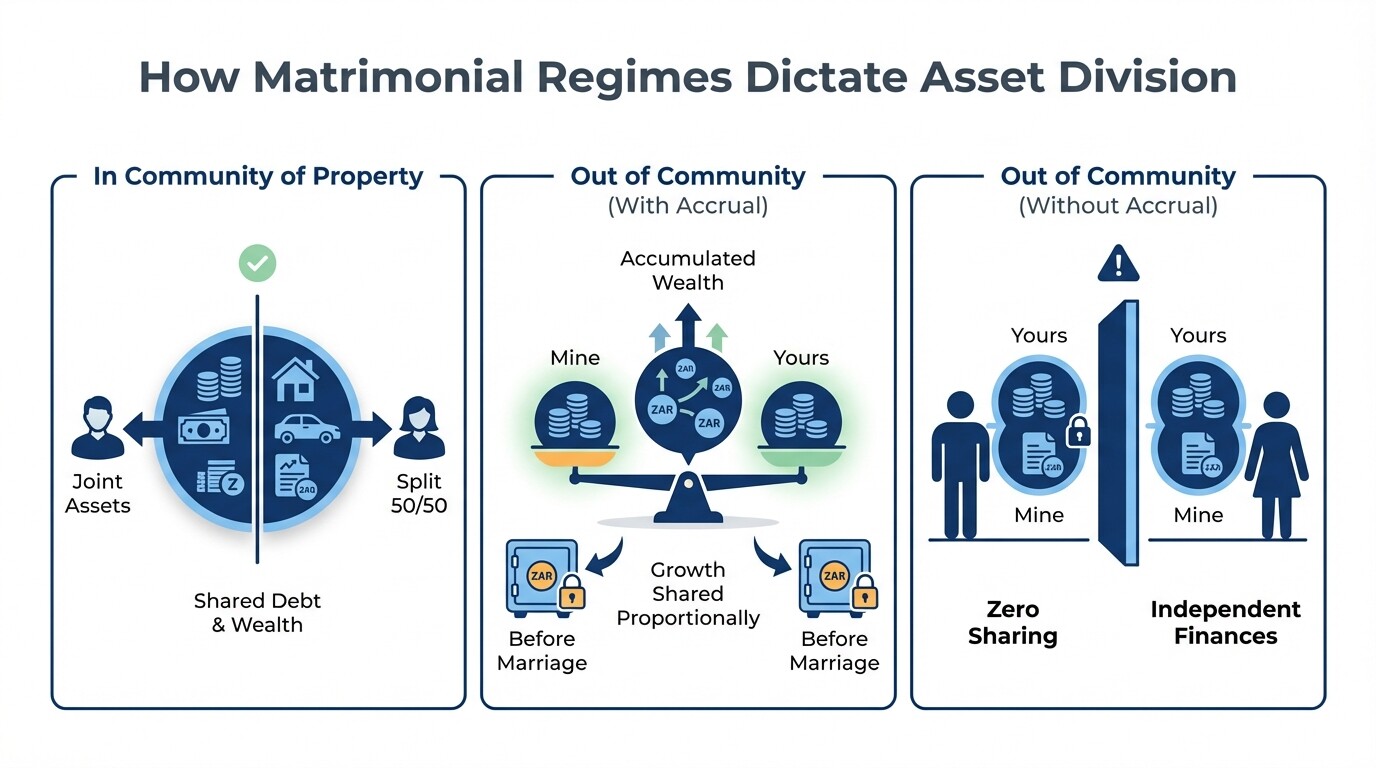
Your matrimonial property regime dictates exactly how assets and debts are divided when the marriage ends. If you did not sign an Antenuptial Contract (ANC) before marrying, you are automatically married in community of property under South African law.
- In Community of Property: The spouses share a single joint estate. Upon divorce, all assets and liabilities acquired before and during the marriage are split equally (50/50). This means you are also equally responsible for your spouse's debts.
- Out of Community of Property (With Accrual): You keep what you owned prior to the marriage, but the wealth accumulated during the marriage is shared. The spouse whose estate grew less during the marriage has a claim against the spouse whose estate grew more, ensuring a fair split of the financial growth.
- Out of Community of Property (Without Accrual): There is a complete separation of assets. What you bring into the marriage and what you earn during it remains exclusively yours. There is no sharing of wealth or debt upon divorce.
Determining Primary Care and Contact for Minor Children
South African family law prioritizes the best interests of the child when determining primary care (custody) and contact (access). The Office of the Family Advocate must evaluate and endorse any agreement involving minor children before a judge grants the divorce.
Under the Children's Act, the focus has shifted away from "custody" toward "parental responsibilities and rights." Courts encourage co-parenting and shared decision-making. Spouses are required to draft a comprehensive Parenting Plan that outlines where the child will live primarily (primary care), visitation schedules for the other parent (contact), and how education and healthcare decisions will be made. If parents cannot agree, the Family Advocate will conduct an investigation, interview the children if they are old enough, and make a formal recommendation to the court.
Using Mediation to Reduce Litigation Costs
Before proceeding to trial, spouses in South Africa are legally required to consider mediation as an alternative dispute resolution method. This process involves a neutral third party helping you reach a settlement, which significantly reduces exorbitant litigation costs.
High Court Rule 41A dictates that parties must file a notice indicating whether they agree to or oppose mediation. Mediation allows couples to maintain control over the outcome rather than leaving their future in the hands of a judge. A successful mediation can cost between ZAR 10,000 and ZAR 25,000 in total. In stark contrast, a fully contested divorce that goes to trial can easily exceed ZAR 150,000 to ZAR 300,000 per spouse in legal fees.
Timeline Expectations: High Court vs. Regional Divorce Court
Your divorce timeline depends entirely on whether the matter is contested and which court handles the proceedings. While the Regional Court is generally more accessible, the High Court handles more complex financial and custodial disputes.
In an uncontested divorce, the timeline is highly efficient. Once the settlement is signed and the summons is served, you can typically secure a court date and finalize the divorce in 4 to 12 weeks, regardless of the court.
For contested matters, the backlog and procedural requirements create significant delays. A contested divorce in the Regional Magistrates' Court (often used for simpler estates) generally takes 1 to 2 years to reach trial. The High Court, which hears high-net-worth cases and complex disputes, has heavier caseloads. A contested High Court divorce can easily take 2 to 4 years to finalize.
Common Misconceptions About South African Divorces
Many individuals enter divorce proceedings with false assumptions based on television or foreign laws. Understanding South African specific rules prevents costly strategic mistakes.
- "Mothers always get full custody." South African law is gender-neutral regarding parenting. The courts look strictly at the best interests of the child, and fathers have equal rights to fight for primary care or demand substantial contact.
- "If my spouse cheated, they get nothing." South Africa has a "no-fault" divorce system. Adultery is generally irrelevant to the division of assets. A court will only alter the asset split (forfeiture of benefits) in extreme cases of gross financial misconduct, not merely for infidelity.
- "I can deny visitation if they do not pay maintenance." Child maintenance and child contact are entirely separate legal issues. You cannot withhold contact because a spouse is behind on maintenance payments, nor can you stop paying maintenance because contact is denied.
Frequently Asked Questions
How much does a divorce cost in South Africa?
An uncontested, DIY divorce through the Regional Court can cost as little as ZAR 1,500 to ZAR 5,000 if you handle the paperwork yourself. Using an attorney for an uncontested divorce averages ZAR 7,500 to ZAR 15,000. Contested divorces easily cost upwards of ZAR 100,000 per spouse depending on the length of the trial.
Can I get a divorce if my spouse refuses to sign?
Yes. You do not need your spouse's permission to get a divorce in South Africa. If they refuse to sign a settlement or ignore the summons, you can ask the court for a default judgment, allowing the divorce to proceed without their participation.
Do both spouses have to appear in court?
No. In an uncontested divorce, only the plaintiff (the person who initiated the summons) needs to appear briefly in front of the judge. If the divorce is contested, both spouses must attend the trial to give evidence.
When to Hire a Family Lawyer
While simple uncontested divorces can be handled alone or through cheap online services, complex estates or custody disputes require professional legal representation. Hiring an attorney early protects your financial future and parental rights.
You should hire a lawyer immediately if your spouse is hiding assets, if there is a history of domestic violence, or if you anticipate a bitter battle over the primary care of your children. Additionally, if your marriage involves complex business ownerships, trusts, or high-value pension funds, a lawyer is essential to ensure a fair calculation of the accrual or joint estate.
Next Steps
The first action you should take is to locate your marriage certificate and, if applicable, your Antenuptial Contract. These documents form the foundation of your divorce proceedings. Next, assess your financial situation by gathering recent bank statements, pension fund values, and property valuations. Once your documents are organized, consult with an experienced professional to discuss your specific rights. You can easily connect with qualified family lawyers in South Africa to help you chart the most efficient path forward.