- Legal Framework: South Africa governs cross-border insolvency through the Cross-Border Insolvency Act 42 of 2000, which incorporates the UNCITRAL Model Law.
- Mandatory Recognition: Foreign liquidators or "representatives" have no standing to deal with South African assets until they obtain a formal recognition order from a South African High Court.
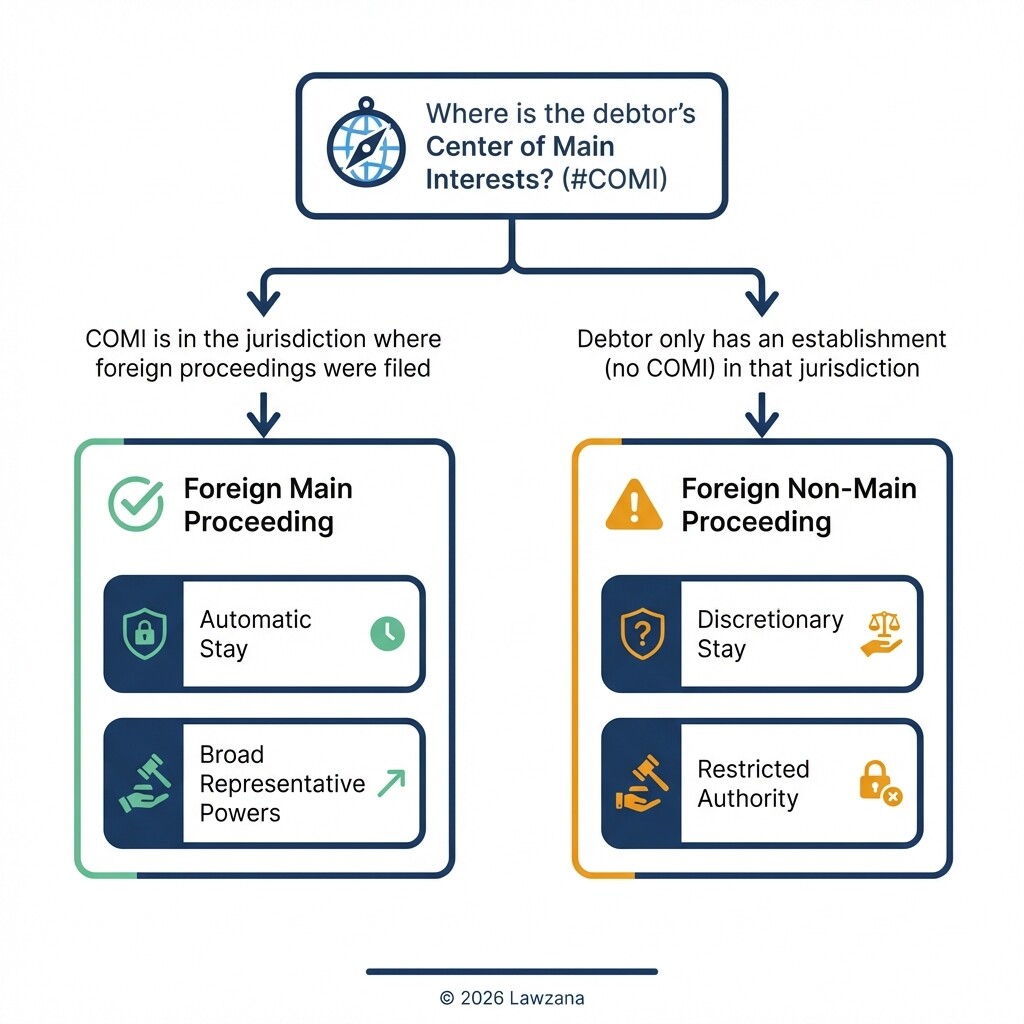
- COMI Principle: Recognition distinguishes between "foreign main proceedings" (where the debtor has its center of main interests) and "non-main proceedings" (where the debtor has only an establishment).
- Automatic Stay: Once a foreign main proceeding is recognized, a stay on all local legal actions against the debtor's assets is automatically triggered.
- Local Creditor Protection: South African courts prioritize the protection of local creditors to ensure they are not unfairly prejudiced by the transfer of assets to a foreign jurisdiction.
Application of the UNCITRAL Model Law in South Africa
South Africa adopted the UNCITRAL Model Law on Cross-Border Insolvency via the Cross-Border Insolvency Act 42 of 2000. This law provides a streamlined framework for cooperation between South African courts and foreign jurisdictions to manage the insolvency of companies with international footprints.
The Act applies when a foreign court or representative requests assistance in South Africa, or when a South African representative seeks assistance abroad. Its primary goal is to ensure the fair and efficient administration of cross-border insolvencies, protecting the interests of all creditors while maximizing the value of the debtor's assets. By following this internationally recognized model, South Africa provides a predictable environment for global trade and investment, ensuring that asset recovery is handled with technical precision.
Procedural Checklist for Foreign Recognition Orders
To gain authority over assets located in South Africa, a foreign representative must successfully apply to the High Court. The process is formal and requires specific documentation to prove the validity of the foreign insolvency proceeding.
Recognition Application Checklist
| Item | Requirement Detail |
|---|---|
| Certified Order | A certified copy of the foreign court order or certificate declaring the commencement of insolvency proceedings and the appointment of the representative. |
| Translation | If the foreign order is not in English, a sworn translation into English must be provided. |
| Identification of COMI | Evidence proving that the "Center of Main Interests" (COMI) is in the foreign jurisdiction for a "Main Proceeding" designation. |
| Asset Schedule | A comprehensive list of the debtor's known assets located within South African borders (real estate, bank accounts, equipment). |
| Creditor List | Details of all known South African creditors, including the nature and amount of their claims. |
| Proof of Reciprocity | Confirmation that the foreign state has been designated by the Minister of Justice (though the High Court maintains inherent jurisdiction to assist regardless). |
| Affidavit of Urgency | If assets are at risk of being dissipated, an affidavit justifying an urgent hearing. |
Procedural Requirements for Obtaining a High Court Recognition Order
A foreign representative must file a notice of motion supported by an affidavit in the High Court division where the assets are located. The application must satisfy the court that the foreign proceeding is a "foreign proceeding" as defined by the Act and that the applicant is a "foreign representative."
Once the papers are filed, the court evaluates whether the recognition would be contrary to South African public policy. While this is a high bar to meet, the court will specifically look at whether local creditors have been notified. In many cases, the court will grant a provisional recognition order first (a rule nisi), requiring the foreign representative to publish notice of the order in local newspapers and the Government Gazette. This gives local stakeholders an opportunity to show cause why the recognition should not be made final.
Prioritization of Local vs. Foreign Creditor Claims
South Africa adheres to the principle of paritas condicio creditorum (equality of creditors), meaning that foreign and local creditors should generally be treated equally. However, the High Court has the discretion to impose conditions on a recognition order to protect the interests of local creditors.
Before allowing a foreign representative to remit assets or proceeds out of South Africa, the court may require that:
- Local secured and preferential creditors (such as employees or the South African Revenue Service) are paid first according to South African ranking rules.
- Sufficient security is provided by the foreign representative to cover potential local claims.
- The foreign representative submits to the jurisdiction of the South African courts for any disputes arising from the local assets.
Methods for Staying Local Litigation Against a Foreign Insolvent Entity
The recognition of a foreign main proceeding immediately halts all individual legal actions and execution proceedings against the debtor's assets in South Africa. This "stay" is essential to prevent a "grab law" scenario where local creditors attempt to seize assets before the foreign representative can consolidate the estate.
For "non-main proceedings," the stay is not automatic, but the High Court has the power to grant a discretionary stay upon request. This ensures that the foreign representative has the "breathing room" necessary to evaluate the debtor's position. If a local creditor wishes to proceed with litigation despite the stay, they must apply to the High Court for specific leave, demonstrating that their interests outweigh the collective interests of the insolvency estate.
Alternative Restructuring Options: Business Rescue vs. Liquidation
When a foreign entity faces financial distress in South Africa, the foreign representative must decide whether to wind up the company or attempt a reorganization. The South African Companies Act 71 of 2008 provides two distinct paths.
| Feature | Business Rescue (Restructuring) | Liquidation (Winding Up) |
|---|---|---|
| Primary Goal | To rehabilitate the company and continue its existence. | To sell off assets and distribute proceeds to creditors. |
| Management | A Business Rescue Practitioner (BRP) takes full management control. | A Liquidator takes control to realize assets. |
| Outcome | Approval of a Business Rescue Plan by 75% of creditors. | Dissolution of the company and removal from the registry. |
| Threshold | "Financially distressed" (unlikely to pay debts in 6 months). | Insolvent (liabilities exceed assets or unable to pay debts). |
| Timeline | Designed to be short-term (approx. 3-6 months). | Can take years depending on asset complexity. |
Common Misconceptions Regarding Cross-Border Insolvency
Recognition is Automatic
Many international practitioners believe that a foreign court order is automatically valid in South Africa. This is incorrect. Without a High Court recognition order, a foreign liquidator has no legal standing to sue, transfer property, or close bank accounts within South Africa.
Foreign Law Dictates Local Distribution
While the foreign proceeding manages the global estate, the physical distribution of assets located in South Africa is often subject to local "ranking of claims." South African law usually dictates who gets paid first from the proceeds of local assets, particularly regarding tax and labor claims.
FAQ
How long does it take to get a recognition order in South Africa?
An unopposed application for recognition can typically be heard within 4 to 8 weeks. However, if the matter is urgent and assets are at risk of being moved, an interim order can sometimes be obtained within days.
What is the "COMI" and why does it matter?
COMI stands for "Center of Main Interests." If the High Court determines the debtor's COMI is in the foreign jurisdiction, it recognizes the case as a "Main Proceeding," which grants the representative more powerful and automatic protections, including a stay on litigation.
Can a foreign representative sell South African real estate?
Yes, but only after receiving a final recognition order from the High Court. The representative will also need to comply with local conveyancing requirements and obtain a certificate from the Master of the High Court.
Do I need a local South African lawyer?
Yes. Only practitioners admitted to the South African High Court can file the necessary applications. Furthermore, the procedural nuances of the various High Court divisions require local expertise to avoid delays.
When to Hire a Lawyer
You should engage a South African legal expert if you are a foreign liquidator discovering assets in South Africa, or a local creditor of a multinational company that has entered insolvency abroad. Legal counsel is essential when navigating the intersection of the Cross-Border Insolvency Act and the South African Companies Act, especially when competing claims arise over high-value assets. If there is a risk of local assets being dissipated or seized by other creditors, immediate legal intervention is required to secure a stay of proceedings.
Next Steps
- Identify Assets: Conduct a thorough audit of all tangible and intangible assets held by the debtor within South African borders.
- Gather Documentation: Obtain certified and apostilled copies of your appointment and the foreign insolvency order.
- Appoint Local Counsel: Select a South African law firm specializing in restructuring and insolvency to draft the High Court application.
- Notify the Master: Ensure that the Master of the High Court is informed of the proceedings as they play a supervisory role in all insolvency matters.
- Secure Assets: Once the provisional order is granted, immediately move to secure bank accounts and physical property to prevent unauthorized transfers.