Commercial Litigation Timelines for Foreign Investors in South Africa
Managing a commercial dispute in South Africa requires understanding local court procedures, expected timelines, and funding requirements. The country has an independent judiciary with established commercial precedents. However, foreign investors face systemic court backlogs and specific procedural rules, such as providing security for costs.
- Civil litigation in major South African High Courts takes 18 to 36 months from the summons to the trial date.
- Foreign plaintiffs generally must provide "security for costs" to guarantee they can cover the defendant's legal fees if their claim fails.
- Urgent interdicts (injunctions) offer immediate relief and are granted within hours or days to stop irreversible commercial harm.
- South Africa uses a split legal profession. Companies must hire both an instructing attorney and a specialist advocate (barrister).
- Prevailing parties typically recover 40% to 60% of their actual legal costs through court awards.
Expected Timelines for High Court Commercial Litigation
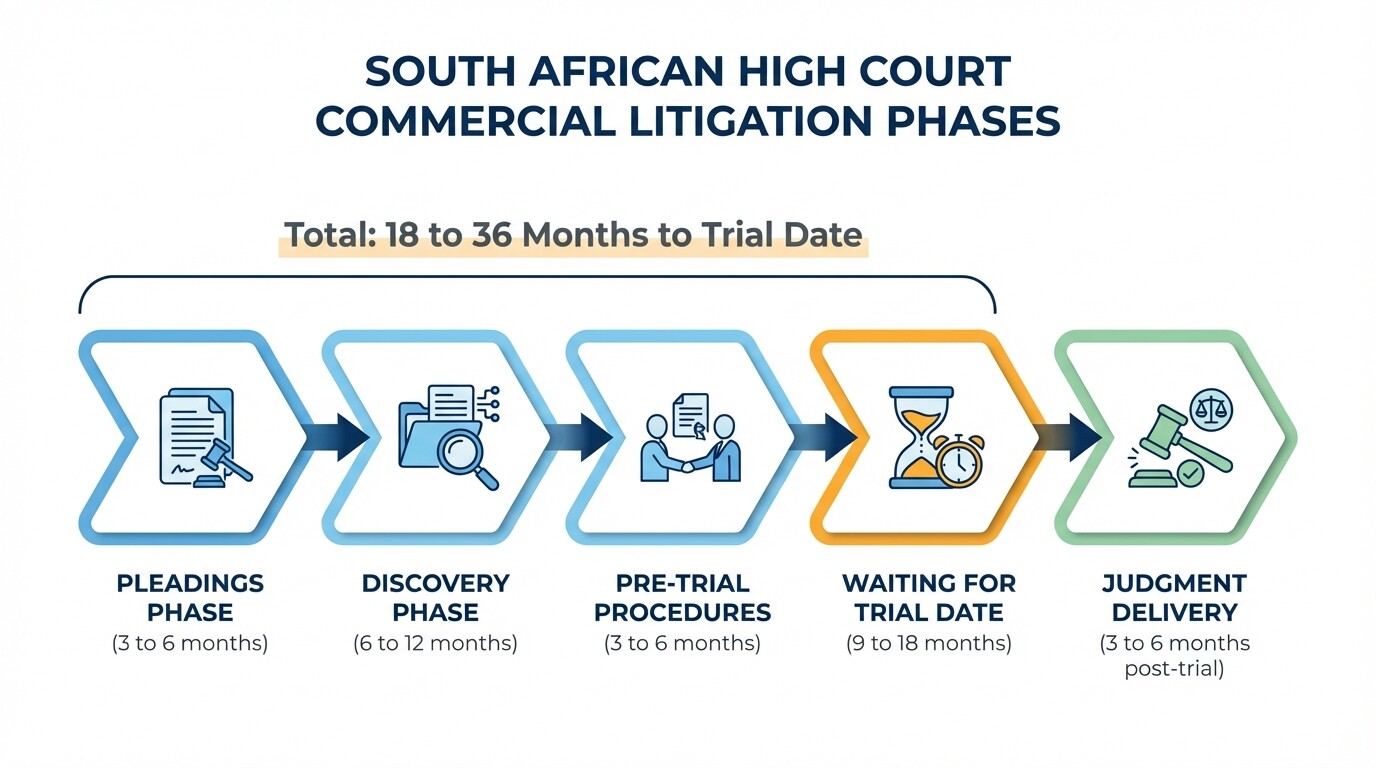
Getting a trial date in major South African High Courts takes 18 to 36 months. Courts in major commercial hubs like Johannesburg (Gauteng Local Division) and Cape Town (Western Cape Division) have heavy case backlogs, which pushes timelines toward the 36-month mark.
The standard timeline breakdown for a defended commercial action is:
| Litigation Phase | Expected Duration | Primary Activities |
|---|---|---|
| Pleadings Phase | 3 to 6 months | Exchanging Summons, Plea, and Counterclaims. |
| Discovery Phase | 6 to 12 months | Locating, indexing, and exchanging relevant documentary evidence. |
| Pre-Trial Procedures | 3 to 6 months | Requesting trial dates, holding pre-trial conferences, and narrowing disputes. |
| Waiting for Trial Date | 9 to 18 months | Time spent on the court roll waiting for an available judge. |
| Judgment Delivery | 3 to 6 months post-trial | The judge deliberates and issues a written judgment. |
Step-by-Step South African Civil Litigation Process
The South African civil litigation process follows a strict sequence set by the Uniform Rules of Court. Each stage has statutory deadlines. Missing these deadlines can lead to default judgments or procedural penalties.
- Summons and Particulars of Claim: The plaintiff initiates the lawsuit. The Sheriff of the Court serves a summons on the defendant detailing the legal basis of the claim and the relief sought.
- Notice of Intention to Defend and Plea: The defendant has 10 court days to file a notice of intention to defend, and another 20 court days to file a Plea responding to the allegations.
- Discovery of Documents: Both parties disclose all documents and recordings relevant to the dispute, including evidence detrimental to their case. Privileged communications remain protected.
- Pre-Trial Conference: Legal representatives meet to discuss settlement, narrow the disputed issues, and agree on trial logistics to save court time.
- Trial: Lawyers call and cross-examine witnesses. South Africa does not use jury trials. A single High Court judge presides and makes the final decision. Key witnesses usually testify in person, though courts increasingly allow foreign witnesses to testify via secure video link with prior approval.
Security for Costs: Requirements for Foreign Plaintiffs
Foreign companies filing lawsuits in South Africa usually must provide security for the defendant's legal costs. This rule protects local defendants, allowing them to recover legal expenses if they win without pursuing enforcement abroad.
After a foreign entity files suit, the South African defendant will formally request security. If the parties cannot agree on the amount, a court official called the Taxing Master sets a reasonable sum based on the expected defense costs. Plaintiffs usually provide this security by lodging funds in a trust account or presenting a local bank guarantee. If the foreign plaintiff fails to post security, the court may pause or dismiss the lawsuit.
Urgent Interdicts: Protecting Foreign Commercial Interests
An urgent interdict is the South African equivalent of a preliminary injunction. It allows foreign investors to stop immediate commercial harm. Courts grant these expedited orders when standard litigation timelines would cause irreparable damage to the applicant's business.
To secure an urgent interdict, an applicant must prove four requirements:
- Prima Facie Right: Clear evidence of a legal right protecting the commercial interest.
- Irreparable Harm: A well-grounded fear that the business will suffer damage that cannot be reversed or compensated later.
- Balance of Convenience: Proof that granting the interdict favors the applicant more than it prejudices the respondent.
- No Alternative Remedy: Proof that standard litigation or a damages claim will not protect the investor's interests.
Cost Breakdown: Attorney and Advocate Fees
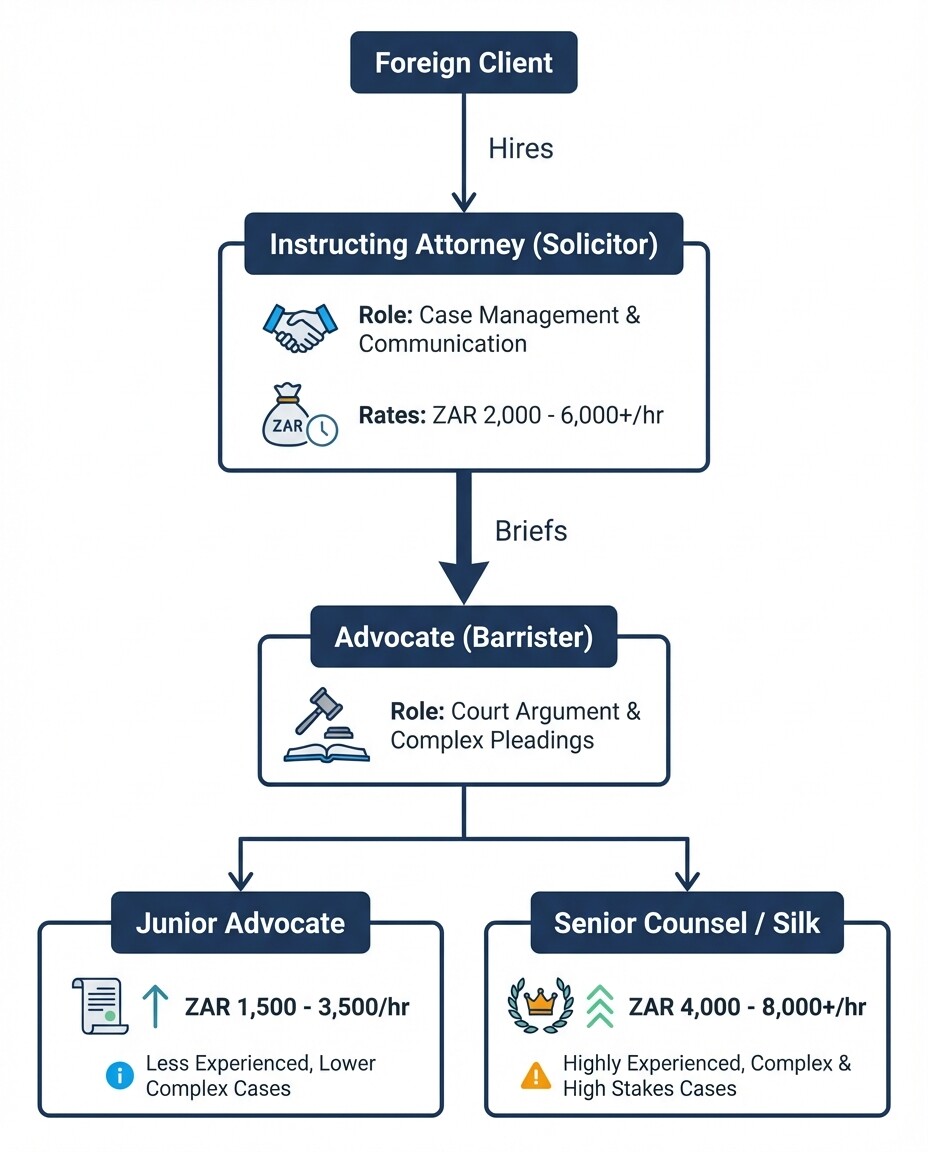
Commercial litigation in South Africa requires paying both an attorney (who manages the case and client communication) and an advocate (who drafts complex pleadings and argues in court). Total costs for a standard commercial High Court trial range from ZAR 500,000 to ZAR 2,000,000 or more. The final bill depends on the trial's length and the seniority of the counsel.
Foreign investors should anticipate the following average fee structures:
- Attorneys (Solicitors): Charge hourly rates between ZAR 2,000 and ZAR 6,000+. They handle the daily administration of the file.
- Junior Advocates: Charge hourly rates between ZAR 1,500 and ZAR 3,500, or daily trial fees of ZAR 15,000 to ZAR 35,000.
- Senior Counsel (Silks): Highly experienced advocates charging ZAR 4,000 to ZAR 8,000+ per hour, or daily trial fees of ZAR 40,000 to ZAR 80,000+. Complex commercial disputes almost always require Senior Counsel.
To manage these costs, hire specialized commercial litigation lawyers in South Africa who can provide accurate budget forecasts early in the process.
Common Misconceptions About South African Litigation
Foreign investors often apply their home country's litigation expectations to South Africa, leading to strategic errors. Understanding the local judicial environment prevents costly surprises.
- Cost recovery: South African courts award costs on a "party-and-party" scale based on a set court tariff, not actual invoices. A successful litigant generally recovers only 40% to 60% of their actual legal spend.
- Jury trials: South Africa abolished jury trials in 1969. Judges decide all civil and commercial matters based on the law and facts.
- Direct instruction of advocates: Due to the split bar system, foreign clients cannot instruct an advocate directly for litigation. You must first hire a law firm (attorneys), which then briefs an advocate for court appearances.
Statute of Limitations (Prescription)
Under the Prescription Act 68 of 1969, ordinary commercial debts and breach of contract claims expire (prescribe) three years from the date the debt became due and the creditor became aware of it.
Enforcing Foreign Judgments
A final and conclusive judgment from a foreign court can be enforced in South Africa. The judgment must not violate South African public policy and must come from a court with proper international jurisdiction.
When to Hire a South African Commercial Litigator
Engage a commercial litigator as soon as a dispute threatens your South African business interests or when you receive a formal letter of demand. Early intervention allows legal counsel to explore alternative dispute resolution, track the three-year prescription period, and structure the legal team efficiently. Waiting until a summons is served limits your legal options and tightens response deadlines.
Next Steps for Foreign Investors
To prepare for a commercial dispute in South Africa, preserve all relevant communications and financial records immediately. Review your commercial agreements to identify arbitration clauses or specific jurisdictional agreements that dictate where the dispute must be resolved. Consult with a locally qualified attorney to conduct a risk and cost analysis before initiating formal court proceedings.