- Rules of origin: Products do not automatically qualify for tariff reductions. Exporters must prove local value addition and secure an official AfCFTA Certificate of Origin from the South African Revenue Service (SARS).
- Document alignment: Mismatched HS codes and commercial invoices cause most delays at South African land borders. Documents must match exactly.
- Supply route diversity: Relying on a single border crossing is risky. Multinational exporters need alternative logistics hubs to bypass regional bottlenecks.
- Regional IP security: A South African trademark does not protect your brand across the continent. Use regional bodies like ARIPO to secure intellectual property before expanding.
- International arbitration: Standardize commercial contracts with clear arbitration clauses to avoid foreign domestic courts during trade disputes.
Comprehensive AfCFTA Trade Compliance Checklist
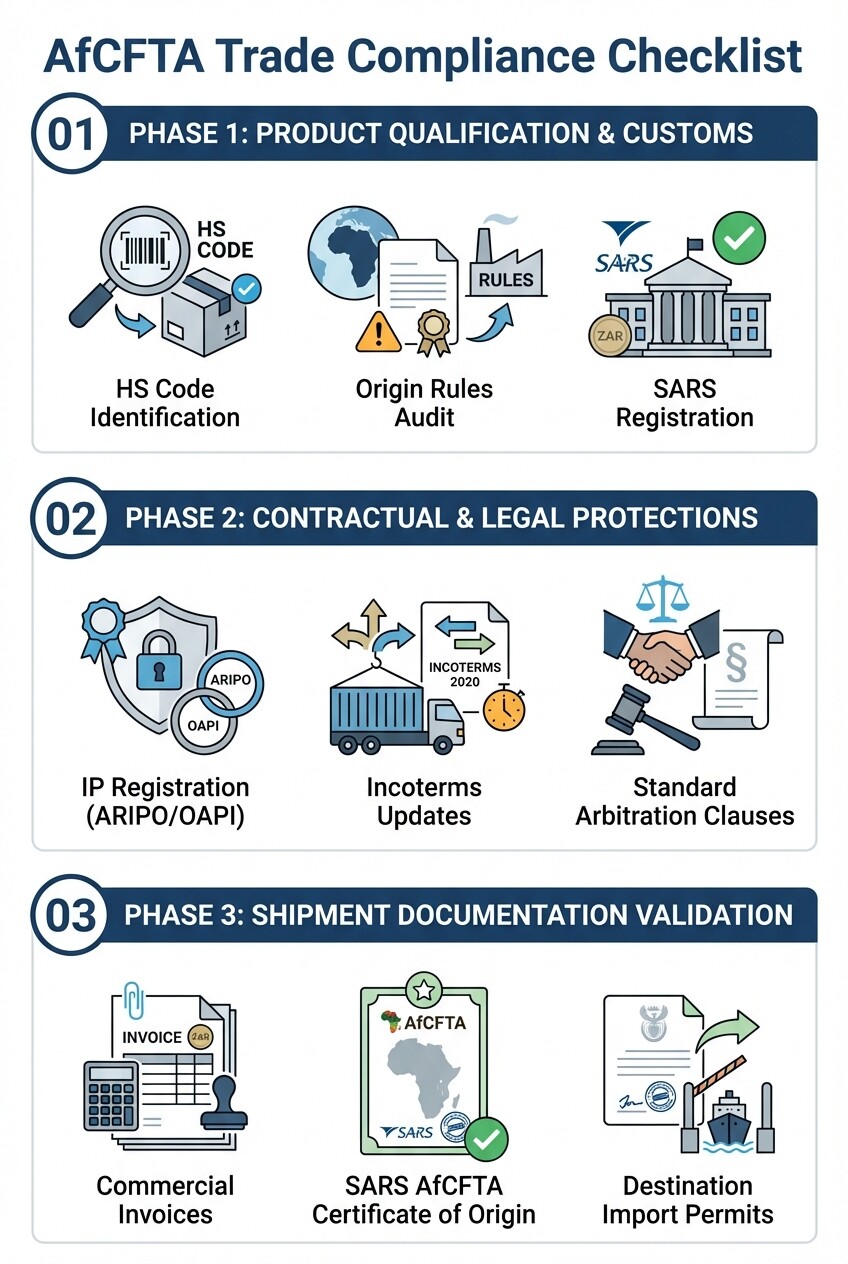
This framework helps multinational exporters in South Africa systematically claim preferential tariffs under the African Continental Free Trade Area (AfCFTA) and avoid border delays. Use it to audit current cross-border operations.
Phase 1: Product Qualification & Customs Registration
- Identify the exact 6-digit Harmonized System (HS) code for all export products.
- Check products against the AfCFTA tariff schedules for the destination country to confirm duty phase-down status.
- Audit manufacturing processes to meet AfCFTA Rules of Origin (wholly obtained or sufficient material transformation).
- Register the company as an official Exporter with SARS specifically for the AfCFTA.
Phase 2: Contractual & Legal Protections
- Register trademarks and patents in destination countries using national IP offices or regional frameworks (ARIPO/OAPI).
- Update distributor and vendor agreements to reflect Ex Works (EXW) or Free Carrier (FCA) Incoterms® 2020.
- Embed standard international arbitration clauses in all cross-border commercial contracts.
- Meet local labeling, packaging, and language requirements for the destination country.
Phase 3: Shipment Documentation Validation
- Generate a compliant Commercial Invoice detailing exact product descriptions, values in the agreed currency, and HS codes.
- Obtain an AfCFTA Certificate of Origin approved and stamped by SARS.
- Prepare packing lists that match the exact quantities and weights on the commercial invoice.
- Secure all required destination-specific import permits or sanitary/phytosanitary certificates.
How to Verify Rules of Origin Requirements
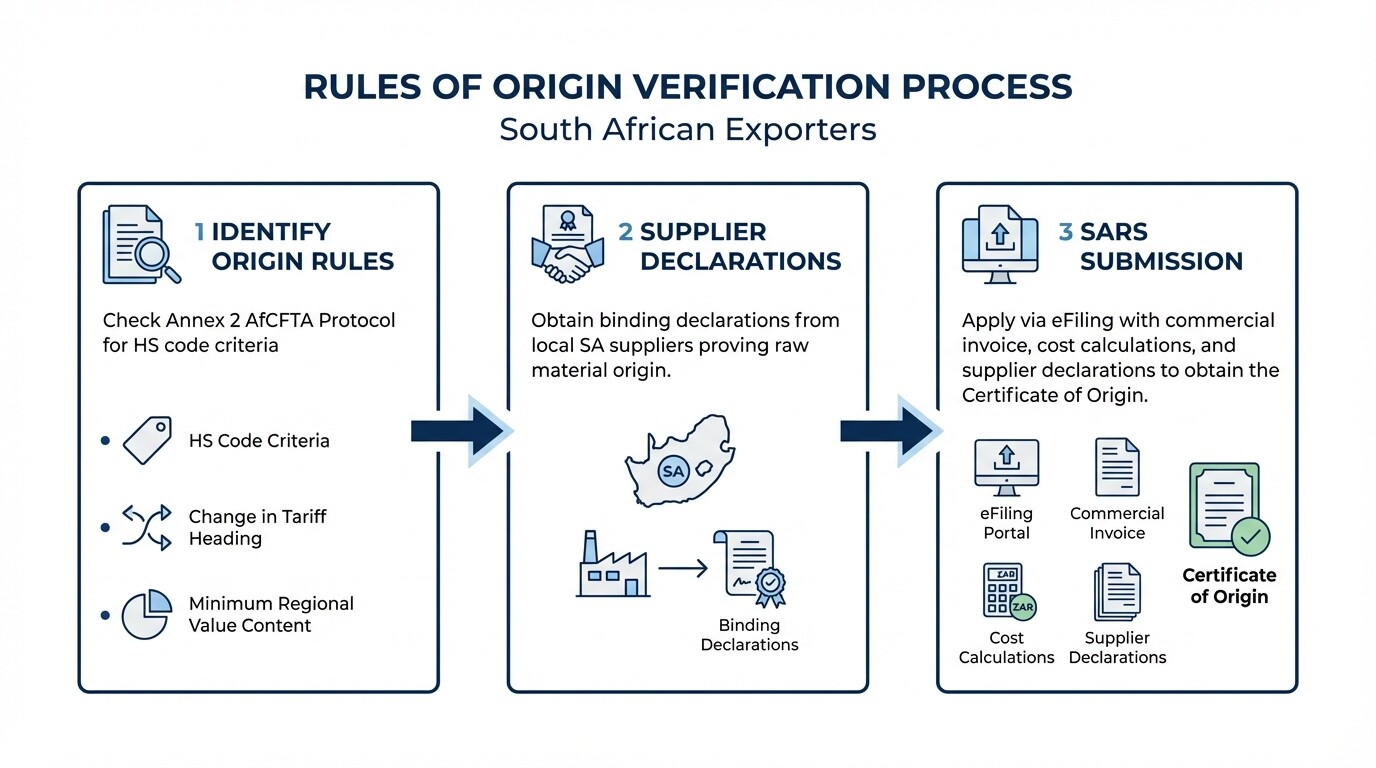
To benefit from preferential tariffs, exporters must prove their goods are wholly obtained or substantially transformed within state parties. South African exporters must secure an AfCFTA Certificate of Origin vetted by the South African Revenue Service (SARS).
Proving origin is the primary hurdle in AfCFTA compliance. The agreement specifies strict criteria to prevent transshipment, where outside countries route goods through South Africa to avoid tariffs.
To verify a product qualifies:
- Identify origin rules: Check Annex 2 of the AfCFTA Protocol on Trade in Goods for the product's HS code. The rule typically requires a change in tariff heading (CTH), a minimum regional value content (e.g., 40% value added in Africa), or specific manufacturing processing.
- Supplier declarations: Obtain legally binding declarations from local South African suppliers to prove the origin of raw materials used in manufacturing.
- SARS submission: Apply for the AfCFTA Certificate of Origin via the SARS eFiling system or at a designated customs branch. Include the commercial invoice, manufacturing cost calculations, and supplier declarations.
Common Mistakes in Cross-Border Customs Documentation
Customs delays at South African borders, such as the Beitbridge or Lebombo crossings, frequently stem from mismatched commercial invoices, incorrect HS codes, and missing certificates of origin. Exact alignment across all shipping documents prevents cargo holds.
Multinational exporters often lose weeks of transit time due to administrative errors. Customs authorities across the continent operate with minimal tolerance for discrepancies.
- Inconsistent valuations: Declaring a different cargo value on the customs declaration compared to the commercial invoice triggers immediate audits for potential tax evasion.
- HS code misclassification: Using an outdated or incorrect tariff code delays the shipment and can result in the rejection of an AfCFTA Certificate of Origin. This forces exporters to pay standard Most-Favored-Nation (MFN) duties.
- Missing supplementary permits: Attempting to export agricultural, pharmaceutical, or chemical products without the sanitary, phytosanitary, or regulatory compliance certificates demanded by the destination state.
- Typographical errors: Minor discrepancies in company names, vehicle registration numbers, or container seal numbers between the bill of lading and customs documents.
Establishing Alternative Supply Chain Hubs
Relying on a single land border crossing increases vulnerability to infrastructure bottlenecks, geopolitical disruptions, and natural disasters. Exporters benefit from establishing secondary distribution hubs and utilizing multi-modal transport routes through key South African ports and regional corridors.
African logistics face frequent disruptions. To maintain delivery schedules and fulfill contractual obligations, exporters must build redundancy into supply chains.
- Special Economic Zones (SEZs): Establish bonded warehousing or distribution centers in South African SEZs, such as the Coega Development Corporation or Dube TradePort. These zones offer expedited customs procedures and proximity to deep-water ports or international airports.
- Multi-modal transport: Avoid relying exclusively on road freight. Integrate rail solutions via regional corridors (like the Maputo Development Corridor) or short-sea shipping (cabotage) to reach West and East African markets.
- Regional stock locations: Instead of shipping on-demand from Johannesburg or Cape Town, hold fast-moving inventory in secure bonded warehouses in regional anchor countries (e.g., Kenya for East Africa, Ghana for West Africa) to bypass immediate border transit risks.
Resolving Commercial Trade Disputes Through Arbitration
Commercial contracts under AfCFTA should explicitly outline international arbitration as the primary dispute resolution mechanism rather than relying on local national courts. This ensures a neutral, enforceable, and confidential resolution process across diverse legal systems.
When exporters engage distributors, logistics providers, or buyers in other African nations, the risk of breach of contract, non-payment, or delivery failure increases. Relying on a foreign domestic court often leads to lengthy and unpredictable outcomes.
- Draft clear arbitration clauses: Specify the arbitration institution (e.g., the Arbitration Foundation of Southern Africa), the seat of arbitration (e.g., Johannesburg or Mauritius), the number of arbitrators, and the governing law of the contract.
- Leverage the New York Convention: Ensure the buyer's country is a signatory to the New York Convention on the Recognition and Enforcement of Foreign Arbitral Awards. This guarantees an arbitration award won in South Africa can be legally enforced against the buyer's assets in their home country.
- State-to-State disputes: Private companies cannot directly use the AfCFTA Dispute Settlement Mechanism, as it is reserved for member states. However, corporations can lobby the South African government (via the Department of Trade, Industry and Competition) to initiate a dispute if a foreign country consistently violates AfCFTA protocols to block exports.
Protecting Intellectual Property Rights Across Jurisdictions
Despite the AfCFTA Protocol on Intellectual Property Rights, exporters must proactively register patents, trademarks, and copyrights in target markets. A South African IP registration alone leaves brands vulnerable to regional infringement.
Expanding into new African markets exposes products to counterfeiting and brand hijacking. IP rights are territorial; a trademark registered with the South African Companies and Intellectual Property Commission (CIPC) holds no legal weight in Nigeria or Kenya.
- Utilize regional IP systems: Instead of filing in every single country, leverage regional organizations. File with the African Regional Intellectual Property Organization (ARIPO) to cover English-speaking nations, and the Organisation Africaine de la Propriété Intellectuelle (OAPI) for Francophone countries.
- Conduct freedom-to-operate (FTO) searches: Before exporting to a new market, conduct legal searches to ensure your product name, logo, or technology does not infringe on an existing registered right in that specific country.
- Record rights with local customs: In countries that permit it, record trademark registrations directly with national customs authorities. This empowers border officials to seize counterfeit goods attempting to enter or exit the country bearing your brand.
Key Compliance and Operational Facts
Exporters often misjudge AfCFTA benefits and border procedures. Knowing the exact rules helps with financial forecasting and supply chain planning.
- Tariff elimination is gradual: Goods do not automatically cross borders duty-free. The AfCFTA is a phased agreement. Tariffs on 90% of goods are eliminated over 5 to 10 years, depending on the country's development status. The product must explicitly qualify under the Rules of Origin to receive any reduction.
- Import permits are still required: The AfCFTA only addresses customs duties and quotas. It does not exempt products from local regulatory standards, health inspections, or specific import licensing required by the destination country.
- Customs procedures vary: While the AfCFTA promotes harmonization, border management remains under the control of sovereign nations. Exporters will encounter varying digital systems, inspection protocols, and clearance timelines at different borders.
- Specific SARS registration is required: Businesses must formally register as an exporter with SARS and apply for "Approved Exporter" status or request individual AfCFTA Certificates of Origin for each shipment.
- VAT still applies: The AfCFTA reduces or eliminates customs duties (tariffs) only. Standard domestic tax laws regarding zero-rated exports from South Africa and the levying of import VAT by the destination country's tax authority still apply.
- Exporters bear legal liability: A freight forwarder or customs clearing agent can file paperwork, but the legal liability for the accuracy of origin declarations and product valuations remains strictly with the exporter.
When to Hire a South African Trade Lawyer
Engaging specialized legal counsel helps structure cross-border supply chains, draft regional distribution agreements, and manage complex customs audits. A South African trade lawyer navigates domestic SARS regulations alongside international AfCFTA protocols.
You may need legal counsel to formally challenge a customs classification, address a rejected AfCFTA Certificate of Origin, or structure multi-jurisdictional IP protection. An experienced attorney also ensures commercial contracts contain robust international arbitration clauses to protect financial interests. You can find international trade law lawyers in South Africa to assist with corporate structuring and compliance needs.
Next Steps
Begin AfCFTA integration by conducting a comprehensive audit of product lines against the agreement's tariff schedules and origin rules.
- Analyze your top export products to confirm their exact HS codes and verify their current tariff phase-down status in primary target markets.
- Initiate the process with SARS to formally register the business as an exporter under the AfCFTA framework.
- Review existing supply chain contracts to update Incoterms, IP protection requirements, and arbitration provisions for cross-border trade.