- Medical malpractice claims in South Africa fall under the law of delict, requiring proof of negligence, causation, and actual damages.
- The standard prescription period for filing a claim is generally three years from the date the patient became aware of the negligence.
- Expert medical testimony is mandatory to establish whether a healthcare provider deviated from the standard of care expected of a reasonable professional.
- Compensation can cover past and future medical expenses, loss of earnings, and general damages for pain and suffering.
- Claims against state-owned hospitals require a formal notice of intent to sue within six months of the incident under the Institution of Legal Proceedings Against Certain Organs of State Act.
How do you prove a breach of medical standards in South Africa?
Proving medical negligence requires demonstrating that a healthcare professional breached their duty of care by failing to act with the skill and diligence expected of a reasonable practitioner in their field. You must show that a legal relationship existed, that the provider's conduct fell below professional standards, and that this specific failure directly caused your injury.
South African courts apply the "reasonable person" test, adapted for professionals. This means the court asks: "What would a reasonably competent doctor in the same branch of medicine have done in these circumstances?"
To build a successful case, you must establish four specific elements:
- Duty of Care: A legal obligation existed where the provider was responsible for your safety and treatment.
- Breach of Duty: The provider acted (or failed to act) in a way that deviated from accepted medical protocols.
- Causation: The breach of duty was the direct or "proximate" cause of the harm you suffered.
- Damages: You experienced actual loss, whether physical, emotional, or financial.
What is the role of expert medical witnesses in proving causation?
Expert medical witnesses are essential because judges generally do not possess the specialized clinical knowledge to determine if a complex procedure was performed correctly. These experts review medical records, examine the patient, and provide a professional opinion on whether the defendant's actions caused the injury.
The expert must address the "but-for" test (conditio sine qua non). The court must be convinced that "but for" the doctor's negligence, the patient would not have suffered the harm. If the injury would have happened anyway due to an underlying condition, the claim will fail.
The role of the expert includes:
- Establishing the Standard: Defining what the "gold standard" or "reasonable standard" of care is for the specific procedure.
- Identifying Deviations: Pinpointing exactly where the treating physician moved away from that standard.
- Determining Foreseeability: Confirming whether the harm was a foreseeable consequence of the doctor's mistake.
- Assessing Quantum: Helping the court understand the long-term medical needs and costs the patient will face.
What are the statutory time limits for filing a medical negligence claim?
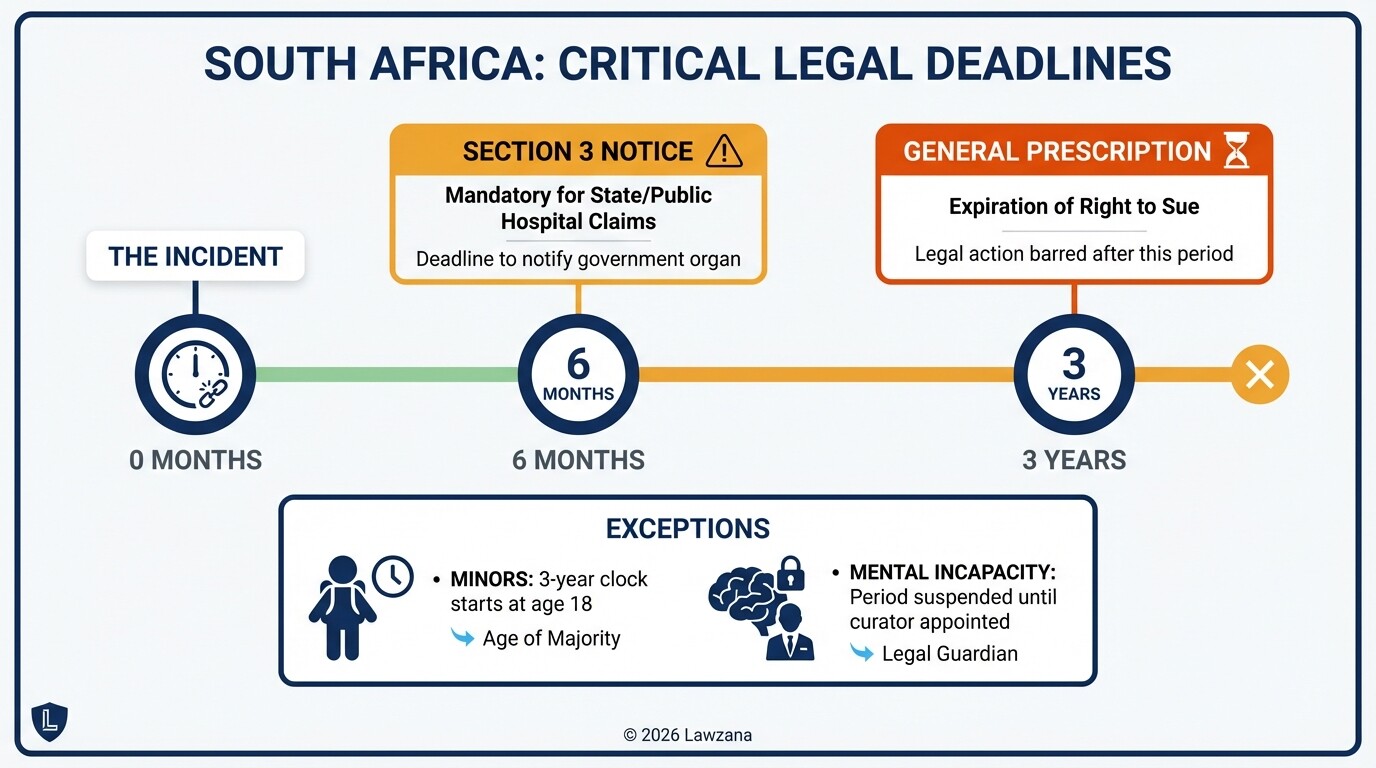
In South Africa, the Prescription Act dictates that a medical malpractice claim must generally be filed within three years of the date the incident occurred or the date the patient reasonably became aware of the negligence. Failing to initiate legal action within this window usually results in the claim "prescribing," meaning it is legally extinguished and cannot be pursued.
However, there are critical exceptions and additional requirements depending on the defendant:
- Claims Against the State: If you are suing a public hospital or the Department of Health, you must serve a formal "Section 3 Notice" within six months of the incident. While you still have three years to file the actual summons, failure to send this early notice can lead to the court dismissing your case unless you apply for condonation.
- Minors: For children under 18, the three-year clock typically only begins to run once they reach the age of majority (18). This gives families more time to assess the long-term impact of birth injuries or pediatric errors.
- Mental Incapacity: If the patient is mentally incapacitated as a result of the negligence, the prescription period may be suspended until they recover or a curator is appointed.
What compensation can you claim in a medical malpractice lawsuit?
Compensation, known as "damages," is designed to place the injured party in the position they would have been in had the negligence not occurred. In South Africa, these are divided into special damages (monetary losses) and general damages (non-monetary losses).
The calculation of these amounts is a highly technical process involving actuaries and medical specialists. Because South Africa does not have a "cap" on economic losses, claims involving permanent disability can reach millions of Rands.
| Category of Damage | Description | Examples |
|---|---|---|
| Past Medical Expenses | Reimbursement for all medical bills paid since the injury occurred. | Hospital stays, surgeries, medication, and therapy. |
| Future Medical Costs | The estimated cost of lifelong care, equipment, and treatment. | Home nursing, specialized wheelchairs, and future corrective surgeries. |
| Past Loss of Earnings | Income lost because the patient was unable to work during recovery. | Salaries and bonuses missed during hospital leave. |
| Future Loss of Earnings | The loss of future "earning capacity" if the patient can no longer work. | Early retirement or the inability to pursue a promoted career path. |
| General Damages | Compensation for non-economic impacts like pain and suffering. | Loss of amenities of life, disfigurement, and emotional trauma. |
Mediation vs. Litigation in South African healthcare disputes
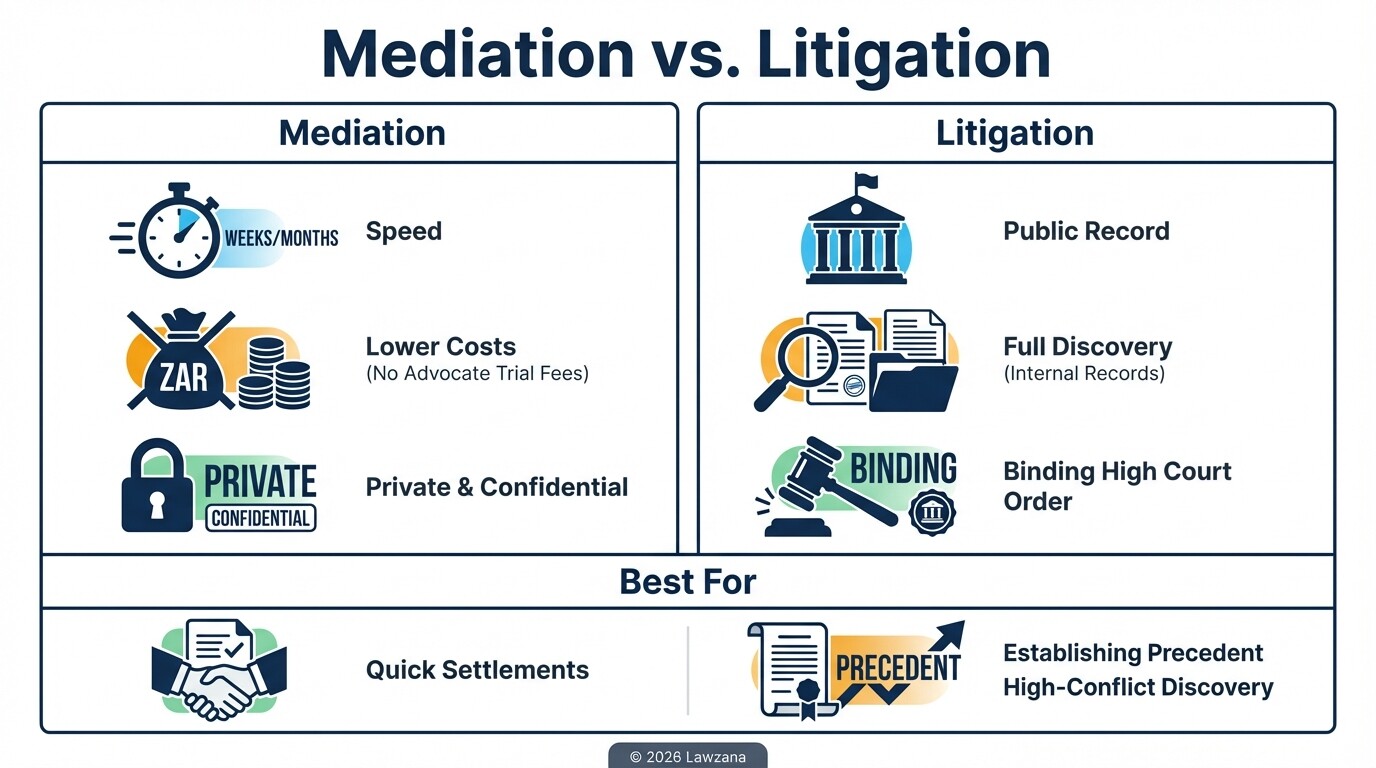
Mediation is a voluntary, confidential process where a neutral third party helps the patient and the healthcare provider reach a settlement without a trial. In contrast, litigation involves a formal battle in the High Court where a judge makes the final, binding decision.
The South African Department of Health increasingly encourages mediation for claims involving state hospitals to reduce the massive backlog of legal cases and save on legal costs.
Benefits of Mediation:
- Speed: Settlements can be reached in weeks or months, whereas litigation often takes 3 to 7 years.
- Cost: Significant savings on advocate fees and expert witness trial attendance.
- Privacy: The details of the settlement are not part of the public court record.
Benefits of Litigation:
- Precedent: A court judgment can establish a new legal principle or hold a provider publicly accountable.
- Full Discovery: Litigation forces the defendant to hand over internal documents and records that they might withhold during voluntary mediation.
- Formal Award: A High Court order is an enforceable debt that can be executed via the Sheriff if the defendant refuses to pay.
Common Misconceptions About Medical Malpractice
Myth 1: Every bad medical outcome is malpractice.
A medical procedure failing or a patient not recovering as expected does not automatically mean the doctor was negligent. Medicine is inherently risky. To win a case, you must prove the doctor made a mistake that no other reasonable doctor would have made.
Myth 2: You can sue for any amount you want.
While you can "claim" any amount, South African courts are conservative regarding general damages (pain and suffering). Unlike the United States, South Africa does not award "punitive damages." You only receive what you can objectively prove you lost or will need for future care.
Myth 3: Public hospitals cannot be sued.
Many citizens believe that because public healthcare is a state service, it is immune from lawsuits. This is false. The State Liability Act allows citizens to sue the government for negligence, provided the correct procedural notices are served.
Step-by-Step Guide to Filing a Claim
- Request Your Records: Secure all medical files, charts, and test results immediately. You have a right to these under the Promotion of Access to Information Act (PAIA).
- Consult a Specialist Lawyer: Medical malpractice is a niche field; a general practitioner lawyer may not have the resources to fund expert reports.
- Obtain a Medico-Legal Report: Your lawyer will send your records to an independent medical expert to determine if there is a "prima facie" case of negligence.
- Issue a Notice of Intent: If suing the state, send the Section 3 Notice within six months.
- Serve the Summons: Once the expert confirms negligence, the formal legal process begins in the High Court.
- Discovery and Pre-Trial: Both sides exchange evidence. Many cases are settled during this stage before reaching a full trial.
FAQ
How much does it cost to sue for medical malpractice?
These cases are expensive due to the high fees of medical experts. However, many specialist lawyers work on a "contingency fee" basis (No Win, No Fee), where they cap their fee at 25% of the total payout as per the Contingency Fees Act.
How long does a medical negligence case take in South Africa?
Due to court backlogs and the complexity of gathering medical evidence, most cases take between 3 and 6 years to reach a conclusion or settlement.
Can I sue the hospital for a nurse's mistake?
Yes. Under the principle of "vicarious liability," a hospital (the employer) is generally responsible for the negligent actions of its employees (nurses, technicians, and resident doctors) performed during their employment.
What if I signed a consent form?
A consent form does not give a doctor a "license to be negligent." It proves you accepted the inherent risks of a procedure, but it does not mean you consented to sub-standard care or preventable errors.
When to Hire a Lawyer
You should consult a legal professional immediately if a medical incident resulted in permanent disability, significant financial loss, or the death of a family member. Because of the strict six-month notice period for claims against the state and the three-year prescription limit, waiting too long can permanently bar you from seeking justice.
A specialized lawyer is necessary to navigate the Health Professions Council of South Africa (HPCSA) complaints process and to manage the high costs of medical experts required to prove your case.
Next Steps
- Document everything: Write a detailed timeline of events while your memory is fresh.
- Do not sign settlements: Avoid signing any "full and final settlement" documents offered by a hospital's insurance company without legal review.
- Contact an expert: Reach out to a qualified medical malpractice attorney to evaluate the merits of your case and discuss fee structures.
- Visit the Department of Justice: Review the Department of Justice and Constitutional Development website for information on High Court procedures and legal aid options.