


- Arbitration in Thailand is governed by the Arbitration Act B.E. 2545 (2002), which is largely based on the UNCITRAL Model Law.
- Parties can choose between institutional arbitration, such as the Thai Arbitration Institute (TAI) or the Thailand Arbitration Center (THAC), or ad hoc proceedings.
- Thailand is a signatory to the New York Convention, making foreign arbitral awards generally enforceable through the Thai court system.
- Including a specific arbitration clause in commercial contracts is mandatory to bypass the standard court litigation process.
- The "seat" of arbitration determines the legal framework and the supervisory court, while the "venue" refers only to the physical location of hearings.
How to Draft an Effective Arbitration Clause in Thailand
An enforceable arbitration clause in Thailand must be in writing and clearly demonstrate the parties' intent to submit disputes to arbitration rather than the judiciary. A well-drafted clause specifies the governing rules, the number of arbitrators, the language of the proceedings, and the "seat" of the arbitration.
To ensure your arbitration clause is robust under Thai law, consider the following elements:
- Written Agreement: The agreement must be contained in a document signed by the parties, an exchange of letters, or electronic communication that provides a record of the agreement.
- Selection of Rules: Specify whether you will use institutional rules (e.g., THAC or TAI) or ad hoc rules (e.g., UNCITRAL).
- Number of Arbitrators: Usually one or three. An odd number is required to avoid deadlocks.
- Language: For international contracts, specifying English is crucial, as the default language for many Thai institutions may otherwise be Thai.
- Governing Law: Clearly state that the substantive law of the contract is Thai law (or another preferred jurisdiction).
| Clause Element | Recommended Approach |
|---|---|
| Institution | THAC or TAI for domestic; ICC or SIAC for international. |
| Number of Arbitrators | 1 for smaller claims (cost-effective); 3 for complex disputes. |
| Language | Explicitly state "English" if any party is non-Thai. |
| Seat | "Bangkok, Thailand" to ensure the Arbitration Act B.E. 2545 applies. |
Contracts with the Thai Government
If your contract is with a government agency or state enterprise (an "Administrative Contract"), standard arbitration rules do not apply automatically.
-
Cabinet Resolution (2015): Strict rules now limit the inclusion of arbitration clauses in state contracts. You typically need specific Cabinet approval to include one.
-
The Risk: Without this approval, the arbitration clause may be deemed void ex tunc (from the beginning), potentially nullifying any award you win years later. Always consult a specialist before signing a B2G (Business-to-Government) contract in Thailand.
Understanding the Seat of Arbitration vs. Venue
The seat of arbitration is the legal jurisdiction to which the arbitration is tied, whereas the venue is simply the geographical location where hearings take place. Choosing Bangkok as the seat means that the Thai Arbitration Act governs the procedure and the Thai courts serve as the supervisory body for the arbitration.
In Thailand, the distinction carries significant legal weight:
- The Seat: Determines which court has the power to set aside an award or provide assistance, such as appointing an arbitrator when parties cannot agree.
- The Venue: Hearings can be held anywhere for the convenience of witnesses or experts without changing the legal seat. You could have a "seat" in Bangkok but hold a "venue" hearing in Singapore.
- Procedural Law: The Thai Arbitration Act B.E. 2545 applies to any arbitration where the seat is in Thailand, regardless of the nationality of the parties.
Obtaining Interim Relief and Preserving Evidence
Under the Thai Arbitration Act, parties have the right to request interim measures from a competent court to protect their interests while the arbitration is pending. This includes injunctions to prevent the transfer of assets or orders to preserve critical evidence that might otherwise be destroyed.
The process for seeking interim relief in Thailand involves:
- Filing a Motion: A party may file a motion with the Thai Civil Court or a relevant provincial court before or during the arbitration proceedings.
- Judicial Discretion: The court will grant relief if it believes that if such a measure is not taken, the enforcement of the eventual award would be difficult or impossible.
- Types of Relief: Common measures include temporary injunctions, seizure of property, or the attachment of bank accounts (Mareva-style injunctions).
- Emergency Arbitrators: Some institutions like the THAC provide for "Emergency Arbitrators" who can grant urgent relief before the full tribunal is even constituted.
Recognition and Enforcement of Arbitration Awards
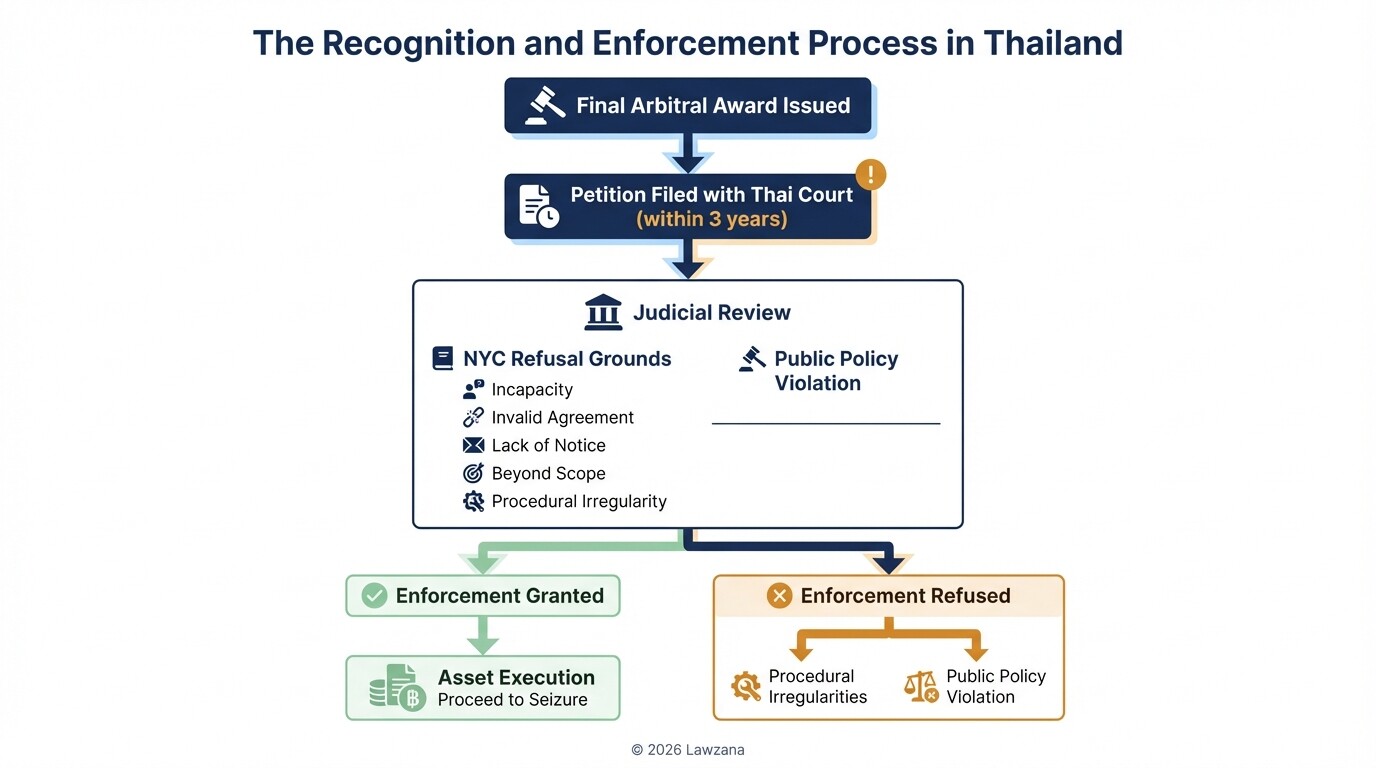
Arbitral awards are not automatically enforced in Thailand; the winning party must petition the Thai court for recognition and enforcement within three years from the date the award is sent to the parties. Thailand is a signatory to the 1958 New York Convention, meaning it must recognize and enforce foreign awards unless specific, narrow grounds for refusal exist.
The Thai court may refuse to enforce an award only if the losing party proves:
- A party to the arbitration agreement was under some incapacity.
- The arbitration agreement is not valid under the law chosen by the parties.
- The party against whom the award is invoked was not given proper notice of the appointment of the arbitrator or the proceedings.
- The award deals with a dispute not falling within the terms of the submission to arbitration.
- The composition of the arbitral tribunal or the procedure was not in accordance with the agreement of the parties.
- The award has not yet become binding or has been set aside by a court in the country where the award was made.
Additionally, the court may refuse enforcement if it finds the dispute is not arbitrable under Thai law or if enforcement would be contrary to public policy.
Expected Costs and Timelines for Arbitration in Thailand
Arbitration in Thailand is generally faster than the Thai court system, which can take several years through multiple levels of appeal, but it involves higher upfront costs. Most institutional arbitrations in Bangkok reach a final award within 12 to 18 months.
Cost Breakdown (Estimates):
- Filing/Registration Fees: Approximately 5,000 THB to 50,000 THB depending on the institution.
- Administrative Fees: Calculated as a percentage of the amount in dispute (e.g., THAC scales).
- Arbitrator Fees: These vary based on the complexity of the case and the number of arbitrators. For a 10 million THB claim, arbitrator fees might range from 200,000 to 500,000 THB.
- Legal Fees: Typically billed hourly or as a fixed stage-based fee.
Common Misconceptions About Arbitration in Thailand
"Arbitration is always cheaper than court"
While arbitration avoids the long-term costs of multi-year litigation and appeals, the parties must pay for the arbitrators' time and the institution's administrative fees. In Thai courts, the judge's "fee" is covered by the state, though court filing fees apply. Arbitration is more "cost-efficient" regarding time and business continuity, but not necessarily "cheaper" in raw numbers.
"Foreigners cannot represent parties in Thai arbitration"
This was a historical hurdle, but the law has evolved. Under the Arbitration Act, foreign lawyers and arbitrators are permitted to work on arbitration cases in Thailand, provided the governing law is not Thai law or the award does not require enforcement under specific restricted conditions. To facilitate this, the Board of Investment (BOI) now offers the Smart T" (Talent) Visa for Alternative Dispute Resolution experts. This visa allows foreign arbitrators and counsel to enter and work in Thailand on arbitration cases without the complex requirements of a standard Work Permit.
FAQ
Can an arbitration award be appealed in Thailand?
No, the merits of an arbitration award cannot be appealed to a Thai court. A court can only set aside or refuse to enforce an award based on procedural irregularities or public policy violations, not because the arbitrator made a mistake of fact or law.
Which is better: TAI or THAC?
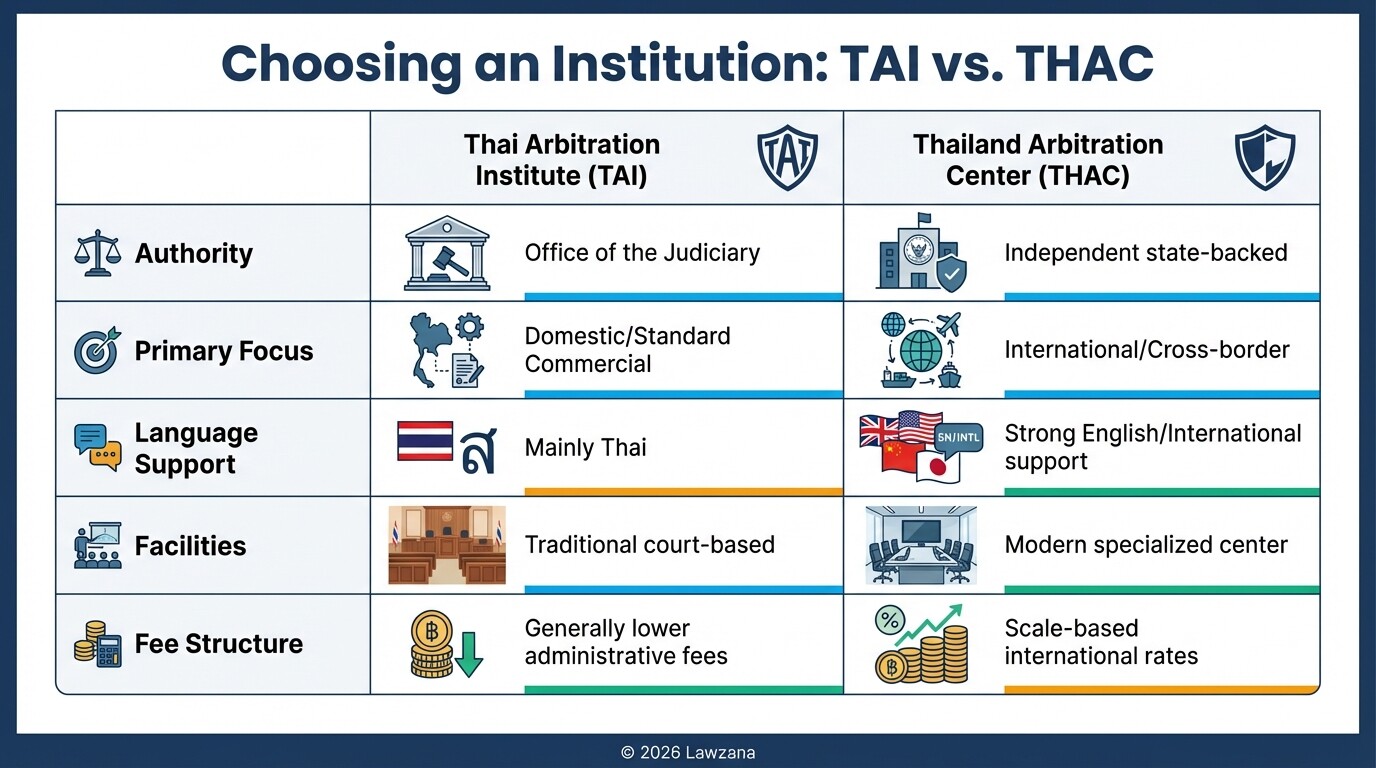
The Thai Arbitration Institute (TAI) is operated by the Office of the Judiciary and is often seen as more traditional and cost-effective for domestic disputes. The Thailand Arbitration Center (THAC) is a newer, state-backed but independent entity focused on international standards, offering modern facilities and English-speaking support.
The choice often comes down to cost vs. convenience.
-
Thai Arbitration Institute (TAI): Operated by the Office of the Judiciary. Its biggest advantage is cost: TAI charges no institutional fees (admin services are free); parties only pay the arbitrators' fees and actual expenses. However, it is more traditional, and proceedings often follow a style similar to Thai court litigation.
-
Thailand Arbitration Center (THAC): A modern, independent statutory body. It charges institutional fees (calculated as a percentage of the claim), but offers world-class facilities, full English-language support, and a more international service standard.
Verdict: Use TAI for domestic disputes where budget is key. Use THAC for cross-border contracts requiring international standards.
Is the "public policy" exception used often to block enforcement?
Historically, Thai courts were criticized for a broad interpretation of "public policy." However, in recent years, the Supreme Court of Thailand has narrowed this definition significantly, aligning it with international standards to ensure that enforcement is the rule rather than the exception.
When to Hire a Lawyer
You should engage a specialized arbitration lawyer if:
- You are drafting a high-value cross-border contract and need a "bulletproof" arbitration clause.
- A dispute has arisen, and you need to file a "Notice of Arbitration" or a "Response."
- You need to apply for emergency interim measures to freeze a counterparty's assets.
- You have won an arbitration abroad and need to enforce the award against assets located in Thailand.
- Your dispute involves complex technical issues, such as construction or intellectual property, requiring expert witness coordination.
Next Steps
- Audit Existing Contracts: Review your current Thai contracts to see if they contain a valid arbitration clause or if they default to the Thai court system.
- Select an Institution: Decide between the TAI or THAC for future contracts based on your budget and the language of your business operations.
- Consult Counsel: If you are facing a dispute, seek a legal opinion on the strength of your case and the potential costs of arbitration versus a settlement.
- Secure Evidence: Before initiating proceedings, ensure all digital and physical evidence is preserved in a format admissible under the Thai Arbitration Act.