


- Hourly Cost Structure: Unlike other major institutions, the London Court of International Arbitration (LCIA) charges administrative and arbitrator fees based on hourly rates rather than a percentage of the disputed amount, making it highly cost-effective for high-value B2B disputes.
- Global Enforceability: Arbitration awards seated in London are enforceable in over 170 jurisdictions worldwide under the New York Convention, a significant advantage over standard court judgments.
- Procedural Flexibility: Parties can tailor the dispute timeline, choose arbitrators with specific technical expertise, and maintain strict confidentiality-features unavailable in public High Court litigation.
- Predictable Timelines: A standard international commercial arbitration in London takes 12 to 18 months from the initial filing to the final award, with expedited options available for urgent commercial matters.
Why London Remains the Global Dispute Resolution Hub in 2026
International firms consistently choose London for commercial arbitration because of its pro-arbitration legal framework, the predictability of English commercial law, and the specialized expertise of the London Court of International Arbitration (LCIA). In the 2026 legal landscape, London continues to offer unmatched infrastructure for complex cross-border disputes, balancing modern efficiency with established legal precedent.
The foundation of this reputation is the Arbitration Act 1996, which governs arbitrations seated in England and Wales. This legislation strictly limits court intervention in the arbitral process while providing robust supervisory support when necessary, such as freezing assets or compelling witness testimony. Furthermore, London's deep pool of technical experts, seasoned commercial barristers, and industry-specific arbitrators ensures that highly technical corporate, intellectual property, and maritime disputes are handled by subject-matter experts rather than generalist judges.
Advantages of LCIA Arbitration Over UK Court Litigation
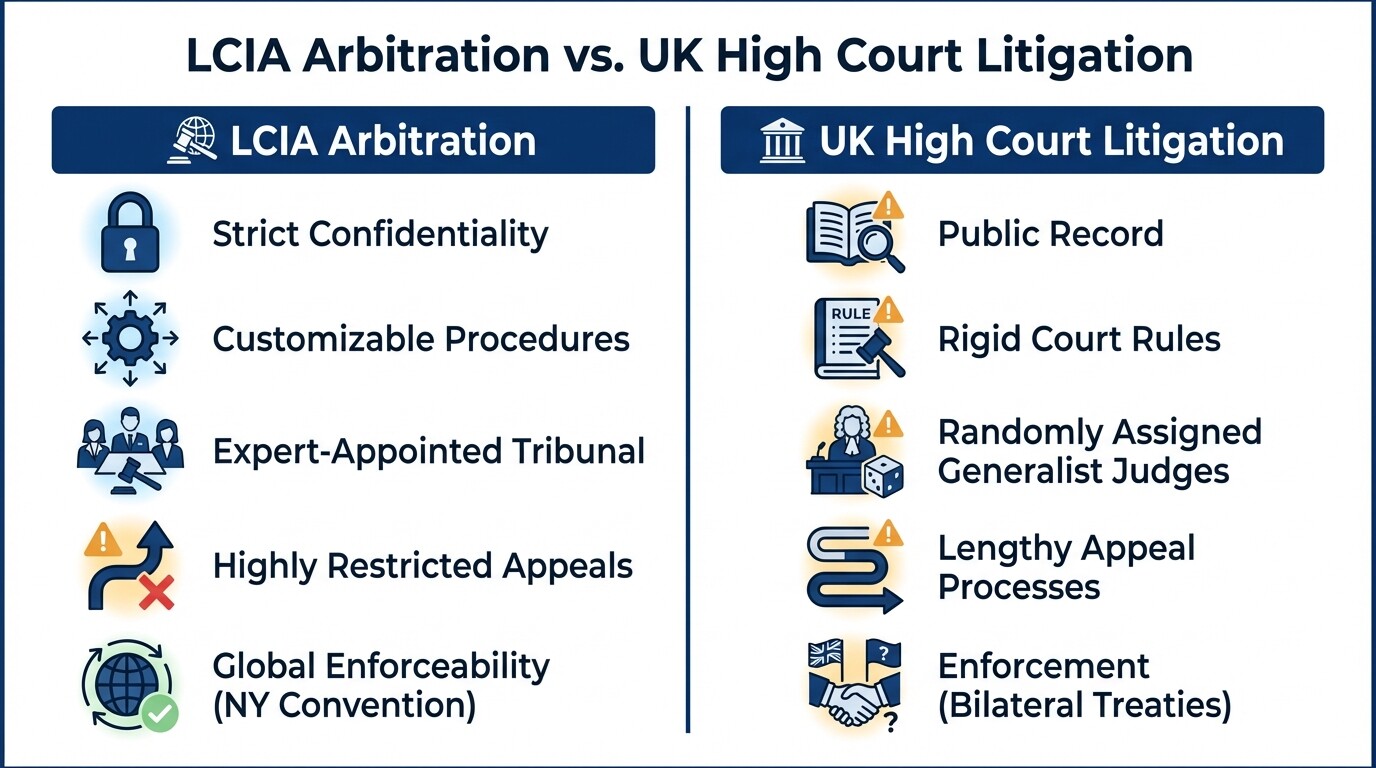
The primary advantages of LCIA arbitration include procedural flexibility, strict confidentiality, and the global enforceability of awards. Unlike litigation in the English High Court, arbitration allows parties to customize the evidence process, select tribunal members with niche industry expertise, and keep sensitive commercial disputes out of the public record.
- Strict Confidentiality: Under LCIA rules, all hearings, case materials, and final awards remain entirely confidential. This protects trade secrets, financial health, and public relations during high-stakes commercial conflicts.
- Expert Tribunals: Instead of being assigned a judge randomly, businesses can appoint arbitrators who are engineers, financial auditors, or IT specialists, ensuring the decision-maker actually understands the underlying industry mechanics.
- Finality of the Decision: English court judgments can be tied up in years of appeals. Arbitration awards have extremely narrow grounds for appeal, usually limited to serious procedural irregularities or lack of jurisdiction, allowing businesses to resolve matters and move forward faster.
- Neutrality for International Parties: When a dispute arises between companies from two different countries, neither party typically wants to litigate in the other's home courts. London serves as a neutral, trusted ground for both sides.
LCIA Arbitration Costs and Fee Breakdown in 2026
The LCIA calculates arbitration costs based on the hourly rates of the arbitrators and a separate administrative fee, rather than taking a percentage of the total disputed amount. This hourly model makes London highly attractive for massive corporate disputes, as the administrative costs do not artificially inflate just because the claim value is exceptionally high.
Below is the standard breakdown of LCIA costs expected for a mid-to-high complexity commercial dispute in 2026. Note that these figures exclude external legal counsel fees and expert witness costs, which form the bulk of the overall expense.
| Cost Component | 2026 Estimated Rate (GBP) | Application |
|---|---|---|
| Registration Fee | £1,950 | Flat fee paid by the Claimant when filing the Request for Arbitration. |
| Arbitrator Hourly Rates | £300 - £650 per hour | Capped by the LCIA based on the arbitrator's seniority and case complexity. |
| LCIA Administrative Rates | £200 - £350 per hour | Charged by the LCIA Secretariat for case management and accounting. |
| Hearing Room & Tech Fees | £1,500 - £4,000 per day | Costs for physical rooms in London, transcription, and virtual hearing technology. |
Standard Timeline: From Request to Final Award
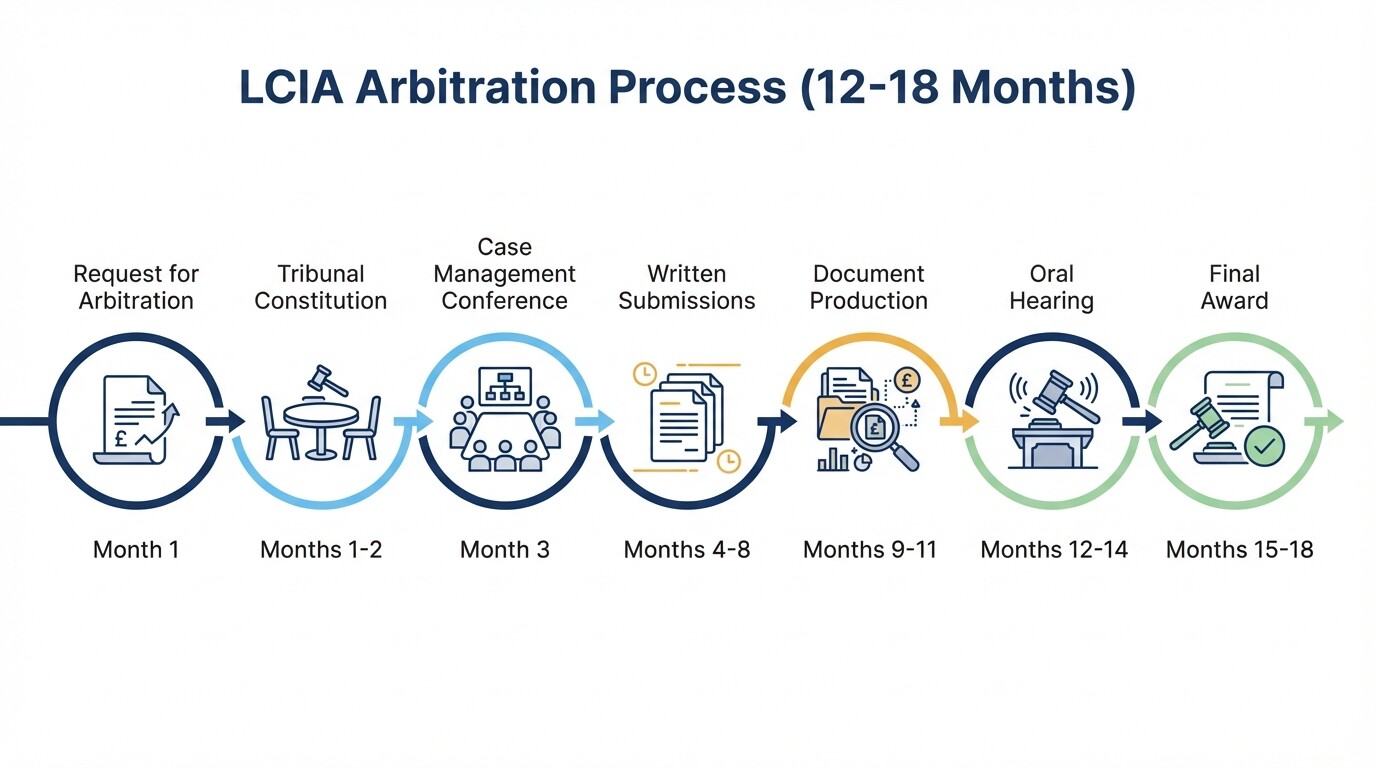
A standard LCIA arbitration takes between 12 and 18 months from the initial filing to the issuance of the final award. The process follows a highly structured path of written submissions, document production, and a final evidentiary hearing, though parties can agree to modify these steps to save time.
- Request for Arbitration (Month 1): The Claimant files a formal request outlining the dispute, the arbitration agreement, and the initial claim amount, alongside the registration fee.
- Response and Tribunal Constitution (Months 1-2): The Respondent submits a brief reply and any counterclaims. The parties and the LCIA appoint the sole arbitrator or a three-person tribunal.
- Case Management Conference (Month 3): The tribunal holds a preliminary meeting with legal counsel to establish the procedural timetable and rules of evidence.
- Written Submissions (Months 4-8): Both sides exchange detailed Statements of Case and Statements of Defense, supported by factual exhibits, witness statements, and expert reports.
- Document Production (Months 9-11): A limited discovery phase where parties request specific, highly relevant categories of documents from one another (often governed by the IBA Rules on the Taking of Evidence).
- Oral Hearing (Months 12-14): The tribunal holds a hearing in London (or virtually) to cross-examine factual and expert witnesses and hear opening and closing arguments from legal counsel.
- Final Award (Months 15-18): The tribunal deliberates and issues a binding, written award detailing the decision, damages, and the allocation of arbitration costs.
Expedited Procedures and Mediation Alternatives
Parties facing urgent disputes can use the LCIA's expedited formation of the tribunal or apply for an Emergency Arbitrator to secure immediate interim relief. Additionally, businesses routinely integrate mediation into their dispute resolution strategies to attempt a commercial settlement before incurring full tribunal costs.
If a company faces imminent harm-such as the unauthorized release of intellectual property or the dissipation of assets-they can file for an Emergency Arbitrator under Article 9B of the LCIA Rules. This arbitrator is appointed within days and has the power to issue binding emergency injunctions pending the formation of the full tribunal.
Alternatively, parties can utilize Med-Arb (Mediation-Arbitration) clauses. Under this approach, parties agree to spend a fixed period (e.g., 30 days) attempting to resolve the dispute through a neutral mediator. If mediation fails, the process seamlessly transitions into binding LCIA arbitration, ensuring no time is wasted while preserving the opportunity for an amicable, cost-free resolution.
Enforcing London Awards Globally Under the New York Convention
An arbitration award issued in London is enforceable in over 170 countries worldwide through the New York Convention. This international treaty requires domestic courts of signatory states to recognize and enforce foreign arbitral awards as if they were domestic judgments, with very limited grounds for refusal.
This is the single greatest advantage of international arbitration over cross-border litigation. If a UK company wins a High Court judgment against a company in Asia or South America, enforcing that judgment relies on patchy, bilateral treaties or local judicial goodwill. In contrast, a London-seated arbitration award can be taken directly to the courts of the losing party's home country. Under the New York Convention, local courts are generally prohibited from reviewing the merits of the tribunal's decision. They can only refuse enforcement on extremely narrow procedural grounds, such as a lack of due process or if the award violates fundamental local public policy.
Common Misconceptions About London Arbitration
Many international businesses mistakenly believe that arbitration in London requires applying English substantive law or that the process is entirely immune from court intervention. In reality, parties have total freedom to choose any governing law for their contract, and English courts maintain a limited but vital supervisory role to ensure fairness.
- Misconception: A London seat means English law applies. You can seat your arbitration in London (benefiting from the Arbitration Act 1996 for procedural rules) while having the actual contract governed by New York, Swiss, or Singaporean law.
- Misconception: You can appeal if the arbitrator makes a legal error. Unlike court cases, you generally cannot appeal an arbitral award simply because the tribunal misinterpreted the law or facts. Appeals under English law are primarily restricted to serious procedural irregularities or jurisdictional overreach.
- Misconception: The LCIA is only for British companies. The vast majority of parties using the LCIA are international. It is a truly global institution that frequently administers disputes where neither party has any connection to the UK.
Frequently Asked Questions
What is the difference between the seat and the venue of arbitration?
The "seat" is the legal home of the arbitration, determining the procedural framework and the national courts that have supervisory jurisdiction (e.g., London). The "venue" is merely the physical location where the hearings take place, which can be anywhere in the world or entirely virtual.
Can the losing party be forced to pay the winner's legal fees?
Yes. In LCIA arbitrations seated in London, tribunals generally follow the English legal principle that "costs follow the event." The losing party is usually ordered to reimburse a significant portion of the prevailing party's legal fees, expert costs, and the tribunal's expenses.
Can we arbitrate a dispute if our contract does not have an arbitration clause?
Yes, but only if both parties agree to it in writing after the dispute has arisen. Because obtaining agreement from an adversarial party is difficult once a conflict starts, it is always recommended to include a well-drafted arbitration clause in the original commercial contract.
When to Hire a Lawyer and Next Steps
You should hire an international arbitration lawyer as soon as a commercial dispute becomes highly probable, ideally before sending any formal notice of breach or dispute. Early legal counsel ensures you strictly comply with mandatory pre-arbitration procedural steps, preserve essential evidence, and strategically select an arbitrator who aligns with the technical nature of your case.
As an immediate next step, locate your original commercial contract and review the dispute resolution clause to confirm whether you are required to mediate first, which institution rules apply, and where the seat of arbitration is located. Gather all relevant correspondence and contract variations, and avoid communicating further with the opposing party without legal guidance. To find qualified counsel, you can review specialized ADR, Mediation & Arbitration Lawyers in the United Kingdom who have direct experience handling complex LCIA proceedings.