


Key Takeaways
UK privacy laws prohibit transferring personal data to the United States without specific legal safeguards. American corporations must implement recognized mechanisms so UK resident data receives protections equivalent to UK law.
- US companies must use the UK International Data Transfer Agreement (IDTA) or the UK Addendum to the EU Standard Contractual Clauses (SCCs) for restricted data transfers.
- A Transfer Risk Assessment (TRA) is a mandatory prerequisite before executing a data transfer agreement.
- The Information Commissioner's Office (ICO) can levy fines up to £17.5 million or 4% of global annual turnover for unlawful data transfers.
- Legacy commercial contracts relying on outdated transfer mechanisms must be audited and updated to maintain legal compliance.
- The UK Extension to the EU-US Data Privacy Framework (the Data Bridge) offers a streamlined alternative for eligible US companies that self-certify.
Legal Requirements for Restricted Transfers
US companies receiving personal data from the UK must establish a valid transfer mechanism. The UK General Data Protection Regulation (UK GDPR) restricts transferring personal data to countries lacking a blanket adequacy decision.
A restricted transfer occurs when a UK-based entity sends personal data to a legally distinct receiver located outside the UK. For US corporations, this happens during cloud hosting, global payroll processing, centralized customer relationship management, and cross-border marketing operations. If your US company is not certified under the UK-US Data Bridge, you must rely on an authorized contractual safeguard.
The UK government authorizes two primary mechanisms:
- The standalone UK IDTA: A contract designed specifically for data transfers originating solely from the UK.
- The UK Addendum: A supplementary document attached to the EU SCCs. Multinational companies prefer this option because it covers both EU and UK data transfers under a unified global framework.
The core provisions of these approved documents cannot be altered or negotiated. Contracting parties may only complete the required factual annexes regarding the entities involved, the data transferred, and the applied security measures.
UK Data Transfer Compliance Checklist
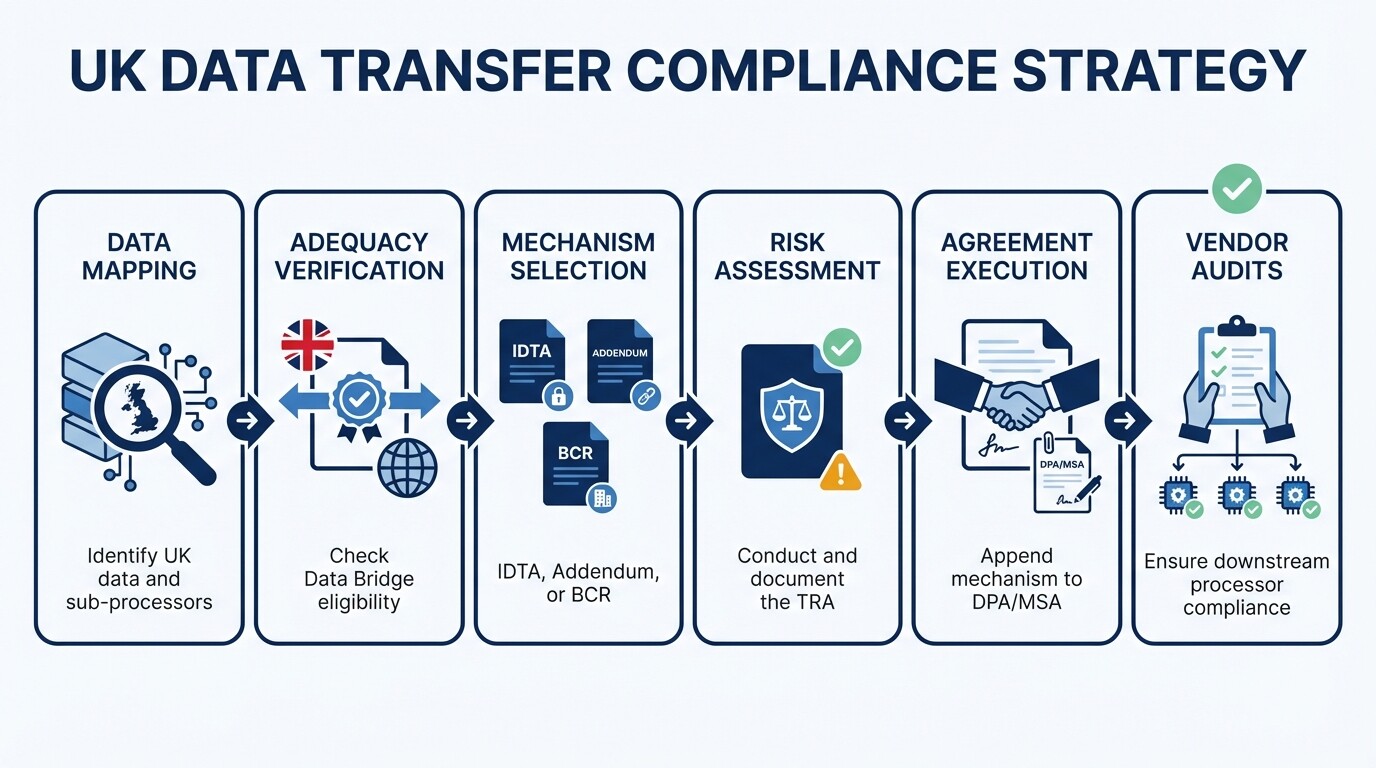
Achieving transatlantic data compliance requires a systematic review of corporate data flows and commercial contracts. Use this checklist to structure your data protection strategy.
- Data mapping: Identify what UK personal data the US entity receives, its storage location, and which subcontractors have access.
- Adequacy verification: Check if the US organization is actively certified under the UK-US Data Bridge.
- Mechanism selection: Choose between the standalone UK IDTA, the UK Addendum, or Binding Corporate Rules based on your corporate structure.
- Risk assessment: Perform and document a Transfer Risk Assessment to evaluate the data importer's legal environment.
- Agreement execution: Sign the IDTA or UK Addendum and append it to your Master Services Agreement or Data Processing Agreement.
- Vendor audits: Confirm all downstream US-based processors and sub-processors have signed equivalent transfer agreements.
The Transfer Risk Assessment (TRA)
A Transfer Risk Assessment evaluates whether the destination country provides protections equivalent to UK standards. US companies must complete and document this risk analysis before executing an IDTA or UK Addendum.
Contractual clauses cannot stop foreign governments from accessing personal data through national security laws. When assessing transfers to the US, companies must analyze the potential impact of surveillance laws like FISA Section 702. The assessment requires identifying the specific data transferred, evaluating the importer's legal framework, and determining the likelihood of third-party access causing harm to data subjects.
You must update your TRA whenever the data transfer process or the destination country's legal environment changes materially. Reviewing the TRA at least annually is standard practice.
If the TRA identifies risks, the US data importer must implement supplementary measures. These include technical safeguards like end-to-end encryption, organizational measures like strict access controls, and contractual commitments to challenge broad government data requests.
Sample Contract Provision: Integrating the UK Addendum
Incorporating the UK Addendum into an existing Master Services Agreement or Data Processing Agreement requires specific incorporation language. This sample clause demonstrates how to legally bind the parties to the UK Addendum without pasting the entire multi-page document into the contract.
Incorporation of the UK Addendum
"Where the processing of Personal Data falls within the scope of the UK GDPR and involves a Restricted Transfer from the United Kingdom to the United States, the parties agree that the UK Addendum to the EU Standard Contractual Clauses, issued by the Information Commissioner's Office under section 119A of the Data Protection Act 2018, shall be incorporated by reference into this Agreement. The parties agree that the information required by Part 1 of the UK Addendum is set forth in Exhibit A to this Agreement. In the event of any conflict between the terms of this Agreement and the UK Addendum, the terms of the UK Addendum shall prevail regarding the relevant restricted transfer."
Alternative Routes: BCRs and the Data Bridge
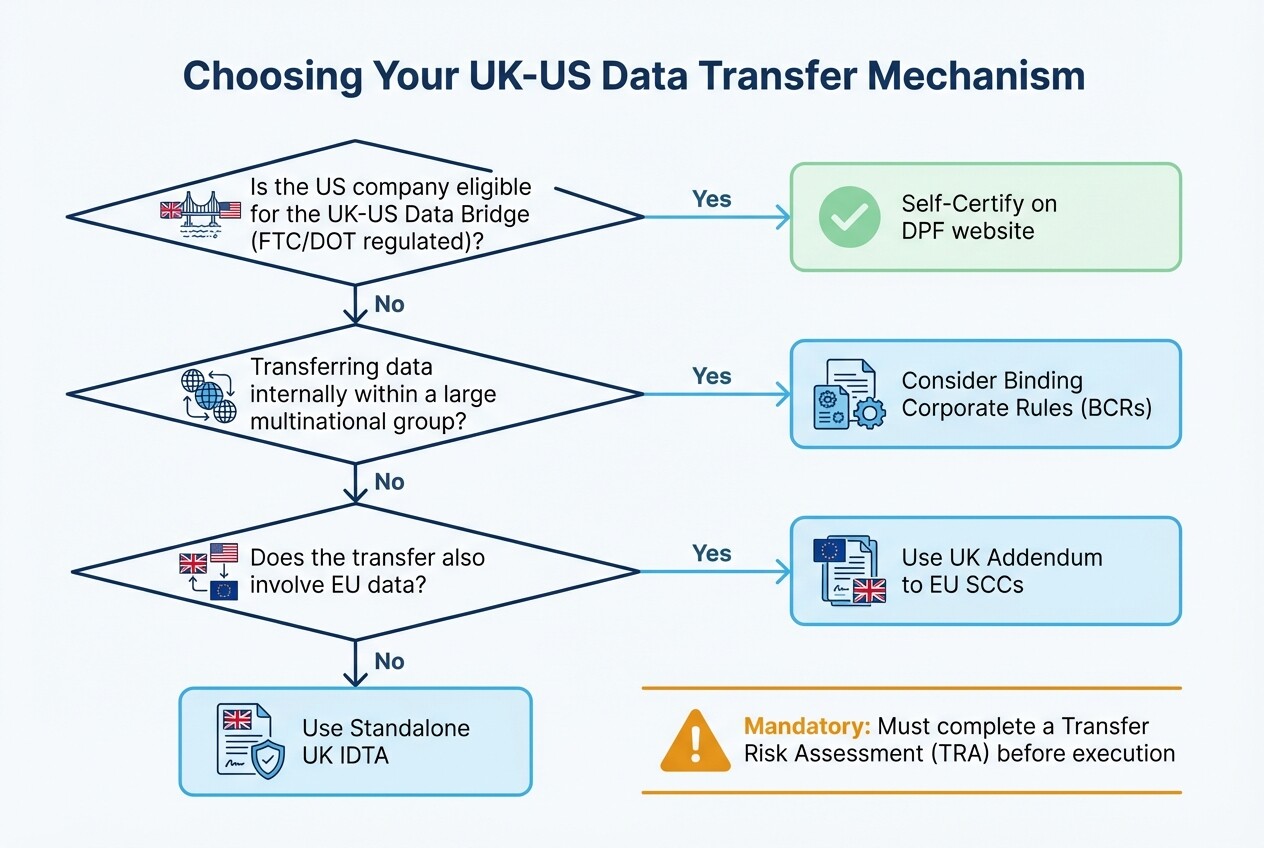
Large multinational corporations can utilize alternative frameworks for transatlantic data flows to improve operational efficiency.
Binding Corporate Rules (BCRs) are internal codes of conduct allowing global corporate groups to transfer personal data freely among their affiliates. Securing BCR approval requires direct authorization from the Information Commissioner's Office. This option is reserved for large enterprise organizations due to the high setup costs and lengthy approval timelines.
The UK-US Data Bridge (the UK Extension to the EU-US Data Privacy Framework) eliminates the need for an IDTA entirely. However, it is only available to US organizations subject to the jurisdiction of the Federal Trade Commission or the US Department of Transportation. Banking, insurance, and telecommunications companies generally do not qualify and must rely on an IDTA or UK Addendum.
Eligible companies self-certify their adherence to specific privacy principles. Once listed on the official Data Privacy Framework website, the US company can receive UK personal data without executing standardized contracts or performing individual risk assessments.
ICO Enforcement and Penalties
Failing to implement valid transfer mechanisms exposes US companies to severe penalties enforced by the UK's Information Commissioner's Office. The ICO acts on complaints from consumers and business partners regarding data mishandling.
Under the Data Protection Act 2018, the ICO issues administrative fines for unlawful data transfers up to £17.5 million or 4% of a company's total global annual turnover, whichever is higher.
The ICO can also issue enforcement notices prohibiting a US company from processing UK data. This stops the company's ability to service UK clients or operate in the British market. Enforcement actions are public record and cause reputational damage. UK businesses are legally liable for the vendors they choose and avoid partnering with non-compliant foreign entities.
Updating Legacy Contracts
US corporations must audit and amend legacy commercial agreements to incorporate the current UK IDTA or UK Addendum. The grace period for relying on older data transfer mechanisms has expired, rendering legacy contracts invalid.
Many US companies still rely on the old EU Standard Contractual Clauses drafted before the UK left the European Union. These clauses no longer satisfy UK legal requirements. Companies must execute commercial amendments with their clients, vendors, and sub-processors to replace the old framework with current UK-approved documents.
Identify all active Data Processing Agreements, determine the appropriate new mechanism, and issue updated addendums to all counter-parties. Waiting for contract renewal cycles violates compliance requirements.
Common Misconceptions
Many US companies misunderstand the application of UK privacy laws, leading to compliance gaps.
EU compliance guarantees UK compliance The UK operates its own independent data protection regime. Utilizing an EU transfer mechanism without the specific UK Addendum leaves a company legally exposed in the United Kingdom.
Only enterprise companies need an IDTA UK data transfer rules apply to organizations of all sizes. A small US-based software startup processing the data of a single UK resident is subject to the exact same transfer restrictions and IDTA requirements as a Fortune 500 corporation.
Storing data in the US avoids UK jurisdiction The physical location of the server does not dictate jurisdiction. If the data originates from a UK resident or a UK-based company, UK GDPR rules attach to that data and follow it into the United States.
When to Hire a Lawyer and Next Steps
Retaining a legal professional is necessary when managing complex data supply chains or negotiating global vendor agreements. A minor drafting error in a Data Processing Agreement can invalidate your transfer mechanism.
Engage legal counsel if you process sensitive personal data, use a network of downstream sub-processors, or need to transition from legacy SCCs to the new UK framework. A lawyer will conduct legally privileged Transfer Risk Assessments and draft integration clauses that satisfy UK regulators.
To secure your data flows, audit your current data inventory to identify all restricted transfers originating from the UK. Determine whether your organization qualifies for the UK-US Data Bridge or requires contractual mechanisms. For specific guidance on executing valid agreements and conducting risk assessments, contact corporate lawyers in the United Kingdom.