


- Residency Over Citizenship: Your immigration status or citizenship does not affect your privacy rights. If you live in California for non-temporary purposes, you are protected under the California Consumer Privacy Act (CCPA).
- Specific Lawsuit Grounds: You can only file a private lawsuit if your unencrypted or unredacted personal information was exposed in a data breach, not for general privacy policy violations.
- Statutory Payouts: California law allows consumers to recover between $100 and $750 per incident, or actual damages, whichever is greater.
- Mandatory Notice: Before filing a lawsuit for statutory damages, you must provide the company with a 30-day written notice giving them a chance to "cure" the violation.
Understanding the CCPA Private Right of Action and 2026 Updates
The California Consumer Privacy Act (CCPA) grants consumers the legal right to sue companies directly, but only for specific data breaches involving unencrypted and unredacted personal information. This "private right of action" allows you to seek financial compensation when a business fails to implement reasonable security procedures, resulting in your sensitive data being stolen or exposed.
As privacy enforcement has matured into 2026, the California Privacy Protection Agency (CPPA) has finalized stricter guidelines on what constitutes "reasonable security." For foreign nationals, the most important factor is understanding that the law protects California consumers, which the state defines based on residency, not immigration status. If a business loses your passport number, financial details, or biometric data due to negligence, you possess the exact same legal standing to sue as a US citizen. For official regulatory text, you can review the California Attorney General's CCPA guidelines.
Required Documentation: Proving Residency and Damages
To successfully bring a CCPA claim, you must prove that you were a California resident at the time of the breach and document the extent of your financial damages. Because the law requires you to be in the state for "other than a temporary or transitory purpose," tourists are excluded, but expats, international students, and foreign workers on visas (like H-1B, L-1, or O-1) are fully covered.
Gather the following documentation to establish your standing and build your case:
- Proof of California Residency: Current lease agreements, California utility bills, a California driver's license or ID card, or state tax returns.
- Visa or Employment Documentation: Documents showing your long-term intent to remain in the state, such as an active employment contract or a multi-year visa.
- Proof of the Data Breach: The official breach notification letter or email you received from the compromised company.
- Evidence of Actual Damages: Bank statements showing fraudulent charges, receipts for identity theft protection services you had to purchase, or logs of time spent resolving identity theft issues.
Estimated Litigation Costs and Statutory Recovery Amounts
Filing an individual privacy lawsuit in a California Superior Court typically requires an initial filing fee of roughly $435, but most consumers pay nothing upfront because privacy lawyers work on a contingency fee basis. Under a contingency arrangement, the attorney takes a percentage of your final settlement or court award-usually between 30% and 40%-and covers the procedural costs during the litigation.
The CCPA provides a clear framework for financial recovery. If your data is breached, you can seek statutory damages ranging from $100 to $750 per consumer per incident. If your actual financial losses (such as stolen funds that your bank did not refund) exceed $750, you can sue for that exact "actual damage" amount instead. In class action settlements, the final payout per person often falls on the lower end of the statutory scale due to the high volume of claimants sharing the settlement fund.
Class Action vs. Individual Privacy Claim Comparison
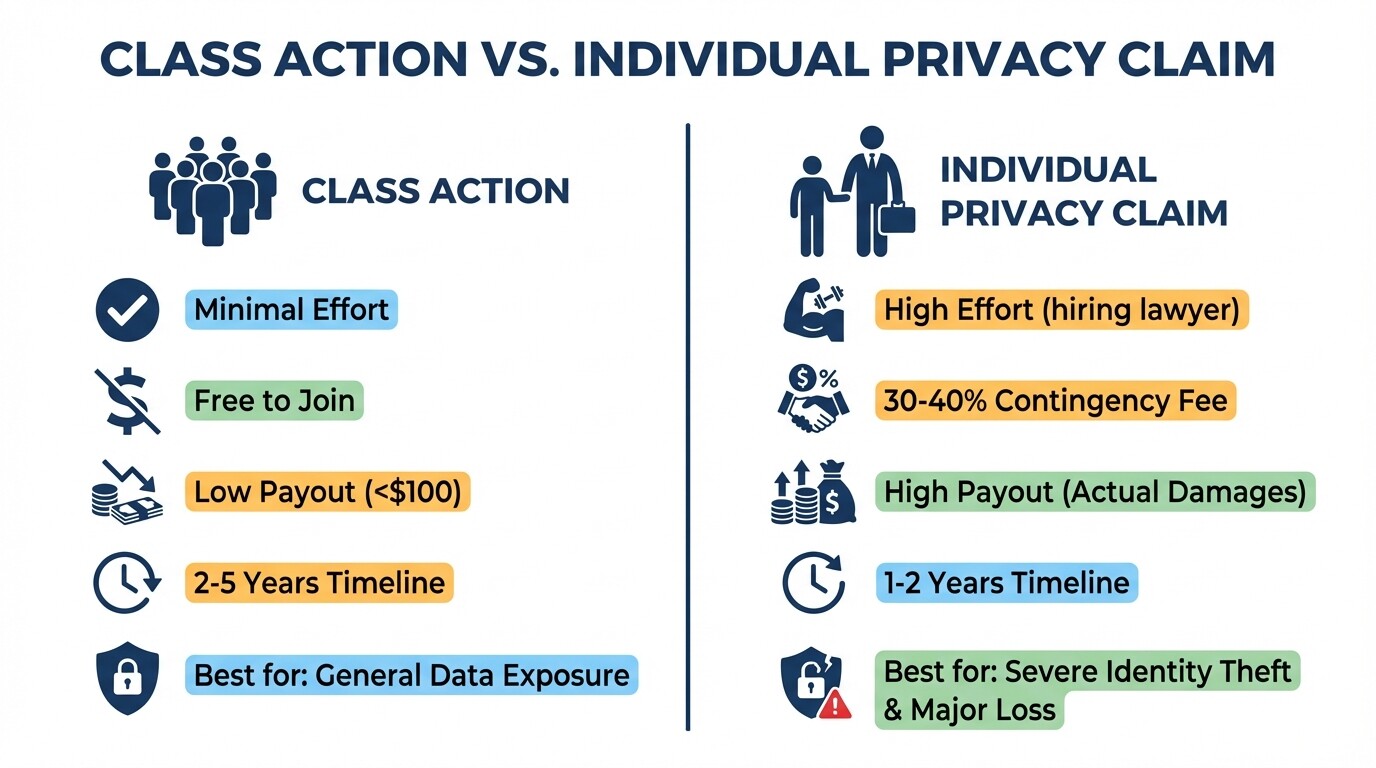
Choosing between joining a class action lawsuit or filing your own individual claim depends entirely on the financial impact the breach had on you. A class action groups thousands of affected consumers together into one massive lawsuit, while an individual claim requires you to hire your own attorney to fight solely for your specific losses.
| Feature | Class Action Lawsuit | Individual Privacy Claim |
|---|---|---|
| Effort Required | Minimal. You usually just fill out an online claim form. | High. Requires hiring a lawyer, gathering personal evidence, and potential court appearances. |
| Financial Cost | Free to join. Lawyers are paid from the total settlement fund. | No upfront cost if on contingency, but lawyer takes 30-40% of your specific award. |
| Potential Payout | Typically low ($50 to a few hundred dollars) due to the large number of plaintiffs. | High, but only if you have substantial "actual damages" (e.g., thousands of dollars stolen). |
| Timeline | Can take 2 to 5 years to resolve and distribute checks. | Generally faster (1 to 2 years), but depends on court backlogs. |
| Best For... | Consumers who suffered no direct financial loss but whose data was exposed. | Consumers who suffered severe, documented identity theft and major financial losses. |
Statute of Limitations and Filing Procedures for Foreign Nationals
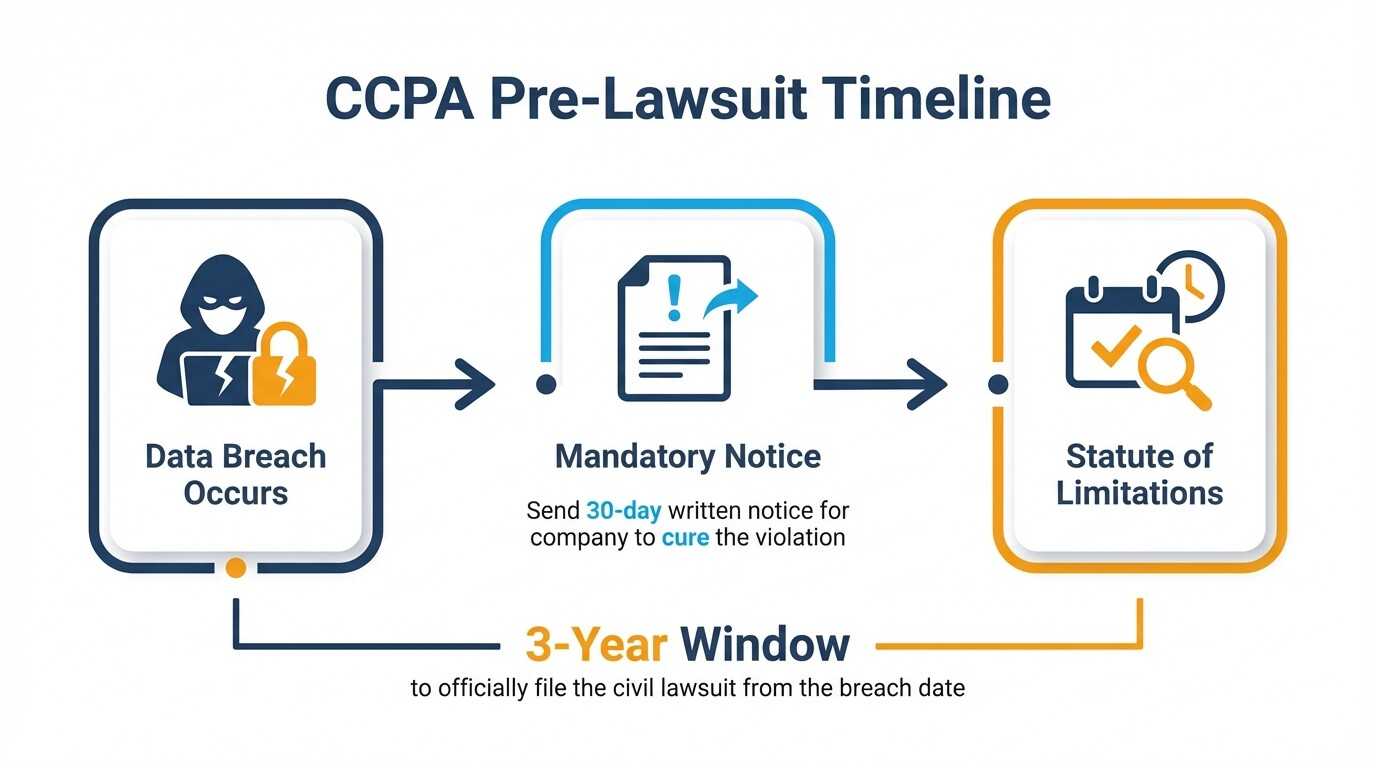
You generally have three years from the date the data breach occurred to file a privacy lawsuit under California law. However, procedural rules require you to act long before that deadline expires to preserve your rights to statutory damages.
Before filing the lawsuit, California Civil Code requires you to send the business a formal 30-day written notice detailing the specific CCPA violations. This gives the company 30 days to "cure" the violation-though courts generally agree that once a data breach has occurred, the exposure of your data cannot genuinely be "cured." If the company responds within 30 days with a written statement that the issue is fixed and no further violations will occur, statutory damages may be restricted, though you can still pursue actual damages. For expats and foreign nationals, this notice must be drafted carefully, ensuring your foreign-issued identification or passport numbers exposed in the breach are properly cited in the legal complaint.
Common Misconceptions About Foreign Nationals and California Privacy Law
Many international residents incorrectly assume they have no legal voice in the US legal system, causing them to leave thousands of dollars in compensation unclaimed.
- Misconception: Only US citizens can participate in class action settlements. Class action administrators do not check citizenship. If your data was breached while you were residing in California and using the company's services, you are fully entitled to claim your portion of the settlement.
- Misconception: A privacy lawsuit will negatively impact my visa status. Filing a civil lawsuit for consumer rights has absolutely no bearing on your immigration status, visa renewals, or future green card applications. Civil courts and immigration authorities operate independently.
- Misconception: I can sue a company just because their website tracks my cookies. The private right of action only applies to data breaches where sensitive information is stolen due to poor security. You cannot personally sue a company simply because they sold your data or failed to honor an "opt-out" request; only the California Attorney General or CPPA can enforce those specific violations.
2026 Privacy Lawsuit FAQ for Expats
What if I move back to my home country before the lawsuit settles?
You can still receive your settlement or lawsuit payout even if you relocate outside the United States. Ensure your attorney or the class action administrator has your updated international address and preferred digital payment method (like PayPal or international wire instructions).
Do I have to pay taxes on a privacy lawsuit settlement in the US?
Generally, settlements for physical injuries are tax-free, but settlements for privacy breaches or financial losses may be subject to US federal and state taxes. As a foreign national, your tax liability will depend on your tax residency status at the time of the payout; consult a tax professional regarding your specific situation.
Can I sue if my foreign passport was exposed in a breach of a California company?
Yes. If you are a California resident and a business fails to protect your unencrypted government-issued identification number-regardless of which country issued the passport-you have grounds for a CCPA claim.
How do I join a class action if I missed the notification email?
If you know a company you use had a breach, you can search for the official class action settlement website online. These official sites allow you to submit a claim using your name and contact information, even if you lost the original notice.
When to Hire a Privacy Lawyer
You should consult a privacy lawyer immediately if a data breach results in severe identity theft, unauthorized loans taken out in your name, or substantial funds stolen from your bank accounts. While minor breaches are best handled by simply joining an existing class action, catastrophic personal data leaks require an attorney to help you pursue actual damages. A lawyer can also draft the mandatory 30-day notice to cure on your behalf, ensuring you preserve your right to claim maximum statutory damages.
Next Steps
If you receive notice that your data was involved in a breach, your first step is to immediately freeze your credit with the three major US credit bureaus (Equifax, Experian, and TransUnion) to prevent identity theft. Next, preserve all evidence by saving the breach notification letter and documenting any suspicious financial activity. Finally, search online to see if a class action investigation is already underway for the breach, or connect with lawyers in the United States to evaluate whether your financial losses justify filing an individual privacy claim.