


- US federal antitrust laws can target foreign corporations if their overseas conduct significantly impacts United States commerce.
- Foreign entities can challenge US court authority by filing a motion to dismiss for lack of personal jurisdiction.
- Conflicts between broad US electronic discovery rules and foreign data privacy laws require careful navigation to avoid severe sanctions.
- Early intervention through the Department of Justice leniency programs or private mediation can drastically reduce financial and criminal exposure.
- Defending a US antitrust lawsuit is a multi-year process that routinely costs millions of dollars in legal and discovery fees.
Understanding the Extraterritorial Reach of US Federal Antitrust Laws
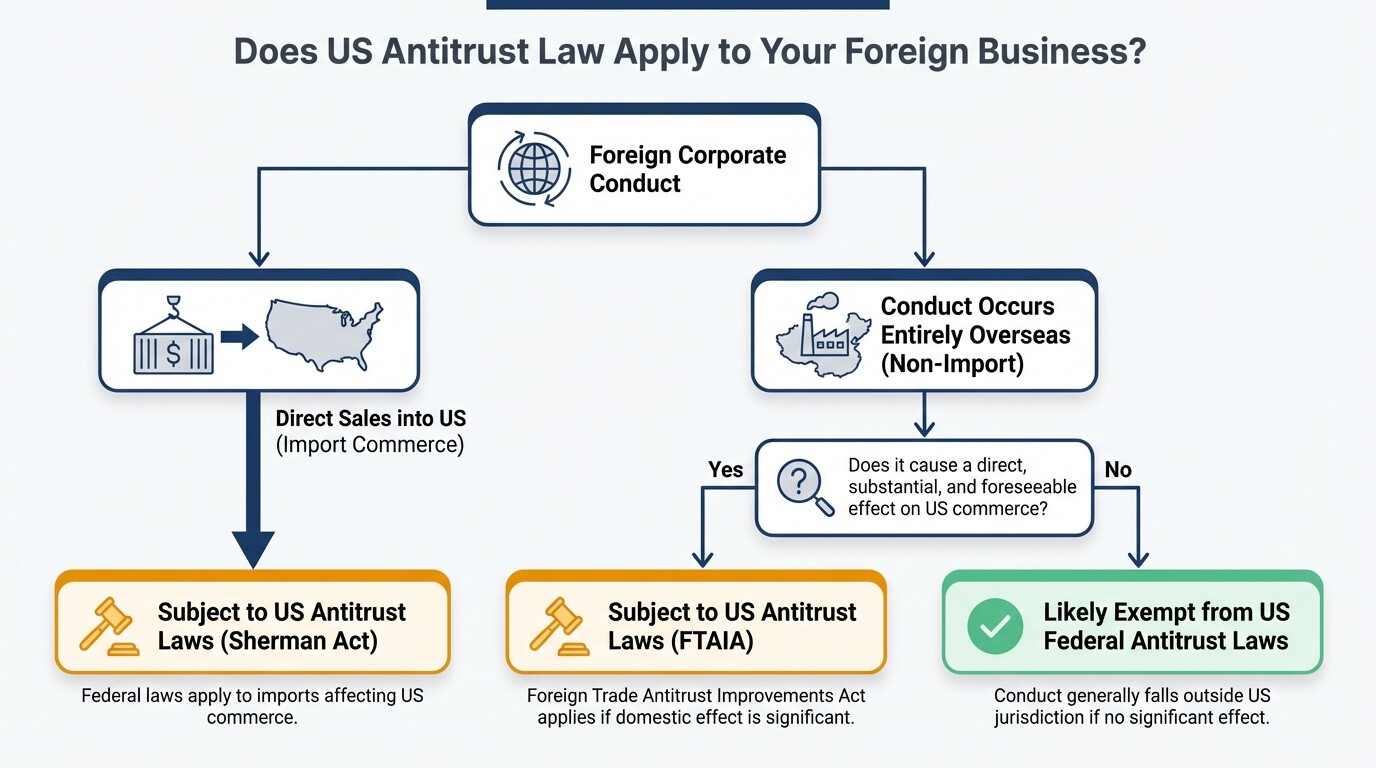
US federal antitrust laws apply to foreign conduct if that conduct has a direct, substantial, and reasonably foreseeable effect on US commerce. The Foreign Trade Antitrust Improvements Act (FTAIA) governs this standard, meaning companies without a physical US presence can still face Department of Justice (DOJ) prosecution or private lawsuits.
To determine whether a foreign corporation falls under US antitrust scrutiny, courts and federal agencies look at the economic reality of the business transactions. The Sherman Act is the primary statute used to prosecute anti-competitive behavior, and its international application relies on specific criteria:
- Import Commerce: If a foreign corporation is directly selling goods or services into the United States, its conduct is automatically subject to US antitrust laws.
- Non-Import Commerce: For conduct occurring entirely overseas, the 15 U.S.C. § 6a (FTAIA) requires that the behavior causes a direct and substantial effect on US domestic trade or export commerce.
- Global Cartels: Price-fixing, bid-rigging, or market allocation schemes negotiated in Europe or Asia can trigger US prosecution if the targeted products ultimately end up in the American market.
Legal Methods for Challenging US Court Jurisdiction Over Foreign Operations
Foreign corporations can challenge US jurisdiction by filing a motion to dismiss under Federal Rule of Civil Procedure 12(b)(2) for lack of personal jurisdiction. Courts will evaluate whether the company has sufficient "minimum contacts" with the United States to justify being sued there.
Successfully dismissing a case on jurisdictional grounds is one of the most effective early defense strategies. Courts generally look at two types of jurisdiction when assessing a foreign defendant:
- General Jurisdiction: The corporation's affiliations with the US must be so continuous and systematic that it is essentially "at home" in the US. This is exceptionally difficult for plaintiffs to prove against a foreign entity.
- Specific Jurisdiction: The specific anti-competitive conduct alleged in the lawsuit must arise out of or relate to the corporation's contacts with the United States.
- Piercing the Corporate Veil: Plaintiffs often try to establish jurisdiction by linking the foreign parent company to a US-based subsidiary. Defense counsel must demonstrate that the foreign parent maintains formal corporate separation and does not exert daily operational control over the US entity.
Pre-Litigation Defense Checklist for Foreign Entities
Taking immediate, structured action when facing a potential US antitrust probe minimizes exposure and prevents accidental evidence destruction. This checklist outlines the critical steps foreign corporations must take before a formal lawsuit or government indictment is filed.
- Institute an Immediate Legal Hold: Suspend all routine document destruction policies across global offices to prevent the deletion of emails, chat logs, and financial records.
- Conduct a Jurisdictional Audit: Document exactly how products enter the US market, identifying whether sales are direct, through subsidiaries, or via independent third-party distributors.
- Map Corporate Data: Identify where servers are located and which foreign data privacy laws apply to employee communications.
- Isolate US Subsidiaries: Ensure that corporate formalities between the foreign parent and US subsidiaries are strictly observed to protect against alter-ego liability claims.
- Review Insurance Policies: Analyze Directors and Officers (D&O) liability policies to determine if antitrust defense costs are covered.
Common Mistakes in Cross-Border Electronic Discovery and Data Preservation
Foreign companies frequently mishandle US electronic discovery by failing to issue immediate legal holds or incorrectly assuming domestic privacy laws will shield their data. Navigating the conflict between broad US discovery demands and foreign data protection regulations requires specialized corporate protocols.
US courts have a notoriously wide scope for civil discovery, which routinely clashes with international business practices. Avoiding these common errors is critical to surviving the discovery phase:
- Ignoring Spoliation Risks: Deleting data after reasonably anticipating a US lawsuit can result in severe sanctions, including default judgments. US courts do not accept ignorance of American preservation duties as an excuse.
- Relying Exclusively on Blocking Statutes: Many foreign executives mistakenly believe that foreign blocking statutes or the GDPR provide a blanket shield against US subpoenas. US judges routinely order data production anyway, forcing the foreign company to choose between violating US court orders or their home country's privacy laws.
- Overlooking Mobile and Chat Data: Failing to preserve WhatsApp, WeChat, or Telegram messages used by foreign executives is a leading cause of discovery violations in modern antitrust litigation.
Alternative Pre-Litigation Settlement Strategies and Mediation Options
Foreign defendants can resolve antitrust disputes before trial by utilizing the DOJ Corporate Leniency Program or engaging in structured mediation with private plaintiffs. Early settlement negotiations often focus on cooperating with US authorities in exchange for reduced fines and immunity from criminal prosecution.
Litigating a federal antitrust case to a jury verdict is highly unpredictable. Exploring alternative resolutions early can protect the company's bottom line and public image:
- DOJ Corporate Leniency: The DOJ Corporate Leniency Policy allows the first corporation to report a cartel to avoid criminal convictions and massive fines. This requires admitting to the conduct and fully cooperating with the investigation against co-conspirators.
- Civil Consent Decrees: Companies can negotiate an agreement with federal agencies to stop specific business practices without formally admitting guilt. This resolves the government investigation swiftly.
- Private Mediation: In civil class-action lawsuits, entering early mediation allows foreign corporations to negotiate a confidential financial settlement before the costly electronic discovery phase begins.
Anticipating Legal Costs, Reputational Damage, and Defense Timelines
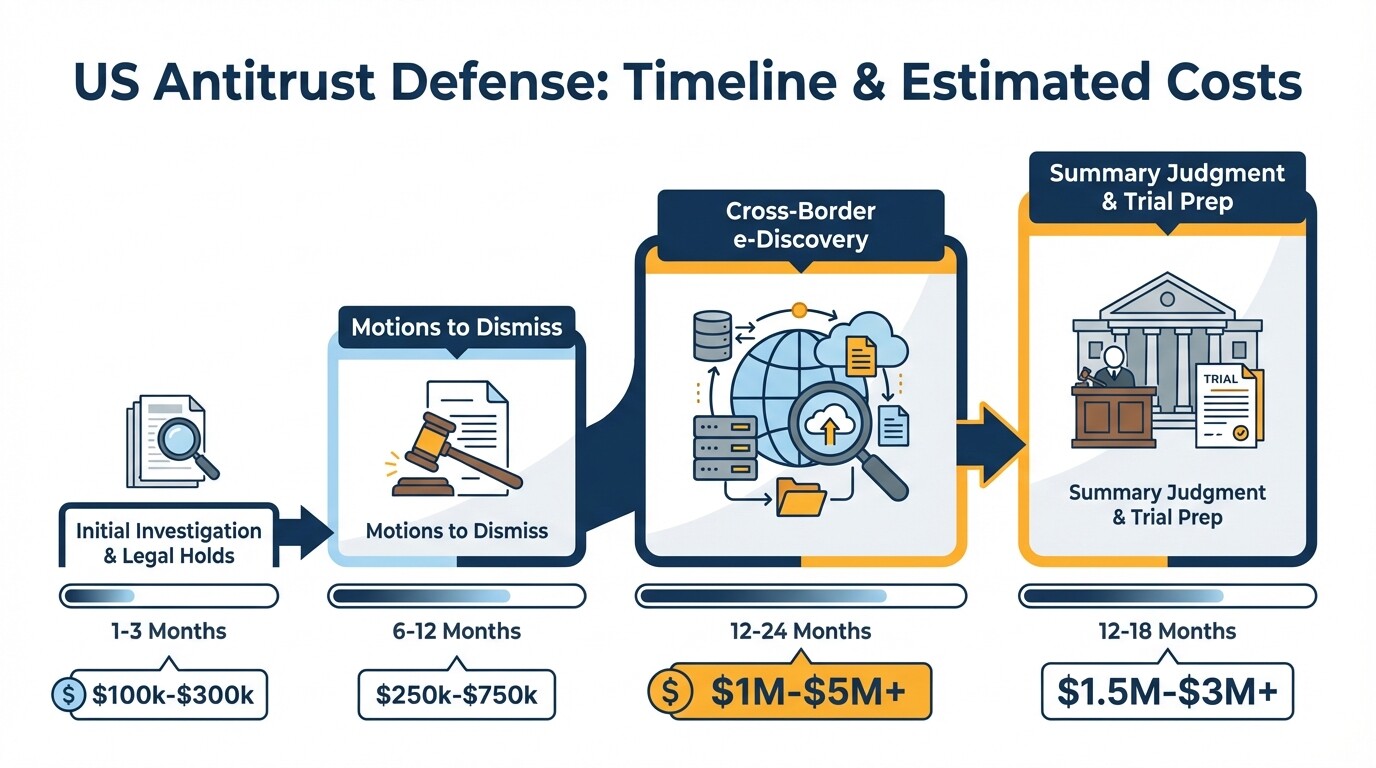
Defending a US federal antitrust case is highly expensive, typically costing millions of dollars in legal fees and lasting three to five years. Foreign corporations must budget for massive e-discovery expenses while simultaneously managing global public relations to protect their market valuation.
Understanding the financial and temporal commitment required helps boards of directors make informed decisions about whether to fight or settle.
| Phase of Litigation | Estimated Timeline | Anticipated Costs (USD) |
|---|---|---|
| Initial Investigation & Legal Holds | 1 to 3 Months | $100,000 to $300,000 |
| Motions to Dismiss (Jurisdiction) | 6 to 12 Months | $250,000 to $750,000 |
| Cross-Border Electronic Discovery | 12 to 24 Months | $1,000,000 to $5,000,000+ |
| Summary Judgment & Trial Prep | 12 to 18 Months | $1,500,000 to $3,000,000+ |
Beyond direct legal costs, antitrust allegations often trigger stock price drops, damage relationships with global supply chain partners, and invite copycat lawsuits in other jurisdictions like the European Union.
Common Misconceptions About US Antitrust Law
International business leaders often hold dangerous misconceptions about US antitrust enforcement that can lead to severe legal exposure. Clarifying these myths is essential for developing a strong defense posture.
- No US office means immunity: Many executives believe that without a physical branch in the United States, they cannot be sued. The effects test under the FTAIA means that if your foreign actions impact US commerce, you are vulnerable to litigation.
- Government approval at home is an absolute defense: Legal approval or encouragement of a business practice by a foreign government does not automatically protect a company from US antitrust laws, unless the strict requirements of the "Foreign Sovereign Compulsion" doctrine are met.
- Only cartels are targeted: While price-fixing grabs headlines, foreign companies are routinely sued for monopolization, exclusive dealing contracts, and tying arrangements that restrict competition in the US market.
Frequently Asked Questions
Can foreign executives be extradited to the US for antitrust violations?
Yes, the United States routinely seeks the extradition of foreign executives for criminal antitrust violations, such as price-fixing and bid-rigging. The success of extradition depends on the specific treaties between the US and the executive's home country.
What is the Hague Evidence Convention and how does it apply?
The Hague Evidence Convention is an international treaty that provides a formal process for US courts to request evidence located in another country. However, US courts frequently bypass this treaty, forcing foreign corporations to produce documents directly under standard US federal rules.
How do US class-action lawsuits impact foreign corporations?
If a government antitrust investigation becomes public, private plaintiffs in the US will almost immediately file civil class-action lawsuits seeking treble damages. This means the foreign corporation could be forced to pay three times the actual financial harm caused by the anti-competitive conduct.
When to Hire a Lawyer and Next Steps
Retain US antitrust counsel the moment you suspect your foreign corporation is under investigation or facing a civil complaint. Early intervention allows your legal team to challenge jurisdiction, secure leniency, or negotiate a favorable pre-litigation settlement before costs spiral out of control.
Your first step should be consulting with experienced antitrust defense attorneys in the United States who specialize in cross-border disputes. They will guide your executive team in instituting legal holds, auditing your US market contacts, and building a unified global defense strategy.