


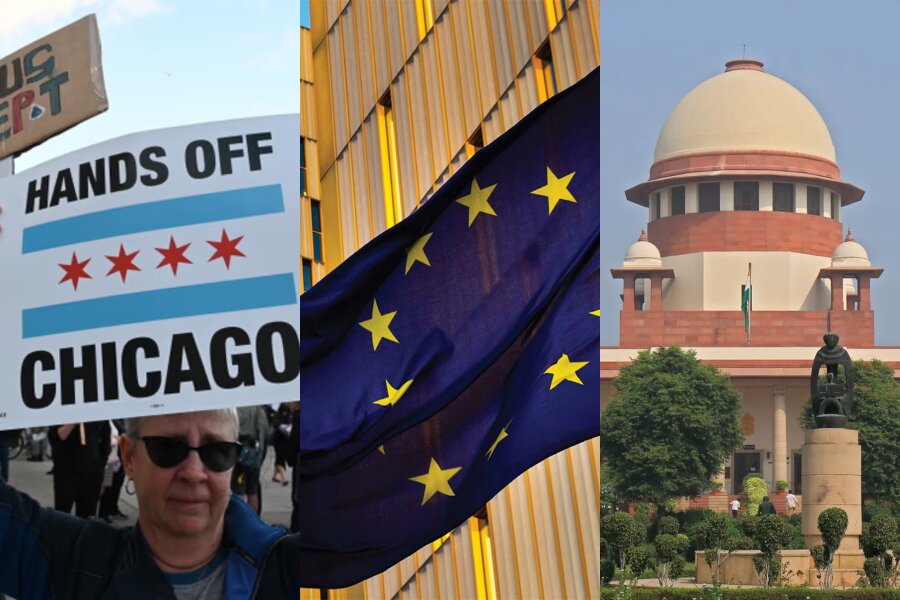
Supreme Court Blocks Trump Administration’s Bid to Federalize National Guard for Domestic Policing
The U.S. Supreme Court has denied the Trump administration's attempt to federalize the Illinois National Guard to police civil unrest in Chicago. In a 6-3 decision in Trump v. Illinois, the Court ruled that the President failed to meet the statutory requirements of 10 U.S.C. §12406. The administration argued it was "unable" to enforce laws using regular troops due to the Posse Comitatus Act, thus justifying the seizure of the state militia. The Court rejected this, interpreting "unable" as a factual incapacity, not a legal restriction. The ruling preserves state control over National Guard forces against federal commandeering for domestic law enforcement, though a concurring opinion by Justice Kavanaugh affirmed the President's inherent power to use regular troops for protecting federal property.
Source: The Guardian
Brazil Supreme Court Orders Mass House Arrests for Coup Plotters Following Flight Attempt
Brazil’s Supreme Federal Court has ordered the full house arrest of ten individuals convicted for their roles in the 2022 coup attempt, following the discovery of an active escape network. Justice Alexandre de Moraes issued the order after a co-conspirator was arrested in Paraguay attempting to flee to El Salvador with a forged passport. The Court ruled that the individuals, described as the "intellectual authors" of the coup plot, posed a severe flight risk and continued to threaten public order through disinformation. This decision escalates the judicial crackdown on the "Digital Militias" network and follows the earlier house arrest of former President Jair Bolsonaro.
Source: The Jurist
Kenyan Banks Face $800 Million Liability as Court Rules Interest Rate Hikes Illegal
The High Court of Kenya has dismissed a petition by the Kenya Bankers Association, confirming that banks are liable for unapproved interest rate hikes dating back to the 1990s. Upholding a Supreme Court precedent, the ruling states that banks violated Section 44 of the Banking Act by failing to seek Cabinet Secretary approval for rate variations. This decision creates a retrospective liability estimated at $800 million (KES 100 billion), wiping out nearly 40% of the sector's annual profits. The judgment rejects the defense of "market practice," prioritizing strict statutory compliance and consumer protection over the financial stability of the banking industry.
Source: Ecofin Agency
South African Court Pierces Corporate Veil to Punish Estate Agent’s Fraudulent Scheme
The Supreme Court of Appeal in South Africa has finalized a punitive judgment against estate agent Jean Pierre Nortje for defrauding a client. Nortje manipulated corporate structures to sell a client's property to a company he secretly owned and then used a sham "builder's lien" to deny the seller access. The Court applied the doctrine of "piercing the corporate veil," treating the agent and his companies as a single entity to expose the fraud. The judgment included a punitive costs order, signaling judicial intolerance for professionals who breach fiduciary duties and use corporate shells to exploit clients.
Source: Biz Community
Japan Supreme Court Finalizes Dentsu Conviction in Tokyo Olympics Bid-Rigging Scandal
The Supreme Court of Japan has dismissed the final appeal of Dentsu Group Inc., confirming its criminal conviction for bid-rigging related to the Tokyo 2020 Olympics. The Court upheld findings that Dentsu orchestrated a cartel to pre-determine winners for both test events and the main Games, rejecting the company's argument that these were separate commercial phases. The ruling imposes a 300 million yen fine and finalizes a suspended prison sentence for a former executive. This decision concludes the major corruption scandal, establishing that dominant firms cannot manipulate public tenders through complex contract segmentation.
Source: Japan Times
India Supreme Court Decouples Passport Renewal from Right to Travel
The Supreme Court of India has ruled that pending criminal proceedings are not sufficient grounds to deny a citizen a passport renewal. In Mahesh Kumar Agarwal v. Union of India, the Court distinguished between the right to possess a passport (identity) and the right to travel abroad (movement). The judgment declares that passport authorities act ultra vires if they withhold the document when criminal courts have already granted "no objection" to the renewal. The ruling ensures citizens retain their identity documents while awaiting trial, provided they seek court permission for actual travel.
Source: SCO
CJEU Declares Polish Constitutional Tribunal Illegitimate in Historic Rule-of-Law Ruling
The Court of Justice of the European Union (CJEU) has ruled that the Polish Constitutional Tribunal is not an independent and impartial court, citing irregular judicial appointments. The CJEU condemned the Tribunal's 2021 decisions that challenged EU law supremacy as "double ultra vires" violations. This judgment legally empowers the current Polish government to disregard the Tribunal's rulings, validating the "non-regression principle" which prevents EU Member States from backsliding on judicial independence. The decision marks a critical turn in the ongoing rule-of-law crisis between Brussels and Warsaw.
Source: Verfassungsblog
Russian Supreme Court Formally Voids ECHR Applicability, Cementing Legal Isolation
The Russian Supreme Court has officially annulled the legal force of the European Convention on Human Rights (ECHR) within the domestic judicial system. Revoking a 2013 decree, the Court ordered judges to rely solely on the Russian Constitution and non-binding international declarations. This ruling finalizes the legal separation resulting from Russia's expulsion from the Council of Europe in 2022. It eliminates the Strasbourg court as a venue of appeal for Russian citizens, effectively insulating the state from external human rights oversight.
Source: The Moscow Times
NZ Supreme Court Rules Climate Impact Mandatory in Oil Tenders
The New Zealand Supreme Court has ruled that the government must consider climate change when awarding oil and gas exploration permits. Rejecting the argument that mining laws focus solely on economic benefits, the Court determined that the statutory mandate to act for the "benefit of New Zealand" includes environmental sustainability. While the specific permits challenged in the case were upheld on factual grounds, the precedent binds all future Ministers to conduct rigorous climate impact assessments before opening land for fossil fuel extraction.
Source: RNZ