- Australian courts strongly uphold the commercial autonomy of parties, meaning clearly drafted governing law and jurisdiction clauses are generally enforced.
- Arbitration is heavily preferred over litigation for cross-border B2B disputes because foreign arbitral awards are easily enforced in Australia under the New York Convention.
- Enforcing a foreign court judgment in Australia is often more complex and limited than enforcing an arbitral award, relying heavily on specific bilateral agreements.
- Drafting errors in dispute resolution clauses-such as naming non-existent institutions-frequently cause costly delays and jurisdictional challenges.
- Managing recovery timelines requires understanding that enforcing an award in the Federal Court of Australia typically takes between six and twelve months, barring significant appeals.
Determining Jurisdiction and Governing Law Clauses in Australian Courts
Australian courts respect the autonomy of commercial parties to choose their governing law and jurisdiction, provided the choices are explicit in the contract. Without a clear clause, courts apply complex conflict-of-law rules to determine the closest connection to the dispute, which can lead to unpredictable outcomes.
Governing law dictates which country's legal principles apply to interpret the contract, while the jurisdiction clause specifies where the dispute will be heard. In cross-border B2B contracts, it is common to see a governing law of a neutral jurisdiction paired with international arbitration. When a contract designates an exclusive foreign jurisdiction or foreign arbitration, Australian courts will typically stay local proceedings to hold the parties to their agreement. This framework is heavily supported by the International Arbitration Act 1974, which integrates international standards into Australian federal law.
Sample International Arbitration Clause
A well-drafted arbitration clause prevents preliminary disputes about how and where a conflict will be resolved. Below is a standard, enforceable template for international commercial contracts involving an Australian entity, modeled on best practices from leading arbitral institutions.
Standard Arbitration Provision "Any dispute, controversy, or claim arising out of, relating to, or in connection with this contract, including any question regarding its existence, validity, or termination, shall be resolved by arbitration in accordance with the ACICA (Australian Centre for International Commercial Arbitration) Arbitration Rules.
- The seat of arbitration shall be Sydney, Australia.
- The language of the arbitration shall be English.
- The number of arbitrators shall be [one or three]."
Note: Choose a single arbitrator for disputes likely to be under $5 million AUD to save on costs, or three arbitrators for highly complex, high-value matters.
Common Mistakes in Drafting International Arbitration Clauses
Poorly drafted arbitration clauses-often called "pathological clauses"-can render an agreement unenforceable or trigger costly jurisdictional battles. Avoiding ambiguity is critical to ensuring your dispute resolution mechanism works as intended without requiring preliminary court intervention.
- Naming non-existent institutions: Drafting a clause that refers to the "International Arbitration Court of Sydney" (which does not exist) rather than the exact institutional name (e.g., ACICA) creates immediate legal hurdles.
- Conflicting dispute clauses: Contracts sometimes accidentally include both an exclusive court jurisdiction clause and a binding arbitration clause. This contradiction forces courts to interpret the parties' true intent, causing massive delays.
- Omitting the seat of arbitration: The "seat" determines the procedural law governing the arbitration and which country's courts have supervisory authority. Failing to name a seat leaves the arbitration vulnerable to interference from unpredictable local courts.
- Over-complicating arbitrator qualifications: Demanding an arbitrator with an overly specific, rare combination of skills (e.g., "A commercial lawyer with 20 years of maritime engineering experience speaking fluent Mandarin and Dutch") can make it impossible to constitute the tribunal.
Alternative Dispute Resolution Methods for Cross-Border B2B Conflicts
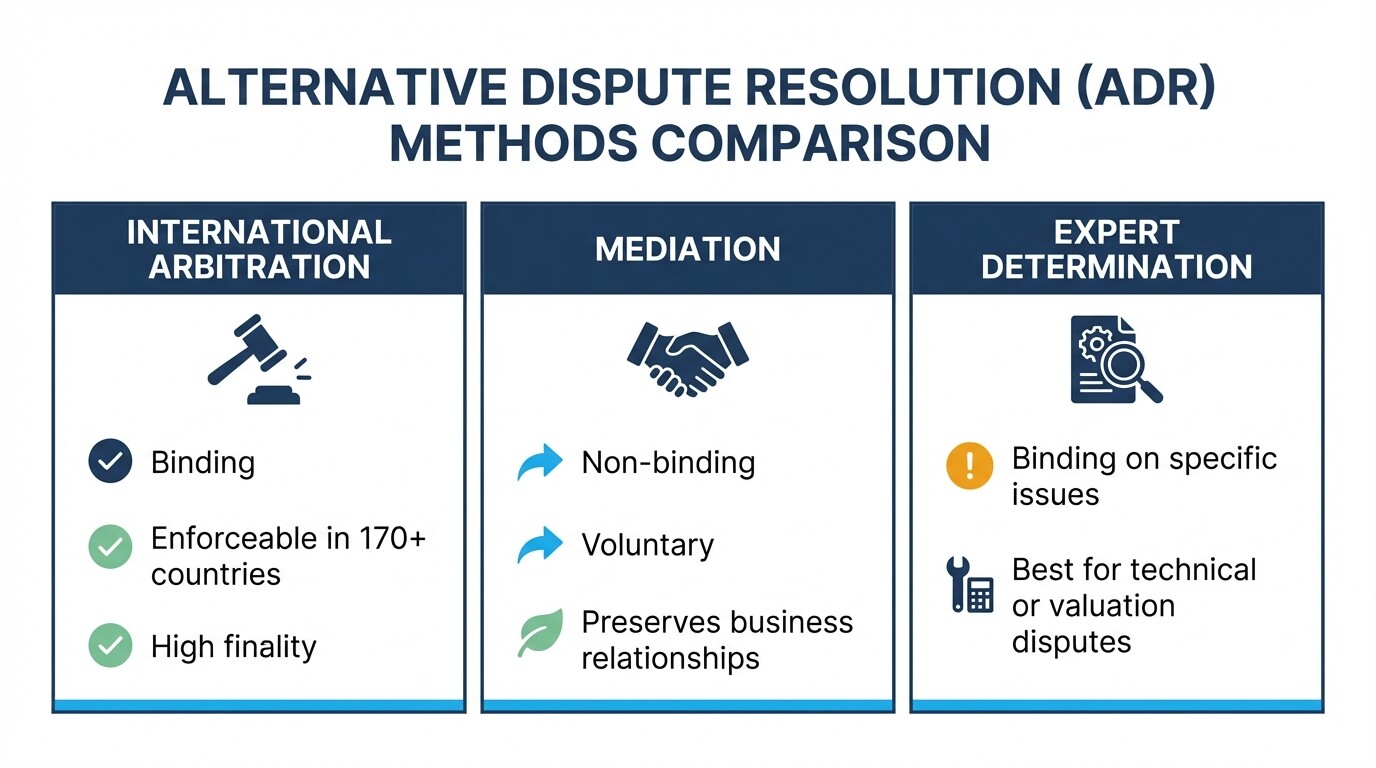
International commercial disputes are rarely resolved through traditional litigation due to enforcement complexities and high cross-border costs. Arbitration and mediation are the primary alternative dispute resolution (ADR) methods utilized in cross-border B2B conflicts to maintain confidentiality and ensure enforceability.
- International Commercial Arbitration: This is the gold standard for global B2B contracts. It results in a binding award that is enforceable in over 170 countries, including Australia, under the New York Convention. The process is private, allows parties to choose expert adjudicators, and offers limited grounds for appeal, bringing finality to the dispute.
- Mediation: A voluntary, non-binding process where a neutral third party facilitates a negotiated settlement. It is highly cost-effective and preserves ongoing commercial relationships. Many modern contracts feature multi-tier dispute resolution clauses, requiring executives to attempt mediation before initiating arbitration.
- Expert Determination: Best suited for highly technical or valuation disputes (such as software development milestones or accounting discrepancies). An independent industry expert makes a binding decision on a specific issue rather than applying legal arguments to a broader contractual breach.
Step-by-Step Process for Enforcing a Foreign Arbitral Award Locally
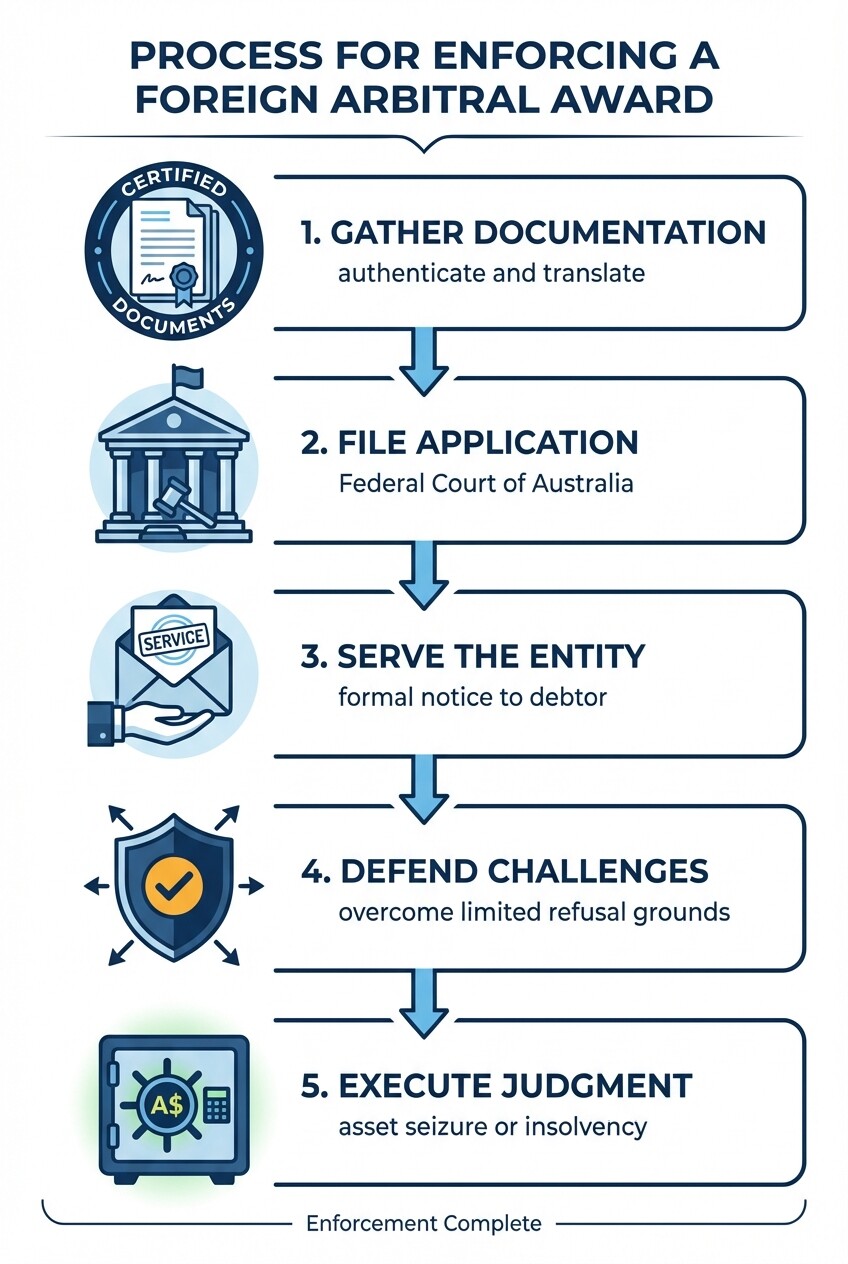
Australia is a signatory to the New York Convention, making foreign arbitral awards highly enforceable in Australian courts with limited grounds for refusal. The process involves an application to the Federal Court of Australia or a relevant State Supreme Court.
- Gather authenticated documentation: Obtain the original (or a certified copy) of both the arbitral award and the underlying arbitration agreement. If the documents are not in English, they must be translated by a certified professional.
- File an originating application: Submit an application to the Federal Court of Australia under the International Arbitration Act 1974, accompanied by an affidavit attaching the authenticated documents.
- Serve the Australian entity: The application must be formally served on the Australian judgment debtor in accordance with local court rules to ensure they have notice of the enforcement action.
- Defend against challenges: The Australian party has limited grounds to resist enforcement, such as proving they were denied a fair hearing, the arbitration agreement was invalid, or enforcing the award would violate Australian public policy.
- Execute the judgment: Once the court recognizes the award, it becomes enforceable as a judgment of the Australian court. You can then use local enforcement mechanisms like asset seizure, garnishing bank accounts, or initiating corporate insolvency proceedings.
Managing Litigation Costs and Financial Recovery Timelines
Enforcing a commercial contract in Australia requires a strategic budget and realistic timeline, as cross-border disputes can easily stretch across multiple financial quarters. Upfront planning helps businesses measure the commercial viability of pursuing a claim against an Australian entity.
| Dispute Phase | Estimated Cost (AUD) | Typical Timeline |
|---|---|---|
| Pre-Dispute Negotiation / Mediation | $10,000 - $30,000 | 1 - 3 Months |
| International Arbitration | $150,000 - $500,000+ | 12 - 24 Months |
| Enforcing Uncontested Award in Australia | $15,000 - $25,000 | 3 - 6 Months |
| Enforcing Contested Award in Australia | $50,000 - $150,000 | 9 - 18 Months |
Costs scale significantly based on document volume, expert witness requirements, and the belligerence of the opposing party. In Australia, the successful party in court enforcement proceedings can typically recover a portion of their legal costs from the losing party, usually calculated on a "party-party" basis (roughly 60% to 70% of actual costs incurred).
Common Misconceptions About Cross-Border Enforcement
Executives often underestimate the procedural hurdles of cross-border enforcement, leading to misaligned legal strategies. Clarifying these myths prevents costly missteps when dealing with Australian business partners.
- Foreign court judgments are as easy to enforce as arbitral awards: While arbitral awards benefit from global treaties, enforcing a foreign court judgment in Australia depends on bilateral treaties or common law principles. Judgments from the US, for example, require a more complex common law enforcement process than judgments from the UK or New Zealand.
- Australian courts will review the merits of the arbitration: A common fear is that an Australian court will reopen the case and re-examine the evidence. In reality, Australian courts are strictly prohibited from reviewing the substantive merits of a foreign arbitral award during enforcement proceedings.
- The winning party recovers 100% of their legal fees: While Australian courts follow the "loser pays" principle, cost recovery is rarely total. Businesses should budget for a 30% to 40% shortfall between what they spend on legal counsel and what the court orders the losing party to reimburse.
Frequently Asked Questions
Can an Australian court refuse to enforce a foreign arbitral award?
Yes, but only on very narrow, exhaustive grounds outlined in the New York Convention. These include an invalid arbitration agreement, a lack of due process, the tribunal exceeding its authority, or if enforcement would contravene fundamental Australian public policy.
Does Australia recognize the Singapore Convention on Mediation?
Australia signed the Singapore Convention on Mediation in 2021, which provides a framework for the cross-border enforcement of mediated settlement agreements. However, domestic legislation is still required to fully implement its mechanisms into Australian federal law.
How do I know if the Australian company has assets to seize?
Before initiating costly enforcement proceedings, you should conduct corporate intelligence and asset tracing in Australia. This involves searching public records like the Australian Securities and Investments Commission (ASIC) registry, land title registries, and the Personal Property Securities Register (PPSR).
When to Hire an International Commercial Lawyer
Engaging local legal counsel early is crucial to securing your financial interests and avoiding procedural defaults. An Australian commercial disputes lawyer can assess the enforceability of your contract before a minor breach escalates into a multi-jurisdictional crisis. You should contact an attorney immediately if negotiations break down, if you need to secure interim measures (such as freezing an Australian bank account to prevent asset dissipation), or if you are ready to initiate formal arbitration. You can find experienced local counsel through platforms listing ADR mediation & arbitration lawyers in Australia.
Next Steps
Taking immediate, documented action preserves your rights and strengthens your position for negotiation or enforcement. Follow these practical steps to initiate the dispute resolution process effectively.
- Review the Dispute Resolution Clause: Locate the governing law and jurisdiction/arbitration clauses in your executed contract to confirm exactly what procedural steps must be followed.
- Issue a Formal Notice of Dispute: Draft and send a formal, written notice to the Australian party as required by your contract. Detail the specific breaches, the financial impact, and a deadline to rectify the issue.
- Preserve Evidence: Halt any routine document destruction policies. Save all communications, invoices, delivery receipts, and internal emails related to the contract and the dispute.
- Conduct an Asset Search: Verify the current legal status and financial health of the Australian entity through ASIC to ensure they have the financial capacity to satisfy a potential judgment or award.