- Vietnam is a signatory to the 1958 New York Convention, meaning foreign arbitral awards are legally enforceable, provided they meet specific procedural criteria.
- The statute of limitations for filing a recognition and enforcement application is one year from the date the award becomes legally effective.
- The "violation of fundamental principles of Vietnamese law" (public policy) is the most frequent ground used by local courts to refuse enforcement.
- Applications must be submitted to the Ministry of Justice or directly to the competent Provincial People's Court where the judgment debtor resides or has assets.
- Legal fees and court charges vary, but the process generally takes between 6 to 12 months, excluding potential appeals.
What are the grounds for refusing to recognize an international arbitral award in Vietnam?
Vietnamese courts may refuse to recognize and enforce a foreign arbitral award if the respondent proves the proceedings violated procedural fairness or if the court finds the award conflicts with Vietnam's public policy. These grounds are codified in Article 459 of the Civil Procedure Code 2015, which largely mirrors Article V of the New York Convention.
The following specific grounds allow a Vietnamese court to reject an application:
- Incapacity or Invalidity: The parties to the arbitration agreement lacked the capacity to sign it, or the agreement itself is invalid under the law chosen by the parties.
- Lack of Notice: The party against whom the award is invoked was not given proper notice of the appointment of the arbitrator or the arbitration proceedings.
- Scope of Dispute: The award deals with a dispute not contemplated by or not falling within the terms of the submission to arbitration.
- Composition of Tribunal: The constitution of the arbitral tribunal or the arbitral procedure was not in accordance with the agreement of the parties.
- Award Not Binding: The award has not yet become binding on the parties or has been set aside or suspended by a competent authority of the country in which the award was made.
- Non-Arbitrable Subject Matter: The dispute is not capable of settlement by arbitration under the laws of Vietnam (e.g., certain land disputes or criminal matters).
- Public Policy: The recognition and enforcement of the award would be contrary to the "fundamental principles of Vietnamese law."
What is the role of the Ministry of Justice and local courts in the enforcement process?
The Ministry of Justice (MOJ) acts as the central administrative clearinghouse for foreign awards, while the Provincial People's Courts serve as the judicial gatekeepers. While it is possible to file directly with a court, many foreign creditors utilize the MOJ to ensure documents are correctly routed to the appropriate jurisdiction.
The Ministry of Justice (MOJ)
The MOJ's role is primarily administrative. Upon receiving a petition, the MOJ reviews the dossier for completeness. Within five working days of receiving a valid application, the MOJ must transfer the file to the competent Provincial People's Court. The MOJ does not rule on the merits of the case but ensures the paperwork meets the formal requirements set by Vietnamese law.
The Provincial People's Courts
The court system is where the substantive legal review happens. The court in the province where the judgment debtor is headquartered or where their assets are located holds jurisdiction. The court's primary duty is to verify that no grounds for refusal exist. They do not re-examine the merits of the underlying dispute, though in practice, the "public policy" review can sometimes lead to a deeper look at the case details than international parties might expect.
The Civil Judgment Enforcement Agency (THADS)
Once a court issues a decision to recognize and enforce the award, the file is transferred to the Civil Judgment Enforcement Agency. This government body is responsible for the actual seizure of assets, freezing of bank accounts, or other coercive measures necessary to satisfy the debt.
What are the time limits and procedural requirements for filing?
Creditors must file their application for recognition and enforcement within one year from the date the foreign arbitral award becomes legally effective. This timeline is strict, though it can be extended if the applicant can prove "force majeure" or "objective obstacles" prevented them from filing on time.
Step-by-Step Filing Process
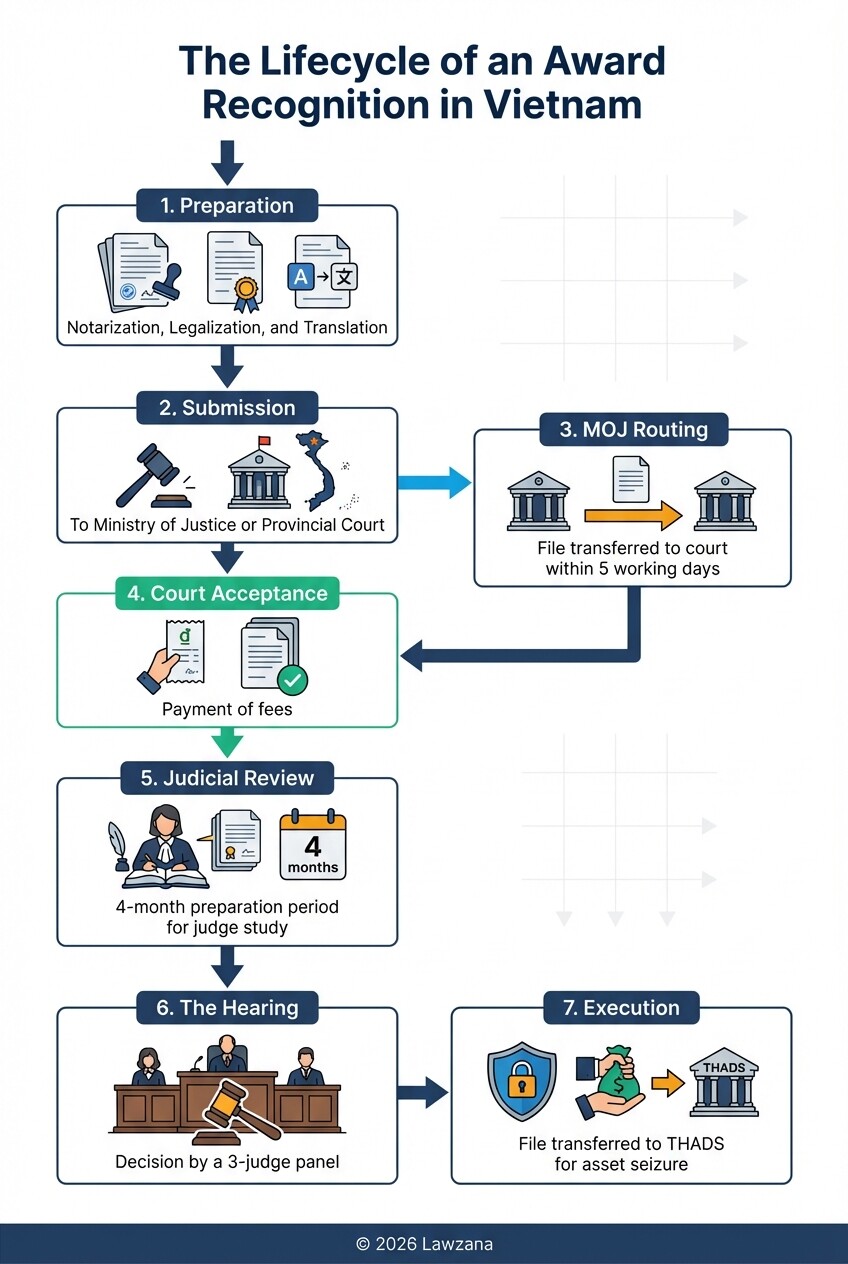
- Dossier Preparation: Collect the original arbitral award and the original arbitration agreement (or certified copies).
- Legalization and Translation: All documents must be notarized, legalized by the relevant Vietnamese consulate abroad, and translated into Vietnamese by an authorized translator.
- Submission: Submit the petition to the MOJ or the competent Provincial People's Court.
- Court Acceptance: The court reviews the fee payment and formally accepts the case.
- Preparation Period: The court has four months to study the file, during which it may request explanations from the parties.
- The Hearing: A panel of three judges conducts a hearing to decide on recognition.
- Issuance of Decision: The court issues a written decision to recognize or refuse the award.
Document Checklist
| Document | Requirement |
|---|---|
| Formal Petition | Must follow the template provided in the Civil Procedure Code. |
| Original Award | Or a certified copy; must be legalized. |
| Arbitration Agreement | Or a certified copy; must be legalized. |
| Power of Attorney | If using a lawyer; must be legalized. |
| Translation | All non-Vietnamese documents must have certified translations. |
How do Vietnamese courts interpret the "public policy" exception?
The "public policy" exception is the most controversial aspect of arbitration enforcement in Vietnam because it is defined broadly as "the fundamental principles of Vietnamese law." Historically, this allowed local courts to refuse awards that they felt were unfair or inconsistent with local statutes, even if those statutes were not "fundamental."
However, recent trends show a shift toward a more pro-arbitration stance. The Supreme People's Court issued Resolution No. 01/2014/NQ-HDTP, which clarified that an award should only be considered a violation of public policy if it violates "the basic principles of conduct that have the most general effect on the formulation and implementation of Vietnamese law."
Despite this guidance, challenges remain:
- Interpretive Discretion: Local judges in smaller provinces may still apply a protectionist view to favor local state-owned enterprises.
- Interest Rates: Courts have occasionally refused to enforce the interest rate portions of awards if they exceed the caps set by the Civil Code of Vietnam, citing public policy.
- Procedural Technicalities: Small deviations from the agreed-upon arbitration rules are sometimes escalated to "public policy" violations by defendants looking to stall enforcement.
Are mediation and settlement viable alternatives in Vietnam?
Given the potential delays and complexities of court enforcement, many international businesses opt for commercial mediation or post-award settlements. Vietnam formally recognized commercial mediation through Decree 22/2017/ND-CP, providing a legal framework for settlements to be recognized by courts with the same force as a judgment.
Why choose mediation?
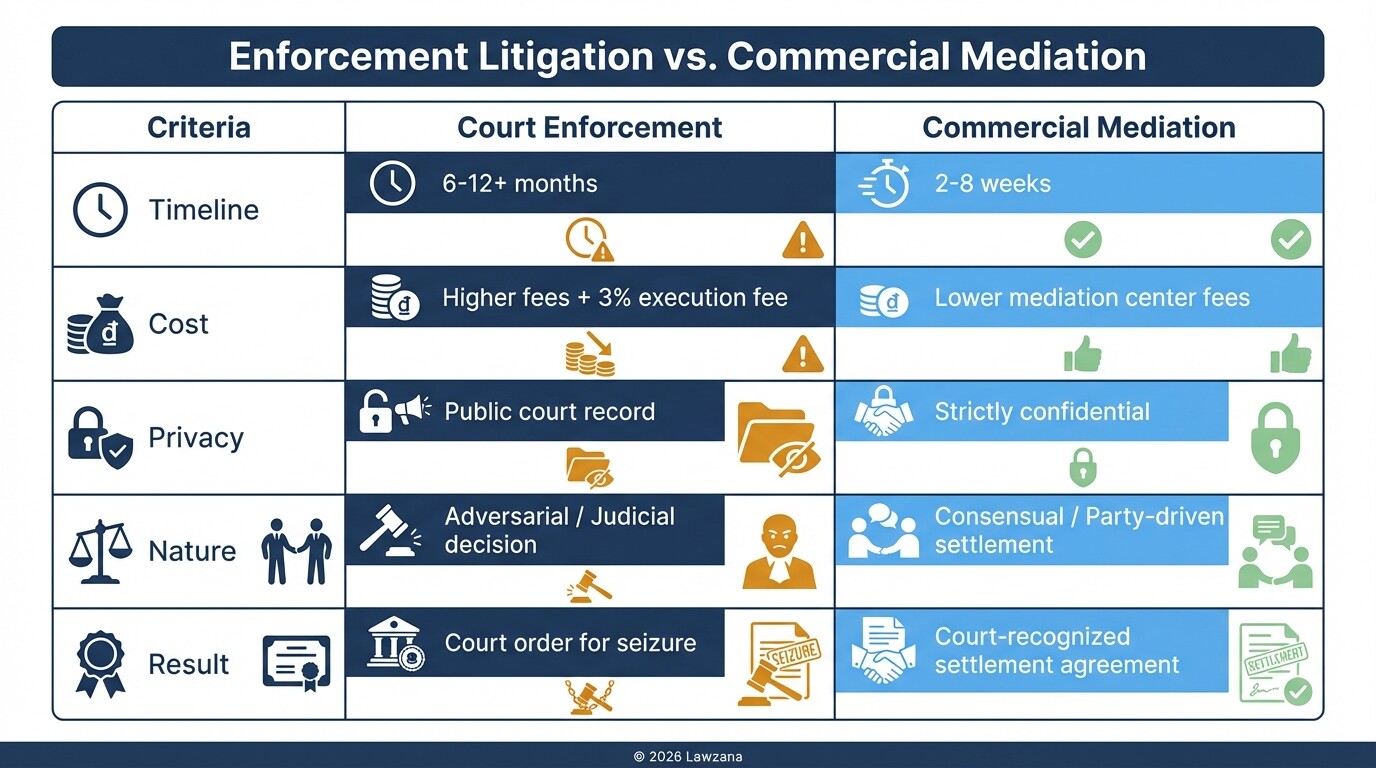
- Speed: Mediation can often resolve a dispute in weeks, whereas enforcement litigation can take years if appealed.
- Cost-Efficiency: The costs for a mediator and the Vietnam Mediation Centre (VMC) are typically lower than a full-scale enforcement proceeding and subsequent asset seizure.
- Relationship Preservation: In B2B sectors like M&A or long-term manufacturing, mediation allows parties to settle without permanently destroying the business relationship.
- Enforceability: Under the Civil Procedure Code, a "successful mediation result" can be recognized by a Vietnamese court in a simplified procedure, making it immediately enforceable by the Civil Judgment Enforcement Agency.
Common Misconceptions
"The New York Convention guarantees automatic enforcement."
Many foreign investors believe that because Vietnam signed the Convention, their award is automatically "money in the bank." In reality, the Convention only provides a framework. You must still navigate the local court system, handle legalization of documents, and overcome potential "public policy" challenges.
"The court will re-try the entire case."
Legally, Vietnamese courts are prohibited from reviewing the merits of the dispute. They are only supposed to check for procedural compliance. However, debtors often try to smuggle merit-based arguments into the hearing under the guise of "public policy" violations. A strong legal strategy is required to keep the court focused on the procedural limits of its review.
"Enforcement is impossible against State-Owned Enterprises (SOEs)."
While enforcing against an SOE can be politically sensitive, it is not impossible. Vietnam's increasing integration into global trade (via the EVFTA and CPTPP) has put pressure on the judiciary to demonstrate a fair and predictable legal environment for all entities, regardless of ownership.
FAQ
How much does it cost to enforce an award in Vietnam?
The court fee for an application to recognize and enforce a foreign arbitral award is relatively low (roughly 3,000,000 VND), but this does not include lawyer fees, translation costs, or the 3% execution fee charged by the enforcement agency if assets are successfully seized.
Can a court's decision on recognition be appealed?
Yes. Both the applicant and the judgment debtor have the right to appeal the court's decision to the High People's Court within 15 days of the ruling. The Procuracy (state prosecutors) also has the right to protest the decision.
Do I need to be present in Vietnam to file the application?
No, you can appoint a local legal representative via a legalized Power of Attorney to handle the entire process on your behalf.
What happens if the debtor has no assets in Vietnam?
If the debtor has no assets or presence in Vietnam, the Vietnamese court will likely lack jurisdiction to hear the recognition application. Enforcement is typically sought in the jurisdiction where the assets are physically located.
When to Hire a Lawyer
You should engage a Vietnamese legal expert as soon as you receive a favorable arbitral award if the counterparty has assets in Vietnam. Expert counsel is particularly critical if:
- The judgment debtor is a major local entity or a State-Owned Enterprise.
- The award involves complex interest calculations or damages that might trigger "public policy" scrutiny.
- You need to conduct an asset search to determine which provincial court has jurisdiction.
- The one-year statute of limitations is approaching.
Next Steps
- Audit Your Award: Ensure the award is "final and binding" under the rules of the seat of arbitration (e.g., SIAC, HKIAC, or ICC).
- Gather Documents: Immediately begin the process of notarization and legalization of the original award and the underlying contract.
- Identify Assets: Work with local investigators or counsel to identify the debtor's bank accounts, real estate, or inventory within Vietnam.
- Submit to MOJ: File your petition through the Ministry of Justice to start the formal recognition process.
- Monitor the Timeline: Ensure your legal team tracks the court's preparation period to prevent unnecessary delays in the hearing schedule.