- Commercial arbitration in Malaysia is governed by the Arbitration Act 2005, which is based on the UNCITRAL Model Law, ensuring a framework that aligns with international standards.
- The Asian International Arbitration Centre (AIAC) in Kuala Lumpur serves as the primary regional hub for dispute resolution, providing cost-effective administration and a panel of international experts.
- Malaysia is a signatory to the New York Convention, meaning arbitral awards issued in Malaysia are enforceable in over 170 countries, and foreign awards are similarly enforceable in Malaysian courts.
- Arbitral proceedings are private and confidential by default under Malaysian law, protecting sensitive commercial data and trade secrets from public record.
- Choosing Kuala Lumpur as a seat of arbitration is typically 30% to 50% more cost-effective than competing hubs like Singapore or Hong Kong due to lower administrative fees and operational costs.
Why Choose Arbitration Over Litigation in Malaysia?
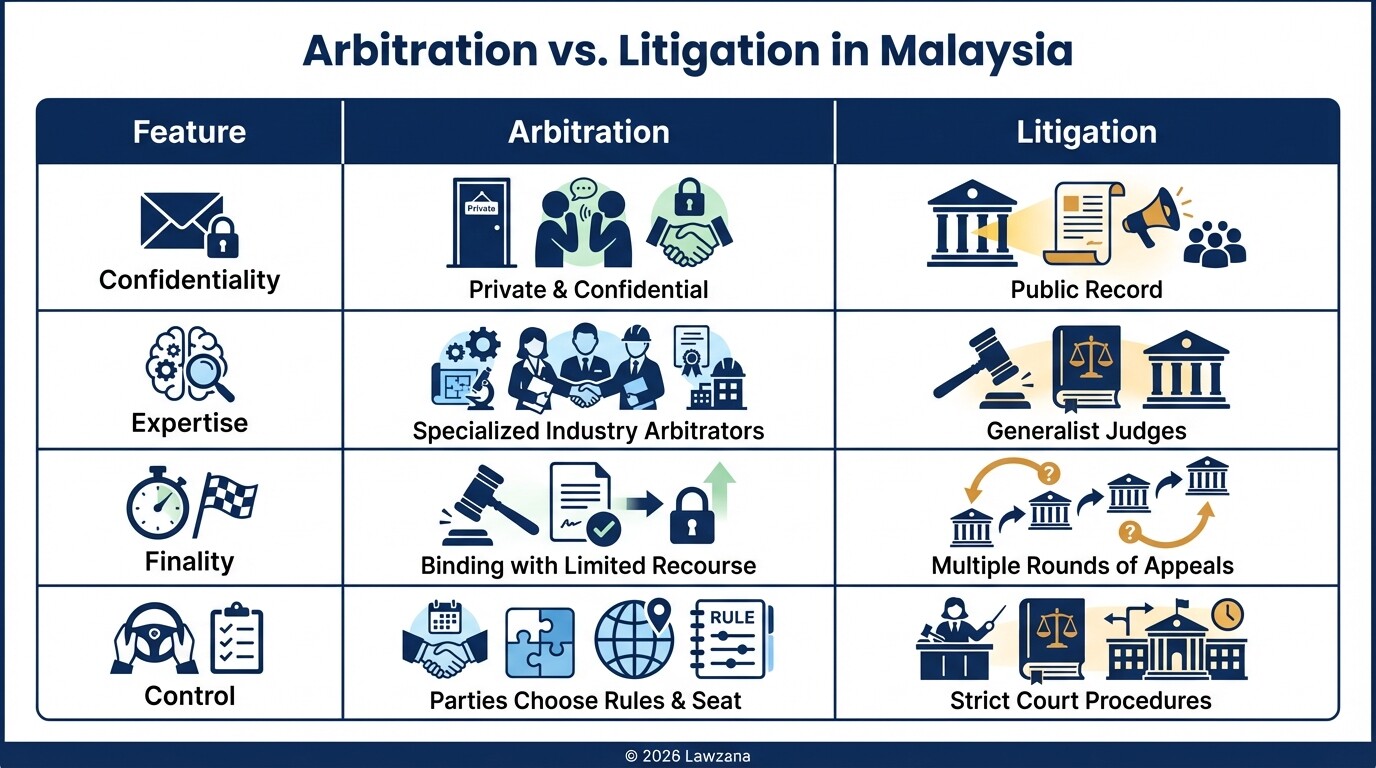
Arbitration offers a private, flexible, and final method of resolving disputes that avoids the backlog and public nature of the Malaysian court system. Unlike litigation, where a judge is assigned regardless of their background, arbitration allows parties to select specialized experts who understand the technical nuances of their specific industry, such as construction, oil and gas, or intellectual property.
The advantages of choosing arbitration in the Malaysian jurisdiction include:
- Confidentiality: Under Section 41A of the Arbitration Act 2005, proceedings and awards are confidential. This prevents competitors and the public from accessing sensitive financial or strategic information.
- Finality: Arbitral awards are generally final and binding. The grounds for challenging an award in Malaysian courts are extremely narrow, preventing the years of appeals common in litigation.
- Neutrality: International firms can avoid the "home court advantage" by selecting a neutral seat and a tribunal composed of various nationalities.
- Speed: While the Malaysian judiciary has improved efficiency, commercial arbitration allows for tailored schedules that can resolve complex disputes faster than the standard court diary.
How to Draft Effective Arbitration Clauses for 2026
An effective arbitration clause acts as a roadmap that prevents "disputes about the dispute" before they begin. In 2026, businesses should ensure their clauses are precise, referencing the Asian International Arbitration Centre (AIAC) Rules to provide a clear procedural framework that accounts for modern digital evidence and remote hearing protocols.
To ensure a clause is enforceable and efficient, include the following elements:
- The Agreement to Arbitrate: Use clear, mandatory language such as "shall be referred to and finally resolved by arbitration."
- The Rules: Specify the AIAC Arbitration Rules. These rules provide a comprehensive structure for everything from the commencement of claims to the delivery of the final award.
- The Seat of Arbitration: Designate Kuala Lumpur, Malaysia. The "seat" determines the legal framework and the "curial law" that governs the proceedings.
- The Number of Arbitrators: Decide between one or three arbitrators. A sole arbitrator is more cost-effective for smaller claims, while three may be preferred for high-value, complex disputes.
- The Language: Explicitly state that the language of the arbitration shall be English to avoid translation costs and confusion.
| Clause Component | Recommended Phrasing |
|---|---|
| Scope | "Any dispute, controversy, or claim arising out of or relating to this contract..." |
| Seat | "The seat of arbitration shall be Kuala Lumpur, Malaysia." |
| Authority | "The arbitration shall be administered by the AIAC." |
| Law | "The governing law of this contract shall be the substantive law of Malaysia." |
What is the Process for Appointing an Arbitrator via AIAC?
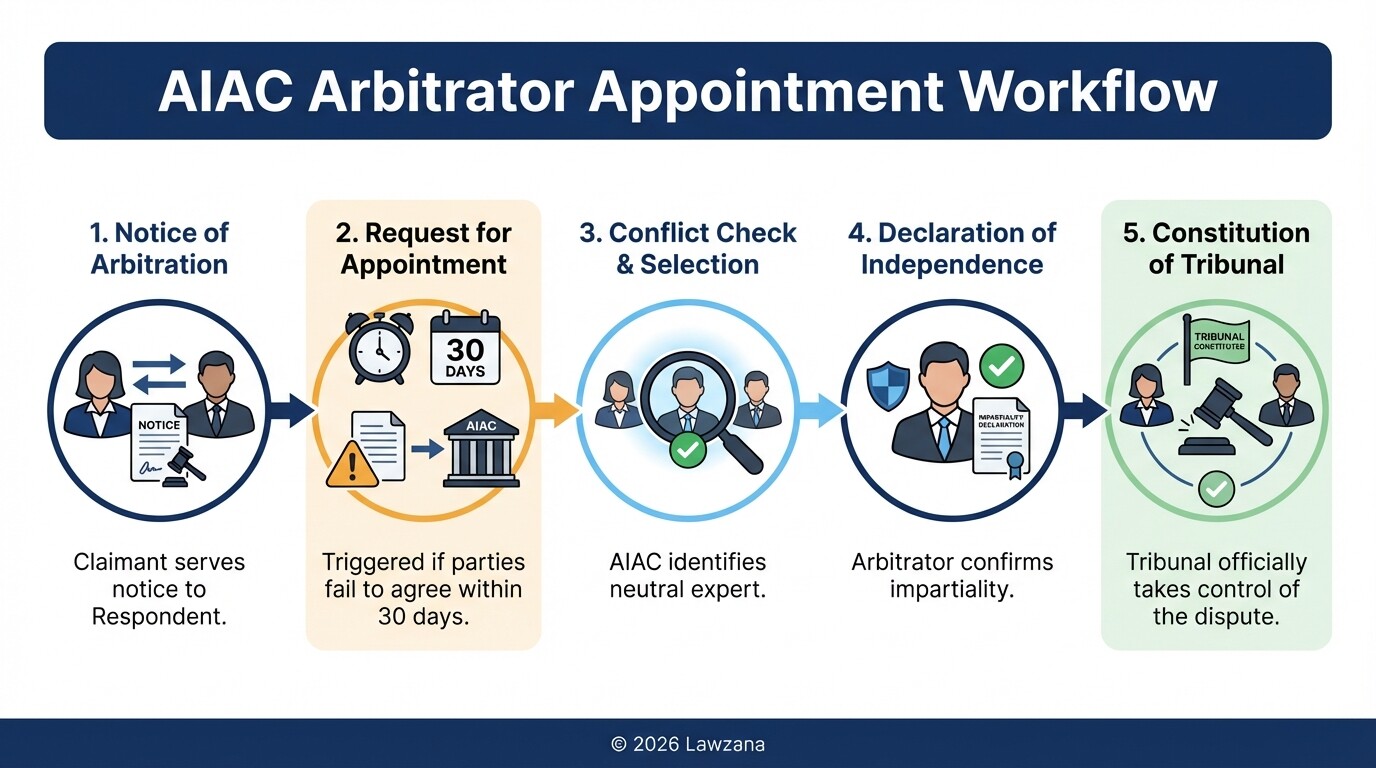
The process for appointing an arbitrator in Malaysia is streamlined through the AIAC to ensure neutrality when parties cannot agree on a candidate. If the parties fail to reach a consensus within 30 days of a request, the Director of the AIAC acts as the appointing authority to select a qualified neutral from their international panel.
The steps involved in an AIAC-administered appointment include:
- Notice of Arbitration: The claimant serves a notice to the respondent and the AIAC, outlining the nature of the dispute.
- Request for Appointment: If the contract specifies the AIAC as the appointing authority, or if parties cannot agree, a formal request is submitted to the AIAC Director.
- Conflict Check: The AIAC identifies potential arbitrators who possess the required technical expertise and ensures they have no conflicts of interest.
- Confirmation: Once the arbitrator is selected, they must sign a declaration of independence and impartiality before the appointment is finalized.
- Constitution of the Tribunal: The AIAC formally notifies both parties that the tribunal is constituted, at which point the arbitrator takes control of the proceedings.
How are Foreign Arbitral Awards Enforced in Malaysia?
Malaysia enforces foreign arbitral awards through a simplified registration process in the High Court, as mandated by the New York Convention and Sections 38 and 39 of the Arbitration Act 2005. Once a foreign award is recognized by the Malaysian High Court, it is treated as if it were a judgment of the court itself, allowing for enforcement through asset seizure, garnishment, or winding-up proceedings.
To enforce an award in Malaysia, the following conditions must be met:
- Documentation: You must provide the original or a certified copy of the arbitral award and the original arbitration agreement.
- Translation: If the award is not in English or Bahasa Malaysia, a certified translation must be provided.
- Statutory Compliance: The award must be from a state that is a signatory to the New York Convention.
- Limited Grounds for Refusal: The Malaysian court can only refuse enforcement on very specific grounds, such as incapacity of the parties, lack of proper notice, or if the award violates Malaysian public policy.
For more information on the judicial process for enforcement, visit the Official Website of the Judicial System of Malaysia.
What are the Timeline and Cost Expectations for Arbitration?
Commercial arbitration in Malaysia is generally faster and more affordable than in other major financial hubs, with most cases concluding within 12 to 18 months. Costs are divided into three main categories: AIAC administrative fees, the arbitrator's fees, and legal representation costs.
The AIAC uses a regressive scale for fees, meaning that as the amount in dispute increases, the percentage charged decreases. This makes Malaysia a highly competitive venue for multi-million dollar international claims.
Estimated Cost Breakdown (in MYR)
| Claim Amount (MYR) | AIAC Admin Fee (Estimate) | Arbitrator Fee (Estimate) |
|---|---|---|
| 500,000 | 10,000 - 15,000 | 25,000 - 45,000 |
| 1,000,000 | 15,000 - 20,000 | 45,000 - 75,000 |
| 5,000,000 | 35,000 - 50,000 | 120,000 - 180,000 |
| 10,000,000+ | Capped or Negotiated | Based on Scale |
Note: These are estimates. Total costs will also include hearing room rentals, transcription services, and legal fees.
Common Misconceptions About Malaysian Arbitration
Myth 1: Arbitration is always more expensive than court.
While parties must pay for the arbitrator and the venue, arbitration often saves money in the long run. By avoiding the lengthy appeal processes of the Malaysian court system and using an expert who requires less "education" on industry technicalities, the total billable hours for legal counsel are often significantly lower.
Myth 2: The Malaysian government can interfere in the process.
The Arbitration Act 2005 follows the principle of "minimal court intervention." Under Section 8, no court shall intervene in matters governed by the Act except where specifically provided. The Malaysian judiciary has consistently demonstrated a "pro-arbitration" stance, upholding the autonomy of the arbitral process.
Myth 3: Arbitration is only for massive multinational corporations.
Small and medium enterprises (SMEs) in Malaysia frequently use "Fast Track" arbitration rules. The AIAC offers expedited procedures for smaller claims that can lead to a final award in as little as 120 days, providing a swift resolution that protects a smaller company's cash flow.
FAQ
Can an arbitral award be appealed in Malaysia?
No, there is no right of appeal on the merits of the case (errors of fact or law). A party can only apply to "set aside" an award under Section 37 of the Arbitration Act for procedural irregularities, such as a lack of jurisdiction, breach of natural justice, or conflict with public policy.
Is the AIAC a government body?
The Asian International Arbitration Centre (AIAC) is an independent, international organization established under the auspices of the Asian-African Legal Consultative Organization (AALCO). While it receives support from the Malaysian government, it operates with complete institutional autonomy.
Can I use arbitration for employment disputes in Malaysia?
While commercial disputes are the primary focus, certain employment disputes can be arbitrated if the employment contract contains a valid arbitration clause. However, statutory claims under the Employment Act 1955 or the Industrial Relations Act 1967 generally fall under the jurisdiction of the Labour Department or Industrial Court.
What happens if the other party refuses to participate?
If a party refuses to participate after being properly notified, the arbitration can proceed "ex parte." The tribunal has the power to hear the evidence from the participating party and issue a final, binding award that is enforceable against the non-participating party's assets.
When to Hire a Lawyer
Navigating the AIAC rules and the Arbitration Act 2005 requires specialized legal knowledge to ensure your interests are protected. You should consult a qualified Malaysian arbitration lawyer if:
- You are drafting a high-value international contract and need a watertight dispute resolution clause.
- You have received a Notice of Arbitration and need to file a Response within the strict 30-day window.
- You need to apply for interim measures, such as an injunction to freeze assets while the arbitration is pending.
- You have won an arbitral award and need to navigate the High Court process for recognition and enforcement.
Next Steps
- Review Existing Contracts: Audit your current commercial agreements to see if they contain valid arbitration clauses or if they still default to the local courts.
- Select Your Venue: If you are negotiating a new deal, propose the AIAC in Kuala Lumpur as the administrative body to benefit from regional expertise and lower costs.
- Gather Evidence: If a dispute is brewing, begin documenting all correspondence, invoices, and performance records immediately, as arbitration is heavily document-centric.
- Consult an Expert: Reach out to a legal professional specializing in Malaysian ADR to evaluate the strengths of your claim and estimate your potential recovery.