- Malaysia is a signatory to the Madrid Protocol, allowing international brands to streamline trademark registration through a single application.
- Intellectual property enforcement is managed by the Intellectual Property Corporation of Malaysia (MyIPO) and the Ministry of Domestic Trade and Cost of Living (KPDN).
- Trade secrets are protected under common law and breach of confidence principles, making robust Non-Disclosure Agreements (NDAs) essential for tech firms.
- Upcoming 2026 guidelines will provide clearer frameworks for software patentability and AI-generated intellectual property.
- International entities without a local presence must appoint a registered Malaysian patent or trademark agent to manage MyIPO filings.
IP Protection Checklist for International Brands
To successfully secure and maintain intellectual property rights in Malaysia, international brands should follow this structured roadmap. Completing these steps ensures legal standing for enforcement and litigation.
| Phase | Action Item | Priority |
|---|---|---|
| Registration | Conduct a comprehensive search on the MyIPO IP Online Portal. | High |
| Registration | File trademark applications via the Madrid Protocol or local MyIPO agent. | High |
| Customs | Record registered trademarks with the Royal Malaysian Customs Department. | Medium |
| Contractual | Execute localized Non-Disclosure Agreements (NDAs) for all employees and partners. | High |
| Compliance | Review software and digital assets against the 2026 patentability guidelines. | Medium |
| Monitoring | Set up "Watch Services" to detect unauthorized filings or brand squatting. | Low |
Sample Mutual Non-Disclosure Agreement (NDA) Clause
For tech firms and international brands, the following sample language can be used to protect trade secrets within Malaysian jurisdictions:
"The Receiving Party acknowledges that the Confidential Information constitutes a trade secret under Malaysian common law and the principles of breach of confidence. The Receiving Party agrees to maintain the strict confidentiality of the Disclosing Party's proprietary software, algorithms, and business processes for a period of five (5) years following the termination of this Agreement, or for as long as the information remains a trade secret under the law, whichever is longer."
Navigating the Malaysian Intellectual Property Corporation (MyIPO) Processes
Registration of IP in Malaysia is centralized through the Intellectual Property Corporation of Malaysia (MyIPO). This statutory body oversees the registration of trademarks, patents, industrial designs, geographical indications, and voluntary notification of copyright.
International brands must recognize that Malaysia operates on a first to file system rather than a first to use system for trademarks. While common law rights exist for unregistered marks under the tort of passing off, these cases are significantly more difficult and expensive to prove in court. Consequently, formal registration should be the first step for any brand entering the Southeast Asian market.
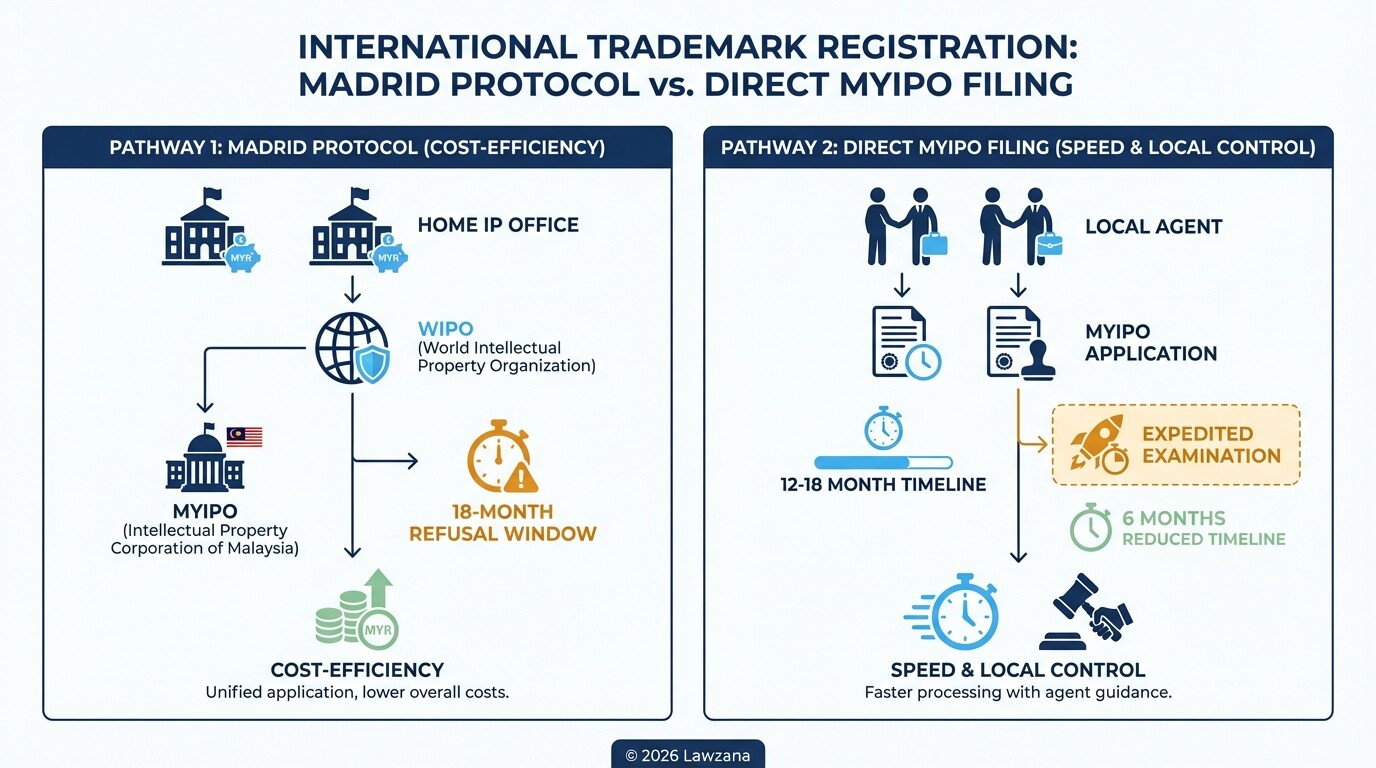
- Trademark Filing: Applications take approximately 12 to 18 months. Expedited examination is available for an additional fee of RM 1,200, which can reduce the timeline to 6 months.
- Patent Application: Malaysia offers both standard patents (20 years) and utility innovations (10 years, renewable). The process involves a formal examination followed by a substantive examination.
- Local Representation: Under the Trademarks Act 2019 and Patents Act 1983, any applicant not residing or having a principal place of business in Malaysia must appoint a registered local agent.
- Fees: Standard trademark filing fees start at approximately RM 950 per class for online submissions.
Leveraging the Madrid Protocol for International Trademark Registration
The Madrid Protocol provides a cost-effective and centralized system for international brands to protect their trademarks in Malaysia by filing one application in one language. Malaysia officially joined the Protocol in 2019, aligning its trademark laws with international standards.
By using the Madrid System, a brand can designate Malaysia in an international application filed through their home country's IP office. This eliminates the need to pay individual filing fees to MyIPO initially or to hire a local agent unless the application faces a provisional refusal or opposition.
- Cost Efficiency: Consolidates multiple national filings into a single transaction with the World Intellectual Property Organization (WIPO).
- Management: Simplifies the renewal and name/address change process through a single centralized portal.
- Refusal Period: MyIPO has 18 months to notify WIPO of any grounds for refusal. If no notice is given, the mark is deemed protected in Malaysia.
Enforcement Procedures Against Counterfeiters Through Malaysian Courts
Enforcement of IP rights in Malaysia is a dual-track system involving civil litigation in the specialized Intellectual Property High Court and criminal enforcement through government agencies. International brands often utilize the Enforcement Division of the Ministry of Domestic Trade and Cost of Living (KPDN) for rapid action against physical counterfeit goods.
For civil enforcement, brands can seek injunctions, damages, or an account of profits. The Malaysian legal system also provides for "Anton Piller" orders, which are ex parte search warrants that allow a brand owner to enter a defendant's premises to inspect and seize evidence of infringement without prior notice.
- KPDN Raids: Brand owners can file a formal complaint with KPDN. If the ministry finds merit, they can conduct raids and seize counterfeit goods under the Trade Descriptions Act 2011.
- Border Measures: Trademark owners can apply to the Registrar of Trademarks to restrict the importation of infringing goods. Once approved, Customs can seize suspected counterfeit shipments at the port of entry.
- Litigation Timeline: A standard IP infringement suit in the High Court typically takes 12 to 24 months to reach a final judgment.
Protection of Trade Secrets and Non-Disclosure Agreements for Tech Firms
Malaysia does not have a dedicated Trade Secrets Act; however, protection is robustly enforced through the common law "action for breach of confidence." For international tech firms, this means that protection is primarily established through well-drafted contracts and the demonstration that the information has the "necessary quality of confidence."
To succeed in a claim for breach of confidence in Malaysia, a brand must prove three elements: the information was confidential, it was disclosed in a situation importing an obligation of confidence, and there was unauthorized use of that information to the detriment of the owner.
- Employment Contracts: Must include specific clauses defining what constitutes a trade secret (e.g., source code, client databases).
- Non-Compete Clauses: While generally difficult to enforce in Malaysia due to Section 28 of the Contracts Act 1950 (restraint of trade), "Non-Solicitation" and "Confidentiality" clauses are widely upheld.
- Physical/Digital Security: Courts often look at whether the brand took reasonable steps to keep the information secret, such as encryption and restricted access.
New 2026 Guidelines for Digital IP and Software Patentability
The Malaysian government and MyIPO are preparing to implement updated guidelines in 2026 to address the rapid growth of the digital economy. These guidelines aim to provide more clarity on the patentability of computer-implemented inventions (CII), artificial intelligence (AI), and blockchain technologies.
Under current practice, software "as such" is not patentable. However, software that produces a "technical effect" or solves a technical problem can be patented. The 2026 updates are expected to align Malaysia more closely with European Patent Office (EPO) standards, making it easier for international tech brands to secure patents for innovative software architectures.
- AI Inventions: The 2026 guidelines will clarify whether AI-generated inventions can list an AI as an inventor (currently unlikely) and how to demonstrate human-led inventive steps.
- Digital Designs: New protections for Graphical User Interfaces (GUIs) and icons under the Industrial Designs Act are expected to be expanded.
- Blockchain: Clarification on the patentability of cryptographic methods and decentralized ledger applications.
Common Misconceptions About IP in Malaysia
"Copyright must be registered to be protected."
Copyright protection in Malaysia is automatic upon the creation of the work. While you do not have to register it, filing a "Voluntary Notification" with MyIPO is highly recommended. This provides a certificate that serves as prima facie evidence of ownership in court, significantly lowering the burden of proof during a dispute.
"A trademark registered in the US or Europe is valid in Malaysia."
Intellectual property rights are strictly territorial. A US patent or an EU trademark provides zero legal protection in Malaysia. You must file locally or through an international treaty (like the Madrid Protocol or Patent Cooperation Treaty) to gain rights within the country.
FAQ
How much does it cost to register a trademark in Malaysia?
For a single class, the official MyIPO filing fee is RM 950 for online submission. If you use a local agent, professional fees typically range from RM 1,500 to RM 3,000 per mark, excluding disbursements.
Can I protect my business name before I start operating in Malaysia?
Yes. You can file for a trademark before you begin commercial operations. Malaysia allows for "intent to use" applications. However, if the mark is not used within three years of the completion of the registration process, it may be vulnerable to cancellation by a third party for non-use.
How long does patent protection last in Malaysia?
A standard patent is protected for 20 years from the date of filing, provided that annual renewal fees are paid. Utility innovations are protected for an initial 10 years and can be extended for two subsequent 5-year periods.
What should I do if I find my brand being sold on Shopee or Lazada?
Both platforms have established IP protection portals (e.g., Shopee Brand Registry). You should submit your MyIPO registration certificate to the platform to have the infringing listings taken down. If the infringement is large-scale, you should consult a lawyer about a KPDN raid.
When to Hire a Lawyer
While MyIPO provides a user-friendly portal, international brands should engage a Malaysian IP attorney in the following scenarios:
- Objections and Oppositions: If MyIPO issues a provisional refusal or if a third party opposes your trademark registration.
- Complex Patent Drafting: Ensuring your software or tech invention meets the "technical character" requirement.
- Litigation and Raids: When you need to coordinate with KPDN for criminal enforcement or file a lawsuit in the High Court.
- Licensing and Franchising: To ensure your IP royalty structures comply with Malaysian tax and commercial laws.
Next Steps
- Audit Your Assets: Identify which trademarks, designs, and patents are currently used in your Malaysian operations.
- Search MyIPO: Visit the MyIPO IP Online Search to check for conflicting marks or patents.
- Consult an Agent: Contact a registered Malaysian IP agent to discuss whether the Madrid Protocol or a direct filing is more cost-effective for your specific needs.
- Secure Your Contracts: Review your NDAs and employment agreements to ensure they meet Malaysian common law standards for trade secret protection.