
- Australian Consumer Law protections frequently apply to business-to-business contracts, exposing foreign companies to strict regulations regarding unfair contract terms.
- The "loser pays" system in Australian courts means unsuccessful litigants generally pay 50 to 70 percent of the winning party's legal costs.
- Pre-litigation alternatives like commercial mediation can save companies hundreds of thousands of Australian dollars compared to full Federal Court proceedings.
- Drafting a mandatory, multi-tiered dispute resolution clause is the most effective preventative strategy for managing cross-border commercial risks.
Understanding Australian Consumer Law in B2B Cross-Border Disputes
Foreign companies operating in Australia or contracting with Australian entities are frequently surprised to find that the Australian Consumer Law applies to their commercial contracts. The statutory framework protects businesses against unfair contract terms and misleading conduct, provided the transaction meets specific criteria.
The Australian Competition and Consumer Commission oversees these rules, which can invalidate standard contract terms that foreign companies rely on globally. Understanding these boundaries is critical before initiating or responding to a dispute.
- Financial Thresholds: The Australian Consumer Law applies to B2B purchases if the price of the goods or services does not exceed $100,000 AUD.
- Nature of Goods: Regardless of price, the law applies if the goods or services are of a kind ordinarily acquired for personal, domestic, or household use or consumption.
- Unfair Contract Terms: Standard form B2B contracts are subject to strict scrutiny. Terms that permit one party to unilaterally terminate the contract, alter its terms, or limit liability may be declared void and unenforceable by an Australian court.
- Misleading and Deceptive Conduct: Section 18 of the Australian Consumer Law strictly prohibits conduct in trade or commerce that is misleading or deceptive. This is the most heavily litigated statutory provision in Australian corporate disputes. For detailed regulatory guidance, foreign businesses should review official resources from the Australian Competition and Consumer Commission.
Cost Estimates: Commercial Litigation vs. Pre-Litigation Settlements
Resolving a commercial dispute through the Australian Federal Court or State Supreme Courts is exceptionally expensive compared to early settlement. Foreign entities must also account for adverse costs orders, where the losing party is ordered to pay a significant portion of the successful party's legal fees.
Engaging in pre-litigation strategies significantly reduces financial exposure. The table below outlines the estimated costs and timelines for a mid-tier commercial dispute (valued between $500,000 and $2,000,000 AUD) in Australia.
| Expense Category | Pre-Litigation (Mediation/Negotiation) | Full Commercial Litigation (Federal/Supreme Court) |
|---|---|---|
| Legal Professional Fees | $15,000 to $40,000 AUD | $150,000 to $400,000+ AUD |
| Filing and Institutional Fees | $2,000 to $5,000 AUD (Mediator fees) | $4,000+ AUD (Corporate filing) plus daily hearing fees |
| Typical Time to Resolution | 1 to 3 months | 12 to 24+ months |
| Cost Recovery Risk | None (Parties usually bear own costs) | High (Loser typically pays 50-70% of winner's costs) |
| Management Time | Low to Moderate | Exceptionally High |
Commercial Mediation and Arbitration as Court Alternatives
Commercial arbitration and mediation offer private, flexible, and enforceable alternatives to the public Australian court system. Foreign companies often prefer these methods to avoid local court biases, maintain confidentiality, and utilize international enforcement conventions.
Australian courts are highly supportive of alternative dispute resolution and will stay court proceedings if a valid arbitration or mediation agreement exists between the parties.
- Commercial Mediation: A facilitative process where an independent mediator helps parties negotiate a settlement. It is non-binding until a formal deed of settlement is signed. Mediation is highly successful in Australia, with resolution rates commonly exceeding 70 percent.
- International Arbitration: A binding process where an arbitrator issues an enforceable award. Australia is a Model Law jurisdiction and a signatory to the New York Convention, making arbitral awards made in Australia enforceable in over 160 countries.
- Institutional Rules: Foreign companies commonly utilize the Australian Centre for International Commercial Arbitration rules to govern the procedural aspects of the dispute, providing predictability and structure outside the local court rules.
Regulatory Requirements for Formal Letters of Demand
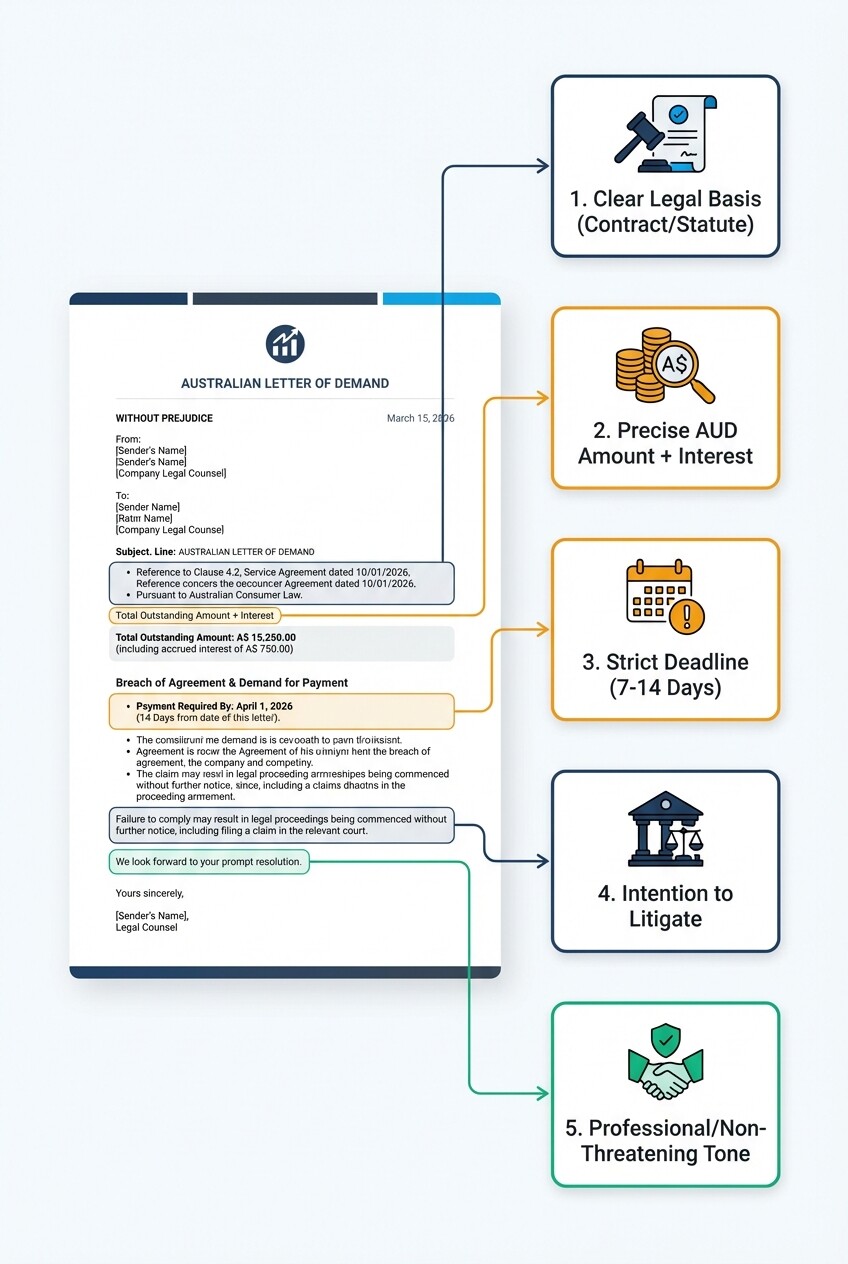
A letter of demand is the standard precursor to litigation in Australia, serving as formal notice that legal action will commence if a dispute is not resolved. Australian courts expect parties to make a genuine attempt to resolve matters before filing, often penalizing those who skip this step with unfavorable cost orders.
To be effective and legally compliant, a letter of demand must meet specific standards without crossing into unlawful coercion.
- Clear Identification of the Claim: State the exact legal basis of the dispute, referencing specific contract clauses or statutory breaches.
- Precise Quantification: Detail the exact amount claimed in Australian Dollars, including any calculations for interest or damages.
- Reasonable Timeframe: Provide a specific deadline for response or payment. Australian standard practice is strictly 7 to 14 days.
- Consequences of Non-Compliance: Clearly state the intention to commence formal legal proceedings if the demand is not met.
- Avoidance of Harassment: The language must be strictly professional. Threatening criminal prosecution or using the letter to extort a settlement breaches Australian professional conduct rules and can result in civil liability.
Sample Dispute Resolution Clauses for Australian Contracts
An enforceable multi-tiered dispute resolution clause requires parties to attempt negotiation and mediation before they can file a lawsuit. Australian courts strongly support and enforce these clauses if they are drafted with precise, mandatory language.
Vague clauses simply stating that parties will "discuss the matter in good faith" are often deemed unenforceable agreements to agree. To secure pre-litigation protection, insert a structured escalation clause like the sample provided below.
Sample Multi-Tiered Dispute Resolution Clause
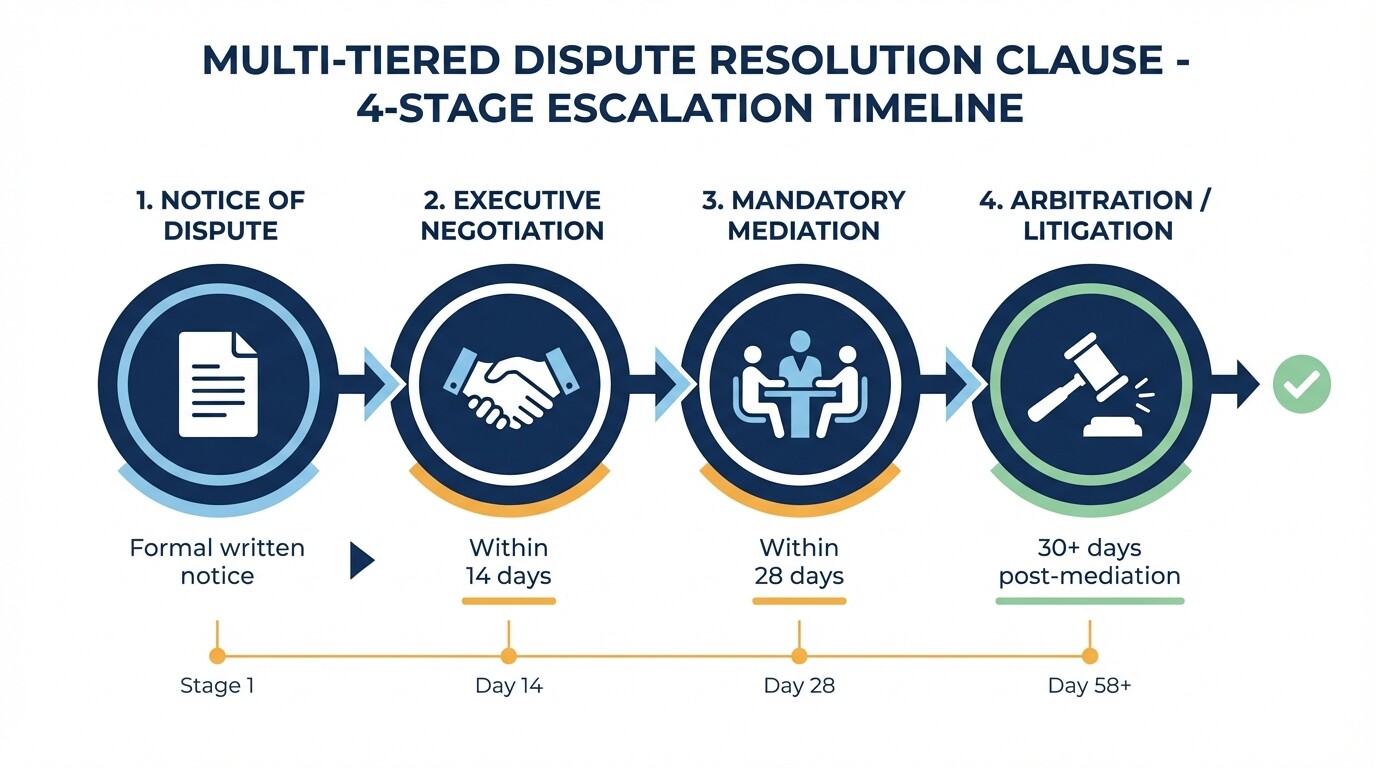
1. Notice of Dispute: A party claiming that a dispute has arisen under this Agreement must give written notice to the other party specifying the nature of the dispute. 2. Executive Negotiation: Within 14 days of the notice being given, senior executives of each party with authority to settle the dispute must meet in person or via video conference to attempt to resolve the dispute in good faith. 3. Mandatory Mediation: If the dispute is not resolved within 28 days of the notice, the parties must submit the dispute to mediation administered by the Australian Disputes Centre in accordance with its Guidelines for Commercial Mediation. 4. Arbitration / Litigation: Only if the dispute remains unresolved 30 days after the commencement of mediation may a party commence arbitration or court proceedings. Nothing in this clause prevents a party from seeking urgent interlocutory injunctive relief.
Common Misconceptions About Resolving Disputes in Australia
Foreign businesses frequently misunderstand the jurisdictional and cost risks of litigating in Australia. Relying on assumptions from US or European legal systems often leads to severe strategic errors.
- Ignoring the Adverse Costs Rule: Unlike the US system where parties pay their own legal fees, Australian courts operate on a "loser pays" principle. Commencing speculative litigation is highly risky, as an unsuccessful foreign plaintiff will be ordered to pay the Australian defendant's legal costs.
- Assuming Courts Favor Local Entities: Australia has a highly independent, globally respected judiciary. Foreign entities are not systematically disadvantaged in Australian courts, though they may be required to provide a financial deposit known as "security for costs" before proceeding.
- Viewing Pre-Action Steps as Optional: Skipping letters of demand and early negotiation is heavily penalized by Australian judges. Courts can refuse to award legal costs to a winning party if that party behaved unreasonably by rushing into litigation without attempting early resolution.
Frequently Asked Questions
What is the standard time to respond to a letter of demand in Australia?
The standard response time is between 7 and 14 days. If the matter is complex, a party can formally request an extension to investigate the claims, which is generally granted to show good faith.
Can a foreign company be ordered to pay security for costs in Australia?
Yes. Australian courts frequently order foreign corporate plaintiffs to pay a sum of money into the court to cover the defendant's potential legal costs. This protects the Australian defendant if the foreign company loses the case and refuses to pay the adverse costs order.
Are mediation settlements legally binding in Australia?
A verbal agreement reached at mediation is generally not binding on its own. The settlement becomes a legally enforceable contract once the parties draft and sign a formal Deed of Settlement and Release.
Do I have to travel to Australia for commercial mediation?
No. Following the global shift toward remote work, most commercial mediations and arbitrations involving foreign entities are now conducted successfully via secure video conferencing platforms.
When to Hire a Lawyer and Next Steps
Engaging Australian legal counsel early in a dispute maximizes your leverage and ensures compliance with local pre-action procedures. Waiting until litigation is unavoidable significantly increases your financial exposure and limits your strategic options.
A local legal expert will review your contract, draft a compliant letter of demand, and outline the most cost-effective path to resolution. To protect your commercial interests and mitigate costs, you should find experienced dispute prevention and pre-litigation lawyers in Australia as soon as a material dispute arises. Gather all relevant contracts, correspondence, and evidence of financial loss before your initial consultation to ensure accurate preliminary advice.