- Governing Law Dictates the Path: Your contract's jurisdiction clause determines whether Australian state courts, federal courts, or international arbitration bodies will hear the dispute.
- Mandatory Pre-Action Steps: Australian courts require parties to attempt dispute resolution, typically starting with a formal letter of demand, before filing litigation.
- Cost Recovery is Partial: Australia operates on a "loser pays" principle, but successful parties generally only recover 50% to 70% of their actual legal costs.
- Security for Costs: Foreign plaintiffs are routinely required by Australian courts to pay funds into a trust to cover the defendant's potential legal fees before proceedings begin.
- Statutory Demands: For undisputed debts, issuing a statutory demand under the Corporations Act 2001 is a highly effective tool for foreign suppliers seeking payment from Australian entities.
Determining Jurisdiction and Applicable Law in Cross-Border Contracts
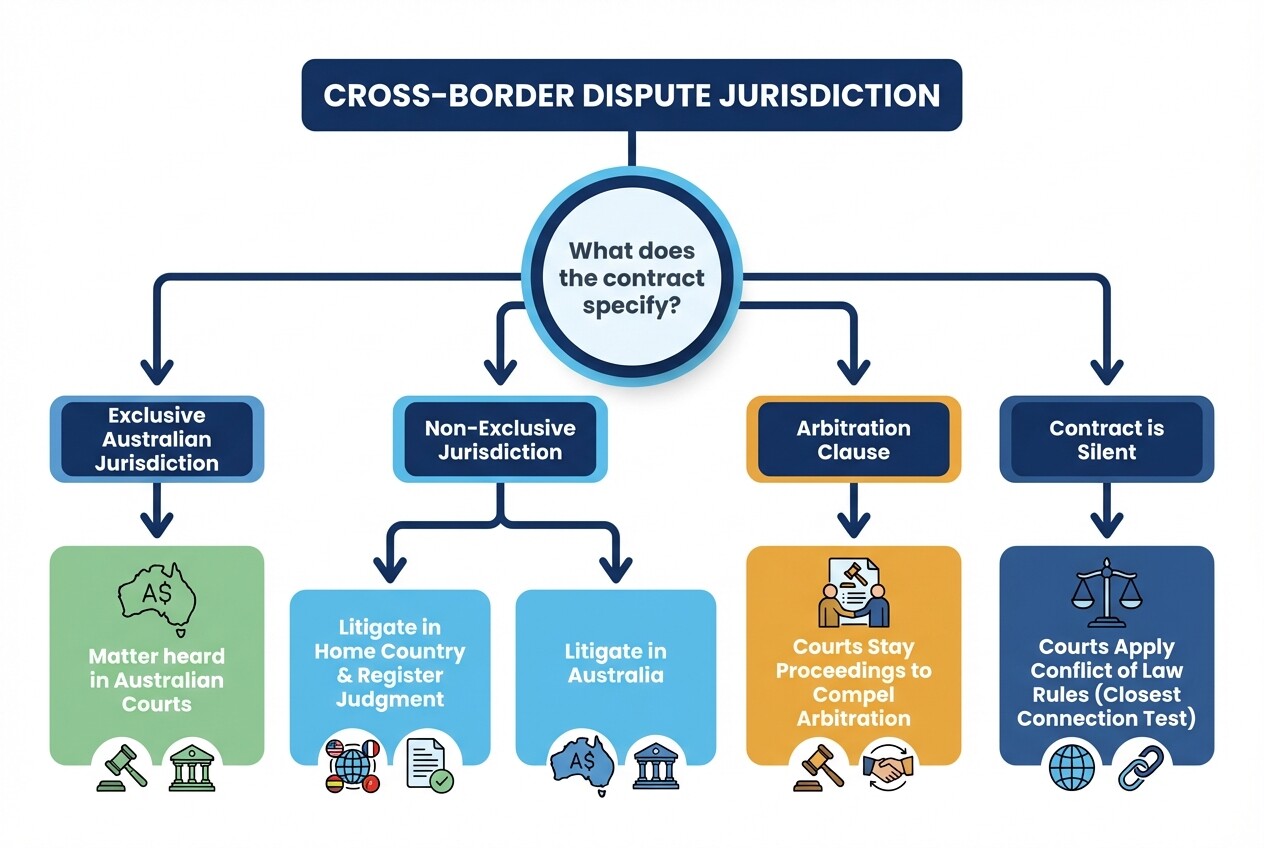
The applicable law and jurisdiction for a cross-border dispute depend primarily on the governing law clause within your commercial agreement. If the contract is silent, Australian courts apply common law conflict of law rules to determine which country's legal system has the closest connection to the transaction.
When a contract explicitly names Australia (or a specific Australian state, like New South Wales or Victoria) in an exclusive jurisdiction clause, Australian courts will generally enforce it and hear the matter. If the clause is non-exclusive, you may have the option to litigate in your home country and later register the judgment in Australia under the Foreign Judgments Act 1991. However, litigating directly in Australia is often more efficient if the Australian business holds all its assets locally. For arbitration clauses, Australian courts strongly support international agreements and will typically stay court proceedings to compel arbitration in accordance with the International Arbitration Act 1974.
Evidence and Documentation Checklist for Breach of Contract Claims
Successfully proving a breach of contract in Australia requires a comprehensive paper trail demonstrating the agreement, the breach, and the resulting financial loss. Foreign suppliers must compile all relevant communications, delivery records, and financial statements before initiating legal action.
To build a robust commercial claim in an Australian court, gather the following documentation:
- Contractual Foundations: Fully executed master service agreements, terms of trade, purchase orders, and any variations or amendments.
- Proof of Performance: Customs clearance documents, bills of lading, freight forwarding receipts, and signed delivery dockets proving the goods or services entered Australia.
- Evidence of Breach: Unpaid invoices, statements of account, and documentation showing defective performance or failure to accept goods.
- Communication Records: All email threads, formal notices, text messages, and meeting minutes where the dispute, delays, or payment issues were discussed.
- Financial Impact: Accounting records demonstrating direct financial loss, currency exchange impacts, and evidence of reasonable steps taken to mitigate your damages.
Pre-Litigation Steps: Issuing a Formal Letter of Demand
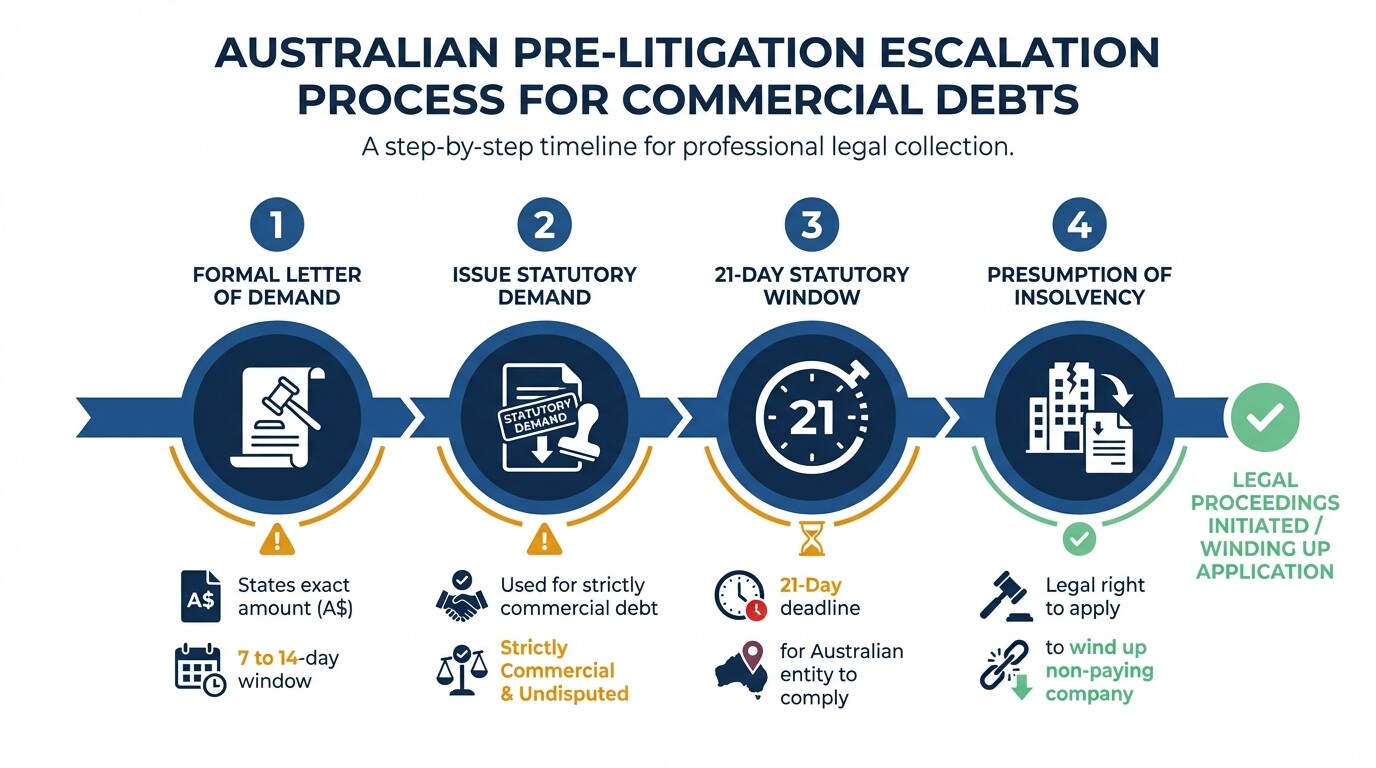
Before filing a lawsuit in an Australian court, you must issue a formal letter of demand outlining the dispute, the legal basis of your claim, and a strict deadline for resolution. This step complies with Australian pre-action protocols and frequently resolves disputes without the need for court intervention.
A standard letter of demand should clearly state the exact amount owed, the specific contractual clauses breached, and provide a 7 to 14-day window for the Australian company to rectify the issue. If the debt is strictly commercial and undisputed, foreign suppliers can escalate this by issuing a formal statutory demand. As detailed by the Australian Securities and Investments Commission (ASIC), failing to comply with a statutory demand within 21 days creates a legal presumption that the Australian company is insolvent, allowing you to apply to wind up the company.
Options for Alternative Dispute Resolution (ADR) and International Arbitration
Australian courts strongly encourage or mandate Alternative Dispute Resolution (ADR) to resolve B2B conflicts before proceeding to a full trial. Foreign suppliers can utilize mediation, conciliation, or international arbitration to secure confidential, timely, and enforceable outcomes.
Mediation is the most common form of ADR in Australia, involving an independent mediator who facilitates a commercial settlement between the parties. If your contract contains an arbitration clause, the dispute will bypass the public court system entirely. International arbitration is highly favored for cross-border supplier disputes because arbitral awards are easily enforceable across international borders under the New York Convention, to which Australia is a signatory. Institutions like the Australian Centre for International Commercial Arbitration (ACICA) frequently manage these complex cross-border proceedings.
Timeline and Expected Legal Costs for Commercial Litigation
Commercial litigation in Australia typically takes between 12 and 24 months to reach a final trial, with total costs frequently exceeding $100,000 AUD depending on the complexity of the dispute. Australia operates on a "loser pays" system, meaning the unsuccessful party is generally ordered to pay a portion of the successful party's legal costs.
Below is an estimated breakdown of timelines and costs for resolving a commercial contract dispute in an Australian Supreme Court or the Federal Court.
| Litigation Phase | Estimated Timeline | Expected Legal Costs (AUD) |
|---|---|---|
| Pre-Litigation & Demand | 1 to 3 months | $2,000 to $10,000 |
| Filing & Pleadings | 2 to 6 months | $15,000 to $40,000 |
| Discovery & Evidence | 4 to 8 months | $30,000 to $80,000+ |
| Trial Preparation & Hearing | 6 to 12 months | $50,000 to $150,000+ |
Common Misconceptions About Litigating in Australia
Foreign suppliers often enter the Australian legal system with incorrect assumptions about cost recovery, timelines, and court processes. Understanding the reality of Australian commercial law prevents costly strategic errors and mismanaged expectations.
- Full cost recovery is guaranteed: Many foreign plaintiffs assume that winning their case means the defendant will pay 100% of their legal fees. In reality, Australian courts typically award costs on a "party and party" basis, which only covers 50% to 70% of your actual out-of-pocket legal expenses.
- Foreign judgments are automatically enforceable: Securing a court victory in your home country does not mean you can immediately seize Australian assets. The judgment must first be formally recognized and registered by an Australian court, which can be contested if the defendant proves they were denied procedural fairness.
- Only written contracts are enforceable: Foreign businesses often mistakenly believe they have no claim if a formal contract was never signed. Australian law frequently enforces verbal agreements, implied terms, and email exchanges if they demonstrate a clear intent to create legal relations.
Frequently Asked Questions
Can a foreign company sue an Australian company without a local presence?
Yes, foreign entities have full standing to initiate legal proceedings in Australian courts without registering a local subsidiary. However, the court will likely require you to provide a security for costs payment to ensure you can cover the defendant's legal fees if your claim is unsuccessful.
How do Australian courts handle disputes over currency exchange rates?
Australian courts have the power to award judgments in foreign currencies if the contract dictates it or if the plaintiff's primary loss was suffered in that currency. If the judgment is converted to Australian Dollars, the court typically uses the exchange rate applicable on the date the debt became payable or the date of the judgment.
What is security for costs and will I need to pay it?
Security for costs is a financial deposit paid into the court or a trust account by the plaintiff before litigation proceeds. Because foreign suppliers do not have assets in Australia, defendants routinely and successfully apply for these orders to ensure they can recover their legal costs if they win the case.
When to Hire an Australian Commercial Litigation Lawyer
You should engage an Australian commercial litigation lawyer as soon as a contract dispute escalates beyond routine commercial negotiations. Early legal intervention ensures your claims comply with Australian jurisdictional requirements, prevents the expiration of statutory time limits, and preserves critical evidence.
Partnering with local counsel is especially critical when dealing with uncooperative Australian debtors, as domestic lawyers understand the nuances of state versus federal court systems and local pre-action protocols. You can explore qualified Australian commercial litigation lawyers to evaluate your contract, draft enforceable letters of demand, and represent your interests in ADR or formal court proceedings.
Next Steps for Foreign Suppliers
Taking swift and methodical action is essential to protecting your commercial interests and recovering outstanding business debts in Australia. Foreign businesses should immediately secure their documentation, restrict further supply to the defaulting party, and seek local legal counsel.
Begin by centralizing all contract documentation, communications, and invoices related to the dispute into a single file. Review the governing law and dispute resolution clauses in your contract to confirm your jurisdictional standing. Once your evidence is compiled, consult with an Australian litigation expert to issue a formal letter of demand or a statutory demand, setting a strict legal deadline for the Australian entity to resolve the matter.