

Pre-Litigation Strategies for Foreign Investors Facing B2B Disputes in Kenya
- Act early with formal demands: A well-drafted demand letter is a mandatory pre-action protocol in Kenya and often resolves disputes without court intervention.
- Prioritize Alternative Dispute Resolution (ADR): Mediation and arbitration save foreign investors years of litigation delays and significant legal costs.
- Secure assets immediately: Use preemptive injunctions to freeze assets and prevent local partners from dissipating funds while you negotiate.
- Verify jurisdiction clauses: Kenyan courts respect foreign jurisdiction clauses, but enforcing them requires careful alignment with local public policy and mandatory laws.
- Engage local counsel preemptively: Hiring legal representation before a dispute escalates ensures compliance with Kenyan procedures and strengthens your negotiating position.
Sending Formal Demand Letters and Securing Early Legal Representation
A formal demand letter is the required first step in Kenyan commercial disputes to officially notify the opposing party of a breach and establish a firm timeline for resolution. Securing local legal representation before sending this communication ensures compliance with Kenyan pre-action protocols and demonstrates your seriousness to the opposing party.
In Kenya, courts expect parties to attempt an amicable settlement before filing a lawsuit. A demand letter serves as evidence of this attempt. It must clearly outline the specific contractual breaches, detail the financial or operational impact on your business, and state the exact remedies sought. Typically, demand letters in Kenya provide the defaulting party with a 7 to 14-day window to respond or rectify the breach.
Engaging dispute prevention and pre-litigation lawyers in Kenya at this stage is critical. Local counsel will ensure the demand letter is served properly under Kenyan law, preventing the opposing party from claiming they never received formal notice. Furthermore, early legal representation allows you to map out a comprehensive strategy, identifying the strongest leverage points in your contract before entering negotiations.
Preserving Evidence and Protecting Commercial Assets During Disputes
Foreign investors must immediately secure physical and digital records and consider seeking early court injunctions to prevent the opposing party from hiding or dissipating assets. This proactive approach ensures you maintain financial and evidentiary leverage if negotiations fail.
When a B2B relationship sours, the risk of data destruction or asset flight increases. Implementing a strict asset and evidence protection strategy is non-negotiable for foreign entities operating remotely.
Evidence and Asset Preservation Checklist:
- Issue a litigation hold: Instruct all internal teams to suspend routine data deletion policies and preserve all emails, financial records, and WhatsApp communications related to the Kenyan partner.
- Secure a Mareva Injunction: Apply to the High Court of Kenya for a freezing order (Mareva Injunction) if there is a real risk that the local partner will move funds out of their Kenyan bank accounts to frustrate a potential judgment.
- Revoke system access: Immediately suspend the opposing party's access to shared corporate networks, proprietary software, or joint financial platforms.
- Conduct a site audit: If applicable, send an independent local agent to document physical inventory, machinery, or project progress through photographs and sworn affidavits.
- Lock down intellectual property: Ensure all trademarks and patents registered in Kenya are secure and that the opposing party cannot exploit them during the dispute.
Mediation Process Timelines Prior to Formal Commercial Litigation
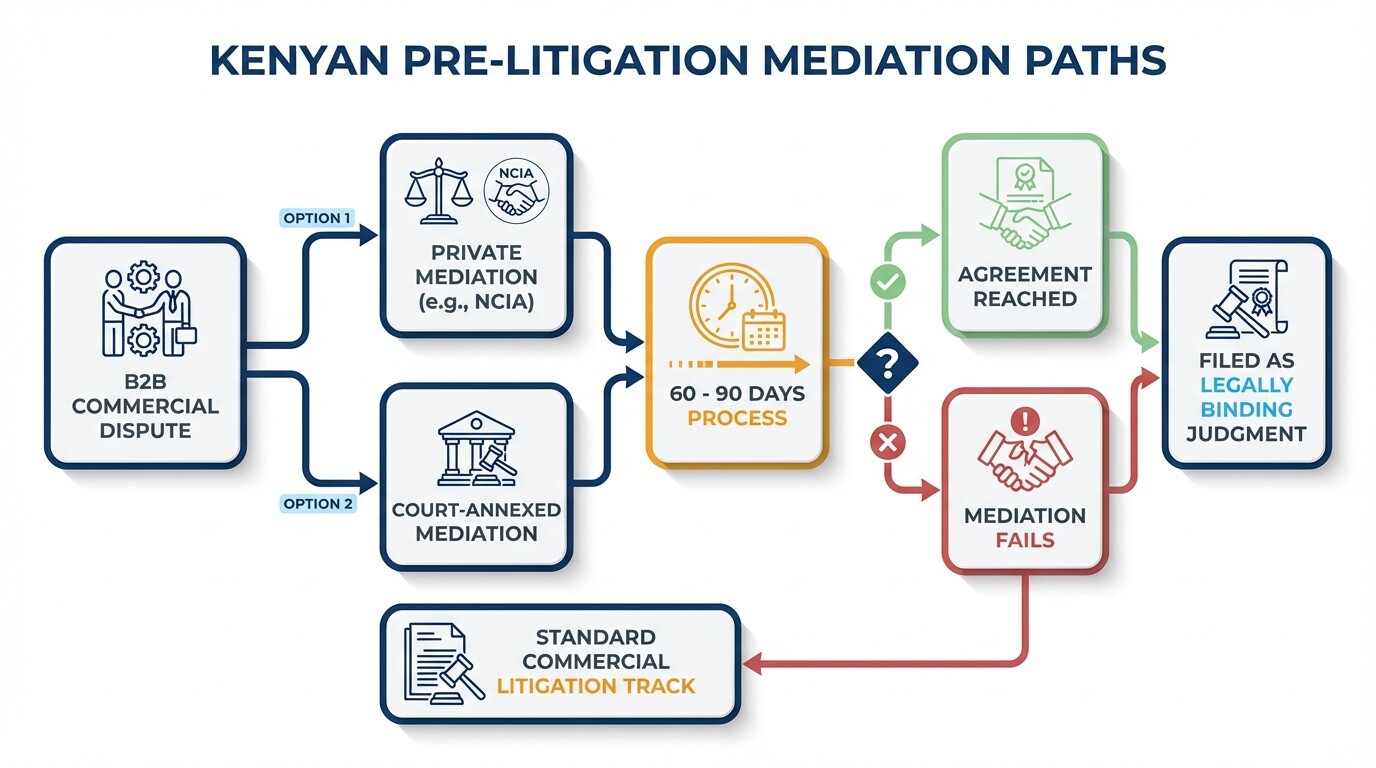
Pre-litigation mediation in Kenya typically resolves disputes within 60 to 90 days, offering a significantly faster route than the commercial court system. Engaging in private mediation or Court-Annexed Mediation is highly encouraged to avoid the severe case backlogs prevalent in local courts.
Mediation allows foreign investors to maintain confidentiality, protect commercial relationships, and control the outcome. Private mediation, often facilitated by institutions like the Nairobi Centre for International Arbitration (NCIA), can be initiated within weeks of a dispute arising. The parties agree on a neutral mediator and set their own schedule, which usually concludes within two to three months.
If a case does advance to court, the Civil Procedure Act mandates that certain commercial disputes be screened for Court-Annexed Mediation. Under this framework, parties are given 60 days to resolve the matter through a court-appointed mediator. If an agreement is reached, it is filed as a legally binding judgment of the court. If mediation fails, the case returns to the standard litigation track.
Evaluating the Enforceability of Foreign Jurisdiction Clauses in Kenyan Courts
Kenyan courts generally uphold foreign jurisdiction and arbitration clauses in B2B contracts, provided the agreement is clear and does not violate Kenya's public policy. However, local courts may assume jurisdiction if challenging the foreign clause is deemed necessary to protect mandatory local laws or if enforcing it causes severe injustice.
Foreign investors routinely include clauses directing disputes to courts in London, New York, or international arbitration centers. The Kenyan judicial system respects the principle of party autonomy. If a Kenyan partner attempts to bypass a foreign jurisdiction clause by filing a lawsuit locally, your legal counsel can apply to stay the local proceedings and compel the partner to honor the agreed-upon forum.
To ensure enforceability, the clause must be drafted as an "exclusive" jurisdiction clause rather than "non-exclusive." Kenyan courts will scrutinize the contract to ensure the choice of forum was mutual and not forced through unconscionable means. It is also important to note that certain disputes, such as those involving Kenyan real estate, local employment rights, or tax obligations, fall under the exclusive jurisdiction of Kenyan courts regardless of what the contract dictates.
Cost Estimates: Alternative Dispute Resolution vs. Full Court Trials
Resolving a B2B dispute through Alternative Dispute Resolution in Kenya costs significantly less than a full Commercial Court trial. While mediation costs are predictable and lower, litigation fees escalate quickly due to court delays, instruction fees based on the claim's value, and expert witness expenses.
Understanding the financial exposure of different dispute resolution mechanisms helps foreign investors choose the most cost-effective strategy. Costs in Kenya are generally assessed under the Advocates (Remuneration) Order, which sets minimum fees based on the monetary value of the dispute.
| Dispute Resolution Method | Estimated Timeline | Estimated Costs (KES) | Cost Predictability | | : | : | : | : | | Demand Letter & Negotiation | 2 to 4 weeks | KES 50,000 to 150,000 | High | | Private Mediation | 1 to 3 months | KES 200,000 to 500,000 | High | | Local Arbitration | 6 to 12 months | KES 1,000,000 to 3,000,000+ | Medium | | Commercial Court Trial | 2 to 5 years | KES 2,000,000 to 5,000,000+ | Low |
Note: Costs vary widely based on the complexity of the matter, the seniority of the legal counsel, and the specific value of the commercial claim. Excludes international arbitration costs.
Common Misconceptions About B2B Disputes in Kenya
Foreign investors often misunderstand the speed of local courts and the enforceability of international contracts in Kenya. Correcting these assumptions early prevents costly strategic errors and misaligned expectations.
- Aggressive litigation is the best way to show strength: Many foreign executives believe filing a lawsuit immediately will force a quick settlement. In reality, the Kenyan court system faces significant backlogs. Filing a suit without attempting ADR often locks the company into a multi-year process, whereas mediation yields faster, more controllable results.
- Foreign court judgments are automatically enforceable: Winning a case in your home country does not guarantee immediate payment in Kenya. Foreign judgments must go through a specific registration and recognition process under the Foreign Judgments (Reciprocal Enforcement) Act, which can be contested by the local partner.
- Written contracts cover everything: Investors sometimes assume a tight contract makes pre-litigation strategy unnecessary. However, local commercial practices, implied terms under Kenyan law, and statutory obligations can override certain contractual provisions, requiring nuanced local legal interpretation.
Frequently Asked Questions
What is the statute of limitations for commercial disputes in Kenya?
Under the Limitation of Actions Act, parties generally have six years from the date of the breach of contract to file a commercial lawsuit in Kenya. Waiting too long can permanently bar your right to recover damages.
Can I recover my legal fees if I win a commercial dispute in Kenya?
Yes, the general rule in Kenya is that "costs follow the event," meaning the losing party pays the winning party's legal costs. However, courts rarely award 100% of actual fees paid; costs are strictly assessed by a taxing master and often cover only a portion of your total legal spend.
Do I have to travel to Kenya for pre-litigation mediation?
No. Virtual mediation has become widely accepted and institutionalized in Kenya, especially since 2020. Foreign investors can fully participate in negotiation and mediation sessions via video conferencing platforms.
When to Hire a Lawyer and Next Steps
You should hire local legal counsel the moment a commercial partner in Kenya misses a critical contract milestone, stops communicating, or threatens a breach. Early intervention preserves your rights, prevents asset dissipation, and sets a strong foundation for a favorable settlement without entering the courtroom.
To initiate an effective pre-litigation strategy, take these immediate steps:
- Gather and securely store all signed contracts, amendments, invoices, and email correspondence related to the dispute.
- Quantify your exact financial exposure and outline the ideal business outcome you wish to achieve.
- Consult with a Kenyan commercial lawyer to draft a formal demand letter and assess the viability of immediate alternative dispute resolution.