- Jurisdiction is residency-based: You can file for divorce in Cyprus if you or your spouse have resided in the country for at least three continuous months, regardless of where you were married.
- Property and divorce are separate: Under Cypriot law, dissolving the marriage, dividing assets, and determining child custody require separate legal applications to the Family Court.
- Mediation saves time and money: Using a certified family mediator can resolve asset and custody disputes out of court, significantly reducing the standard two-to-three-year timeline of contested litigation.
- Relocation requires consent: Moving a child out of Cyprus without the other parent's written consent or a court order is considered international child abduction under the Hague Convention.
Expat Divorce Navigation Checklist
Preparing for a cross-border divorce requires gathering specific documentation and making strategic decisions before filing any formal petitions. Taking these steps early will protect your rights and streamline either mediation or court proceedings.
Complete this checklist before initiating formal legal action:
- Establish your residency timeline: Document your exact dates of residency in Cyprus using utility bills, rental agreements, or immigration documents (Yellow Slip/MEU1).
- Locate your original marriage certificate: Obtain the original certificate or a certified copy. If it was issued outside of Cyprus, ensure it has an Apostille stamp and an official Greek translation.
- Inventory global assets: List all bank accounts, investments, and real estate, clearly distinguishing between assets acquired before the marriage and those acquired during it.
- Secure children's travel documents: Keep your children's passports in a safe, neutral location to prevent unilateral international travel during the dispute.
- Consult a certified family mediator: Schedule an initial consultation with a neutral third party to assess if your disputes can be settled outside of the Family Court.
Establishing Legal Jurisdiction in Cyprus
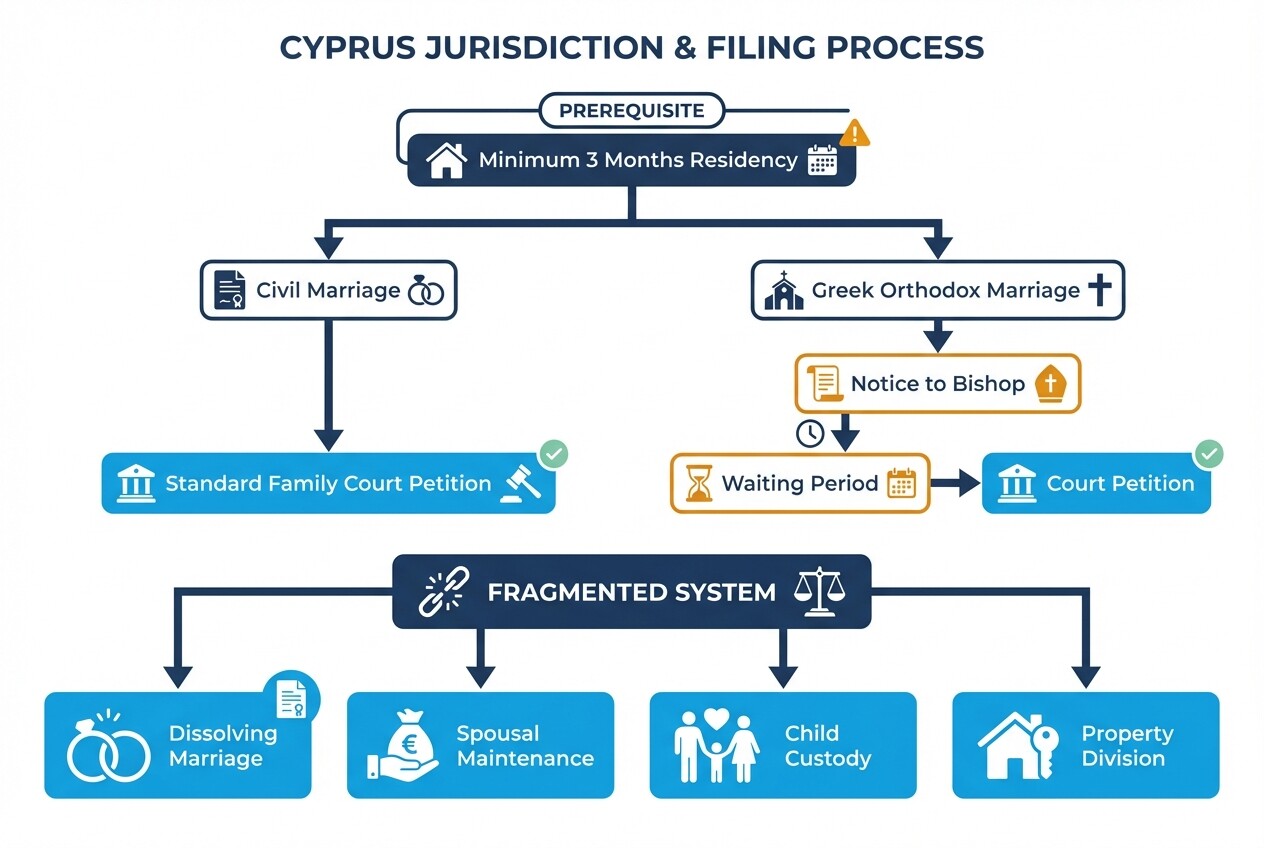
You can file for divorce in the Cypriot Family Courts if either you or your spouse has been a resident of the Republic of Cyprus for a continuous period of at least three months before filing. The nationality of the spouses or the country where the marriage took place does not restrict the court's jurisdiction, provided the residency requirement is met.
For expats, establishing jurisdiction involves proving your "habitual residence." The court will look at where you work, where your children go to school, and where your primary home is located. If you were married in a civil ceremony, the standard Family Court handles your case. However, if you were married in a Greek Orthodox church, Cypriot law requires you to first send a formal notice to the Bishop seeking spiritual dissolution, followed by a mandatory waiting period before you can file a court petition.
It is also important to note that Cyprus treats family law disputes as fragmented cases. Filing for divorce only dissolves the marriage. You must file entirely separate applications to the court to address spousal maintenance, child custody, and property division.
Common Misconceptions About Expat Divorce in Cyprus
Many foreign nationals approach a Cypriot divorce expecting the laws of their home country to apply, leading to costly strategic errors. Understanding how local family law treats international assets is critical to protecting your financial future.
Here are the most common mistakes expats make during pre-litigation:
- Assuming a 50/50 split of global assets: Cyprus does not have a strict 50/50 community property rule. Instead, it operates on a "separation of property" regime. If a spouse contributes to the increase of the other's assets during the marriage, the law presumes a one-third (1/3) contribution, though this can be contested.
- Misunderstanding international real estate division: Cypriot Family Courts generally do not have the authority to issue binding property transfer orders for real estate located outside of Cyprus. Disputes over a family home in the UK or elsewhere usually must be resolved in the jurisdiction where the property sits, or through a voluntary mediated settlement.
- Believing the mother automatically gets full custody: Cypriot courts do not default to awarding sole custody to the mother. The legal standard is strictly the "best interests of the child," and joint legal custody with one parent providing the primary residence is the most common outcome.
Resolving Disputes Through Marital Mediation
Family mediation in Cyprus offers a private, legally recognized alternative to court, allowing couples to negotiate asset division and parenting plans amicably. By working with a neutral mediator, spouses can retain control over the outcome rather than leaving deeply personal decisions to a judge.
The Ministry of Justice and Public Order maintains a register of certified family mediators who are trained to handle cross-border sensitivities. During mediation, discussions are strictly confidential and cannot be used against either party if negotiations fail and the case goes to court.
Once both parties reach an agreement on finances and children, lawyers draft a formal settlement deed. This deed is then submitted to the Family Court to be issued as a binding consent order. This pre-litigation strategy bypasses the severe backlogs in the Cypriot court system, turning a potentially hostile, multi-year battle into an administrative process.
Navigating Child Custody and Cross-Border Relocation
Cypriot family courts prioritize the child's physical and emotional well-being above all other factors when determining custody and visitation rights. Relocating a child outside of Cyprus requires either the explicit, notarized consent of the other parent or a formal order from a Cypriot Family Court.
Because Cyprus is a heavily expat-populated island, relocation disputes are common. If one parent wishes to return to their home country with the children, the court will evaluate the motives for the move, the impact on the child's relationship with the left-behind parent, and the practical arrangements in the destination country.
Cyprus is a strict signatory to the Hague Convention on the Civil Aspects of International Child Abduction. Taking a child across the border without consent-even for a "vacation" to a home country-is treated as a serious civil and criminal offense. The left-behind parent can immediately petition the authorities to have the child returned to their habitual residence in Cyprus.
Timelines and Costs: Contested vs. Uncontested Divorce
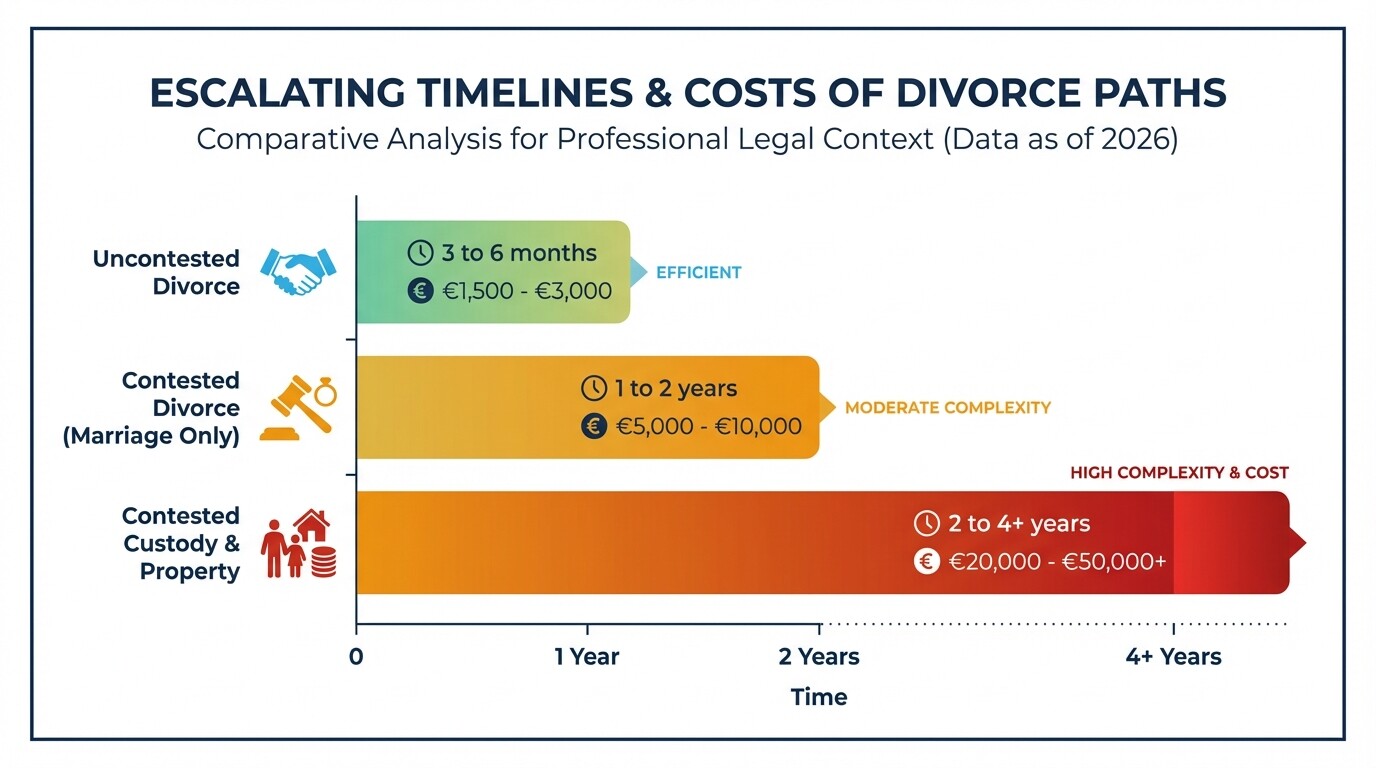
An uncontested divorce in Cyprus typically takes three to six months to finalize and costs between €1,500 and €3,000, whereas contested cases can stretch over several years. Costs scale dramatically when couples choose to litigate property and custody disputes rather than settling through mediation.
Because divorce, custody, and property are separate applications in Cyprus, the total cost depends entirely on how many of those issues require a judge's intervention.
| Type of Proceeding | Estimated Timeline | Estimated Court & Legal Fees | Characteristics |
|---|---|---|---|
| Uncontested Divorce | 3 to 6 months | €1,500 - €3,000 | Both parties consent; issues resolved via mediation; minimal court appearances. |
| Contested Divorce (Marriage only) | 12 to 18 months | €3,000 - €5,000 | Disagreement on the grounds for divorce; requires formal hearings and evidence. |
| Contested Custody & Property | 2 to 4+ years | €5,000 - €15,000+ | Highly adversarial; separate applications filed; requires expert valuations and witness testimonies. |
Frequently Asked Questions
Can I get a divorce in Cyprus if I was married in another country?
Yes. As long as you or your spouse meet the three-month residency requirement in Cyprus, the local Family Court has jurisdiction to dissolve a marriage that took place abroad.
Does my spouse have a claim to the property I owned before we married?
No. Under Cypriot law, assets acquired before the marriage are generally protected and remain the sole property of the original owner. The court only considers the wealth generated or acquired during the marriage for division.
Do I have to appear in court for an uncontested divorce?
In most uncontested cases where spouses have agreed on all terms, your lawyer can represent you in the Family Court proceedings. You typically do not need to attend the hearings in person, which is highly beneficial for expats who have already relocated.
When to Hire a Lawyer and Next Steps
You should engage a legal professional the moment you or your spouse consider separation, especially if international assets or children are involved. Early intervention prevents accidental missteps, such as moving funds or leaving the country with children, which can severely damage your legal standing.
As a first step, gather your financial records, marriage certificate, and residency proofs. If you believe your spouse is open to negotiation, seek out dispute prevention and pre-litigation lawyers in Cyprus who specialize in mediation and collaborative family law. Securing an amicable settlement deed out of court will always be your fastest, most cost-effective path to a secure independent future.