- EU Regulation 650/2012 allows expats to choose the inheritance law of their home country over Cyprus law, but this must be explicitly stated in a will.
- Cyprus "forced heirship" rules automatically reserve a significant portion of your estate for your spouse and children, regardless of your written wishes, unless you opt out.
- You should maintain a separate Cyprus will for "immovable property" (real estate) to simplify the probate process and avoid costly delays in the local Land Registry.
- Cyprus does not currently levy inheritance tax, but your estate may still be subject to taxes in your home country or under specific double-tax treaties.
Estate Planning Checklist for Cyprus Expats
Proper estate planning in Cyprus requires a dual-track approach that considers both local property laws and international regulations. Use this checklist to ensure your assets are protected and your heirs are spared from lengthy litigation.
- Identify All Assets: List all immovable property (apartments, villas, land) and movable property (bank accounts, vehicles, jewelry) located in Cyprus.
- Review Current Wills: Check if your existing home-country will covers "worldwide assets" and if it explicitly mentions Cyprus property.
- Draft a Cyprus-Specific Will: Create a local will to deal specifically with your Cyprus-based assets to speed up the probate process.
- Execute the Choice of Law: Include a specific clause invoking EU Regulation 650/2012 to apply your national law to your estate.
- Appoint Local Executors: Select a person or legal professional in Cyprus who can handle the local courts and the District Lands Office.
- Register the Will: Ensure your lawyer registers the will with the District Court Probate Registry to ensure it is found after your passing.
- Review Title Deeds: Confirm that the title deeds for your property are in your name or that you have a validly lodged Sales Contract at the Land Registry.
Sample Choice of Law Clause
Including a Choice of Law clause is the most effective way to bypass Cyprus forced heirship rules. Below is a standard example of the language used to invoke your national law under EU Regulation 650/2012.
"I hereby declare that, in accordance with Article 22 of EU Regulation No. 650/2012, the law governing the succession of my entire estate, including all movable and immovable property situated in Cyprus, shall be the law of [Your Country of Nationality], of which I am a citizen at the time of making this choice."
What Is Forced Heirship and How Does EU Regulation 650/2012 Affect Your Will?
Forced heirship is a legal principle in Cyprus that restricts your freedom to distribute your estate as you wish. Under the Wills and Succession Law (Cap. 195), a person with a spouse or children cannot leave their entire estate to someone else; a "statutory portion" is automatically reserved for these family members.
However, EU Regulation 650/2012 (often called "Brussels IV") changed the landscape for expats. This regulation dictates that the law of the country where you are "habitually resident" at the time of death applies to your estate. If you live in Cyprus, Cyprus law (and forced heirship) applies by default. The regulation provides a crucial exception: you can formally choose the law of your nationality to govern your estate instead. This allows expats from countries like the US, UK, or Canada to distribute their assets exactly as they please, bypassing the Cyprus statutory portions.
Why Should You Have a Separate Cyprus Will for Immovable Property?
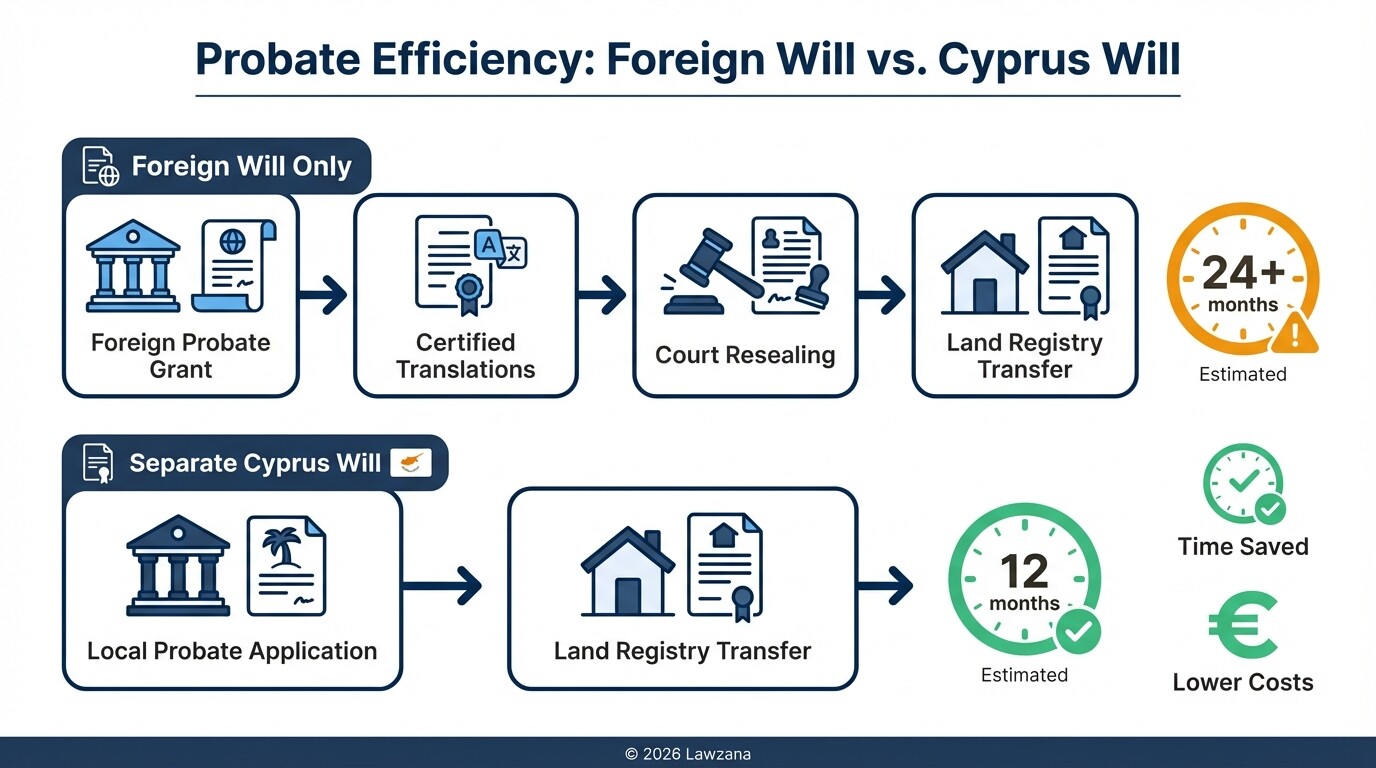
While a single "worldwide will" is legally valid in Cyprus, having a separate local will for your real estate is highly recommended for practical efficiency. A Cyprus-specific will allows your executors to begin the probate process immediately without waiting for a foreign court to grant probate first.
The Cyprus Department of Lands and Surveys requires specific documentation to transfer property titles from a deceased person to their heirs. If you only have a foreign will, it must be "resealed" in a Cyprus court, which involves expensive translations, certifications, and significant time lags. A local will, written in Greek or translated and registered locally, ensures that your villa or apartment can be transferred or sold with minimal administrative friction.
Why Is Specifying the Law of Nationality the Most Critical Step?
The most common mistake expats make is assuming that a simple will written in Cyprus automatically grants them "testamentary freedom." Without a specific "Choice of Law" clause, the Cyprus courts are legally obligated to apply the Wills and Succession Law (Cap. 195) to your estate.
If you omit this clause, your estate will be divided into the "disposable portion" and the "statutory portion." Depending on who survives you, you might only be able to freely bequeath 25% to 50% of your assets. The rest would be divided among your spouse and children according to fixed legal percentages. By explicitly selecting the law of your nationality, you override these local restrictions, ensuring your partner is fully provided for or that specific assets go to the intended beneficiaries.
How Much Does It Cost to Draft a Cross-Border Will in Cyprus?
The cost of professional estate planning in Cyprus varies based on the complexity of your assets and whether you require a single or joint (mirror) will. For most expats, legal fees for a professionally drafted will including the "Choice of Law" provisions range from €800 to €2,000.
| Service Type | Estimated Cost (EUR) |
|---|---|
| Simple Single Will | €500 - €800 |
| Complex Cross-Border Will (EU 650/2012) | €800 - €1,500 |
| Mirror Wills (for couples) | €1,200 - €2,000 |
| Probate Registry Filing Fees | €50 - €100 |
These fees generally include the initial consultation, drafting the document, and the formal registration at the District Court. Complex estates involving trusts or multiple jurisdictions may command higher fees.
What Are the Tax Implications for Deceased Estates in Cyprus?
Cyprus is one of the most tax-friendly jurisdictions in Europe for inheritance, having abolished all estate and succession taxes for deaths occurring after January 1, 2000. This means that heirs do not pay a percentage of the estate's value to the Cyprus government.
However, international tax implications remain, particularly regarding the Greece-Cyprus Double Tax Treaty. If a deceased person was a resident of Cyprus but held assets in Greece (or vice versa), the treaty determines which country has the right to tax those specific assets. Generally, "immovable property" is taxed in the country where it is located. Therefore, while Cyprus may not tax the estate, your home country might still apply inheritance tax based on your domicile or the location of other assets. Always consult the Cyprus Tax Department or a qualified tax advisor regarding your specific residency status.
Common Misconceptions About Cyprus Inheritance
"My UK/US Will is enough to cover my Cyprus house."
While legally valid, a foreign will is often a nightmare to execute in Cyprus. The "resealing" process is slow and requires your executors to hire local lawyers anyway. A separate Cyprus will is the fastest way to handle local real estate.
"I don't need a will because my spouse gets everything anyway."
This is false under Cyprus law. If you die intestate (without a will), the law divides your estate between your spouse and your children. If you have no children, even distant relatives like siblings or parents may have a claim to a portion of your estate.
"Cyprus inheritance tax is 40%."
This is a common myth based on old laws or confusion with other countries. Cyprus has 0% inheritance tax. However, there are still "transfer fees" at the Department of Lands and Surveys if you are transferring property, though these are often reduced or waived for transfers between family members.
FAQ
Does Cyprus recognize "Mirror Wills"?
Yes, Cyprus recognizes mirror wills, which are two separate but identical wills often used by couples to leave assets to each other. Joint wills (a single document signed by two people) are generally not recommended and can be legally problematic in Cyprus.
What happens if I die in Cyprus without a will?
If you die without a will (intestate), the Cyprus Wills and Succession Law (Cap. 195) will dictate how your assets are distributed. This usually results in your estate being split between your spouse and children in equal shares, which may not align with your personal wishes.
Can I leave my Cyprus property to a charity?
Yes, you can leave your property to a charity, but if you have a spouse or children, you can only leave the "disposable portion" of your estate to the charity unless you have used the EU 650/2012 "Choice of Law" clause to apply your national law.
How long does the probate process take in Cyprus?
Probate in Cyprus typically takes between 12 and 24 months, depending on the complexity of the estate and the efficiency of the District Court. Having a local, registered will can significantly shorten this timeframe.
When to Hire a Lawyer
Estate planning for expats is rarely straightforward because it involves the intersection of two different legal systems. You should consult a Cyprus lawyer if:
- You own real estate in Cyprus and want to ensure it transfers smoothly to your heirs.
- You have children from a previous marriage and want to protect their interests.
- You wish to leave your assets to someone other than your "statutory heirs" (spouse and children).
- You are unsure how your home country's tax laws will interact with your Cyprus assets.
Next Steps
- Locate your Title Deeds: Ensure you have physical or digital copies of all property ownership documents.
- Consult a Specialist: Find a Cyprus lawyer who understands both local succession law and EU Regulation 650/2012.
- Draft and Register: Draft your Cyprus will, include the "Choice of Law" clause, and ensure it is formally registered with the District Court.
- Inform Your Executors: Make sure your chosen executors know where the original will is kept and have the contact details for your lawyer in Cyprus.