


- Strict deadlines: Most Canadian provinces enforce a strict two-year limitation period from the date of injury to file a formal lawsuit.
- Settlements dominate: The vast majority of Canadian personal injury claims settle out of court. This allows you to avoid the extensive discovery obligations of a trial.
- Cost structures: Canadian lawyers usually work on contingency. If a formal lawsuit goes to trial and you lose, however, you may have to pay the defendant's legal costs.
- Cross-border claims: Courts calculate compensation for future medical care based on healthcare costs in your home country. Your domestic health insurer will likely assert a lien against your Canadian settlement.
Lawsuit vs Settlement: Comparison Checklist
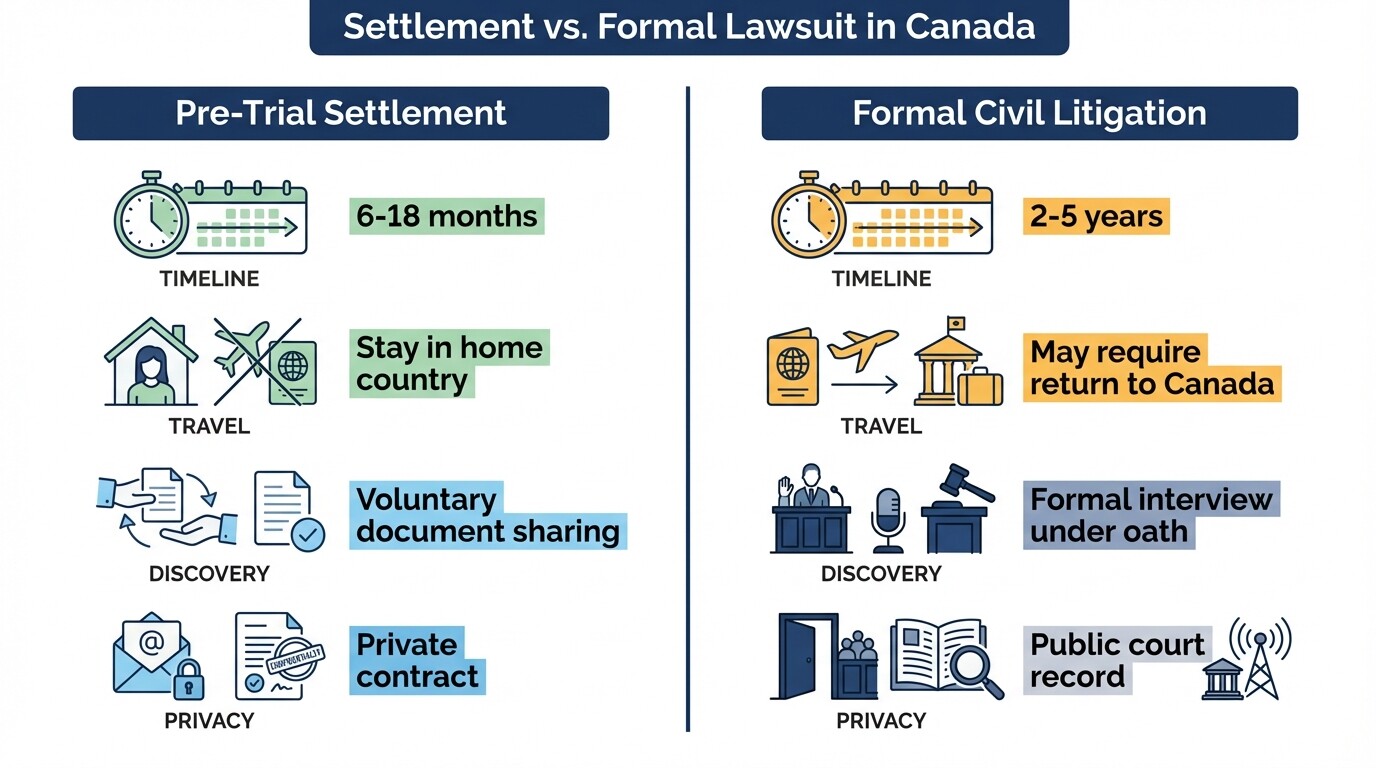
Choosing between a formal lawsuit and an out-of-court settlement dictates how long your claim takes and what evidence you must produce. Settlements rely on direct insurance negotiations with a lower evidentiary burden. Civil litigation requires formal discovery and strict proof of liability.
As a foreign national, your goal is generally to resolve the claim efficiently so you can focus on recovery at home. Review the differing demands of both paths.
Pre-Trial Settlement
- Burden of proof: You present police reports and medical records to convince the insurance adjuster their policyholder is at fault.
- Discovery obligations: You provide medical files, proof of lost wages, and out-of-pocket expenses voluntarily. You do not undergo formal questioning under oath.
- Timeline: Cases frequently resolve within 6 to 18 months, depending on your medical recovery.
- Travel requirements: Your Canadian lawyer handles negotiations remotely. You can remain in your home country.
- Privacy: Settlements are private contracts and stay off the public record.
Formal Civil Litigation
- Burden of proof: You must prove negligence on a balance of probabilities before a judge or jury.
- Discovery obligations: You must disclose your personal history and submit to an Examination for Discovery (an interview under oath). Defense doctors may compel you to undergo independent medical exams.
- Timeline: Court litigation in Canada often takes 2 to 5 years from filing to trial.
- Travel requirements: You may need to return to Canada for discoveries, mediations, or the trial. Courts do allow remote video appearances for certain procedures.
- Privacy: Court proceedings and trial outcomes are a matter of public record.
Legal Costs and Contingency Fees
Canadian personal injury lawyers normally work on a contingency fee basis. You pay no upfront legal fees. However, Canada uses a "loser pays" system. If your case goes to trial and you lose, a judge may order you to pay a portion of the defendant's legal costs.
Travel insurance generally covers emergency medical transportation and immediate hospital bills, but it never covers civil litigation costs. You must rely on a standard retainer agreement to fund your claim.
- Contingency fees: The lawyer takes a percentage of the final settlement or court award. This usually ranges from 25% to 33% depending on the province.
- Expert witness fees: Lawyers hire medical and financial experts to prove complex damages. These reports cost between CAD 2,000 and CAD 10,000 each. Lawyers typically front these costs and recover them from your settlement.
- Adverse costs: The risk of paying the opposing side's legal fees heavily incentivizes out-of-court settlements in Canada.
Alternative Dispute Resolution
Many Canadian personal injury claims avoid the courtroom through mandatory mediation and arbitration. These methods offer a faster path to securing compensation.
- Pre-trial mediation: Several jurisdictions require parties to attend mediation before proceeding to trial. A neutral third party helps both sides evaluate the risks of a trial and find a compromise. Under the Ontario Rules of Civil Procedure (Rule 24.1), this is a mandatory step for civil actions in many specific regions.
- Binding arbitration: Parties involved in complex insurance disputes may opt for arbitration instead of a public trial. An arbitrator reviews the evidence and renders a legally binding decision.
Filing Deadlines by Province
Canadian provinces enforce strict limitation periods. Missing this deadline extinguishes your right to seek compensation entirely.
The clock starts ticking on the exact date your injury occurred. You must file your claim in the province where the injury happened and adhere to its specific rules.
- Ontario: 2 Years (Limitations Act, 2002)
- British Columbia: 2 Years (Limitation Act)
- Alberta: 2 Years (Limitations Act)
- Quebec: 3 Years (Civil Code of Quebec. Note: Car accidents fall under a unique no-fault public scheme).
- Nova Scotia: 2 Years (Limitation of Actions Act)
Note: Exceptions exist for minors or individuals lacking mental capacity, which may pause the legal countdown.
Cross-Border Medical Liens
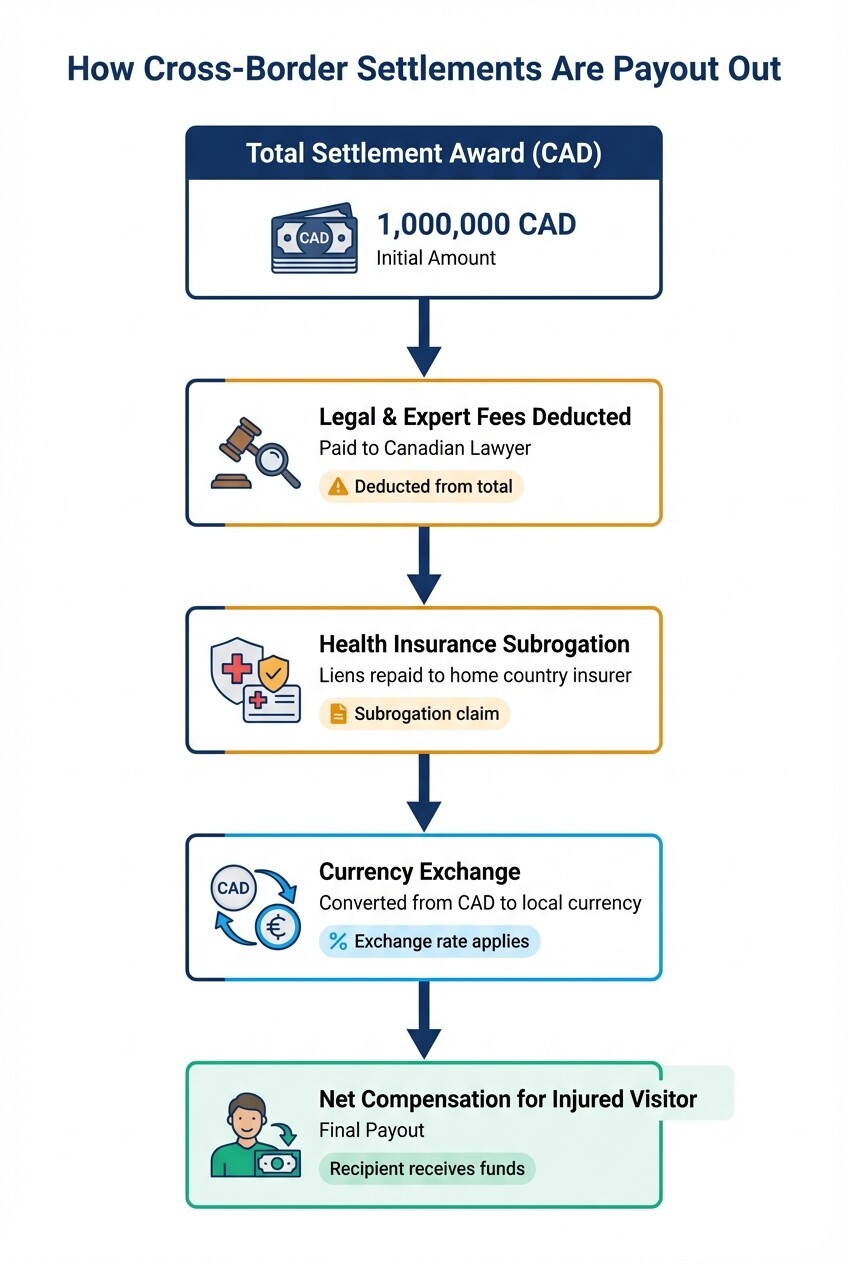
Being a foreign resident changes how courts calculate your damages and how your home country's health insurance receives repayment. You have to navigate cross-border subrogation and currency exchanges when finalizing a settlement.
- Health insurance subrogation: If your US health insurance or Medicare paid for emergency care in Canada, their policy likely includes a subrogation clause. They hold a legal lien on your Canadian settlement and require repayment from your final award.
- Future medical care: If you require lifelong treatment, Canadian courts calculate your future care damages based on the cost of medical services in your home country. This significantly increases the claim value for residents of countries with privatized healthcare.
- Currency exchange: Defendants pay Canadian settlements and court judgments in Canadian Dollars (CAD). Your legal team factors in current exchange rates during negotiations to ensure the payout covers your domestic expenses.
Common Misconceptions for Visitors
Tourists injured in Canada often assume Canadian law operates exactly like the legal system back home. Understanding Canadian civil law prevents costly errors.
- Unlimited pain and suffering: Canada caps non-pecuniary damages (pain and suffering). Adjusted for inflation, the absolute maximum payout for the most catastrophic injuries is roughly CAD 400,000 to CAD 450,000. Multi-million dollar awards strictly cover calculable economic losses like lost income and future medical care.
- Using a hometown lawyer: Only lawyers licensed by the specific Canadian provincial law society where the injury occurred can file a lawsuit or formally represent you there.
- Liability waivers are bulletproof: Tourists frequently sign liability waivers for activities like skiing or ziplining. Canadian courts uphold well-drafted waivers, but they are not absolute. Gross negligence or poorly presented waivers can still leave operators liable.
When to Hire a Canadian Lawyer
Engaging local legal counsel is necessary if your injuries require extensive medical treatment. A local lawyer manages cross-border evidence collection, ensures you meet provincial filing deadlines, and handles communications with Canadian insurance companies.
If you suffered injuries requiring surgery, a hospital stay, or long-term rehabilitation, consult an attorney immediately. Dealing with cross-border health insurance liens is complex and risky to attempt without professional guidance. To find qualified representation, you can browse directory options for lawsuits and disputes lawyers in Canada to ensure your chosen counsel is licensed in the correct province.
Next Steps for Injured Visitors
Taking methodical action protects your health and your legal rights following an accident in Canada.
- Continue treatment: Follow all medical advice in your home country. Tell your doctors the injuries resulted from an accident in Canada so they document the cause correctly.
- Preserve evidence: Save your Canadian hospital discharge papers, police reports, receipts for out-of-pocket expenses, and photographs of the accident scene.
- Notify insurers: Inform your domestic health insurer and travel insurance provider about the accident. Decline to give recorded statements to the at-fault party's Canadian insurance company until you have legal representation.
- Schedule a consultation: Contact a Canadian personal injury lawyer licensed in the province of your injury for an initial case evaluation.