Cross-Border Inheritance Disputes in Greece Explained
- The EU Succession Regulation (Brussels IV) allows foreign nationals to bypass Greek forced heirship by electing to apply the inheritance laws of their home country.
- Greek forced heirship (nomimi moira) guarantees a minimum mandatory share of an estate to a deceased person's spouse, children, or parents, regardless of what the will dictates.
- Cross-border probate litigation in Greek courts typically takes two to five years, making out-of-court mediation a much faster and more cost-effective alternative.
- Significant updates to Greek succession laws are slated for 2026, aiming to modernize digital asset inheritance and streamline the probate process.
- Renouncing a debt-burdened Greek inheritance must be done within a strict time limit-four months for local residents and one year for foreign residents.
How the EU Succession Regulation (Brussels IV) Protects Foreign Nationals
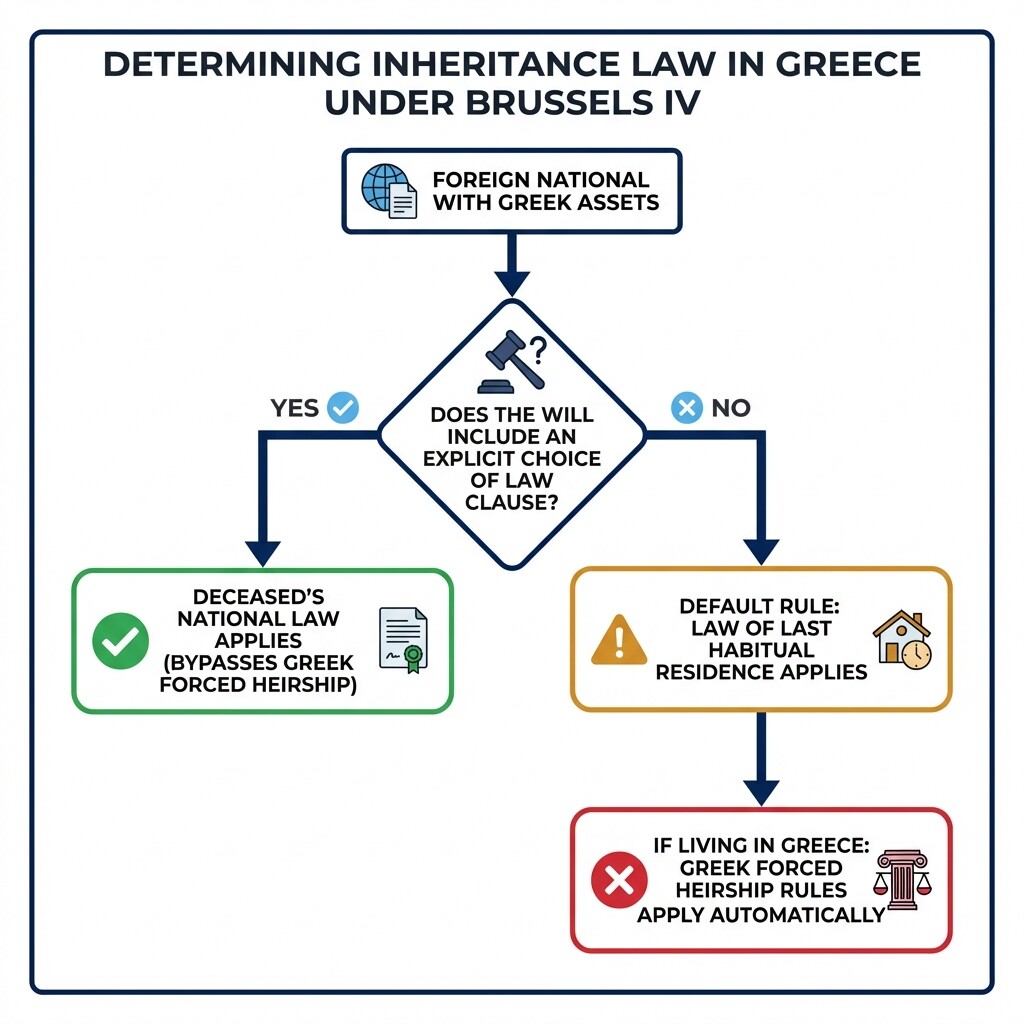
The EU Succession Regulation allows international residents and foreign nationals to choose the inheritance law of their nationality to govern their entire estate, including property located in Greece. This critical regulation prevents domestic Greek laws from automatically overriding your personal wishes regarding how your assets are divided.
By explicitly stating in your will that you wish for your national law (such as US, UK, or Australian law) to apply, you effectively opt out of Greece's strict forced heirship rules. Without this explicit "choice of law" clause, Greek courts default to the law of the deceased's last habitual residence. For foreign nationals retiring or living long-term in Greece, this can result in unintended legal consequences. You can review the official framework for cross-border successions on the European e-Justice portal.
Greek Forced Heirship Rules vs. International Inheritance Laws
Forced heirship in Greece legally reserves a mandatory percentage of an estate for a deceased person's closest relatives, limiting your ability to distribute your assets exactly as you see fit. International laws, particularly those in common law jurisdictions like the US or the UK, generally offer complete testamentary freedom, meaning you can leave your estate to anyone you choose.
Under the Greek Civil Code, the forced share (nomimi moira) is calculated as exactly half of what the heir would have received if there were no will at all (intestate succession).
| Feature | Greek Forced Heirship | Common Law (US/UK/AUS) |
|---|---|---|
| Testamentary Freedom | Restricted. Spouses, children, and parents have guaranteed shares. | Unrestricted. You can leave assets to anyone, including charities. |
| Disinheriting Family | Extremely difficult. Requires proving severe misconduct by the heir. | Generally allowed, though spouses may have some elective share protections. |
| Application to Foreigners | Applies automatically to real estate in Greece unless Brussels IV is invoked. | Applies to the estate if the deceased elected their national law. |
| Protection of Spouses | Spouse is guaranteed a minimum share alongside children. | Spouse is often protected, but children can be entirely disinherited. |
Anticipated 2026 Updates to Greek Inheritance and Succession Laws
The Greek Ministry of Justice is advancing significant reforms to the Civil Code's inheritance provisions, which are expected to take effect by 2026. These updates focus on modernizing outdated succession rules, officially recognizing digital assets, and adjusting the procedural steps for cross-border heirs.
Currently, Greek succession law relies on provisions that have seen little change since the mid-20th century. The 2026 updates are expected to introduce frameworks for digital wills, streamline the timeline for accepting or renouncing an inheritance, and potentially introduce more flexibility into the forced heirship percentages. Additionally, tax reforms are anticipated to further align Greek inheritance tax thresholds with broader European standards, making it easier for diaspora families to transfer generational wealth without crippling tax burdens.
Timelines and Costs for Resolving Probate Disputes in Greece
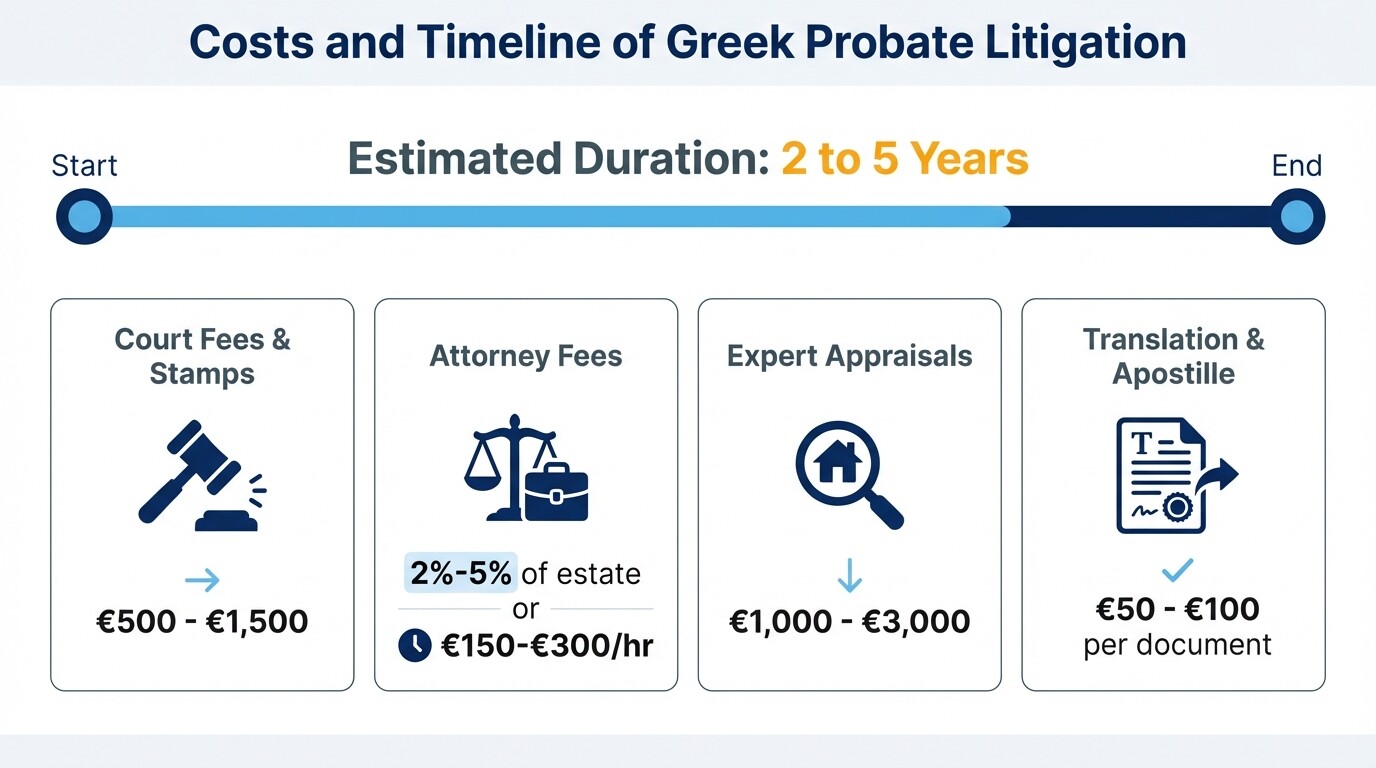
Litigating an inheritance dispute in Greek courts typically takes between two and five years and costs anywhere from €5,000 to over €20,000, depending on the estate's complexity. Prolonged disputes most commonly arise from contested wills, missing heirs, or disagreements over property valuation.
When family members cannot agree, taking a case to the Multi-Member Court of First Instance involves several layers of expenses:
- Court Fees and Stamps: Typically range from €500 to €1,500 just to initiate the lawsuit.
- Attorney Fees: Greek litigation lawyers often charge between 2% and 5% of the disputed estate's value, or they may bill hourly at rates between €150 and €300.
- Translation and Apostille Costs: Foreign documents must be officially translated and apostilled, adding €50 to €100 per document.
- Expert Appraisals: Valuing disputed real estate or business assets usually requires a court-appointed appraiser, costing an additional €1,000 to €3,000.
Mediation and Settlement Alternatives to Court Litigation
Mediation is a voluntary, confidential process where a neutral third party helps heirs reach a binding settlement outside of court. It is significantly faster and cheaper than traditional Greek probate litigation, often resolving complex family disputes in just a few months.
Under Greek law, mediation is actively encouraged for civil disputes. The process works exceptionally well for cross-border inheritance conflicts because it allows families to negotiate creative solutions-such as buying out a sibling's share of a family home-without the rigid constraints of a judge's ruling. Once all parties agree and sign a mediation settlement, the document is filed with the local court, giving it the exact same legal enforceability as a judge's final verdict.
Common Misconceptions About Inheriting Property in Greece
Many foreign nationals misunderstand how Greek law interacts with their overseas wills, leading to unintended disinheritances, family friction, or severe tax penalties.
- A foreign will automatically covers Greek property: Without an explicit choice of law clause invoking the Brussels IV regulation, Greek real estate is subject to Greek law, meaning your foreign will might be partially invalidated by local forced heirship rules.
- Inherited debt disappears: Under Greek law, if you accept an inheritance, you also accept the deceased's debts. You must actively renounce the estate or accept it "with benefit of inventory" to protect your personal assets from the deceased's creditors.
- You avoid Greek inheritance tax if you pay it abroad: Owning real estate in Greece means you are liable for Greek inheritance tax, regardless of your primary residency. While double taxation treaties exist, tax filings must still be completed in Greece within strict deadlines.
Frequently Asked Questions
Do I have to travel to Greece to resolve an inheritance dispute?
No. You can grant a Power of Attorney (PoA) to a trusted legal representative in Greece. This allows your lawyer to file court documents, attend mediation sessions, and negotiate settlements on your behalf without you needing to travel.
What happens if I do not accept the Greek inheritance in time?
In Greece, you do not have to officially "accept" an inheritance; it is acquired automatically. However, if you wish to renounce an inheritance (usually to avoid debt), you must do so within four months if you live in Greece, or within one year if you live abroad. Missing this deadline means you legally accept the estate and all its debts.
Can I completely disinherit my child under Greek law?
Disinheriting a child under Greek domestic law is exceptionally difficult and only permitted under severe circumstances, such as if the child committed a serious crime against the parent. However, if you are a foreign national, you can use the Brussels IV regulation to apply your home country's laws, which may allow for complete disinheritance.
When to Hire a Cross-Border Probate Lawyer
You should hire a specialized cross-border probate lawyer immediately if there is a conflict over the validity of a will, if forced heirship claims arise, or if the estate spans multiple countries. Complex international estates require legal counsel who seamlessly understands both Greek Civil Law and international treaties.
Attempting to navigate the Greek probate system alone from abroad often leads to missed deadlines and tax penalties. If you are dealing with uncooperative co-heirs or debt-burdened estates, you can find experienced litigation lawyers in Greece who can protect your interests and negotiate on your behalf.
Next Steps for Securing Your Greek Inheritance
Taking proactive steps is essential to protect your assets and minimize the risk of a protracted family dispute in the Greek court system.
- Locate and secure all documents: Gather the death certificate, original will, and any property deeds (titloi idoktisias) located in Greece.
- Review your current will: Ensure your will includes a clear choice of law clause invoking your national law if you wish to bypass Greek forced heirship.
- Monitor deadlines: Note the one-year deadline for foreign residents to renounce an inheritance if the estate carries significant debt.
- Initiate mediation early: If family disagreements surface regarding who gets the Greek summer home or agricultural land, propose mediation before anyone files a formal lawsuit.