


Enforcing Foreign Divorce Decrees and Support Orders in Canadian Courts
Key Takeaways
Navigating cross-border family law can feel overwhelming, but Canadian law provides clear mechanisms to recognize and enforce international divorce and support orders.
- A foreign divorce is legally recognized in Canada if at least one spouse lived in the granting country for a full year before the divorce.
- You can enforce child and spousal support across borders without a new trial by using the Interjurisdictional Support Orders (ISO) Act.
- Proper international service of documents is critical; failing to follow international service treaties is a frequent reason cases are dismissed in Canada.
- If a former spouse contests your foreign decree, the process transitions into general civil litigation requiring a formal court application.
Checklist for Enforcing a Foreign Family Law Order in Canada
Preparing your documents correctly before filing in Canada prevents months of delays and saves thousands in legal fees. Follow these steps to assemble a complete enforcement application before approaching a Canadian court.
- Obtain Certified Copies: Secure a certified, court-stamped copy of the original divorce decree or support order from the foreign court.
- Translate Documents: Hire a certified legal translator to translate all court documents into English or French, accompanied by a sworn affidavit of translation.
- Gather Proof of Jurisdiction: Collect utility bills, leases, or employment records proving that you or your ex-spouse lived in the foreign country for at least one year before the divorce.
- Locate the Payer in Canada: Find the current residential address or employer details of the ex-spouse living in Canada for enforcement purposes.
- Confirm Reciprocity: Check if the country where your order was granted has a reciprocating agreement with the specific Canadian province where your ex-spouse resides.
- Complete ISO Forms: If applicable, fill out the required Interjurisdictional Support Orders forms specific to your province.
What Are the Legal Requirements to Recognize a Foreign Divorce in Canada?
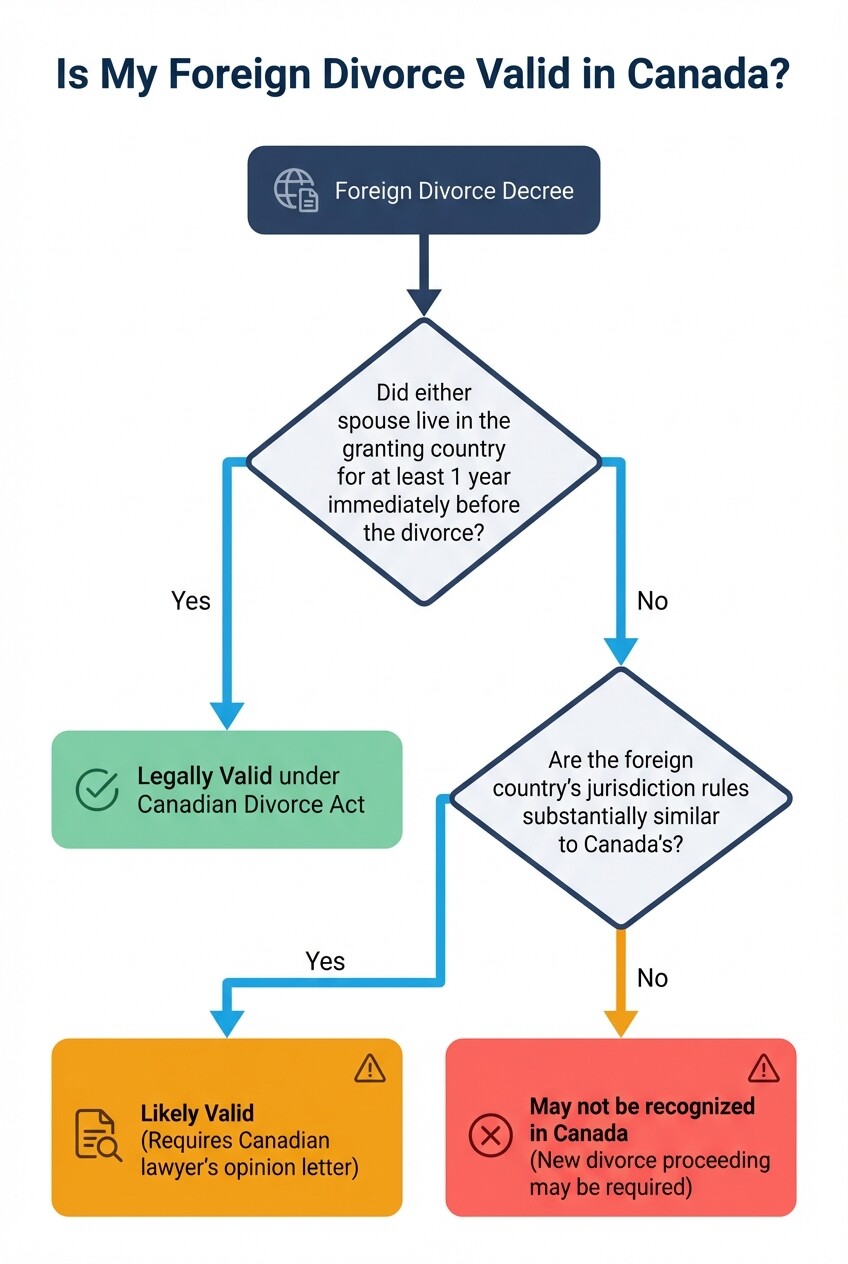
Canada recognizes foreign divorces if either spouse was "ordinarily resident" in the granting country for at least one year immediately before applying for the divorce. If this residency requirement is met, the divorce is treated as legally valid under the Canadian Divorce Act.
Canadian courts look closely at the jurisdictional connection to the country that granted the divorce. They want to ensure the foreign court had a legitimate right to end the marriage. If neither you nor your ex-spouse lived in the foreign country for the required 12 months, the Canadian court may still recognize the divorce if the foreign country's rules for jurisdiction are substantially similar to Canada's. You will need an opinion letter from a Canadian family lawyer verifying this legal threshold before you can remarry in Canada or divide domestic assets.
How to Use the Interjurisdictional Support Orders (ISO) Act
The ISO Act allows you to register and enforce a foreign support order in a Canadian province without needing to travel or hire a lawyer in the other jurisdiction. This provincial legislation creates a streamlined, administrative system between Canada and recognized international partners.
Each Canadian province maintains its own list of "reciprocating jurisdictions." If your home country is on that list, you can submit an application through your local designated authority, who will forward it to the enforcement agency in the Canadian province where the paying spouse lives. The Canadian provincial agency, such as the Family Responsibility Office (FRO) in Ontario or the Family Maintenance Enforcement Program (FMEP) in British Columbia, then takes over. They have the authority to garnish wages, seize tax returns, and suspend the driver's licenses of spouses who fail to pay alimony or child support.
Avoiding Common Procedural Errors in International Service
The most frequent reason foreign judgments are rejected in Canada is the improper service of legal documents to the respondent. If the opposing party was not formally notified of the original foreign proceedings according to the rules of both countries, Canadian courts will not enforce the resulting order.
When initiating legal action overseas that will eventually be enforced in Canada, you must ensure the respondent receives the documents in a way that respects Canadian legal standards. For countries that are members of the Hague Service Convention, documents must be served through a designated Central Authority. Attempting to serve a spouse in Canada via regular mail, email, or a friend when formal international treaties require personal service is a fatal procedural error. Canadian judges will refuse to enforce a foreign decree if they believe the respondent was denied a fair opportunity to defend themselves.
Expected Costs, Timelines, and Enforcement Processes
Enforcing a foreign family law order in Canada typically takes between six months to over a year, with costs ranging from minor administrative fees for ISO registration to over $10,000 CAD for contested litigation. Understanding the financial and temporal commitment helps you choose the most practical legal strategy.
| Enforcement Method | Estimated Timeline | Estimated Legal Costs (CAD) | Best Used For | | : | : | : | : | | ISO Act Registration | 6 to 12 months | $0 to $1,500 | Uncontested support orders from reciprocating countries. | | Uncontested Court Recognition | 3 to 6 months | $2,000 to $5,000 | Recognizing a foreign divorce for remarriage in Canada. | | Contested Litigation | 12 to 24+ months | $10,000 to $30,000+ | Challenged divorces or non-reciprocating jurisdiction orders. |
Timelines can fluctuate based on court backlogs in the specific Canadian province and how quickly the foreign jurisdiction responds to information requests. Budgeting for certified translations and formal process servers is also a necessary part of the cross-border enforcement process.
Litigation Steps if the Opposing Party Contests the Decree
When an ex-spouse challenges the validity of a foreign decree in Canada, the matter transitions into general civil litigation. You must file a formal court application to have a Canadian judge explicitly recognize and enforce the foreign judgment.
If the opposing party argues that the foreign court lacked jurisdiction, that the order was obtained by fraud, or that it violates Canadian public policy, you will need to take the following general litigation steps:
- File a Notice of Application: Submit formal pleadings to the provincial superior court requesting recognition of the foreign judgment.
- Exchange Affidavits: Both parties submit sworn statements detailing the history of the foreign proceeding, residency facts, and evidence of service.
- Cross-Examination: Lawyers for both sides may question the parties under oath regarding the contents of their affidavits.
- Attend the Hearing: A judge reviews the evidence, applies Canadian conflicts of law principles, and determines whether the foreign decree is enforceable.
Because this process involves complex legal arguments about international law, working with experienced litigation lawyers in Canada is highly recommended.
Common Misconceptions About Foreign Judgments
Many people mistakenly believe their legal obligations or rights disappear when they cross international borders. Understanding how Canadian law treats foreign orders prevents costly delays and legal exposure.
- My home country's divorce is automatically valid everywhere: A foreign divorce is not automatically recognized for all purposes in Canada. You must prove it meets Canadian jurisdictional requirements, especially if you want to remarry or enforce property division.
- I have to start a new trial in Canada to get child support: If your country has a reciprocal agreement with a Canadian province, you do not need to litigate the case from scratch. You can register the existing order for enforcement.
- Canadian courts will modify my foreign property division: While Canadian courts will readily enforce foreign child and spousal support, they are generally highly reluctant to alter how a foreign court divided overseas property, provided the original process was fair.
Frequently Asked Questions
Do I need to register my foreign divorce in Canada?
You do not need to register a foreign divorce in Canada just to live there, but you must prove its validity to a provincial government if you intend to remarry within the country.
What is a reciprocating jurisdiction under the ISO Act?
A reciprocating jurisdiction is a specific country, state, or territory that has a formal legal agreement with a Canadian province to recognize and enforce each other's family support orders.
Can Canada enforce a foreign child custody order?
Yes, Canadian courts can recognize and enforce foreign custody orders, particularly if the child has been wrongfully removed to Canada, acting in accordance with the Hague Convention on the Civil Aspects of International Child Abduction.
What happens if my ex-spouse ignores the Canadian enforcement agency?
If an ex-spouse ignores a provincial maintenance enforcement program, the agency has sweeping legal powers to garnish their wages, seize their bank accounts, intercept federal tax refunds, and cancel their passport.
When to Hire a Lawyer and Next Steps
You should hire a Canadian litigation lawyer immediately if your ex-spouse contests the foreign order, or if the granting country is not an ISO reciprocating jurisdiction. A lawyer will help you navigate the complex jurisdictional rules, draft the necessary affidavits, and appear in provincial superior court to enforce your rights.
As a first step, gather your certified foreign court documents and obtain certified English or French translations. Next, identify the exact Canadian province where your ex-spouse resides, as family law enforcement is handled provincially. Finally, consult with a local legal professional to determine whether you can use the administrative ISO process or if you must initiate formal court litigation to secure your support payments or finalize your divorce recognition.