


Executive Employment Contracts in Canada: Expat Guide
- Canada does not recognize "at-will" employment, meaning terminated executives are entitled to substantial severance under common law unless specifically limited by contract.
- Executive contracts must precisely mirror the compensation and duty descriptions submitted to Canadian immigration authorities to secure intra-company transfer visas.
- Cross-border equity plans and relocation allowances require careful documentation to avoid double taxation by both Canadian and US authorities.
- Recent provincial employment laws severely restrict non-compete agreements, though explicit exemptions often exist for C-suite executives.
- Including a specific arbitration clause prevents prolonged, public, and costly cross-border litigation in the event of a dispute.
Understanding Canadian Common Law Severance vs. US "At-Will" Employment
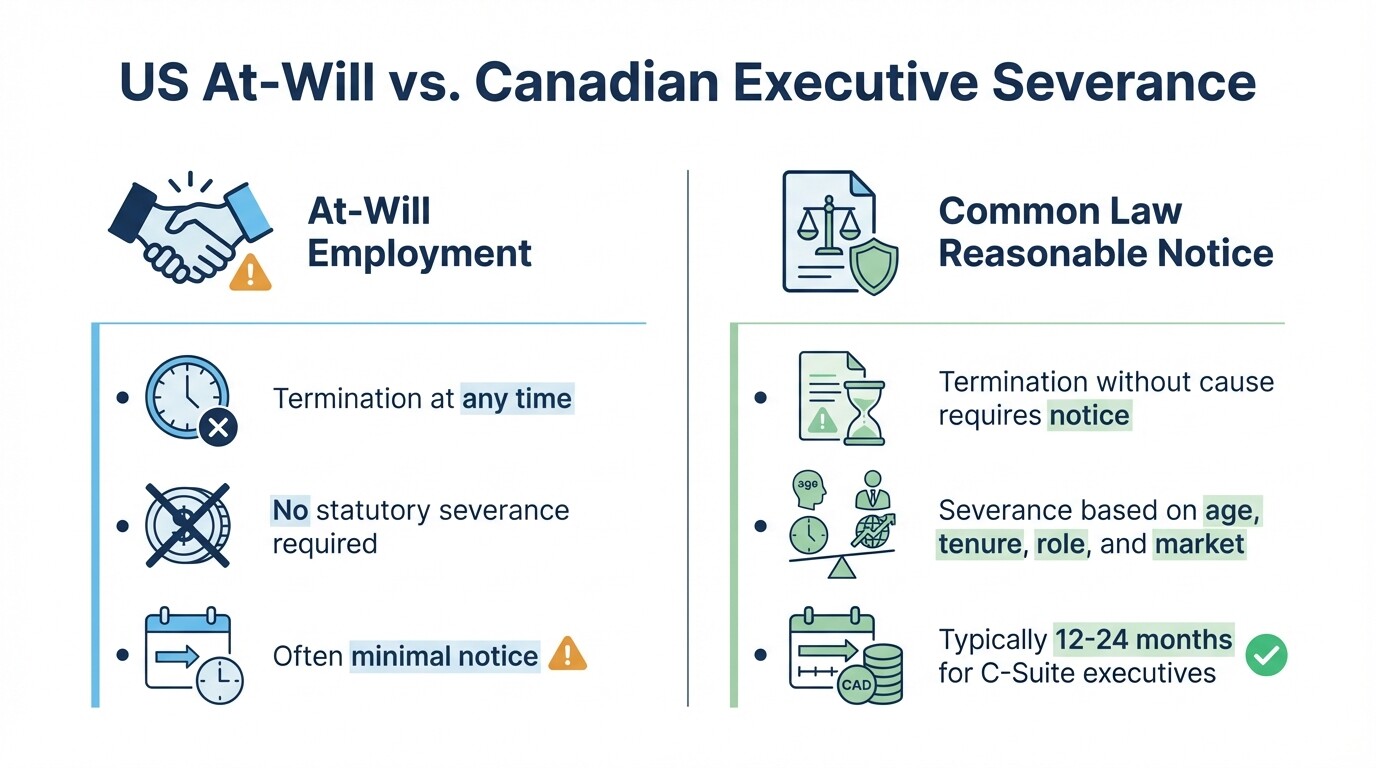
Canadian employment law strictly rejects the American "at-will" doctrine, meaning employers cannot terminate your employment without cause unless they provide advance notice or severance pay. Executive severance in Canada is governed by common law, which generally awards much higher compensation than US standard practices.
When an executive is terminated without cause in Canada, they are entitled to "reasonable notice." Without a valid employment contract limiting this right, Canadian courts determine severance based on age, length of service, character of employment, and availability of similar employment. For senior executives, common law severance frequently ranges from 12 to 24 months of total compensation.
Employers will almost always try to insert a termination clause into your contract to limit severance to the minimums required by provincial employment standards (often just a few weeks). Negotiating a guaranteed executive severance formula-such as one month of pay per year of service, plus bonus continuation-is the most critical step in reviewing a Canadian executive contract.
Executive Compensation Structure and Relocation Agreements
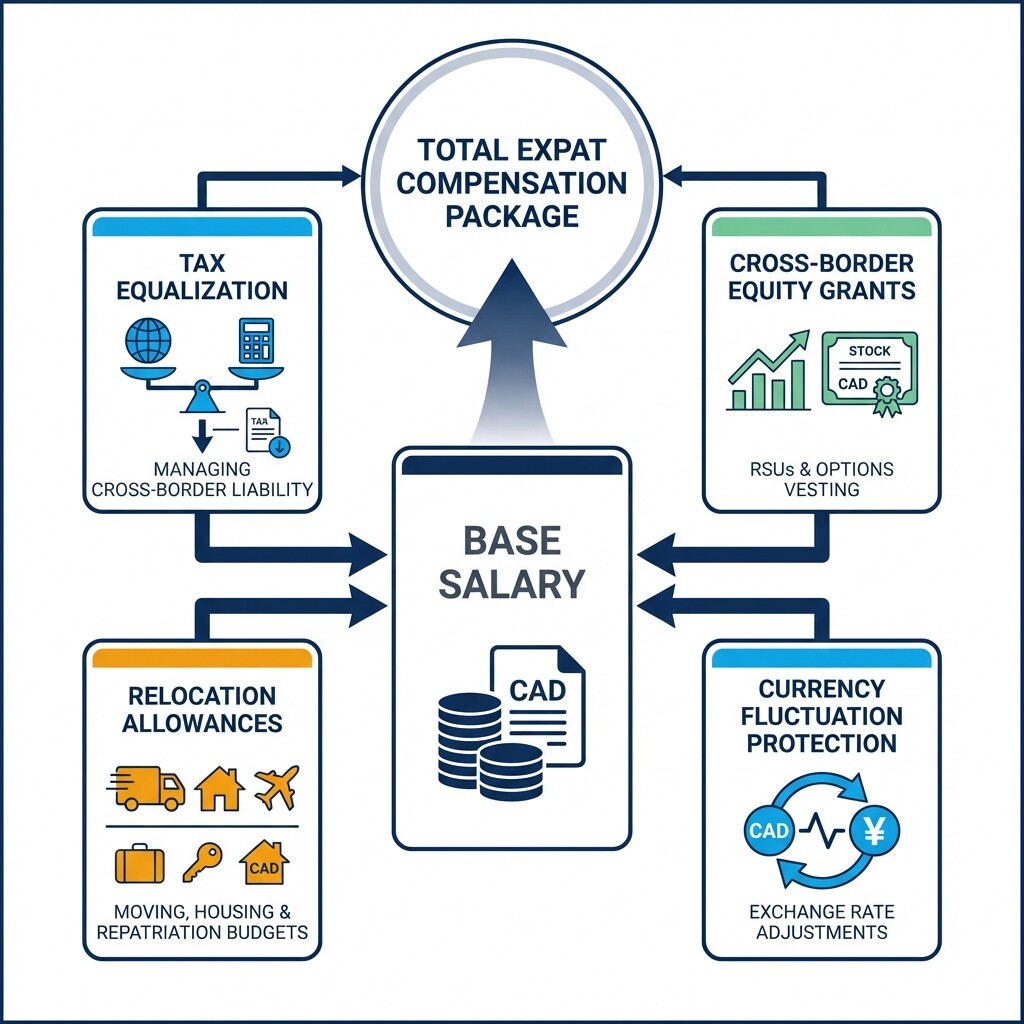
Cross-border executive compensation requires specialized documentation to handle tax equalization, relocation costs, and equity vesting schedules. Structuring these alternative compensation methods correctly ensures you receive your intended pay without facing unexpected tax liabilities in both your home country and Canada.
Standard base salary is only one component of an expat package. Your contract should explicitly detail the following alternative structures:
- Tax Equalization: A binding commitment that the employer will cover excess tax liabilities incurred because of the Canadian assignment, ensuring your net pay remains identical to what it would be in your home country.
- Cross-Border Equity Grants: Clear terms regarding how Restricted Stock Units (RSUs) or stock options vest while working in Canada. The contract must define what happens to unvested equity if you are terminated.
- Relocation and Repatriation Allowances: Specific, CAD-denominated budgets for moving expenses, temporary housing, spousal support, and a guaranteed allowance for returning to your home country at the end of the assignment.
- Currency Fluctuation Protection: A mechanism to adjust base salary if the exchange rate between the Canadian Dollar (CAD) and your home currency shifts significantly.
Executive Visa Documentation Checklist
The terms in your Canadian employment contract must precisely match the details submitted to Immigration, Refugees and Citizenship Canada (IRCC) for your work permit. Any inconsistencies in compensation, job duties, or corporate reporting lines can trigger visa rejections or prolonged delays at the border.
When preparing your executive contract alongside an Intra-Company Transferee (ICT) visa application, ensure the following elements are perfectly aligned:
- Job Title and NOC Code: The formal title in the contract must align with a senior management or executive National Occupational Classification (NOC) code.
- Reporting Structure: The agreement should clearly state that you direct the management of the Canadian entity or a major component of it, receiving only general supervision from higher-level executives or the board of directors.
- Compensation Match: The base salary and guaranteed bonuses listed in the contract must meet or exceed the prevailing Canadian wage for your executive role.
- Duration of Assignment: The contract term should match the requested visa duration (typically one to three years for an initial ICT work permit).
Negotiating Non-Compete and Non-Solicit Clauses
Canadian courts are highly critical of non-compete clauses, heavily favoring the employee's right to work over the employer's desire to limit competition. While broad non-competes are notoriously difficult to enforce in Canada, executives face specialized rules and higher scrutiny regarding restrictive covenants.
Many provinces have taken legislative action to protect employees from restrictive covenants. For example, the Ontario Employment Standards Act strictly prohibits employers from entering into non-compete agreements with employees. However, a specific exemption exists for "chief executive" roles, meaning individuals holding titles like President, CEO, or CFO can still be bound by these clauses.
When negotiating these covenants as a C-suite executive, focus on narrowing the scope. Insist that the non-compete duration does not exceed your guaranteed severance period. Geography should be strictly limited to the specific Canadian provinces where you actually conduct business, and non-solicitation clauses should only apply to clients or employees you directly interacted with during your tenure.
Sample Arbitration Clause for Expat Executives
Incorporating mandatory mediation or arbitration clauses keeps employment disputes out of public courts and resolves them much faster. A well-drafted clause specifies the Canadian province's governing law and the exact procedural rules for arbitration.
If your employer proposes an arbitration clause, or if you wish to avoid public litigation over severance disputes, you can negotiate language similar to this standard provision:
Governing Law and Dispute Resolution: This Agreement shall be governed by and construed in accordance with the laws of the Province of [Insert Province, e.g., British Columbia] and the federal laws of Canada applicable therein. Any dispute, controversy, or claim arising out of or relating to this Agreement, including its termination, shall be settled by binding arbitration in [Insert City, e.g., Vancouver] pursuant to the rules of the ADR Institute of Canada. The arbitration shall be conducted before a single arbitrator mutually agreed upon by the parties. The costs of the arbitration facility and the arbitrator's fees shall be borne entirely by the Employer. This clause does not preclude either party from seeking injunctive relief in a court of competent jurisdiction to enforce restrictive covenants.
Common Misconceptions About Canadian Executive Contracts
Navigating a new legal system often leads to costly assumptions. Expat executives frequently carry over expectations from their home jurisdictions that do not apply in Canada.
- "The parent company is in the US, so US labor laws apply." Even if your employment contract is drafted by a US parent company, if you reside and work in Canada, mandatory Canadian provincial employment standards apply. Employers cannot contract out of Canadian minimum entitlements.
- "Bonus payouts are guaranteed upon termination." Unless your contract explicitly states that bonuses are payable during the common law reasonable notice period, employers will try to cut off your bonus eligibility on the exact day you are terminated. "Active employment" requirements must be carefully negotiated.
- "Stock options aren't taxed until I sell them." Cross-border taxation on equity is highly complex. Moving to Canada with unvested stock options or leaving Canada with vested shares can trigger deemed disposition rules or double taxation if tax equalization clauses are absent.
Frequently Asked Questions
Can an employer force me to sign a new contract upon arriving in Canada?
Yes, but they must provide new "consideration" (something of value, like a signing bonus, a raise, or the relocation package itself) to make the new Canadian contract legally binding. You should never sign a localized Canadian contract without having an executive employment lawyer review how it alters your previous home-country agreement.
How are relocation expenses handled if I resign early?
Most executive contracts include a "clawback" provision requiring you to repay relocation costs if you resign or are terminated for cause within the first 12 to 24 months. You should negotiate to ensure this clawback is pro-rated and does not apply if you are terminated without cause.
Does a fixed-term contract affect my severance rights?
Yes. If you are on a strict fixed-term contract (e.g., exactly two years for a visa assignment) and are terminated early without cause, Canadian courts may award you the entire balance of the contract rather than standard common law severance. Ensure the contract has a clear, fair early-termination formula.
When to Hire an Executive Employment Lawyer
You should engage a legal professional the moment a Canadian offer sheet or localized contract is presented to you, well before applying for your work permit. Because the stakes involving cross-border taxation, equity vesting, and common law severance are exceptionally high, waiting until after you have relocated severely limits your negotiating power. If your employer proposes a major change to your compensation structure or attempts to terminate your assignment early, secure legal representation immediately to protect your rights under Canadian law.
Next Steps
Begin by requesting a complete draft of your proposed Canadian employment agreement, alongside any linked corporate policies regarding bonuses and equity plans. Cross-reference the job title and salary with your intended visa application details to ensure perfect alignment. Once you have the documents, consult with specialized contract lawyers in Canada who understand both provincial employment standards and cross-border executive compensation. They will help you counter-offer with language that secures your severance rights and protects your global financial interests.
